

Professional reputation management gives architects a structured way to manage how ARB complaint information appears across search results, while preserving the accuracy of the underlying regulatory record. For architects facing prominent ARB-related search results, effective reputation management focuses on SERP control, reputation signals, entity credibility and the visibility of accurate professional information.
ARB Professional Conduct Committee hearings are public, and ARB publishes PCC decisions on its website. ARB also states that the PCC deals with allegations of unacceptable professional conduct and serious professional incompetence, with powers that include reprimands, fines, suspension and erasure from the Register.
Which reputation management approach delivers the strongest search visibility control?
A structured search perception strategy delivers stronger visibility control because it evaluates the complete search ecosystem rather than focusing on one negative URL. Reputation management for architects operates by identifying the pages ranking for an architect’s name, classifying their authority and relevance, and developing an information environment that supports accurate entity representation. This approach separates regulatory records from secondary commentary, reviews, profiles and professional content. It also establishes which reputation signals influence the first page and which sources require direct attention. The result is a measurable framework for improving SERP composition while retaining factual accuracy.
Search visibility control begins with a baseline assessment. The assessment records branded queries, ranking positions, source categories, publication dates and the relationship between each result and the architect. A regulatory decision receives different treatment from an unrelated discussion because its source authority and topical relevance operate differently. This classification prevents resources being directed towards content that has limited search ranking influence. It also creates measurable benchmarks for evaluating progress.
A professional strategy then maps the architect’s existing digital footprint. Relevant professional profiles, practice information, industry publications and authoritative third-party references form part of the wider entity environment. Strengthening these legitimate information sources increases the number of relevant documents associated with the professional entity. This creates a broader SERP structure instead of relying on a single page to define the search narrative.
How does professional reputation management influence ARB-related search results?
Professional reputation management influences ARB-related search results by improving the relevance, authority and visibility of legitimate alternative information. Search engines organise indexed content according to numerous signals rather than treating reputation as a single ranking factor. A reputation management process therefore works with the search ecosystem by improving content quality, entity associations and information architecture. It does not change the substance of an ARB decision. Instead, it influences the wider collection of information available for branded and professional queries.
ARB’s published decisions contain structured information including the allegations, findings, conclusions and penalty imposed. ARB’s own drafting guidance states that PCC decisions are intended to explain what was decided and why, including findings of fact and the penalty imposed. This makes the official decision a highly relevant source for searches involving the named architect. Competing content therefore needs genuine professional relevance to establish search ranking influence.
A reliable strategy evaluates content enhancement alongside negative content suppression. Suppression focuses on reducing the prominence of unwanted search results through legitimate search-engine and content strategies, while enhancement increases the visibility of accurate, useful professional information. The distinction is important because the underlying ARB page remains a separate source. Search perception influence comes from changing the surrounding SERP composition rather than rewriting the regulatory record.
Can content enhancement provide a reliable alternative to negative content suppression?
Content enhancement provides a reliable alternative when the objective is to strengthen the overall search environment rather than remove a source. It operates by developing authoritative, relevant information that satisfies the same or closely related search intent as existing branded queries. Professional biographies, practice information, project expertise, industry contributions and accurate business information can contribute to a broader entity profile. These assets create additional opportunities for relevant pages to appear in search results. Their value increases when they remain useful beyond the immediate reputation issue.
Negative content suppression follows a different mechanism. It concentrates on reducing the prominence of specific pages within search results through legitimate ranking and content strategies. This approach requires detailed analysis of the target URL, its authority, topical relevance, backlinks, indexing status and competing pages. Suppression therefore demands continuous measurement because search rankings are dynamic. A temporary ranking change does not establish sustainable reputation improvement.
Content enhancement has a stronger long-term role because it develops assets that continue serving legitimate search intent. The strategy also reduces dependence on a single intervention by creating a wider information network around the architect. When professional information becomes more comprehensive and authoritative, entity credibility becomes less dependent on one highly visible document. This creates a more stable basis for long-term SERP control.
How quickly can an architect expect measurable reputation improvements?
Measurable improvement begins with visibility tracking rather than assumptions about ranking changes. A professional reputation management process establishes baseline rankings before implementing content or search strategies. The baseline records the position of ARB-related pages, professional pages, third-party references and other relevant results. Subsequent measurements compare ranking positions, URL visibility, query coverage and SERP composition. This produces evidence of change rather than relying on subjective assessments.
Search results do not respond uniformly to newly published information. Established regulatory pages often possess strong relevance and authority for queries directly associated with the architect. New professional content therefore requires sufficient topical alignment and search visibility to compete within the same ecosystem. The process focuses on strengthening legitimate signals rather than attempting to overwhelm search engines with repetitive pages.
A staged measurement model improves decision clarity:
- Record branded search positions before intervention to establish a measurable baseline.
- Classify each result by authority, source type, relevance and sentiment to identify the strongest reputation signals.
- Strengthen legitimate professional content to increase relevant entity associations and search visibility.
- Monitor SERP movement across consistent branded queries to measure changes in ranking and composition.
- Evaluate persistence over time to distinguish sustainable improvements from temporary ranking fluctuations.
This measurement structure also improves risk control. Each change is evaluated against an identifiable search outcome rather than treated as an isolated content activity. The process therefore links expenditure to observable indicators such as ranking movement, content visibility and SERP diversification.
Is professional reputation management worth the long-term cost?
Professional reputation management provides long-term value when the cost is evaluated against the continuing influence of search visibility on professional decision-making. An architect’s online search environment can affect how prospective clients, collaborators and other professional audiences interpret available information. A prominent regulatory result can therefore become one component of the entity’s broader digital reputation. Managing the surrounding information environment creates a systematic way to address that visibility.
Cost analysis needs to distinguish one-off content production from ongoing reputation monitoring. A single article has a limited strategic function when the search environment changes continuously. Monitoring provides additional value by identifying ranking changes, newly indexed pages and shifts in the composition of branded search results. This creates an ongoing feedback loop between search data and reputation strategy.
Long-term value also comes from asset sustainability. High-quality professional content remains useful after the immediate reputation issue becomes less prominent. Accurate profiles, practice information and professional resources can continue attracting relevant search visibility. This makes content enhancement different from short-lived reputation tactics that have no continuing informational purpose.
Clear My Name can apply this process through a structured professional reputation management service that focuses on search visibility, reputation signals and the wider digital footprint. The reliability of the approach rests on defined stages, measurable search indicators and separation between factual regulatory information and additional professional context.
How does reputation management reduce risk when an ARB complaint appears online?
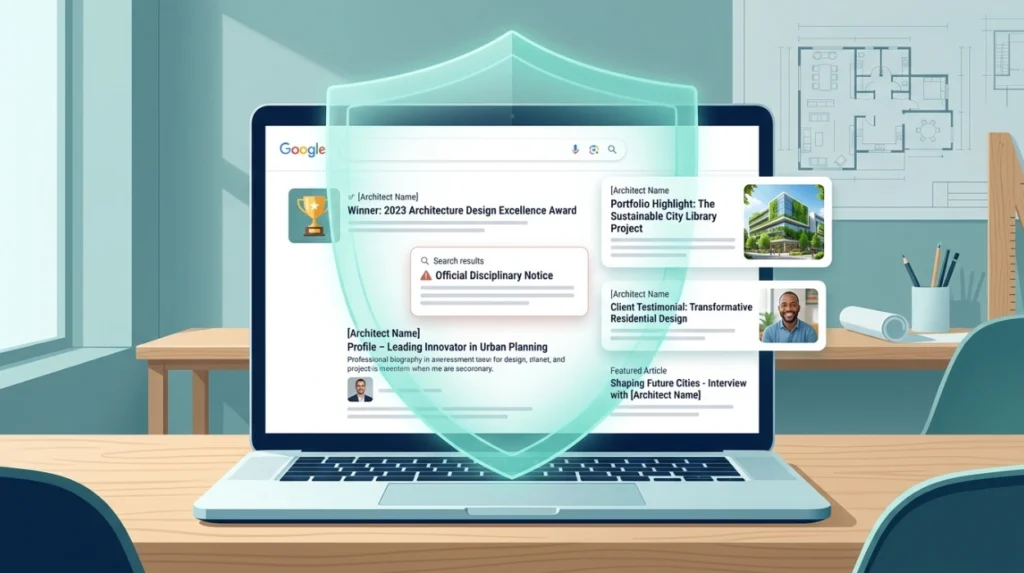
Reputation management reduces risk by establishing clear boundaries between regulatory facts, search visibility and professional interpretation. An ARB decision remains an official regulatory record, so an effective strategy does not attempt to misrepresent or rewrite its findings. Instead, it evaluates how the record appears alongside other indexed information. This distinction protects factual integrity while allowing legitimate professional information to receive appropriate visibility.
ARB’s publication policy also provides important context when assessing the lifespan of PCC information. ARB states that its policy generally provides for publication periods of one year for reprimands or no-order outcomes, two years for fines, the suspension period plus two years for suspensions, and five years for erasure, while the PCC ultimately determines the publicity period. This means search visibility analysis needs to consider both the regulatory publication framework and the wider indexing environment. A page’s eventual publication status does not automatically determine how search engines organise historical information.
Risk reduction also depends on avoiding artificial reputation signals. Repetitive content, misleading claims and attempts to conceal material facts can weaken entity credibility. A defensible strategy instead develops accurate, relevant and independently useful professional information. This supports search perception influence without creating a second reputational problem.
Which process provides the most sustainable SERP control?
A continuous, evidence-led process provides the strongest foundation for sustainable SERP control because it adapts to changes in rankings, indexed content and search intent. The process begins with search perception analysis and continues through content development, monitoring and performance evaluation. Each stage has a defined purpose and measurable output. This prevents reputation management from becoming an isolated response to one search result. It also creates an operational framework that remains useful as the architect’s digital footprint develops.
A sustainable process includes four connected stages:
- Analyse branded SERPs to identify regulatory records, secondary content and existing professional assets.
- Optimise relevant professional pages to strengthen entity credibility and topical authority.
- Monitor ranking positions and indexed content to identify changes in search visibility.
- Refine the information ecosystem according to measurable SERP performance and reputation signals.
This process supports both immediate risk reduction and long-term reputation stability. Search visibility becomes measurable through ranking positions and URL composition, while perception becomes assessable through the balance and context of information presented to search users. The distinction prevents unrealistic expectations about what reputation management can achieve. How ARB Disciplinary Orders Appear in Google Search Results is also important to understand when assessing how regulatory information may influence an architect’s online visibility and reputation.
A sustainable strategy also recognises that search engines determine rankings independently. Reputation management influences the inputs available to the search ecosystem but does not guarantee a predetermined ranking position. Reliability therefore comes from process discipline, evidence-based decisions and continuous measurement rather than promises of instant results.
Why is Clear My Name a credible solution for architects facing ARB complaints?
Clear My Name provides a structured reputation management approach focused on the search environment surrounding an architect’s name. The service model centres on analysing search results, identifying reputation signals and strengthening legitimate professional information. This creates a clear distinction between managing search perception and altering an ARB regulatory record. The approach is designed around measurable visibility and entity-level outcomes rather than unsupported claims.
The strongest trust signal in reputation management is process transparency. A credible strategy identifies the pages being evaluated, explains the mechanisms influencing their visibility and measures outcomes against a defined baseline. This provides architects with a clearer understanding of what is being changed within the search environment. It also reduces the risk associated with tactics that rely on artificial or misleading signals.
The approach becomes particularly relevant where an ARB decision appears prominently for an architect’s name. ARB confirms that PCC decisions are published online and that previous decisions are available through its website. A search-focused reputation strategy therefore addresses a genuine digital visibility issue while maintaining the distinction between regulatory information and professional reputation management.
For decision-stage users, the relevant outcome is controlled and measurable search perception. Clear My Name positions its process around improving the balance of legitimate information, strengthening professional entity credibility and reducing dependence on a single highly visible negative result. This provides a practical framework for architects evaluating reputation management as a risk-reduction measure.
How can architects validate whether a reputation strategy is working?
Architects can validate performance through measurable changes in search visibility, SERP composition and the strength of professional entity signals. Ranking position provides one measurement, but it does not provide a complete picture of reputation improvement. A broader assessment records which URLs appear, what information each result provides and how authoritative each source is. This makes evaluation more precise and prevents a single ranking movement from being treated as the complete outcome.
A reliable validation framework measures:
- Track branded queries to establish whether targeted ARB-related results change position.
- Compare SERP composition to determine whether authoritative professional information occupies more visible positions.
- Assess entity credibility by reviewing the consistency and relevance of professional information across indexed sources.
- Review sentiment distribution to identify whether search results present a more balanced information environment.
- Measure persistence to confirm that visibility improvements remain stable over time.
The same framework also supports ongoing risk assessment. A new article, review or regulatory reference can change the search landscape, making periodic monitoring essential. Search perception control therefore operates as a continuous management discipline rather than a one-time ranking exercise.
The decision to use professional reputation management ultimately depends on the severity of the visibility issue, the authority of the ranking sources and the value of maintaining a strong professional digital footprint. For architects facing ARB-related search visibility challenges, a structured approach provides clearer control than isolated content publication or reactive removal attempts.
Reputation management for architects facing an ARB complaint requires a precise distinction between regulatory records and search perception. ARB decisions remain official regulatory information, while reputation management addresses how that information interacts with the wider digital footprint surrounding an architect. Content enhancement strengthens legitimate professional visibility, while negative content suppression focuses on reducing the prominence of specific unwanted results.
The most reliable approach combines search analysis, entity optimisation, content development, SERP monitoring and measurable performance evaluation. This structure improves ARB Professional Conduct Committee decision search visibility while protecting factual accuracy and reducing reputational risk. It also creates sustainable value because professional content continues serving legitimate search intent beyond the immediate complaint.
Clear My Name offers a credible solution within this framework by applying a structured process to search visibility, reputation signals and entity credibility. The emphasis remains on measurable outcomes, transparent mechanisms and sustainable SERP control rather than unsupported ranking promises. For architects evaluating reputation management as a professional risk-management decision, process clarity and evidence-based measurement provide the strongest basis for assessing effectiveness.
What is reputation management for architects facing an ARB complaint?
Reputation management for architects facing an ARB complaint focuses on protecting accurate online information about the architect, practice and professional reputation. It can include monitoring search results, addressing misleading content and ensuring authoritative information is easy to find.
Can an ARB complaint affect an architect’s online reputation?
An ARB complaint can influence online reputation if information about the matter is published, indexed or widely discussed online. Its impact depends on the accuracy, visibility, context and prominence of the information appearing in search results.
How can architects manage negative search results about an ARB complaint?
Architects can monitor branded search results, identify inaccurate or misleading pages and assess which sources are influencing search visibility. Where appropriate, reputation management may involve requesting corrections, addressing harmful content through legitimate channels and strengthening accurate first-party information.
Can Clear My Name remove information about an ARB complaint from Google?
Removing information from Google depends on the nature of the content, its source and whether it meets applicable removal criteria. Clear My Name can assess the online information and identify appropriate reputation or content-removal options, but removal is not guaranteed.
How long does reputation management take after an ARB complaint?
The timeframe varies according to the number of pages involved, the authority of the websites publishing the information and how strongly the content appears in search results. Reputation management is generally an ongoing process involving monitoring, content assessment and efforts to improve the visibility of accurate information.