
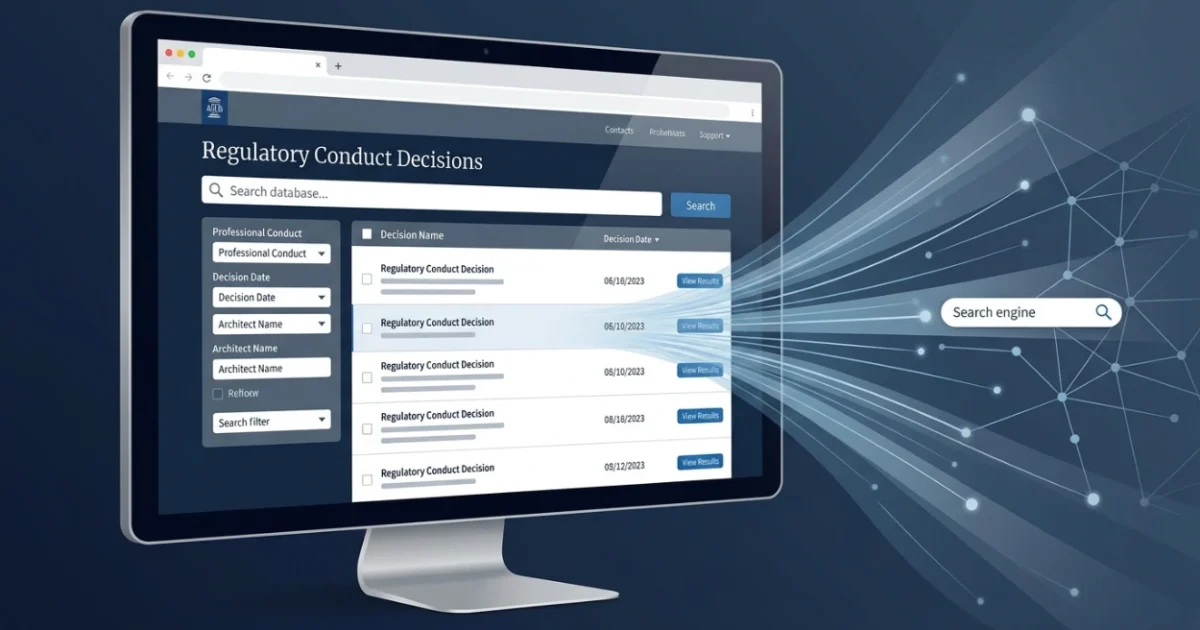
An ARB Professional Conduct Committee decision can remain publicly accessible through the Architects Registration Board (ARB), with published decisions forming part of the searchable information surrounding an architect.
ARB Professional Conduct Committee decision search visibility depends on how published regulatory information is indexed, connected to an architect’s identity and presented within search results.
Reputation management strategies differ based on whether the underlying information can be removed, whether new content can provide additional context, and how strongly existing regulatory pages rank for an architect’s name. Online reputation control methods are evaluated through search visibility, information accuracy, entity credibility, SERP composition and the persistence of authoritative sources.
How does ARB publication compare with ordinary online reputation content?
ARB publication carries a different search significance from ordinary third-party reputation content because it originates from a statutory professional regulator. ARB states that Professional Conduct Committee hearings are public and that decisions are published on its website. The PCC considers allegations of unacceptable professional conduct and serious professional incompetence, with disciplinary outcomes including reprimands, fines, suspension and erasure from the Register.
A regulatory decision is therefore a structured reputation signal rather than an informal online statement. Search engines can associate the architect’s name with the regulator, decision page, professional conduct terminology and relevant disciplinary information. This association creates stronger entity credibility for the source itself because the information is connected to an established regulatory organisation. Content creation does not automatically weaken this relationship because authority and relevance remain separate ranking considerations.
Ordinary reputation content operates differently because its search influence depends on the publisher, topical relevance, links, engagement, indexing and the quality of supporting information. A review, article or discussion can contribute to sentiment distribution without carrying the same regulatory authority as an official decision. The distinction is important when evaluating whether content enhancement can realistically alter the composition of branded search results.
Is content creation more effective than removal for ARB decision visibility?
Content creation and removal address different mechanisms, so neither represents a universal solution for ARB-related search visibility. Removal targets the existence or accessibility of a particular result, whereas content creation introduces additional relevant documents that can compete for search positions. An official PCC decision therefore requires an assessment of whether the underlying information qualifies for any change before content suppression is considered.
ARB explains that PCC decisions are subject to publication policies rather than indefinite publication of every named finding. Its published policy states that reprimand or no-order outcomes are normally publicised for one year, fines for two years, suspensions for the duration of the suspension plus two years, and erasure for five years, although the final publicity period is determined by the PCC.
This makes removal and suppression distinct concepts. Content suppression refers to reducing the prominence of information within search results, while removal refers to eliminating or restricting the underlying source where a legitimate mechanism exists. Search ranking influence cannot be treated as equivalent to deletion because a lower-ranking result remains accessible and authoritative.
Content enhancement takes the opposite approach. It builds a broader information environment around the entity through relevant professional, corporate and informational pages. Its effectiveness depends on whether those pages satisfy search intent strongly enough to occupy meaningful SERP positions rather than simply adding more indexed URLs.
How does organic reputation management compare with reactive reputation management?
Organic reputation management builds search visibility continuously, while reactive management responds after a negative or regulatory result becomes prominent. Organic activity therefore focuses on establishing a stable information ecosystem before a specific reputation event dominates branded searches. Reactive activity concentrates resources around an identified result, query pattern or change in SERP composition.
Organic approaches generally provide greater sustainability because search engines evaluate content within an evolving corpus rather than through a single publication event. Consistent publication of authoritative professional information can strengthen the broader entity profile and create additional relevant pages for branded searches. Its limitation is time: newly created pages do not necessarily acquire search ranking influence immediately.
Reactive management offers greater concentration because it begins with a defined search problem. A practitioner can analyse the exact query, identify the ranking pages, classify source authority and determine whether the dominant result is an official regulatory record, news article, directory or secondary commentary. Its limitation is that reacting after a high-authority result gains visibility does not guarantee that alternative pages will displace it.
The distinction becomes particularly relevant for ARB-related queries because the source hierarchy matters. An official regulatory decision has a stronger informational relationship to an architect’s name than unrelated promotional content. Consequently, reactive content needs strong topical relevance rather than simply higher publication volume.
Does content enhancement suppress an ARB decision from search results?
Content enhancement can change SERP composition without removing the underlying ARB decision. Search results are generated from indexed documents that compete according to relevance, authority and other ranking systems, so introducing additional high-quality pages can influence which information occupies prominent positions. This process is better described as search-result diversification than deletion.
The mechanism begins with entity association. Search engines identify relationships between an architect, practice, professional role, organisation and relevant documents. New content becomes useful when it provides clear information about those entities and addresses legitimate branded or professional search intent. Strong entity alignment makes content more relevant to the same search ecosystem without requiring the content to reproduce or dispute the regulatory finding.
The limitation is source authority. A newly created page does not automatically outrank an ARB document simply because it contains the architect’s name more frequently. Keyword repetition can increase textual relevance while failing to establish equivalent credibility. Sustainable content enhancement therefore depends on informational usefulness, topical completeness and the quality of the wider website rather than keyword density.
This also explains why content suppression versus content enhancement represents a strategic distinction. Suppression focuses on reducing visibility of an existing result, whereas enhancement focuses on strengthening the visibility of alternative legitimate information. The second approach changes the competitive environment rather than attempting to alter the regulator’s underlying record.
How do short-term and long-term strategies differ in search visibility?
Short-term reputation strategies prioritise immediate SERP analysis and response, while long-term strategies develop a durable information architecture around the professional entity. Short-term activity can identify which queries display an ARB decision, which URL ranks, and which other sources appear alongside it. Long-term activity measures whether the wider search ecosystem becomes more balanced over time.
Short-term action provides rapid diagnostic value. A search visibility assessment can classify results according to source type, publication date, authority, sentiment and relevance. This classification establishes whether the reputation issue originates primarily from an official regulatory source or from secondary content repeating the same information.
Long-term activity has a different objective. It establishes a consistent body of accurate professional information that supports entity credibility across multiple search queries. This approach can improve SERP resilience because the entity becomes represented through a broader collection of relevant documents rather than depending on a single page.
Sustainability therefore depends on continuity. A short campaign that produces a group of pages without maintaining their relevance has weaker long-term value than an information ecosystem that continues to provide useful professional context. Search visibility is dynamic, so measurement needs to distinguish temporary ranking changes from durable shifts in SERP composition.
Which reputation management approach creates the lowest risk?

An evidence-led approach creates lower reputational risk because it separates factual regulatory information from interpretation, commentary and promotional content. ARB decisions contain findings and reasons that are intended to explain what the PCC decided and why. ARB’s guidance on drafting PCC decisions states that decisions need sufficient reasoning so interested parties can understand the issues, findings of fact and conclusions.
This distinction makes factual accuracy a central control point. Attempting to contradict an official decision without supporting evidence introduces credibility risk because search users can compare the alternative claim with the primary regulatory source. A more defensible approach analyses the complete search environment and ensures that additional content accurately represents the professional entity.
Risk also differs between removal and enhancement. Removal strategies involve a source-level question: whether there is a valid basis for changing the availability or presentation of information. Enhancement strategies operate at the information-environment level and focus on establishing additional legitimate sources.
For architects, the regulatory context also matters because ARB investigates specific categories of professional conduct and competence rather than every type of dispute. ARB states that its regulatory remit includes unacceptable professional conduct and serious professional incompetence, while certain contractual, compensation, planning and other disputes fall outside its powers.
How should ARB decision search visibility be evaluated over time?
ARB decision search visibility is best evaluated through a structured framework covering source authority, ranking position, query coverage, sentiment distribution and persistence. Ranking position alone does not explain whether a reputation problem has changed because a result can move temporarily while the underlying search landscape remains unchanged. Measurement therefore needs to assess both individual URLs and the overall SERP.
A useful evaluation framework can be structured around four actions:
- Classify each ranking result by source type, regulatory authority and relationship to the architect.
- Measure branded queries across consistent search conditions to identify changes in SERP composition.
- Compare official regulatory results against independent professional and informational content to assess information balance.
- Monitor ranking persistence, sentiment distribution and entity associations over an extended period.
This framework separates visibility from interpretation. A regulatory decision ranking highly does not itself establish how every searcher perceives the architect, while a lower position does not mean that the information has disappeared. Search visibility is an observable property of the information environment, whereas trust and perception involve broader signals.
The approach also supports scalability. Once source classification, query monitoring and ranking measurement are standardised, the same methodology can evaluate different reputation scenarios without assuming that every case requires identical action. That makes the framework more suitable for ongoing reputation analysis than one-off ranking checks.
Does reputation management change the underlying ARB decision?
Reputation management does not alter the substance of an ARB Professional Conduct Committee decision. The regulatory finding remains a matter for the relevant regulatory process, while search perception concerns how information about that finding is discovered and interpreted online. Separating these functions prevents search optimisation from being confused with regulatory review.
The distinction is particularly important because ARB’s PCC has formal powers under the Architects Act 1997. Depending on the circumstances and findings, the Committee can issue a reprimand, impose a fine, suspend an architect or order erasure from the Register. It can also clear an architect of allegations where the relevant charges are not proven.
Search visibility analysis therefore operates downstream from the regulatory process. It evaluates indexed information, query behaviour and SERP composition rather than determining whether professional conduct occurred. This creates a clear boundary between regulatory decision-making and digital reputation management.
For that reason, an analytical strategy focuses on information accuracy, source hierarchy and search behaviour. The objective is not to rewrite the underlying regulatory record but to understand how that record interacts with the wider digital footprint associated with the architect.
What is the most sustainable approach to ARB decision search visibility?
The most sustainable approach combines source analysis, legitimate content enhancement, continuous monitoring and careful separation between regulatory facts and broader professional information. Removal is relevant where a valid source-level mechanism exists, while enhancement is relevant when the objective is to develop a broader and more balanced SERP environment. Reactive management provides targeted diagnosis, whereas organic activity supports longer-term entity development.
The strongest strategy is therefore determined by the structure of the search ecosystem rather than by a single reputation-management technique. An official ARB decision has different authority from a review, article or directory listing, so each source requires separate evaluation. Search ranking influence also changes over time as indexing, content and competing results evolve.
For professionals assessing reputation management for architects, the central consideration is the distinction between changing a source and changing its search context. Reputation Management for Architects Facing an ARB Complaint can therefore be understood as a broader consideration of how regulatory information, professional content and search visibility interact rather than as an attempt to modify the regulatory outcome itself.
ARB Professional Conduct Committee decision search visibility is shaped by the interaction between regulatory publication, search indexing, entity associations and competing information. Removal strategies target the underlying source, while content enhancement seeks to expand the surrounding SERP environment. Organic approaches prioritise sustained entity credibility, whereas reactive approaches focus on an identified visibility issue.
The practical evaluation therefore centres on effectiveness, scalability, risk exposure and sustainability. Official regulatory information carries distinct source authority, making factual accuracy and source classification essential when analysing search perception. A long-term framework that measures SERP composition, ranking persistence, sentiment distribution and entity credibility provides a more precise basis for evaluating reputation outcomes than ranking position alone.
What is an ARB Professional Conduct Committee decision?
An ARB Professional Conduct Committee decision records the outcome of a professional conduct or competence case involving an architect. Published decisions can become part of the architect’s online search profile when indexed by search engines.
How does an ARB decision affect an architect’s online reputation?
An ARB decision can influence online reputation when the decision page appears prominently for searches involving the architect’s name. Its impact depends on search visibility, source authority, entity associations and the wider SERP composition.
Can an ARB Professional Conduct Committee decision be removed from Google?
Removal depends on the circumstances, the underlying source and whether a legitimate removal or de-indexing mechanism applies. Reputation management for architects can also analyse content enhancement and SERP strategies when the original regulatory record remains publicly accessible.
How can architects manage ARB complaint search results?
Architects can evaluate ARB complaint search results by classifying ranking sources, monitoring branded searches and assessing the balance of regulatory and professional information. Content enhancement can provide additional relevant information without altering the underlying ARB decision.
Does reputation management remove an ARB Professional Conduct Committee decision?
Reputation management does not change the substance of an ARB Professional Conduct Committee decision. Approaches such as search visibility analysis and content enhancement instead address how regulatory information appears within the wider online reputation landscape.