

Reputation management is the systematic control and interpretation of information that shapes how individuals or entities are perceived across search ecosystems and digital platforms.
Online reputation refers to the aggregated representation of credibility, sentiment, and authority signals associated with a person or organisation within search engine results pages.
What is reputation management for CEOs in search ecosystems?
Reputation management for CEOs is the structured governance of executive identity within search ecosystems where digital information defines perceived authority and trust. It refers to the process of shaping how executive profiles, mentions, and associated content are indexed, ranked, and interpreted by search engines.
This system operates through entity-based recognition, where search engines construct a persistent identity profile for executives based on content distribution, media references, and semantic associations. SERPs evaluate this identity through relevance signals, topical consistency, and authority alignment across multiple domains. Each indexed result contributes to a cumulative perception layer that defines executive reputation.
Within this framework, reputation is not a static attribute but a dynamic search construct formed through continuous content ingestion and ranking recalibration. Executive reputation becomes visible through structured data, articles, profiles, and third-party references that reinforce or weaken perceived authority.
How does online reputation form in search engine results pages?

Online reputation forms in search engine results pages through algorithmic aggregation of indexed content that collectively defines entity perception. It refers to the structured interpretation of digital information where search engines rank content based on relevance, authority, and contextual alignment with user queries.
Search engines construct reputation profiles by crawling, indexing, and categorising content associated with a specific executive identity. Each indexed page contributes semantic signals that influence how the entity is represented in SERPs. These signals include topical relevance, publication authority, and contextual consistency across domains.
The formation process is continuous and adaptive, as ranking systems recalibrate based on new content ingestion and engagement metrics. SERPs act as the primary interface where reputation becomes visible, positioning certain narratives above others depending on perceived trustworthiness and informational value.
What are reputation signals and how do algorithms evaluate credibility?
Reputation signals are measurable digital indicators that search engines use to evaluate credibility, authority, and trustworthiness of an entity within search ecosystems. These signals define how algorithms rank and interpret content related to executive identities.
Algorithms evaluate credibility through multi-layered signal processing that includes domain authority, backlink structures, content relevance, and semantic consistency. Each signal contributes to a weighted assessment model that determines visibility in search rankings. High-quality signals strengthen entity association, while inconsistent signals reduce perceived reliability.
Search systems also interpret contextual alignment between content sources and entity profiles. When multiple authoritative sources reinforce similar information, credibility scores increase. Conversely, fragmented or contradictory data reduces ranking stability and weakens reputation coherence.
Reputation signals function as the computational foundation of SERP evaluation, where trust is calculated through pattern recognition rather than subjective interpretation.
How does digital footprint influence executive entity perception?
Digital footprint is the cumulative record of all indexed content associated with an executive entity across the internet. It refers to the structured and unstructured data points that collectively define how search engines perceive identity, authority, and relevance.
Search engines interpret digital footprints by mapping content relationships across domains, platforms, and contextual references. Each mention, article, profile, or citation contributes to a broader semantic graph that defines entity perception. This graph determines how prominently an executive appears in search results and how consistently their identity is represented.
A strong digital footprint increases search visibility by reinforcing consistent thematic signals across multiple sources. Weak or fragmented footprints reduce entity clarity, leading to diluted SERP positioning and inconsistent representation across queries.
Digital footprint evaluation also integrates temporal factors, where recent and frequently updated content holds greater influence in shaping current reputation signals.
How do reviews and sentiment affect SERP evaluation of leaders?
Reviews and sentiment are structured evaluative signals that influence how search engines interpret public perception of executive entities. They refer to aggregated opinions, ratings, and linguistic tone extracted from digital content sources.
Search engines process sentiment through natural language analysis systems that classify content as positive, neutral, or negative. These classifications are integrated into ranking models that adjust visibility based on perceived trust and reputational risk. Consistent positive sentiment strengthens authority signals, while negative sentiment introduces volatility in SERP positioning.
Review ecosystems contribute additional structured data points that reinforce entity evaluation. These data points include frequency of mentions, linguistic patterns, and source credibility. Together, they form a sentiment layer that shapes how executive reputations are presented in search results.
SERP evaluation integrates sentiment as a contextual modifier rather than a standalone ranking factor, ensuring reputation reflects aggregated perception rather than isolated content instances.
What role does content indexing play in reputation visibility?
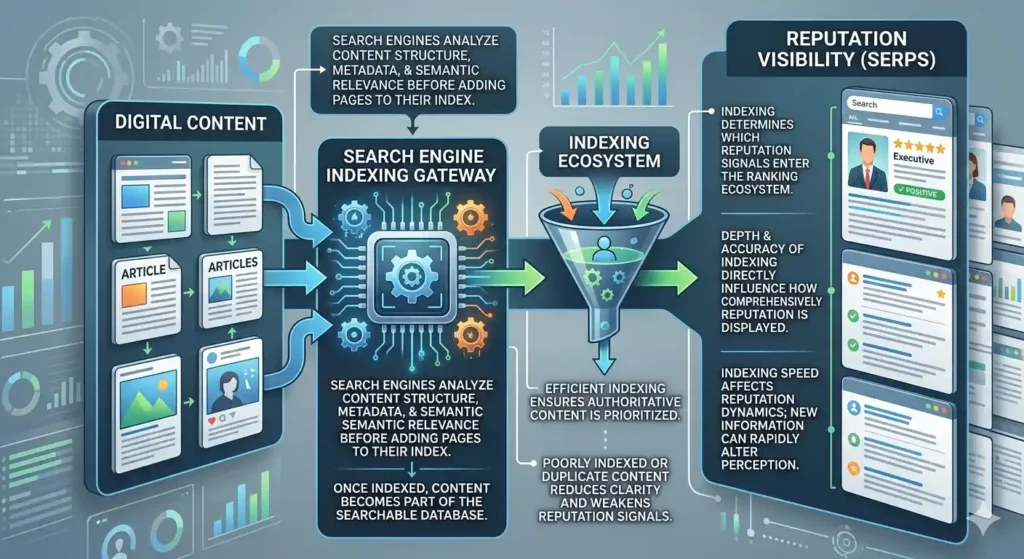
Content indexing is the process through which search engines store, categorise, and retrieve digital information for ranking within search results. It refers to the foundational mechanism that determines whether reputation-related content becomes visible in SERPs.
Search engines analyse content structure, metadata, and semantic relevance before adding pages to their index. Once indexed, content becomes part of the searchable database that defines executive entity representation. The depth and accuracy of indexing directly influence how comprehensively an executive’s reputation is displayed.
Efficient indexing ensures that authoritative content is prioritised in search visibility layers. Poorly indexed or duplicate content reduces clarity and weakens reputation signals. Indexing speed also affects reputation dynamics, as newly published information can rapidly alter perception structures.
Content indexing functions as the gateway mechanism that determines which reputation signals enter the ranking ecosystem.
How is trust constructed through authority signals in search systems?
Trust is constructed through authority signals that demonstrate expertise, credibility, and consistency across indexed digital content. It refers to the algorithmic assessment of reliability based on interconnected validation markers within search ecosystems.
Authority signals include high-quality backlinks, consistent topical coverage, and recognition from established domains. Search engines interpret these signals as indicators of expertise and reliability, increasing visibility for entities with stronger authority profiles. These signals operate collectively rather than individually, forming a network-based trust model.
Entity authority is reinforced when multiple independent sources validate similar information about an executive. This cross-verification strengthens SERP stability and reduces ranking volatility. In contrast, inconsistent authority signals weaken trust construction and fragment entity perception.
Trust in search systems is not explicitly assigned but computed through aggregated authority structures that reflect the overall coherence of digital identity representation.
Dive Deeper With Our Expert Guides:
Online Reputation Management for Doctors to Build Patient Trust and Reviews
Reputation Management for Lawyers: How to Control Your Online Reviews and Image
Reputation within search ecosystems is constructed through structured interpretation of indexed information, authority signals, and semantic relationships. It operates as an evolving entity model shaped by content distribution, SERP evaluation, and algorithmic credibility assessment.
Online reputation reflects how search engines aggregate digital footprints, sentiment patterns, and indexing structures to define entity perception. These mechanisms collectively determine visibility, trust, and informational prominence within search results.
Understanding these systems reveals that reputation is not a singular narrative but a multi-layered computational construct formed through continuous data interpretation and ranking processes.
Answers to Key Questions
What is reputation management for CEOs in search results?
Reputation management for CEOs refers to the control and analysis of executive identity within search engine results pages (SERPs). It focuses on how indexed content, authority signals, and entity recognition shape online credibility and visibility. Search systems evaluate these elements to define perceived trust and leadership reputation.
How does Clear My Name influence executive online reputation?
Clear My Name relates to reputation management processes that organise and structure digital information associated with an executive entity. It helps ensure search engines interpret consistent signals across indexed content and profiles. This improves clarity in entity perception and search visibility.
What factors affect CEO reputation in Google search rankings?
CEO reputation in Google is influenced by authority signals, content relevance, backlink quality, and sentiment analysis. These factors determine how search engines evaluate credibility and rank associated content in SERPs. Consistent and accurate information strengthens entity trust signals.
How do search engines evaluate executive credibility online?
Search engines evaluate executive credibility through semantic analysis of content, authority sources, and topical consistency. They aggregate reputation signals from multiple indexed pages to build an entity profile. This process defines how prominently an executive appears in search results.