

Reputation management is the systematic control of how individuals or entities are represented across search engines, online platforms, and indexed digital content.
Online reputation refers to the aggregated perception formed through search visibility, content indexing, and entity-based evaluation within search ecosystems.
For professors and educators, reputation management for online profile cleaning defines how academic identity is structured, corrected, and represented across SERPs. It focuses on removing inconsistency, aligning professional profiles, and stabilising how search engines interpret authority signals tied to an educator’s name.
What is reputation management for professors and educators in online profile cleaning?
Reputation management for professors and educators in online profile cleaning is the process of structuring, correcting, and aligning academic identity across search-indexed platforms to ensure consistent SERP representation.
This concept defines how educational professionals are represented within search ecosystems through verified profiles, institutional pages, publications, and indexed references. Search engines construct entity profiles by aggregating fragmented data points such as academic affiliations, citations, conference records, and public mentions. When these data points remain inconsistent, entity perception becomes unstable, affecting how authority is evaluated in search results.
The mechanism operates through content consolidation and index alignment. Search crawlers collect data from university websites, academic directories, journals, and third-party platforms. These sources contribute to an entity graph that determines how a professor is represented in knowledge systems. Profile cleaning removes duplication, outdated entries, and conflicting metadata, ensuring that indexing systems interpret a single coherent academic identity.
Within SERP evaluation, consistency across profiles strengthens trust signals associated with academic expertise. Search engines prioritise structured, authoritative content when constructing knowledge panels and ranking results. Clean profiles reinforce clarity in attribution, which stabilises visibility across educational queries linked to the educator’s name.
How does search engine indexing shape academic reputation online?
Search engine indexing shapes academic reputation online by determining how educational content and professional identities are stored, retrieved, and ranked within SERPs.
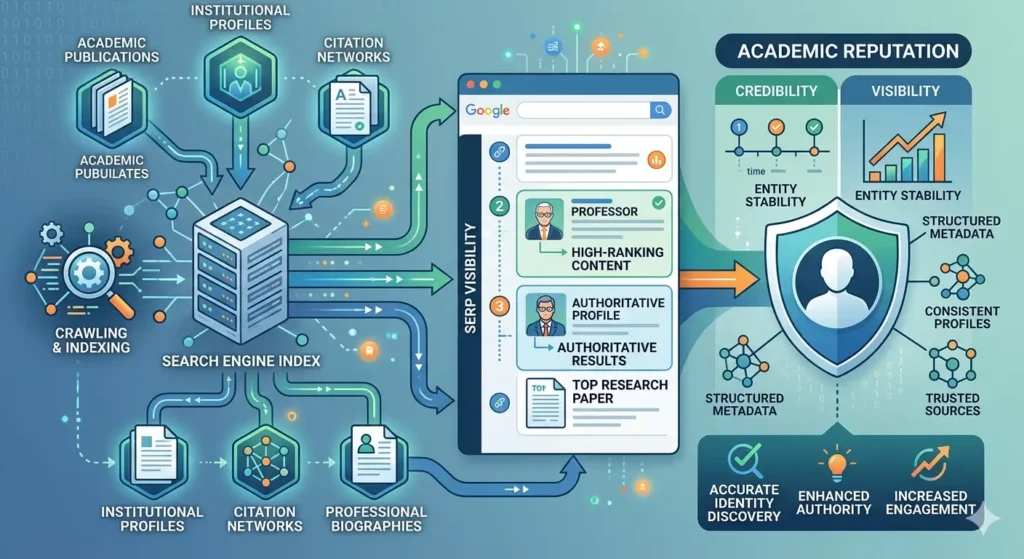
Indexing refers to the process through which search engines catalog digital content into structured databases. For professors and educators, indexing aggregates publications, institutional biographies, citations, and external references into a unified dataset. This dataset becomes the foundation for how academic authority is interpreted across search queries.
The mechanism relies on crawling and entity recognition. Search engines scan academic websites, research repositories, and digital profiles to identify named entities and associated attributes. These attributes include institutional affiliation, research output, and citation networks. Once indexed, this information contributes to the construction of an academic entity profile within the search system.
Indexing directly influences reputation signals by determining which content appears in response to name-based or topic-based searches. High-quality academic pages with structured metadata increase search visibility, while fragmented or outdated pages weaken entity clarity. This structural imbalance affects how authority is distributed across SERPs.
Search engines evaluate index stability by analysing repetition, consistency, and source reliability. When academic profiles are consistently indexed across authoritative domains, the resulting entity representation becomes more stable. This stability reinforces credibility and ensures that search results reflect accurate academic identity rather than dispersed or conflicting data points.
What are reputation signals in SERPs for educators?
Reputation signals in SERPs for educators are structured indicators used by search engines to evaluate academic credibility, authority, and trustworthiness across indexed content.
These signals define how search systems interpret professional legitimacy. They include citation frequency, institutional association, content consistency, and structured data alignment. Each signal contributes to entity perception by reinforcing or weakening the academic profile associated with a professor’s name.
The mechanism operates through weighted evaluation of digital references. Search engines assess how often an educator appears in authoritative domains such as university websites, peer-reviewed journals, and academic databases. Repetition across trusted domains strengthens reputation signals and improves SERP positioning.
Structured data also plays a central role in signal formation. Schema markup, author tags, and verified profiles allow search engines to categorise academic content accurately. When structured metadata remains consistent, it reinforces clarity in entity recognition systems and improves ranking reliability.
SERP evaluation further incorporates sentiment analysis from external references such as academic discussions, forum mentions, and educational directories. These references contribute to contextual understanding of reputation, shaping how an educator is positioned within knowledge panels and search summaries.
Reputation signals collectively determine how prominently an academic identity appears in search results. Strong alignment between indexed content and authoritative references produces stable visibility across educational queries.
How does digital footprint formation affect educator credibility?
Digital footprint formation affects educator credibility by defining the scope, structure, and consistency of all indexed online traces associated with an academic identity.
A digital footprint refers to the cumulative presence of content linked to an individual across search engines, databases, and online platforms. For educators, this includes academic publications, institutional profiles, lecture materials, citations, and external references. Search systems aggregate these traces to construct an entity-level representation of professional identity.
The mechanism of footprint formation relies on continuous content indexing. Each new publication or profile update becomes part of the search ecosystem. When these elements align structurally, they reinforce credibility signals. When inconsistencies exist between profiles, affiliations, or publication records, entity perception becomes fragmented.
Search engines evaluate digital footprints through coherence and authority mapping. Coherent footprints demonstrate stable academic identity across multiple sources. Authority mapping connects these sources to recognised institutions and verified academic networks, strengthening trust signals within SERPs.
Digital footprint structure also influences long-term visibility. Consistent publication history and aligned metadata improve indexing efficiency and reduce ambiguity in search results. This structural clarity enhances how educators are represented in knowledge systems and reduces the likelihood of misattributed or outdated content dominating SERPs.
Credibility within search ecosystems is therefore not isolated to individual content pieces. It emerges from the structured interaction between all indexed traces forming the educator’s digital footprint.
How do algorithms evaluate authority and trust for academic profiles?
Algorithms evaluate authority and trust for academic profiles by analysing structured content signals, source credibility, and entity consistency across indexed academic ecosystems.
Authority evaluation refers to the algorithmic process of determining expertise within a specific domain. For educators, this process relies on publication history, institutional affiliation, citation networks, and cross-domain references. Search engines aggregate these inputs to construct an authority score linked to the academic entity.
Trust evaluation operates through verification of source reliability. Algorithms prioritise content originating from recognised educational institutions, peer-reviewed journals, and established academic repositories. These sources contribute stronger trust signals compared to unverified or fragmented references.
Entity consistency is central to algorithmic interpretation. Search systems compare variations of names, titles, and affiliations across indexed platforms. When inconsistencies appear, trust signals weaken due to uncertainty in entity mapping. Consistent representation across profiles strengthens algorithmic confidence in identity accuracy.
Algorithms also assess semantic relationships between academic content and related topics. Co-occurrence of terms, research fields, and citation networks helps define expertise boundaries. This semantic mapping reinforces authority positioning within SERPs for specific academic domains.
The evaluation process integrates all signals into a unified ranking framework. Authority determines relevance, while trust determines reliability. Together, these metrics define how academic profiles are ranked and displayed in search results.
How does online profile cleaning influence entity perception in search ecosystems?
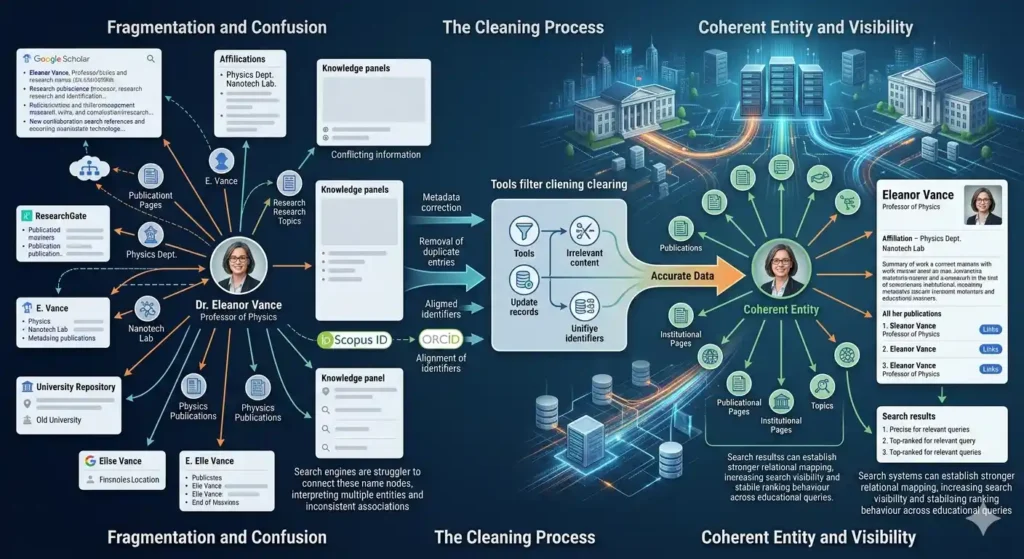
Online profile cleaning influences entity perception in search ecosystems by removing inconsistencies, aligning structured data, and strengthening how search engines interpret academic identity.
Entity perception refers to the way search systems construct meaning around a named individual based on aggregated digital signals. For professors and educators, this perception depends on how accurately profiles, publications, and institutional records are indexed and connected within knowledge systems.
Profile cleaning operates through correction of metadata inconsistencies, removal of duplicate entries, and alignment of academic identifiers across platforms. This process ensures that search engines associate all relevant content with a single coherent entity rather than fragmented variations of identity.
The mechanism directly impacts SERP evaluation. Clean profiles improve clarity in knowledge panels, enhance indexing accuracy, and reduce conflicting interpretations of academic authority. Search engines prioritise structured and consistent data when generating entity summaries and ranking academic results.
Profile cleaning also strengthens internal linking structures within academic ecosystems. When publications, institutional pages, and author profiles align, search systems establish stronger relational mapping between content nodes. This mapping increases search visibility and stabilises ranking behaviour across educational queries.
Reputation management for professors and educators online profile cleaning integrates within this structural alignment process by standardising how academic identity is referenced across indexed environments. This consistency reinforces entity recognition and reduces semantic ambiguity within search graphs.
Dive Deeper With Our Expert Guides:
Reputation Management for CEOs and Executives to Protect Personal Brand Image
Online Reputation Management for Doctors to Build Patient Trust and Reviews
Reputation management is a structured process of controlling how academic identity is represented, indexed, and interpreted within search ecosystems.
Online reputation refers to the aggregated signals formed through SERP evaluation, content indexing, and entity-based mapping.
For professors and educators, reputation is constructed through digital footprint coherence, authority signals, indexing stability, and structured profile alignment. Search engines interpret these elements through algorithmic systems that evaluate trust, relevance, and consistency across multiple data sources.
Entity perception in search systems depends on how accurately academic information is cleaned, connected, and maintained across indexed environments. When structured data remains consistent, search visibility becomes stable and reflective of genuine academic authority.
Answers to Key Questions
What is reputation management for professors and educators?
Reputation management for professors is the process of shaping and maintaining an academic’s online identity across search engines and digital platforms. It focuses on improving search visibility, aligning academic profiles, and ensuring consistent entity signals across SERPs and institutional records.
How does online reputation affect a professor’s search visibility?
Online reputation directly influences how search engines rank and display academic profiles in results pages. Consistent citations, publications, and institutional links strengthen authority signals and improve SERP evaluation of the educator’s identity.
Why is online profile cleaning important for academic professionals?
Online profile cleaning removes outdated, duplicated, or conflicting information that affects entity perception in search ecosystems. It helps search engines correctly index academic data and maintain a stable digital footprint for educators.
How do search engines evaluate an educator’s credibility?
Search engines evaluate credibility using authority signals such as citations, institutional affiliations, and content consistency across indexed sources. These factors help determine how reliably an academic profile is represented within knowledge systems and SERPs.