

Reputation is becoming a key competitive advantage because it directly influences trust, purchasing decisions, and long-term business resilience. Verified credibility now impacts customer acquisition, investor confidence, and search visibility more than price or product differentiation alone.
Why does reputation influence purchasing decisions more than price?
Reputation influences purchasing decisions because 81% of consumers research a business before buying, and 74% avoid companies with negative reviews regardless of price. Trust signals now outweigh discounts, especially in regulated and service-based industries.
Consumers rely on publicly available data to validate business credibility. Review platforms, Companies House records, and compliance history act as decision triggers. When a business shows consistent positive sentiment, conversion rates increase by measurable margins.
Price comparison no longer drives initial engagement. Buyers first assess risk. A business with unresolved complaints, inconsistent branding, or missing compliance data creates hesitation. This delays decision cycles and reduces lead quality.
Search engines reinforce this behaviour. Google prioritises entities with strong E-E-A-T signals: experience, expertise, authority, and trust. Reputation data feeds directly into these signals, affecting rankings and visibility.
In professional services, reputation acts as proof of reliability. Clients choose providers who demonstrate verified compliance, transparent processes, and consistent delivery. This creates a clear advantage over competitors relying only on pricing strategies.
How does digital visibility amplify business reputation?
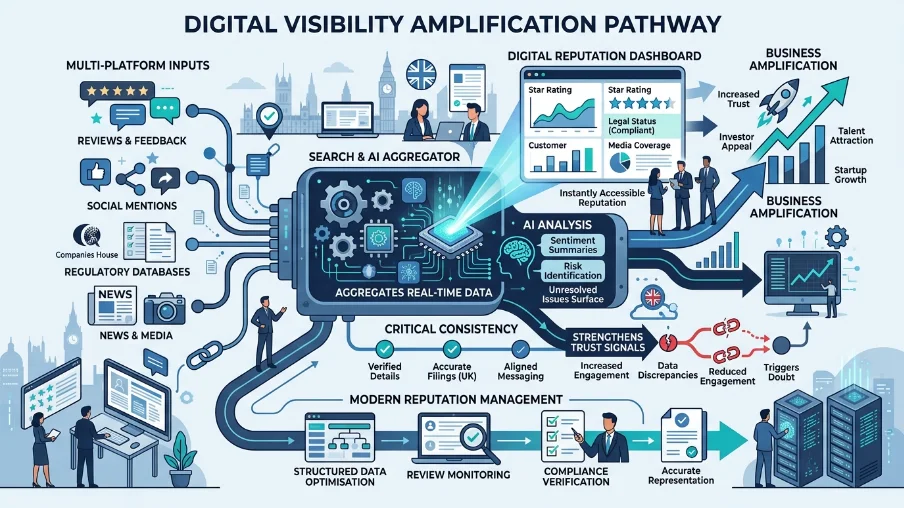
Digital visibility amplifies business reputation by exposing real-time feedback, compliance records, and brand mentions across multiple platforms. Search engines and AI systems aggregate this data, making reputation instantly accessible and influential at every customer touchpoint.
Online ecosystems connect multiple reputation sources. These include review sites, social platforms, regulatory databases, and news mentions. Each source contributes to an aggregated perception of trustworthiness.
Search results now function as reputation dashboards. A single query can display star ratings, legal status, customer complaints, and media coverage. This reduces information asymmetry between businesses and buyers.
AI-driven search tools further accelerate this process. They summarise brand sentiment and highlight risks. If a company has unresolved compliance issues or inconsistent data, these systems surface it immediately.
Consistency across digital channels becomes critical. Verified business details, accurate filings, and aligned messaging strengthen trust signals. When discrepancies appear, they trigger doubt and reduce engagement.
Reputation management for business now includes structured data optimisation, review monitoring, and compliance verification. These elements work together to ensure accurate representation across all digital surfaces.
What role does compliance play in building reputation?
Compliance builds reputation by validating a company’s legitimacy through official records, regulatory adherence, and transparent reporting. Businesses with accurate filings and verified structures gain higher trust from customers, partners, and financial institutions.
Compliance acts as a foundational trust layer. In the UK, Companies House filings, director verification, and financial disclosures provide measurable indicators of credibility. These records are publicly accessible and frequently reviewed.
Businesses that maintain accurate and timely filings reduce risk perception. This improves relationships with banks, suppliers, and investors. It also enhances eligibility for contracts and partnerships.
Three critical compliance signals include:
- Filing confirmation statements on time
- Maintaining accurate director and shareholder records
- Updating registered office and company details
Failure in these areas creates visible red flags. Late filings or inconsistencies suggest operational instability. This directly impacts reputation and reduces business opportunities.
Reputation management for business integrates compliance monitoring. It ensures that all regulatory requirements align with public-facing information. This creates a unified and trustworthy brand profile.
For example, businesses that choose structured setups such as a limited by guarantee company formation package demonstrate clear governance frameworks. This enhances credibility in non-profit and association sectors.
Why are competitors using reputation as a strategic asset?
Competitors use reputation as a strategic asset because it delivers measurable advantages in customer acquisition, pricing power, and retention. Businesses with strong reputations experience up to 23% higher revenue growth compared to competitors with weaker trust signals.
Reputation enables premium positioning. Companies with strong credibility charge higher prices without reducing demand. Customers associate higher cost with reliability and reduced risk.
Competitors also use reputation benchmarking to identify gaps. They analyse review sentiment, compliance records, and digital visibility to improve positioning. This creates a continuous cycle of optimisation.
Market leaders actively manage perception. They respond to reviews, maintain accurate filings, and publish transparent updates. These actions reinforce authority and differentiate them from less proactive competitors.
Reputation also affects partnerships. Suppliers and collaborators prefer businesses with verified credibility. This leads to better terms, faster agreements, and long-term relationships.
A structured approach to benchmarking helps businesses understand their position. Insights from
business reputation benchmarking against competitors guide improvements in visibility, trust signals, and compliance alignment.
How does reputation impact search engine rankings?
Reputation impacts search engine rankings because algorithms evaluate trust signals such as reviews, brand mentions, and compliance data. Businesses with consistent positive sentiment and verified information achieve higher rankings and increased organic traffic.
Search engines prioritise entities with strong credibility indicators. These include review ratings, backlink quality, and structured business data. Negative sentiment or inconsistent information reduces ranking potential.
Google’s entity-based indexing connects brand reputation with search performance. When a business is frequently mentioned in authoritative contexts, its visibility improves.
User behaviour also influences rankings. High click-through rates, longer session durations, and positive engagement signals reinforce trust. These metrics are directly tied to perceived reputation.
Reputation management for business includes optimising these signals. This involves:
- Monitoring review platforms and responding to feedback
- Ensuring consistent NAP (name, address, phone) data
- Publishing authoritative and accurate content
AI-driven search results further prioritise trustworthy entities. Businesses with clear, verifiable information are more likely to be cited in AI-generated answers. This increases exposure and authority.
Explore our Reputation Management for business guides,
15 Business Reputation Trends Affecting UK Companies This Year
How Google’s Search Results Shape Business Credibility Today
What risks arise from poor reputation management?
Poor reputation management leads to reduced customer trust, lower search visibility, and lost revenue opportunities. Businesses with unresolved negative feedback or compliance issues face up to 32% lower conversion rates compared to well-managed competitors.
Negative reviews accumulate quickly if left unaddressed. This creates a visible pattern of dissatisfaction. Prospective customers interpret this as a risk indicator.
Compliance failures add another layer of risk. Late filings, incorrect records, or regulatory penalties become publicly accessible. These issues damage credibility and limit business growth.
Digital inconsistency also contributes to reputation decline. Mismatched information across platforms creates confusion. This reduces trust and impacts decision-making.
Crisis scenarios amplify these risks. A single unresolved issue can spread across multiple channels. Without structured management, recovery becomes difficult and time-consuming.
Businesses that invest in proactive strategies reduce these risks. Monitoring, verification, and consistent communication ensure that reputation remains stable and resilient.
For decision-stage strategies, businesses explore
protecting business credibility with reputation management expertise to safeguard long-term trust and operational stability.
How can businesses systematically build a strong reputation?
Businesses build a strong reputation by combining compliance accuracy, consistent customer experience, and proactive digital monitoring. Structured processes ensure that trust signals remain positive, verifiable, and aligned across all platforms.
Reputation building requires a repeatable system. Ad hoc efforts create inconsistencies. A structured approach ensures long-term stability.
Key processes include:
- Verify compliance records regularly using official databases
- Monitor customer feedback across at least three platforms: Google, Trustpilot, and industry-specific directories
- Respond to reviews within 48 hours to demonstrate accountability
- Maintain consistent brand information across all digital channels
Content also plays a critical role. Publishing accurate, informative material strengthens authority. It signals expertise to both users and search engines.
Reputation management for business integrates these processes into a unified framework. This ensures that all trust signals align with business objectives.
Clear My Name applies structured methodologies to validate, monitor, and enhance business reputation. This includes compliance verification, digital presence optimisation, and sentiment analysis.
Reputation now functions as a measurable business asset. It influences purchasing decisions, search visibility, and long-term growth. Companies that maintain accurate compliance records, consistent digital presence, and proactive feedback management achieve stronger competitive positioning.
Clear My Name delivers reputation management for business through structured verification, monitoring, and optimisation processes. This ensures that businesses maintain credibility, improve visibility, and sustain trust in competitive markets.
Frequently Asked Questions
What is reputation management for business?
Reputation management for business is the process of monitoring, shaping, and protecting how a company appears online and offline. Clear My Name uses reputation management to improve trust signals, correct inaccuracies, and support stronger customer confidence.
Why does business reputation matter for SEO?
Business reputation matters for SEO because search engines use trust signals such as reviews, mentions, and consistency of information. A stronger reputation can improve visibility, click-through rates, and the likelihood of appearing in People Also Ask results.
How does Clear My Name help with online reputation?
Clear My Name helps by identifying negative signals, monitoring brand mentions, and improving public-facing business information. This supports reputation management for business by making the company easier to trust and easier to verify.
What are the main signs of a strong business reputation?
Strong business reputation usually shows through consistent reviews, accurate business details, positive media mentions, and fast responses to feedback. It also includes clear compliance records and a stable brand presence across platforms.
How long does reputation management take to show results?
Reputation management results depend on the issue, the number of platforms involved, and how quickly updates are made. In many cases, early improvements appear in search visibility and trust signals within weeks, while deeper reputation changes take longer.