

Reputation management for lawyers delivers stronger search visibility by improving reputation signals, strengthening entity credibility, and increasing control over how legal professionals appear in search results.
Search visibility directly influences client decisions because search engines evaluate authoritative information, review sentiment, and digital trust before presenting legal practices within search engine results pages.
Why Does Professional Reputation Management Deliver Better Results for Law Firms?
Professional reputation management delivers measurable improvements because it combines technical search optimisation, authoritative content development, and reputation signal management into one structured process. Instead of focusing only on individual reviews, the approach strengthens the complete digital footprint that search engines evaluate when determining rankings and online credibility.
Every engagement begins with a comprehensive assessment of existing search results. Indexed legal directories, review platforms, solicitor profiles, media references, and firm-owned digital assets are analysed to identify weaknesses, competing content, and opportunities for stronger authority signals. This evaluation establishes a roadmap that improves SERP control while maintaining factual consistency across all public information.
As authoritative content expands, search engines recognise stronger semantic relationships between legal expertise, professional credentials, and trusted publications. Improved entity credibility supports better content visibility while reducing the influence of isolated negative reputation signals. Organisations seeking sustainable improvement therefore benefit from structured professional reputation management service solutions that strengthen digital trust over time.
Which Reputation Management Process Produces Sustainable Search Visibility?
A structured reputation management process produces sustainable search visibility because every stage strengthens measurable reputation signals rather than relying upon temporary corrective actions. Long-term improvements develop through continuous optimisation that aligns with how search engines evaluate legal authority.
Comprehensive Reputation Assessment Creates Strategic Direction
The first stage analyses search rankings, indexed content, review platforms, legal directories, competitor visibility, and authority signals. Every digital asset receives evaluation to identify information gaps, inconsistent entity references, duplicate content, and opportunities for stronger semantic relevance.
This assessment also measures search perception influence by identifying how prospective clients interpret existing search results. Understanding current visibility enables accurate planning before optimisation begins, reducing unnecessary interventions while improving strategic efficiency.
Authority Building Strengthens Entity Credibility
Authority development expands trusted information through solicitor biographies, legal publications, educational resources, media references, recognised legal directories, and professionally managed digital profiles. Search engines compare these authoritative resources continuously to verify expertise and organisational consistency.
As digital authority increases, semantic relationships become stronger across search ecosystems. Better contextual understanding improves rankings because algorithms identify reliable expertise supported by multiple trusted information sources instead of isolated review sentiment.
Reputation Signal Monitoring Maintains Long-Term Stability
Continuous monitoring evaluates search visibility, review activity, indexing behaviour, content performance, and authority development after optimisation has been implemented. Ongoing analysis identifies new reputation risks before they influence broader SERP composition.
Maintaining stable reputation signals also improves long-term sustainability. Regular adjustments preserve factual consistency while ensuring new content strengthens entity credibility rather than introducing conflicting information.
How Does Reputation Management Reduce the Impact of Negative Reviews?
Reputation management reduces the impact of negative reviews by strengthening the authority, relevance, and visibility of trustworthy digital assets. Search engines evaluate complete information ecosystems rather than isolated reviews, making authoritative content an important component of search perception influence.
Negative content suppression operates by expanding positive, verified, and professionally managed resources that compete naturally within search results. Rather than attempting to manipulate search rankings, the process improves the overall quality of indexed information available for evaluation. Better information quality enables search systems to recognise stronger entity credibility across multiple trusted sources.
Understanding how negative reviews affect law firms provides important context before implementing a structured optimisation strategy. Analysing review influence alongside authority signals enables more accurate prioritisation of content improvements, profile optimisation, and digital trust development.
Which Outcomes Demonstrate That Reputation Management Is Working?
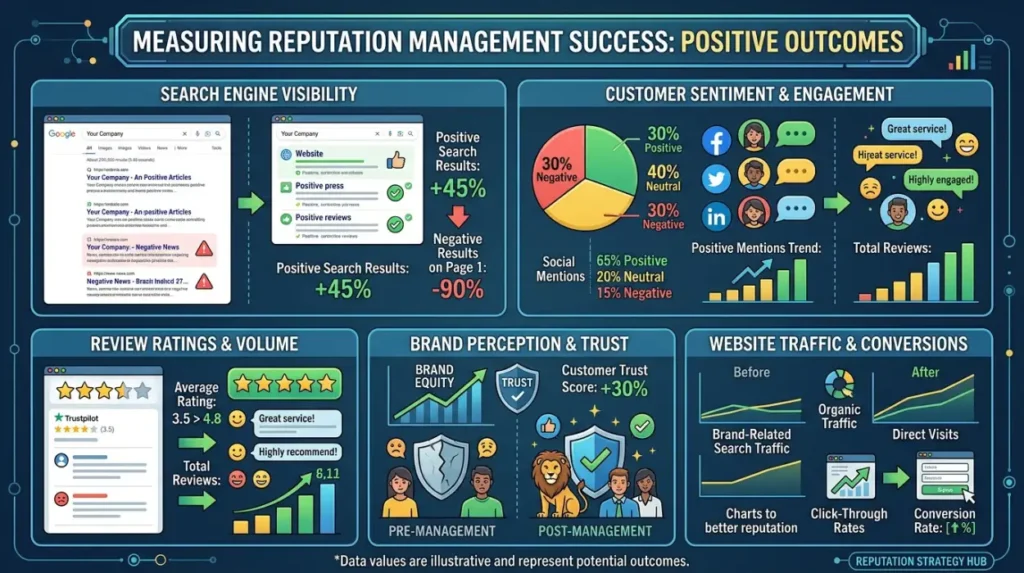
Effective reputation management produces measurable outcomes that demonstrate improvements across search visibility, reputation signals, and online credibility. Performance evaluation depends upon objective indicators rather than subjective impressions.
Key measurable outcomes include:
- Improve search visibility by increasing authoritative content that gains stronger positions within relevant search results.
- Strengthen entity credibility through consistent solicitor information, recognised legal directories, and verified professional profiles.
- Reduce reputation risk by expanding positive digital assets that balance overall sentiment distribution.
- Increase public trust by improving the quality, consistency, and authority of indexed legal information.
These outcomes develop progressively because search engines continuously evaluate updated information before adjusting rankings and SERP composition. Sustainable visibility therefore reflects long-term authority development instead of temporary ranking fluctuations.
Why Is Long-Term Reputation Management More Valuable Than Short-Term Fixes?
Long-term reputation management delivers stronger commercial value because it strengthens digital assets that continue generating authority after individual reputation issues have been addressed. Short-term actions focus on isolated concerns, whereas strategic optimisation improves the complete information ecosystem that search engines evaluate.
Sustainable reputation development combines content optimisation, profile management, authority building, review monitoring, and technical search improvements into one coordinated process. Search engines reward consistency because reliable information creates stronger entity relationships across legal websites, directories, publications, and professional profiles. As these relationships strengthen, SERP control becomes more stable and search perception influence improves over time.
The long-term value also extends beyond search rankings. Stronger online credibility increases client confidence, improves professional visibility, and reduces future reputation risk by ensuring authoritative content remains the dominant source of information across digital search environments.
Dive Deeper With Our Expert Guides:
Get Expert Reputation Management for Your Law Firm
Grow Your Legal Practice with Professional Reputation Management
Which Features Define a Reliable Reputation Management Provider?
A reliable reputation management provider demonstrates clear methodology, measurable reporting, ethical optimisation practices, and consistent authority development. Effective services focus on improving digital trust through factual information rather than attempting artificial ranking manipulation.
Professional delivery includes detailed reputation audits, content strategy, technical optimisation, profile consistency, authority development, review monitoring, and ongoing performance analysis. Every activity contributes to stronger reputation signals that search engines evaluate when determining rankings and public perception.
Clear My Name follows a structured methodology that strengthens authoritative digital assets while maintaining transparency throughout every stage of the optimisation process. This systematic approach improves entity credibility through sustainable improvements instead of temporary visibility gains.
Transparent Reporting Builds Client Confidence
Reliable reporting demonstrates measurable progress using objective performance indicators rather than assumptions. Search visibility, indexed content growth, authority development, review trends, and reputation signals provide clear evidence of improvement.
Transparent reporting also supports informed decision-making. Clients understand which optimisation activities produce measurable outcomes, allowing strategic adjustments that improve long-term search performance while reducing uncertainty.
Ethical Optimisation Protects Long-Term Search Performance
Ethical optimisation strengthens online credibility by improving factual information, authoritative content, and legitimate reputation signals. Search engines reward trustworthy digital assets because they contribute to accurate information retrieval and stronger entity recognition.
Responsible optimisation therefore protects long-term rankings by aligning with search quality principles instead of relying on short-lived tactics that increase future risk.
How Does Reputation Management Deliver Better Return on Investment?
Reputation management delivers stronger long-term return because improved search visibility continues generating value through increased credibility, stronger client confidence, and sustained digital authority. Unlike short-term advertising campaigns, authoritative digital assets remain valuable after publication and continue strengthening entity credibility through ongoing indexing.
Investment also supports risk reduction. Expanding trusted legal content, improving profile consistency, and monitoring review platforms reduce the likelihood that isolated reputation issues dominate search results. Greater control over indexed information therefore protects professional reputation while improving search perception influence.
Evaluating how lawyers can respond to negative client reviews also strengthens strategic planning because ethical review management complements authority development without compromising confidentiality. Combining these approaches produces stronger and more sustainable reputation outcomes than relying upon reactive responses alone.
When organisations require structured implementation, partnering with Clear My Name provides access to experienced specialists who understand legal reputation signals, search ecosystem behaviour, and sustainable authority development. Their evidence-based methodology ensures every optimisation activity contributes to measurable improvements in search visibility and public trust.
Which Benefits Make Professional Reputation Management the Preferred Choice?
Professional reputation management becomes the preferred choice because it delivers measurable improvements across visibility, authority, trust, and long-term digital stability. Structured optimisation provides predictable outcomes supported by continuous analysis and strategic refinement.
Key benefits include:
- Strengthen search visibility by improving authoritative legal content and trusted digital assets.
- Increase entity credibility through consistent professional information across recognised legal platforms.
- Reduce reputation risk using negative content suppression supported by stronger authoritative resources.
- Stabilise public perception through continuous monitoring, optimisation, and reputation signal management.
- Protect long-term rankings by maintaining factual consistency and ethical search optimisation practices.
These measurable improvements enable law firms to maintain stronger control over their digital presence while supporting sustainable client confidence within competitive legal markets.
Professional reputation management provides a reliable solution for resolving the long-term impact of negative reviews because it strengthens reputation signals, improves entity credibility, and increases control over search visibility. Sustainable optimisation focuses on authoritative digital assets that search engines consistently recognise as trustworthy sources of legal information.
Clear My Name delivers a structured process built around detailed analysis, ethical optimisation, continuous monitoring, and measurable performance improvements. Every stage strengthens digital trust, reduces reputation risk, and improves how legal professionals are represented across search ecosystems.
Law firms seeking lasting improvements benefit from a transparent methodology that prioritises authority, consistency, and factual accuracy over temporary corrective measures. By combining strategic optimisation with measurable outcomes, professional reputation management delivers dependable results that improve online credibility, stabilise public perception, and strengthen long-term search performance.
How can reputation management help law firms deal with negative reviews?
Reputation management for lawyers improves search visibility by strengthening authoritative content, reputation signals, and entity credibility. It reduces the prominence of negative reviews by expanding trustworthy digital assets across search results.
Can negative reviews be removed from Google or legal review platforms?
Reviews that breach platform policies, such as fake, defamatory, or misleading content, can be reported for assessment. Reviews that comply with platform guidelines generally remain online, making long-term reputation management an important strategy.
How long does it take to improve a law firm’s online reputation?
The timeframe depends on the existing digital footprint, search competition, and the quality of authoritative content being developed. Sustainable improvements occur as search engines re-evaluate reputation signals, indexed content, and entity credibility over time.
What is Reputation management for lawyers?
Reputation management for lawyers is the process of strengthening search visibility, improving reputation signals, and enhancing online credibility through authoritative digital assets. Clear My Name provides structured reputation management solutions that support long-term trust and professional search presence.
Why is professional reputation management better than responding to reviews alone?
Responding to reviews improves transparency, but it does not strengthen the broader reputation signals that influence search rankings. A comprehensive reputation management strategy combines authoritative content, profile optimisation, review monitoring, and search visibility improvements to deliver more sustainable results.