

Reputation management is the process of understanding how publicly available information influences trust, credibility, and search visibility within digital search ecosystems.
Online reputation refers to the collection of indexed content, reputation signals, authority indicators, and public references that search engines evaluate when presenting law firms in search engine results pages (SERPs).
What Are the Biggest Reputation Risks Facing Modern Law Firms?
The biggest reputation risks facing modern law firms are the public availability of inconsistent information, negative review sentiment, outdated content, inaccurate professional profiles, and fragmented digital authority. These factors influence entity perception because search engines evaluate the complete collection of indexed information rather than isolated web pages.
Modern search ecosystems compare law firm websites, legal directories, review platforms, solicitor biographies, media references, and professional associations to understand organisational credibility. When these resources contain conflicting information or uneven authority signals, search systems identify weaker semantic relationships. This reduces confidence during SERP evaluation and influences how legal practices are represented across search results.
Reputation risks therefore develop from the interaction between publicly available information and search engine interpretation. Search visibility reflects the quality, consistency, and authority of indexed content rather than individual reputation indicators.
How Do Search Engines Interpret Reputation Risks?
Search engines interpret reputation risks by analysing contextual consistency, authority signals, review sentiment, and relationships between indexed digital assets. Reputation is evaluated through entity recognition instead of individual documents.
Algorithms compare legal websites with solicitor directories, recognised legal organisations, review platforms, media publications, and structured business information. Consistent identity information strengthens entity perception because search systems recognise reliable semantic relationships across trusted sources. Conflicting or incomplete information weakens contextual understanding and reduces digital credibility.
Search engines continuously reassess indexed information as new content becomes available. Reputation risks therefore evolve alongside changes in digital footprints, making content indexing an ongoing component of search visibility rather than a one-time evaluation.
Entity Perception Defines Digital Credibility
Entity perception is the process through which search engines identify and evaluate a law firm as a recognised professional organisation. It operates by connecting structured information from authoritative digital resources into a unified understanding of legal expertise.
Strong entity perception develops through consistent professional identities, recognised legal affiliations, authoritative publications, and verified business information. Search systems interpret these relationships as evidence of trust and reliability across digital search ecosystems.
Authority Signals Reduce Information Uncertainty
Authority signals refer to trusted indicators that demonstrate professional credibility within search ecosystems. Legal directories, recognised professional organisations, verified solicitor profiles, educational legal publications, and official websites all contribute to stronger authority evaluation.
Search engines compare these authoritative resources with review platforms and publicly available references before determining online credibility. Strong authority signals reduce uncertainty because algorithms identify factual consistency across multiple independent sources.
Why Does Inconsistent Information Create Reputation Problems?
Inconsistent information creates reputation problems because search engines depend upon factual consistency to identify professional entities accurately. Differences in firm names, solicitor profiles, office details, legal services, or contact information weaken semantic relationships during content indexing.
Entity recognition depends upon matching information across multiple trusted resources. When inconsistencies appear between legal directories, review platforms, firm websites, and professional registrations, search systems require additional contextual validation before confirming organisational identity. This process reduces confidence during SERP evaluation.
Users also interpret inconsistent information as reduced organisational reliability. Although search engines and users evaluate information differently, both rely upon consistency when assessing digital credibility. Accurate public information therefore strengthens both search visibility and professional trust.
How Does Review Sentiment Influence Search Visibility?
Review sentiment influences search visibility by contributing additional reputation signals that search engines analyse alongside authoritative legal information. Reviews provide contextual evidence about public perception but remain only one component of broader entity evaluation.
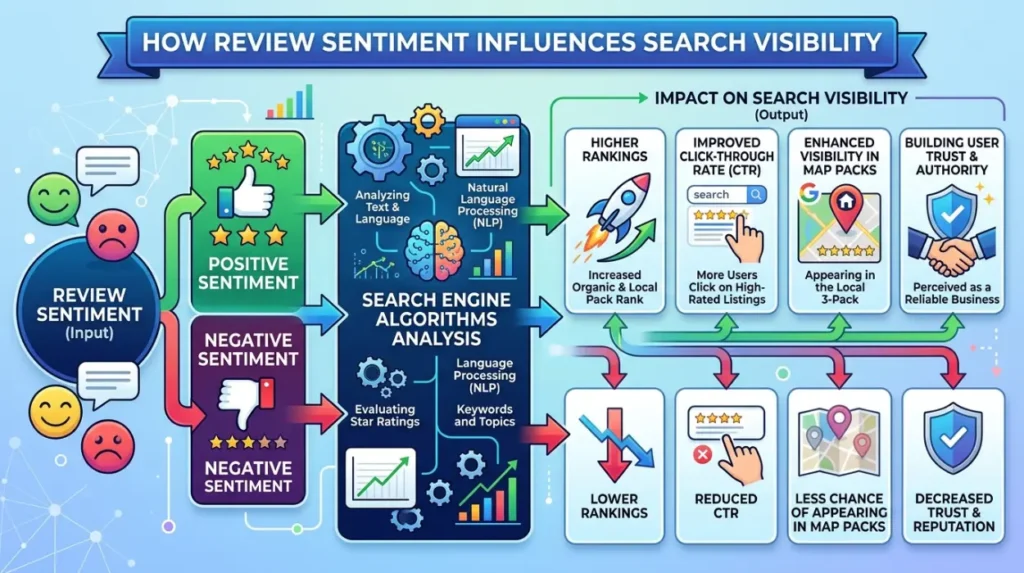
Algorithms assess review authenticity, recurring discussion themes, source reliability, and relationships with recognised legal information before incorporating review signals into overall search interpretation. Authentic reviews from trusted platforms strengthen contextual understanding because they expand publicly available information surrounding a legal practice.
Search visibility therefore depends upon the interaction between review sentiment, authoritative legal resources, and semantic consistency. Balanced information supported by trusted digital assets enables search engines to interpret legal expertise more accurately than review sentiment alone.
Sentiment Distribution Expands Contextual Understanding
Sentiment distribution refers to the balance of positive, neutral, and negative publicly available feedback associated with a legal entity. Search engines evaluate this distribution alongside other reputation signals to understand broader digital credibility.
Balanced sentiment supported by authoritative information contributes stronger contextual evidence than isolated reviews. Algorithms identify recurring patterns across multiple indexed resources before developing an overall interpretation of online reputation.
Content Indexing Shapes Reputation Development
Content indexing is the process through which search engines discover, analyse, organise, and store publicly accessible legal information. Indexed resources become available for retrieval whenever users search for legal professionals or law firms.
The quality of indexed information directly influences reputation development because search systems evaluate newly discovered content continuously. Accurate indexing therefore supports stronger search visibility through reliable information retrieval and improved semantic relationships.
How Do Digital Footprints Expand Reputation Risk?
Digital footprints expand reputation risk because every publicly accessible digital asset contributes additional information for search engine evaluation. A law firm’s digital footprint includes websites, legal directories, professional biographies, review platforms, media references, educational publications, and organisational profiles.
Each indexed resource introduces new reputation signals into search ecosystems. Strong semantic consistency strengthens entity credibility, while fragmented information creates conflicting contextual relationships that reduce search confidence. Search visibility therefore develops through the combined influence of the complete digital footprint rather than isolated web pages.
How Do Negative Content and Outdated Information Affect Law Firm Reputation?
Negative content and outdated information affect law firm reputation by influencing how search engines and users interpret the accuracy and reliability of available information. Search ecosystems continuously evaluate indexed content, meaning older or inaccurate resources can continue contributing to entity perception if they remain publicly accessible.
Outdated solicitor profiles, incorrect practice information, inactive professional references, and unresolved negative discussions create inconsistent reputation signals. Search engines compare these resources with newer authoritative information to determine which sources provide stronger contextual relevance. When outdated information remains prominent, it influences SERP evaluation by creating uncertainty around professional identity and expertise.
Negative content also affects content visibility because search results present information based on relevance, authority, and user intent. Improving the overall quality of indexed resources enables search systems to recognise stronger relationships between a law firm and its verified professional information.
Dive Deeper With Our Expert Guides:
How Negative Reviews Affect Law Firms
How to Manage Your Online Reputation as an Attorney
Which Digital Assets Influence a Law Firm’s Online Credibility?
Digital assets influence online credibility by providing search engines with measurable evidence of expertise, authority, and professional consistency. These assets form the foundation of how legal entities are interpreted across search ecosystems.
Key digital assets include:
- Maintain official legal websites by providing accurate practice information, solicitor profiles, and authoritative resources that improve entity recognition.
- Develop professional publications by creating legal insights and educational content that demonstrate subject relevance and expertise.
- Optimise legal directory profiles by ensuring consistent information across recognised platforms used for professional verification.
- Monitor review platforms by analysing sentiment patterns and maintaining accurate public reputation signals.
Each asset contributes to a broader digital footprint that search engines evaluate during content indexing. Strong relationships between these resources improve semantic understanding and strengthen online credibility.
How Do Content Ranking Dynamics Influence Law Firm Reputation?
Content ranking dynamics influence law firm reputation because search engines determine visibility through relevance, authority, quality, and contextual relationships. Ranking systems analyse whether available content accurately represents a legal entity and satisfies user search intent.
Authoritative content improves visibility because it provides search engines with additional evidence of expertise and professional relevance. Legal guidance articles, verified biographies, recognised publications, and structured information help algorithms understand the relationship between a law firm and its areas of practice.
Content ranking is not determined by individual pages alone. Search engines evaluate the entire information ecosystem surrounding an entity, meaning reputation develops through the combined strength of multiple indexed resources.
How Can Law Firms Reduce Long-Term Reputation Risks?
Law firms reduce long-term reputation risks by maintaining accurate information, strengthening authority signals, and monitoring how their digital footprint develops across search ecosystems. Risk reduction depends upon continuous evaluation rather than isolated reputation corrections.
A structured reputation evaluation includes:
- Analyse search results regularly to identify changes in visibility, indexed content, and reputation signals.
- Review digital profiles to confirm accuracy across legal directories, professional platforms, and organisational references.
- Evaluate content performance to understand how authoritative resources influence entity perception.
- Monitor public feedback to identify sentiment trends and changes in online credibility.
These actions improve search visibility because they maintain consistency between authoritative information sources. Continuous evaluation also supports stronger SERP control by ensuring reliable content remains available for search engine interpretation.
Further analysis of Reputation Monitoring and Protection for Legal Professionals explains how ongoing evaluation methods support the protection of professional credibility within digital search environments.
Why Is Reputation Monitoring Important for Modern Law Firms?
Reputation monitoring is important because search ecosystems constantly change as new reviews, articles, profiles, and digital references become indexed. Monitoring provides visibility into how reputation signals evolve and how search engines interpret professional information over time.
Without continuous observation, outdated information, inaccurate references, or emerging negative discussions can influence entity perception before corrective analysis occurs. Monitoring therefore functions as an information management process that identifies changes within a law firm’s digital footprint.
Search visibility depends on maintaining accurate and authoritative information across the complete search environment. Reputation monitoring supports this objective by measuring content indexing, sentiment distribution, authority signals, and overall digital credibility.
The biggest reputation risks facing modern law firms develop from inconsistent information, unmanaged digital footprints, negative review signals, outdated content, and fragmented authority indicators. Search engines evaluate these factors collectively when determining entity perception, content visibility, and search ranking influence.
Understanding how reputation forms within search ecosystems enables law firms to identify the relationship between indexed content, authority signals, review sentiment, and online credibility. Digital reputation is not created by one platform or one piece of content; it develops through the combined interpretation of multiple trusted and publicly available resources.
Effective reputation analysis focuses on improving information accuracy, strengthening semantic relationships, and maintaining consistent professional visibility. By understanding how search engines evaluate reputation signals, law firms gain clearer insight into protecting their digital presence and supporting long-term credibility.
What are the biggest reputation risks facing modern law firms?
The biggest reputation risks for law firms include negative reviews, inconsistent online information, outdated professional profiles, and weak authority signals. These factors influence search visibility, entity credibility, and how potential clients interpret digital information.
How does online reputation affect a law firm’s search visibility?
Online reputation affects search visibility because search engines evaluate reputation signals, content quality, authority indicators, and public information when ranking legal entities. A consistent digital footprint helps search systems understand professional credibility more accurately.
Why are online reviews important for law firm reputation?
Online reviews provide reputation signals that contribute to how search engines and users evaluate a law firm’s credibility. Review sentiment is analysed alongside authoritative content, legal directories, and professional information to create a broader perception of trust.
What is reputation management for lawyers?
Reputation management for lawyers focuses on monitoring and improving digital credibility by strengthening authority signals, maintaining accurate information, and managing online reputation risks. It helps legal professionals understand how search engines interpret their public digital presence.
How can law firms protect their online reputation from future risks?
Law firms can protect their online reputation by monitoring search results, maintaining consistent professional profiles, developing authoritative content, and analysing reputation signals regularly. These actions support stronger entity credibility and long-term search visibility.