

Reputation monitoring efficiency is determined by tracking measurable changes across digital entity signals, search visibility indices, and sentiment distribution metrics. Online reputation control methods are evaluated through quantitative performance indicators that reflect search ranking influence, content suppression efficacy, and user perception shifts.
What Are the Core Categories of Reputation Signals in Search Ecosystems?
Reputation signals are categorised into three main domains: algorithmic search visibility, external platform sentiment distribution, and entity connection density. Digital reputation management for business operates by monitoring how search engines interpret these signals to establish the baseline authority of an entity. Algorithmic search visibility tracks the ranking positions of owned, earned, and third-party digital properties across specific branded queries. External platform sentiment distribution evaluates the ratio of positive to negative expressions on third-party review platforms, forums, and news outlets. Entity connection density measures how securely a brand is linked to positive industry attributes within computational knowledge graphs.
Search engines interpret these reputation signals through continuous crawl cycles that analyse lexical patterns and user engagement behaviours. When negative content develops high click-through rates and sustained dwell times, search algorithms interpret the content as highly relevant to the entity. This relevance causes the negative content to secure prominent placement within top-tier search results. Conversely, structured entity data and consistent sentiment distributions across authoritative platforms signal stability to search crawlers. Proactive tracking allows organisations to isolate whether a reputation shift stems from algorithmic updates or explicit changes in user-generated content.
The primary limitation of relying solely on external platform sentiment is the susceptibility of these networks to coordinated manipulation. Algorithmic search visibility offers a more stable long-term indicator of entity health because search engines apply complex filters to determine ranking authority. However, search visibility requires longer periods to reflect strategic adjustments, whereas sentiment distribution shifts rapidly during operational crises. Evaluating both categories simultaneously provides a balanced assessment of immediate risk exposure and long-term search ranking influence.
How Does Content Suppression Compare to Content Removal Strategies?
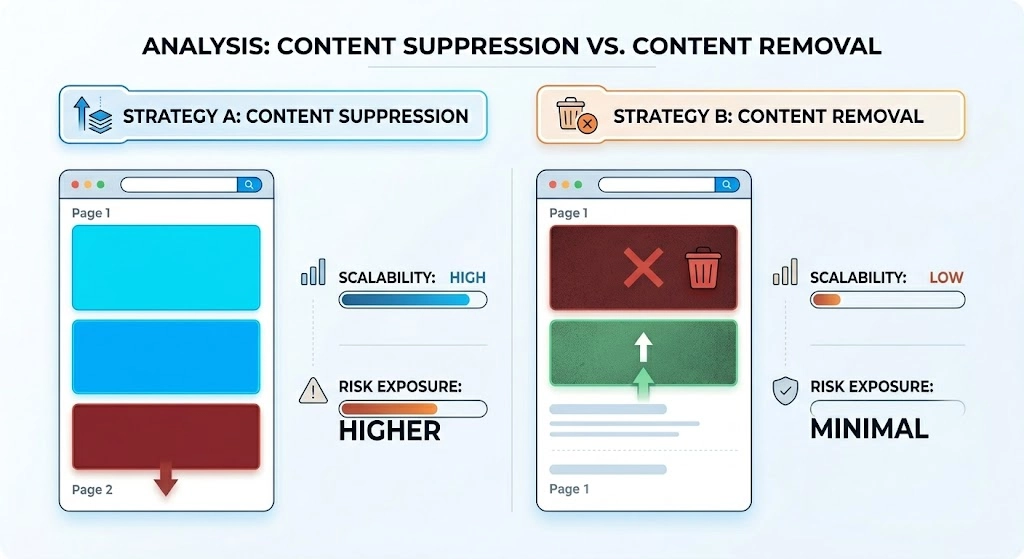
Content suppression and content removal represent the two primary mechanisms for addressing adverse search results. Content suppression is a strategic method that decreases the visibility of negative search results by optimizing and promoting positive, neutral, or owned digital assets. Content removal is the absolute eradication of negative content from the source host or the direct deindexing of specific URLs by search engines. The choice between these two approaches alters the composition of search engine result pages (SERPs) and determines the long-term sustainability of the reputation network.
Mechanisms of Search Engine Result Page Alteration
Content suppression operates by leveraging algorithmic preference for diversity, authority, and freshness in search results. By deploying highly optimized entity-focused content assets across diverse domains, suppression campaigns fill the first page of search results with controlled properties. This process forces negative URLs down to page two or three, where user click-through rates drop below one percent. Content removal operates through legal frameworks, such as the Right to Be Forgotten, copyright infringement claims, or direct terms of service violations. When a removal strategy succeeds, the target URL disappears completely from the index, causing the search engine to pull the next available relevant link into the vacant slot.
Comparative Efficacy and Risk Exposure
- Evaluate scalability: Content suppression scales across multiple keywords and search variations because it builds a broad network of digital assets. Content removal does not scale efficiently, as each negative link requires individual legal or administrative intervention.
- Analyse risk exposure: Content removal carries minimal risk of reversal once the content is deleted from the source host. Content suppression carries higher risk exposure because algorithmic fluctuations can cause suppressed negative links to regain their ranking positions unexpectedly.
- Measure resource sustainability: Suppression requires continuous content production and authority building to maintain search ranking influence over extended periods. Removal requires significant upfront legal or technical expenditure but eliminates ongoing maintenance costs for that specific asset.
Why Is Sentiment Distribution a Critical Key Performance Indicator?
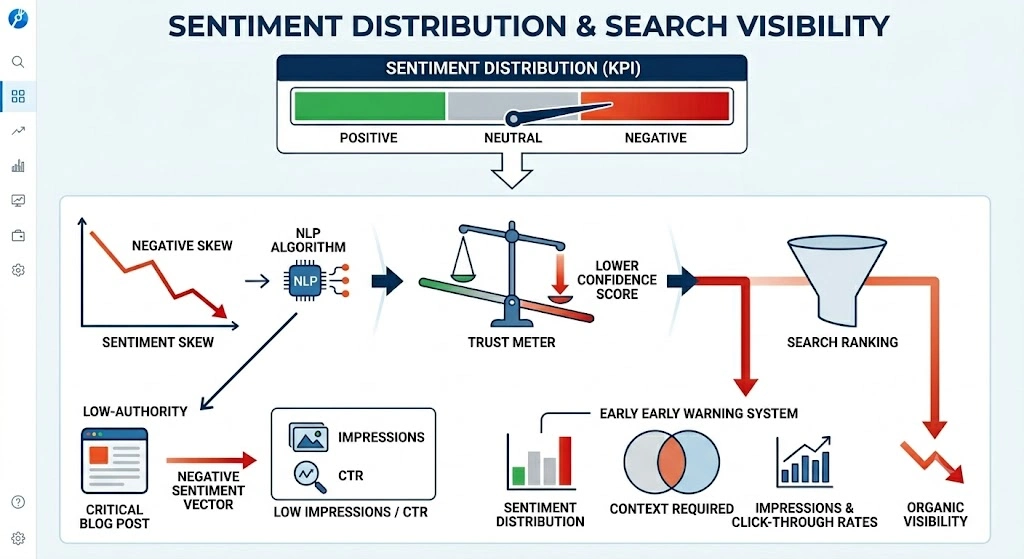
Sentiment distribution measures the mathematical ratio of positive, neutral, and negative textual references associated with an entity across the digital ecosystem. Sentiment distribution is a critical metric because it directly influences how search engines calculate entity credibility and trust signals. Algorithms utilize natural language processing to extract sentiment vectors from unstructured text, mapping these vectors to the entity’s profile within the search database. A skewed sentiment distribution heavily weighted toward negative vectors triggers algorithmic dampening, lowering the organic visibility of the brand’s primary properties.
The mechanism of sentiment analysis relies on entity-attribute pairing within digital content. Search engines identify the brand name as the primary entity and analyse the surrounding vocabulary to classify the context as supportive, critical, or objective. If multiple independent authoritative sites display negative sentiment vectors, the search engine reduces the confidence score of that entity. This lower confidence score limits the brand’s ability to rank for high-value transactional or informational keywords. Tracking sentiment distribution prevents unexpected drops in organic visibility by exposing underlying shifts in public data before those shifts alter search placements.
The limitation of sentiment distribution as a standalone KPI is its frequent lack of context regarding search volume. A highly critical blog post on a low-authority site might generate a negative sentiment vector without ever achieving search visibility. Therefore, sentiment monitoring must be cross-referenced with impressions and click-through rates to determine actual perception damage. When aligned with search data, sentiment distribution serves as an accurate early-warning indicator for potential reputation crises.
How Do Organic and Reactive Reputation Frameworks Differ in Long-Term Impact?
Organic reputation frameworks focus on continuous asset optimization, authority building, and structural trust alignment before any reputation crisis occurs. Reactive reputation frameworks initiate only after a negative event creates visible damage on search engine result pages or social communication networks. Organic methods establish a resilient digital footprint that absorbs negative sentiment without experiencing major ranking drops. Reactive methods focus on rapid crisis communication, immediate content suppression, or legal removal actions to mitigate active damage.
What Metrics Quantify Search Ranking Influence and Entity Credibility?
Quantifying search ranking influence requires tracking specific performance indicators that reflect algorithmic trust, asset strength, and query control. Entity credibility cannot be evaluated through subjective measures; it requires technical data points derived directly from search engine outputs and database structures. The following evaluation framework isolates the key metrics required to measure digital authority accurately:
- Measure Share of Search: Track the volume of branded search queries relative to direct market competitors over fixed monthly intervals. Higher share of search indicates strong market presence and reinforces entity authority within search indexing systems.
- Evaluate Domain Authority Profiles: Analyse the link profiles, trust scores, and ranking strengths of all owned and controlled digital properties. Improving domain authority across peripheral assets ensures these properties can successfully displace negative links during suppression actions.
- Track Knowledge Graph Integration: Monitor whether the entity has achieved a verified knowledge panel or explicit inclusion within search engine knowledge bases. Graph integration confirms that the search engine recognizes the company as a distinct, trusted entity independently of third-party references.
- Calculate SERP Domination Ratios: Compute the percentage of first-page search positions occupied by controlled or positive assets for primary branded keywords. Achieving a domination ratio above eighty percent minimises the probability that negative content can penetrate the first page of search results.
How Long Do Strategic Changes Take to Alter Search Perception?
The time required to alter search perception depends on search engine crawl frequencies, algorithmic indexing delays, and the technical authority of deployed assets. Deployed suppression assets do not instantly shift search engine result pages; they undergo an evaluation phase where algorithms test user engagement metrics. This evaluation period typically spans from three to twelve weeks, depending on how rapidly the new content acquires natural backlink profiles. High-authority domains reflect changes much faster than newly registered sites, which encounter indexing restrictions inside search filters.
The mechanism governing this timeline is the algorithmic freshness signal paired with query-deserves-diversity protocols. When a reputation event occurs, search engines temporarily prioritize real-time updates, forum discussions, and news articles to satisfy user demand for immediate information. As this initial search volume declines, the algorithm transitions back to historical authority signals to determine page-one placements. Proactive reputation management systems exploit this transition phase by introducing highly structured, authoritative content exactly as the real-time freshness signals begin to decay.
Long-term stabilization of search perception requires sustained content optimization for a minimum of six to twelve months. Attempts to accelerate this timeline through artificial link generation or automated content syndication run the risk of triggering algorithmic penalties. If a search engine detects unnatural patterns, it suppresses the entire network of defensive assets, leaving the negative links in prominent positions. Sustainable perception shifts rely on steady, high-quality optimization that aligns with core algorithmic guidelines.
Strategic Considerations for Reputation Monitoring Frameworks
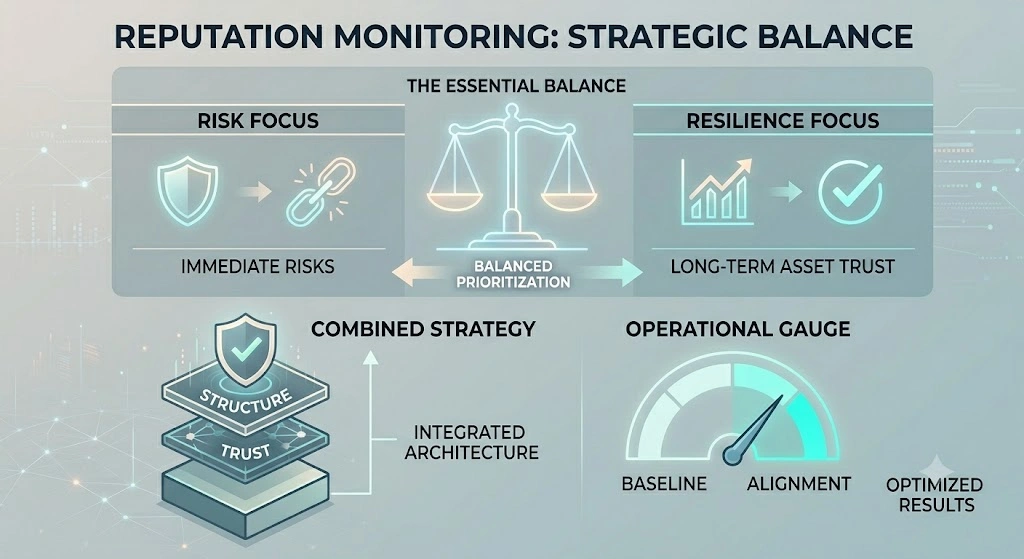
Selecting performance indicators for digital monitoring requires balancing immediate risk exposure against long-term asset resilience. Relying exclusively on immediate sentiment metrics leaves an organization vulnerable to structural changes in search engine algorithms. Conversely, focusing solely on technical domain authority can obscure emerging sentiment crises on unindexed social networks. Effective monitoring architectures combine organic visibility tracking, structured entity verification, and rigorous sentiment distribution analysis to maintain operational trust.
Organisations must establish clear baselines for each metric before deploying active suppression or removal campaigns. Understanding the normal variance in branded search volume and sentiment distribution prevents misallocating resources toward minor, temporary visibility spikes. When evaluating alternative methodologies, prioritising permanent algorithmic trust signals over temporary content placement yields superior structural stability. Selecting the appropriate metrics ensures that investments in digital assets provide measurable protection against competitive and operational threats.
When executing long-term monitoring strategies, enterprises often require advanced infrastructure to manage complex search signals. Selecting comprehensive reputation management solutions designed for modern businesses allows organizations to track entity credibility, monitor sentiment distribution shifts, and maintain search ranking influence across diverse digital touchpoints.
Frequently Asked Questions
What is the most critical metric for tracking corporate reputation health?
The most critical metric is share of search combined with sentiment distribution across authoritative platforms. Tracking these indicators allows Clear My Name to measure how often an entity is searched relative to competitors and whether the surrounding search signals are positive, neutral, or negative. This data provides an objective look at search ranking influence and overall entity credibility within the digital ecosystem.
How do search engines evaluate business reputation signals?
Search engines evaluate reputation signals by analyzing semantic context, user engagement patterns, and entity-attribute pairings across indexed web properties. Natural language processing algorithms scan third-party reviews, news articles, and digital footprints to assign an implicit confidence score to a brand. Proactive reputation management for business ensures these data points remain consistent, preventing adverse content from dominating branded search results.
What is the difference between content suppression and content removal?
Content suppression involves optimizing and promoting positive, authoritative digital assets to push negative links down to lower search result pages where visibility is minimal. Content removal is the permanent eradication of an adverse URL from the source host or through formal search engine deindexing requests. Clear My Name evaluates both approaches based on the legal status of the content, risk exposure, and long-term algorithmic sustainability.
How long does it take to see results from a business reputation strategy?
Altering search perception typically takes between three to twelve weeks for initial content indexing, while comprehensive search engine result page (SERP) stabilization requires six to twelve months. The exact timeline depends on search engine crawl frequencies, the technical authority of the deployed assets, and the velocity of new sentiment distribution metrics. Sustained content enhancement is necessary to build resilient entity credibility that withstands future algorithmic updates.
Why should a business monitor its digital footprint proactively?
Proactive monitoring establishes a secure network of owned and controlled digital properties before a reputation crisis occurs. This defensive infrastructure increases an entity’s domain authority, making it much harder for negative content or volatile sentiment shifts to penetrate page one of the search results. Implementing dedicated reputation management for business allows organizations to isolate risk exposure and maintain a stable, authoritative digital presence.