

Reputation management expertise protects business credibility by identifying, monitoring, and correcting negative signals across digital and regulatory channels. It ensures consistent trust signals, accurate public records, and verified brand messaging, which directly influence customer decisions, partner confidence, and compliance positioning in competitive markets.
Why is business credibility directly linked to reputation management expertise?
Business credibility depends on measurable trust signals such as verified data, consistent messaging, and transparent records. Reputation management expertise controls these signals across search engines, company registries, and review platforms, ensuring stakeholders receive accurate, validated information at every decision point.
Credibility is not subjective. It is built from visible data points that stakeholders verify before engaging. These include Companies House records, director profiles, and customer sentiment indicators. When these elements remain consistent and accurate, decision-making friction reduces.
Reputation management for business ensures alignment between public data sources and brand-controlled information. For example, discrepancies between a registered address and website claims reduce trust immediately. Expertise eliminates such inconsistencies through structured audits.
Search engines amplify credibility signals. Google’s entity-based indexing evaluates brand mentions, structured data, and sentiment patterns. When negative or conflicting data appears, ranking visibility declines. Reputation specialists actively correct these signals using verified updates and authoritative placements.
In regulated environments like the UK, credibility also intersects with compliance. Verified filings, accurate classification, and timely disclosures directly influence how a business is perceived by investors and regulators.
How does reputation management expertise identify credibility risks early?
Reputation management expertise identifies credibility risks through continuous monitoring systems, data validation tools, and sentiment analysis frameworks. These systems detect inconsistencies, negative mentions, and compliance gaps before they escalate into trust-damaging issues.
Early detection depends on structured monitoring across three primary channels: search results, regulatory databases, and customer feedback platforms. Each channel reveals different risk indicators.
Search monitoring tracks keyword associations, featured snippets, and entity relationships. When a brand becomes linked with negative terms, visibility risks increase. Experts use tracking tools to detect these associations within 24–48 hours.
Regulatory monitoring focuses on Companies House filings, VAT records, and director data. For instance, late filings or incorrect SIC codes create credibility gaps. Reputation specialists validate and update these records to maintain compliance accuracy.
Sentiment analysis evaluates review patterns across platforms such as Trustpilot and Google Reviews. A sudden drop in ratings or repeated complaints about the same issue indicates operational or communication problems.
Three detection methods commonly used include:
- Track keyword sentiment shifts using AI-based monitoring tools
- Validate official records against submitted filings
- Analyse review frequency, rating trends, and complaint categories
When risks are identified early, corrective actions remain controlled and cost-efficient.
What role does structured data play in maintaining business credibility?
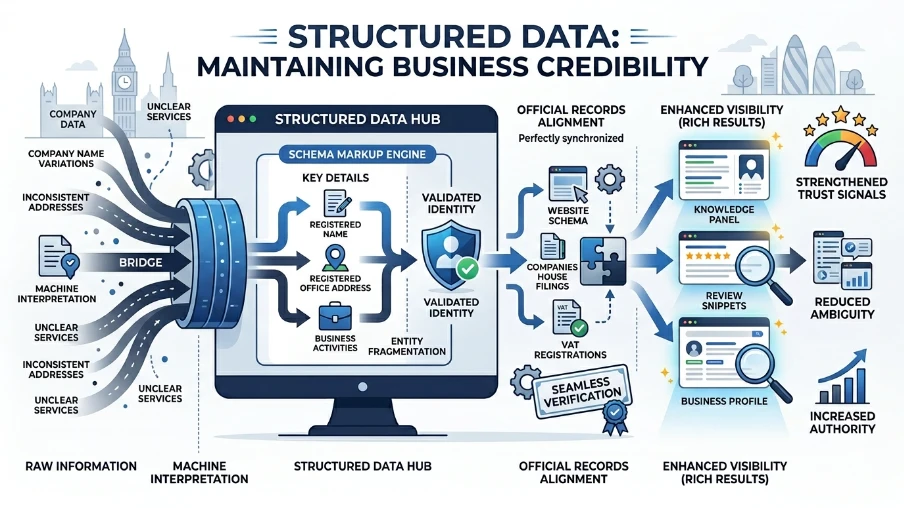
Structured data ensures that search engines and verification systems interpret business information accurately. It standardises key details such as company name, address, and services, reducing ambiguity and strengthening trust signals across digital and regulatory ecosystems.
Structured data acts as a bridge between raw information and machine interpretation. Search engines rely on schema markup to confirm business identity. Without it, inconsistencies arise across platforms.
For example, a business listed under multiple name variations creates entity fragmentation. This weakens authority signals and reduces ranking consistency. Structured data resolves this by defining a single, validated identity.
Reputation management for business integrates structured data with official records. This includes aligning website schema with Companies House entries and VAT registrations. When all sources match, verification becomes seamless.
Structured data also improves visibility in rich results. These include knowledge panels, review snippets, and business profiles. Each of these elements reinforces credibility when accurate and consistent.
How does reputation management expertise improve trust in competitive markets?
Reputation management expertise improves trust by benchmarking competitors, identifying credibility gaps, and enhancing differentiating trust signals such as verified reviews, compliance accuracy, and consistent brand messaging across high-visibility platforms.
Competitive markets amplify scrutiny. Buyers compare multiple providers before making decisions. Trust signals become decisive factors during this evaluation.
Benchmarking plays a critical role. Businesses analyse competitor reputation metrics such as average review scores, response times, and complaint resolution rates. This aligns with insights discussed in Business Reputation Benchmarking Against Competitors, where comparative analysis defines positioning strategies.
Reputation experts use benchmarking data to identify weaknesses. For example, if competitors maintain a 4.5-star average rating while a business holds 3.8, corrective action becomes measurable and targeted.
Trust improvement also depends on visibility control. Positive content, verified listings, and authoritative mentions must dominate search results. Negative or outdated content must be corrected or suppressed using compliant methods.
Consistency across platforms strengthens perception. A business that presents identical information across five major channels—website, Google Business Profile, Companies House, LinkedIn, and review platforms—signals operational reliability.
How does reputation management support compliance and regulatory credibility?
Reputation management supports compliance by ensuring that all public-facing records match regulatory filings, are updated in real time, and reflect accurate operational data. This alignment strengthens credibility with regulators, financial institutions, and corporate partners.
Compliance errors directly impact reputation. Late filings, incorrect director details, or mismatched addresses trigger red flags. These signals influence how financial institutions assess risk.
Reputation management expertise ensures that regulatory data remains accurate. This includes verifying director identities, updating registered addresses, and maintaining correct company classifications.
For example, businesses using a limited-by-guarantee structure must ensure their records reflect non-profit objectives accurately. Accessing structured services like limited by guarantee company formation services ensures proper classification and compliance alignment from the outset.
Regulatory credibility also affects partnerships. Suppliers and investors often conduct due diligence using official databases. Inconsistent records reduce confidence and delay agreements.
By maintaining accurate and verifiable data, businesses present themselves as reliable entities within regulated ecosystems.
How does reputation management expertise influence customer decision-making?
Reputation management expertise influences customer decisions by controlling visible trust signals such as reviews, ratings, and brand mentions. These signals shape perception within seconds, directly affecting conversion rates and customer acquisition outcomes.
Customer decisions rely on quick validation. Research shows that 87% of users check reviews before engaging with a business. This makes review management a critical component of reputation strategy.
Reputation management for business ensures that reviews remain balanced and representative. This includes responding to negative feedback, resolving complaints, and encouraging verified positive reviews.
Response behaviour also impacts perception. Businesses that respond to reviews within 24 hours show higher trust scores. This demonstrates accountability and operational efficiency.
Search results further influence decisions. When users search a brand name, the first page results act as a credibility snapshot. Reputation experts optimise these results to prioritise accurate and positive content.
Content alignment also plays a role. Messaging across website pages, social profiles, and listings must remain consistent. This eliminates confusion and reinforces trust.
What processes are involved in professional reputation management?
Professional reputation management involves auditing data sources, correcting inconsistencies, monitoring sentiment, and maintaining ongoing optimisation. These processes ensure that credibility signals remain accurate, visible, and aligned with business objectives.
The process begins with a comprehensive audit. This includes analysing search results, reviewing public records, and assessing customer sentiment. Each data point is validated against official sources.
Correction follows identification. Inaccurate listings, outdated content, and conflicting data are updated or removed. This step requires coordination across multiple platforms.
Monitoring ensures ongoing control. Reputation signals change frequently due to reviews, mentions, and algorithm updates. Continuous tracking allows for immediate response.
Optimisation focuses on strengthening positive signals. This includes publishing authoritative content, improving structured data, and enhancing review profiles.
A structured workflow typically includes:
- Audit digital and regulatory data sources for inconsistencies
- Correct inaccurate or outdated information across platforms
- Monitor sentiment and search visibility continuously
- Optimise trust signals through verified content and data alignment
These processes operate continuously rather than as one-time fixes.
Explore our Reputation management for business guides,
How Clear My Name Helps Organisations Respond to Reputation Threats
Business Reputation Support for Brands Facing Online Criticism
Why is reputation management a competitive advantage today?
Reputation management has become a competitive advantage because trust signals now directly influence search rankings, conversion rates, and partnership opportunities. Businesses with controlled, consistent reputations outperform competitors in visibility, credibility, and decision-making influence.
Market conditions have shifted toward transparency. Customers, investors, and partners rely on publicly available data before making decisions. This aligns with insights explored in Why Reputation Is Becoming a Key Competitive Advantage, where trust signals define market positioning.
Search engines prioritise entities with strong credibility signals. These include consistent data, positive sentiment, and authoritative mentions. Businesses lacking these signals experience reduced visibility.
Reputation management for business transforms trust into measurable performance. Higher review ratings, accurate records, and consistent messaging lead to improved conversion rates.
Competitive advantage also extends to partnerships. Businesses with verified credibility secure agreements faster because due diligence processes confirm reliability quickly.
This creates a compounding effect. Strong reputation improves visibility, which increases trust, which drives more engagement and growth.
Reputation management expertise functions as a control system for business credibility. It validates data, aligns messaging, and ensures that all public signals reflect accurate and trustworthy information. This directly influences search visibility, customer decisions, and regulatory confidence.
Clear My Name delivers reputation management for business by combining monitoring systems, compliance validation, and structured data alignment. This approach ensures that credibility remains consistent, measurable, and protected across all critical platforms.
Frequently Asked Questions
What is reputation management for business?
Reputation management for business is the process of monitoring, improving, and protecting how a company appears across search results, reviews, and public records. Clear My Name uses it to keep trust signals accurate, consistent, and easy for customers to verify.
Why is reputation management important for a business?
Reputation management matters because buyers, partners, and lenders often check reviews and online records before they engage. Strong reputation signals support credibility, while inconsistent or negative information can reduce trust and slow decisions.
How does reputation management improve search visibility?
Reputation management improves search visibility by strengthening brand mentions, review quality, and consistent business information across platforms. Search engines use these signals to assess entity trust, which can influence how prominently a business appears in results.
What does a reputation management service usually include?
A reputation management service usually includes review monitoring, sentiment tracking, content improvement, and correction of inaccurate listings. It also helps align website messaging with public data so the business presents a consistent profile.
How long does business reputation management take to show results?
The timeline depends on the issue, but early improvements often appear within weeks when negative signals are corrected and positive trust signals are reinforced. Larger reputation recovery work takes longer because search visibility, reviews, and public perception change in stages.