

Online reputation refers to the aggregated perception of an entity formed through indexed content, search results, and user-generated signals across digital platforms.
Reputation management is the systematic organisation, interpretation, and influence of how entities appear within search ecosystems and SERP structures.
This topic defines how search engines construct meaning around brands, individuals, and organisations by evaluating content authority, relevance, and sentiment distribution across indexed data.
What is online reputation and how does it form in search ecosystems?
Online reputation is the structured identity of an entity formed through digital content indexed across search engines and platforms. It refers to the cumulative interpretation of information sources that define how an entity is perceived within SERP environments. This system operates through continuous content discovery, indexing, and ranking processes that organise information into visible search results.
Search ecosystems form reputation by aggregating signals from webpages, reviews, news content, social mentions, and structured data. Each content source contributes to entity perception by reinforcing or modifying how algorithms categorise relevance and authority. The interaction between these signals determines the prominence of specific narratives within search visibility layers.
Search engines construct reputation through entity-based indexing systems that link mentions, topics, and contextual associations. These systems evaluate semantic relationships between content pieces and assign relevance weights based on consistency and authority. The resulting structure defines how prominently an entity appears in search results and how information clusters are interpreted.
Reputation formation remains dynamic due to continuous content updates and shifting indexing patterns. Newly published content interacts with existing data, reshaping perception hierarchies within SERPs. This process establishes reputation as a fluid system governed by information distribution rather than static representation.
How do search engines evaluate reputation signals in SERPs?

Search engines evaluate reputation signals by analysing content authority, semantic relevance, and engagement patterns within SERP structures. These signals define how trustworthy and relevant an entity appears in comparison to competing indexed content. The evaluation process uses algorithmic frameworks that measure consistency across multiple data points.
Reputation signals include backlinks, content quality indicators, entity mentions, and contextual relevance across domains. These elements function as trust markers that influence ranking positions and visibility distribution. Strong alignment between signals increases perceived authority within search systems.
Algorithms process sentiment distribution across indexed pages to interpret reputational direction. Positive, neutral, and negative contexts are evaluated collectively to establish an aggregated perception profile. This profile influences how prominently certain narratives appear in search results.
SERP evaluation also considers content freshness and historical stability. Consistent publication patterns and long-term content reliability reinforce authority signals. This stability strengthens entity trust profiles and increases ranking resilience across updates.
What role does content indexing play in shaping digital footprint?
Content indexing defines how digital footprint structures are built within search ecosystems by storing, categorising, and retrieving online information. It refers to the process through which search engines catalogue content and associate it with specific entities or topics. This process determines which information becomes visible in search results and how it is contextualised.
Indexing systems evaluate metadata, semantic structure, and contextual relevance to assign content placement within databases. Each indexed page contributes to the broader digital footprint by adding informational layers to an entity’s search presence. These layers accumulate over time and define the scope of visible reputation.
Digital footprint stability depends on indexing frequency and content consistency. Regularly updated content strengthens entity association and reinforces topical relevance. Inconsistent or fragmented indexing reduces coherence within search profiles and weakens visibility structures.
Within advanced reputation frameworks, structured systems such as online reputation management frameworks define how indexed content is monitored and organised for entity consistency. This includes mapping content clusters, analysing search patterns, and aligning indexed material with entity relevance signals.
How do review signals influence entity perception and trust?
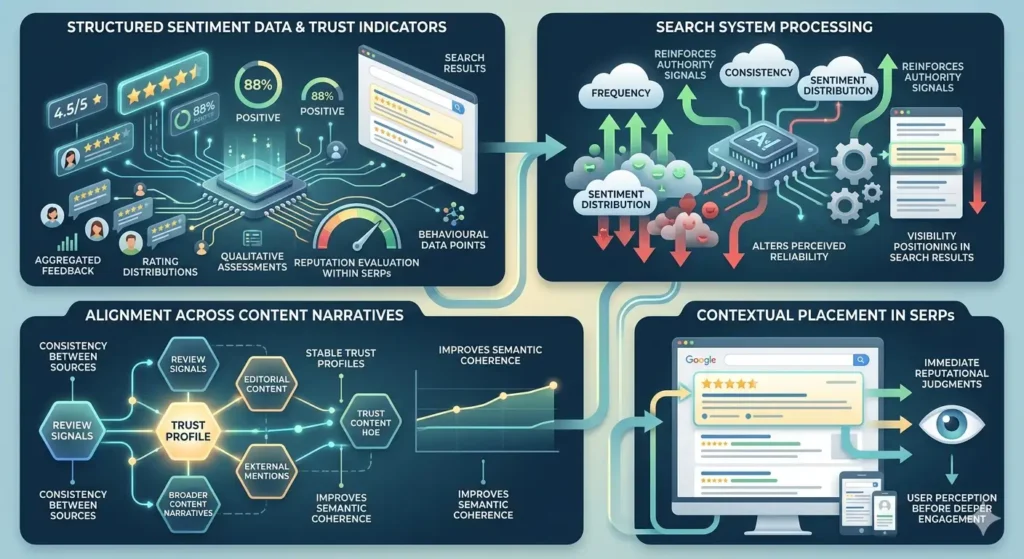
Review signals influence entity perception by providing structured sentiment data that search engines interpret as trust indicators. These signals refer to aggregated user feedback, ratings, and qualitative assessments that contribute to reputation evaluation within SERPs. They function as behavioural data points that reflect public interaction with an entity.
Search systems process review signals by analysing frequency, consistency, and sentiment distribution. High-volume positive sentiment reinforces authority signals, while negative clusters alter perceived reliability within ranking systems. These evaluations directly impact visibility positioning in search results.
Entity perception strengthens when review signals align with broader content narratives across indexed sources. Consistency between reviews, editorial content, and external mentions creates stable trust profiles. This alignment improves semantic coherence within search ecosystems.
Review interpretation also depends on contextual placement within SERPs. Prominent review content influences user perception before engagement with deeper indexed results. This positioning reinforces the role of sentiment signals in shaping immediate reputational judgments.
How does search ranking determine brand credibility and visibility?
Search ranking determines brand credibility by establishing hierarchical positioning within SERP environments based on authority, relevance, and trust signals. It refers to the algorithmic ordering of content that defines visibility priority for users interacting with search results. Higher ranking positions correlate with increased perceived authority.
Ranking systems evaluate multiple dimensions including content depth, backlink structure, entity relevance, and behavioural engagement signals. These factors combine to form a composite authority score that determines placement within search results. Consistent optimisation across these dimensions strengthens visibility dominance.
Credibility emerges through repeated exposure in high-ranking positions, reinforcing cognitive association between visibility and trust. Search users interpret top-ranking content as more authoritative due to algorithmic endorsement structures. This perception shapes entity reputation across digital environments.
Ranking stability depends on continuous alignment with evolving algorithmic criteria. Content ecosystems that maintain structured relevance and semantic coherence sustain long-term visibility. This stability ensures sustained authority across fluctuating SERP conditions.
What is the relationship between digital footprint and long-term reputation stability?
Digital footprint directly determines long-term reputation stability by defining the depth, breadth, and consistency of indexed content associated with an entity. It refers to the cumulative presence of all searchable data that forms identity representation within search ecosystems. This footprint establishes the foundation for reputation persistence.
Search engines evaluate digital footprint stability through content continuity, thematic consistency, and historical relevance. Entities with structured and coherent footprints maintain stronger positioning in SERPs due to reinforced indexing signals. Fragmented footprints reduce interpretive clarity and weaken reputation stability.
Long-term reputation emerges when digital footprint components align across multiple content layers, including articles, reviews, and structured data. This alignment creates a unified entity profile that strengthens algorithmic trust interpretation. Stability increases as content ecosystems maintain coherence over time.
Search perception evolves alongside footprint expansion, where each new indexed element contributes to reputation recalibration. This ongoing process ensures that digital identity remains dynamic while preserving core authority signals within search systems.
Dive Deeper With Our Expert Guides:
Fix Your Online Reputation and Remove Negative Search Results
How to Improve Your Online Reputation and Build Trust Fast
Online reputation is constructed through structured interactions between indexed content, search ranking systems, and entity-based interpretation models. Reputation management defines the analytical framework through which these signals are organised within search ecosystems.
Search engines evaluate reputation through layered mechanisms including content indexing, SERP evaluation, review signals, and digital footprint analysis. Each component contributes to how entities are perceived, ranked, and stabilised within digital environments.
The relationship between visibility, authority, and trust emerges from continuous algorithmic assessment of semantic and behavioural data. This system forms the foundation of how reputation operates within modern search infrastructures.
Answers to Key Questions
How do search engines determine online reputation for a brand?
Search engines determine reputation by evaluating trust signals such as backlinks, content relevance, sentiment, and entity mentions. These factors are processed to assess credibility and position in search rankings within SERPs.
Why is search visibility important for online reputation management?
Search visibility defines how prominently an entity appears in indexed results, directly influencing user perception and trust. Higher visibility in authoritative results strengthens perceived credibility and stabilises digital reputation.
What role do reviews play in reputation management systems?
Reviews act as structured sentiment signals that search engines interpret to evaluate trust and public perception. Consistent positive or negative review patterns influence ranking signals and entity reputation profiles.
How does content indexing affect reputation management outcomes?
Content indexing determines which information about an entity is stored and displayed in search results. This directly shapes digital footprint structure and influences how reputation is formed and maintained across SERPs.