

Professional reputation management for lawyers improves search visibility by strengthening relevant reputation signals, addressing harmful information, and presenting a more consistent digital identity. Clear search perception gives prospective clients stronger evidence when evaluating legal expertise, credibility, and suitability for referral.
Why is reputation management for lawyers a strategic investment?
Reputation management for lawyers is a strategic investment because search results form a significant part of the information environment used to evaluate professional credibility. Prospective clients often research a solicitor or legal practice before making contact, comparing websites, reviews, professional profiles, publications, and other indexed information. A reputation management service analyses this environment to identify which signals influence entity credibility and public perception. The process then prioritises actions that strengthen relevant information while addressing reputation risks. This creates a structured connection between search visibility, trust signals, and referral decisions.
The value of reputation management extends beyond removing an individual negative result. Search perception depends on the overall composition of the search engine results page (SERP), including authoritative content, professional information, reviews, third-party references, and potentially harmful material. A professional approach evaluates these elements as an interconnected reputation system. This makes reputation management a long-term digital trust function rather than a single-content intervention.
How does a professional reputation management service improve search perception?
A professional reputation management service improves search perception by analysing the existing SERP environment and developing actions around the strongest reputation risks and opportunities. The process begins with identifying the information associated with the legal entity across search engines and relevant digital sources. Analysts then assess content visibility, source authority, sentiment, relevance, accuracy, and the relationship between individual results and the entity. This evaluation establishes which reputation signals require strengthening, suppression, correction, or monitoring. The result is a defined strategy based on the actual search environment rather than assumptions about reputation.
The service also distinguishes between content suppression and content enhancement. Negative content suppression addresses specific harmful or inaccurate information through appropriate and legitimate mechanisms where available. Content enhancement strengthens relevant authoritative resources so that search engines have additional high-quality information to evaluate. This combination supports a broader approach to SERP control than relying exclusively on removal.
For legal professionals considering a service, understanding professional reputation management for lawyers provides useful context on how reputation analysis connects search visibility with professional credibility.
Which reputation management approach delivers measurable results?
A combined approach delivers the strongest basis for measurable reputation improvement because it addresses both problematic information and the wider digital footprint. Negative content suppression focuses on reducing the visibility or impact of specific reputation risks, while content development strengthens relevant information associated with the legal entity. Each approach has a different mechanism and measurement framework. Suppression can be assessed through changes in the visibility of targeted results, while enhancement can be assessed through the prominence and relevance of authoritative content. Evaluating both provides a clearer picture of SERP control.
A robust reputation process can measure outcomes across defined indicators:
- Analyse search visibility by tracking the prominence and composition of relevant results for priority reputation queries.
- Evaluate sentiment distribution by monitoring the balance and context of positive, neutral, and negative reputation signals.
- Measure entity credibility by assessing the consistency and authority of information associated with the legal professional.
- Monitor SERP composition by comparing changes in the types of content occupying prominent search positions.
- Review reputation stability by assessing whether improvements remain consistent across subsequent monitoring periods.
These measurements provide a more meaningful assessment than relying on a single ranking position. Search algorithms continuously evaluate indexed information, so sustainable reputation management requires ongoing analysis rather than a one-time ranking adjustment.
How does negative content suppression reduce reputation risk?
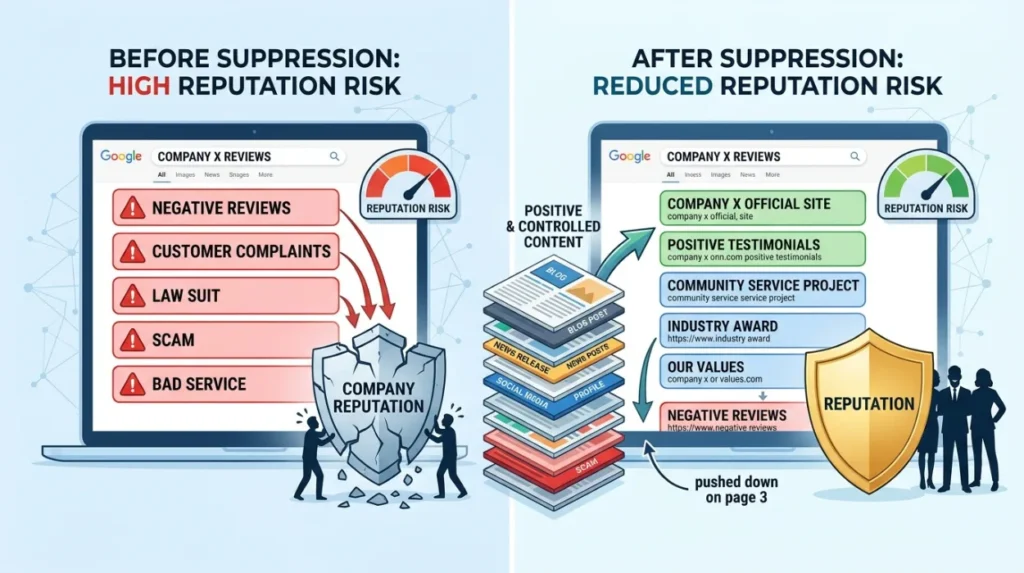
Negative content suppression reduces reputation risk by addressing specific search results that create disproportionate visibility or inaccurate perceptions. The first stage is identifying the source, nature, context, and search prominence of the problematic content. The next stage evaluates the legitimate options available, which depend on content ownership, factual accuracy, platform policies, legal circumstances, and technical conditions. Where direct removal is unavailable, reputation strategies can focus on strengthening more relevant and authoritative information. This creates a controlled process for reducing the prominence of harmful search signals without relying on arbitrary deletion.
Suppression is particularly relevant when one result dominates the first page for a professional name or legal practice. Search users encounter prominent results before lower-ranked information, giving highly visible content greater influence over initial perception. Reducing the prominence of an inappropriate result therefore changes the informational environment presented to users. However, suppression is not equivalent to erasing information from the internet. A reliable service evaluates the actual source and applies the appropriate intervention instead of promising universal removal.
How does content enhancement restore trust and entity credibility?
Content enhancement restores trust by increasing the availability of authoritative, relevant, and accurate information connected to the legal entity. Search engines evaluate indexed content according to relevance, quality, authority, and other ranking signals, meaning strategically relevant content provides additional information for search systems to process. Strong content also gives prospective clients a reliable source for understanding legal expertise and professional identity. This strengthens the relationship between search visibility and entity credibility. The approach becomes particularly valuable when existing search results contain insufficient authoritative information rather than exclusively negative information.
Content enhancement also creates greater control over the narrative surrounding professional expertise. Publishing useful information about relevant legal subjects establishes clearer topical associations between the professional entity and areas of practice. Accurate biographies, professional profiles, legal commentary, and authoritative references contribute additional reputation signals. The resulting digital footprint gives users more information with which to evaluate credibility.
Clear My Name applies this principle within a structured reputation management process by treating search perception as an information ecosystem rather than a single ranking problem. The objective is to strengthen the quality and relevance of information surrounding the entity while addressing identifiable reputation risks.
Dive Deeper With Our Expert Guides:
Build a Five-Star Reputation for Your Law Firm
Ongoing Reputation Management for Growing Law Firms
How quickly can reputation management improve search visibility?
The speed of reputation improvement depends on the type of information involved, the source of the content, search engine indexing, ranking dynamics, and the intervention selected. Direct corrections or legitimate removals have different timelines from content development and organic search visibility improvements. A third-party webpage also operates under different conditions from content controlled by the legal professional. Consequently, a reliable process measures progress according to defined search and reputation indicators rather than promising an identical timeframe for every case.
Search engines require time to discover, index, evaluate, and rank new or modified information. Content enhancement therefore involves an indexing and ranking cycle before its full search visibility becomes measurable. Suppression also depends on the response of the relevant platform or source and subsequent changes in search results.
Speed must therefore be evaluated alongside sustainability. A rapid change that depends on a temporary ranking movement provides less strategic value than an improvement supported by stronger authority and consistent reputation signals. Decision-making should consider both the immediate reputation risk and the durability of the intended outcome.
Is reputation management cost-effective for legal professionals?
Reputation management becomes cost-effective when the value of improved trust and reduced reputation risk is evaluated against the potential consequences of an uncontrolled search environment. Legal services depend heavily on professional credibility, making search perception particularly relevant when prospective clients compare unfamiliar professionals. A prominent inaccurate or damaging result can affect the information available during this evaluation stage. Managing the underlying search environment provides a structured method for reducing that exposure.
Cost evaluation also depends on the complexity of the reputation problem. A limited issue involving one inaccurate source requires a different level of analysis from a digital footprint containing conflicting profiles, negative reviews, multiple harmful results, or weak authoritative content. A transparent service therefore begins with assessment rather than applying the same process to every professional.
Long-term value comes from building a more resilient reputation system. Accurate professional information, relevant authoritative content, review monitoring, and regular SERP evaluation create an ongoing framework for maintaining search perception. This reduces dependence on emergency interventions when a reputation problem becomes highly visible.
What process does reputation management for lawyers follow?
A structured reputation management process improves reliability because every intervention is connected to a defined diagnostic stage. The process identifies the reputation environment first and then selects actions according to source, visibility, relevance, and risk. This prevents isolated tactics from being applied without understanding their effect on the wider SERP.
A professional process typically follows these stages:
- Audit the digital footprint by identifying indexed pages, reviews, profiles, publications, references, and reputation-sensitive search results associated with the legal entity.
- Evaluate reputation signals by assessing authority, relevance, sentiment, accuracy, visibility, and potential influence on professional perception.
- Prioritise reputation risks by identifying the results and information sources with the greatest visibility or potential impact on entity credibility.
- Apply appropriate interventions by using legitimate correction, removal, suppression, content enhancement, or reputation development methods according to the source.
- Monitor SERP changes by tracking search visibility, content indexing, ranking movement, sentiment distribution, and changes in the overall search environment.
- Stabilise the digital footprint by maintaining accurate information and developing relevant authoritative content that supports consistent entity perception.
This process creates accountability at each stage. It also provides measurable checkpoints for determining whether an intervention is changing search visibility and reputation signals in the intended direction.
How does reputation management support legal client referrals?
Reputation management supports legal client referrals by improving the information environment prospective clients use before contacting a legal professional. Search visibility introduces the professional to potential clients, while reputation signals help those users evaluate credibility and expertise. Reviews provide external experiences, authoritative content demonstrates knowledge, and consistent professional information establishes identity. When these signals work together, the search environment provides clearer evidence for decision-making. Reputation management therefore supports the conditions surrounding a referral rather than treating rankings as a direct guarantee of referrals.
The relationship becomes clearer when reputation management is viewed alongside the underlying search behaviour. Prospective clients often compare multiple sources before selecting a professional. They evaluate professional information, search results, reviews, expertise, and perceived trustworthiness as part of the research process. A coherent digital reputation reduces uncertainty within this evaluation by presenting consistent and relevant information.
For a deeper understanding of this relationship, the earlier analysis of how digital reputation influences legal referrals explains how search visibility, reviews, authority, and entity perception interact during the client research process.
How does Clear My Name approach reputation management for lawyers?
Clear My Name approaches reputation management by focusing on the relationship between search visibility, reputation signals, and professional perception. The process is designed around assessment of the existing digital footprint before determining which reputation interventions have the strongest relevance. This provides a structured basis for identifying harmful content, weak authority signals, inconsistent information, and opportunities for content enhancement. The emphasis remains on measurable search conditions rather than unsupported promises of universal removal or guaranteed rankings.
The approach also recognises that legal reputation requires sustained monitoring. Search engines continuously process new and existing information, while reviews and third-party references can change the visible reputation environment. Ongoing evaluation therefore helps identify changes in SERP composition and reputation signals. This creates a more reliable framework for maintaining search perception over time.
The strategic objective is to create greater clarity around professional identity and expertise while reducing identifiable reputation risks. This connects reputation management with the wider referral journey, where search visibility and trust influence how potential clients evaluate legal professionals.
How should legal professionals evaluate a reputation management provider?
Legal professionals can evaluate a reputation management provider by examining process transparency, measurement criteria, risk controls, and the distinction between legitimate reputation improvement and unsupported promises. A credible provider explains how reputation signals are assessed, which interventions are available, and how progress is measured. Clear reporting should distinguish ranking changes from broader improvements in search perception and entity credibility. The evaluation should also establish how third-party content, reviews, inaccurate information, and new reputation risks are handled.
A reliable service provides clarity about limitations. Search engines control organic rankings, third-party websites control their own content, and removal depends on the specific source and circumstances. Transparent expectations therefore represent an important trust signal. Providers that explain these constraints allow legal professionals to evaluate the service according to realistic outcomes.
This evaluation also connects with reputation strategies for generating more client referrals, which examines how content enhancement, suppression, organic reputation development, and reactive approaches compare before a decision is made.
What outcomes can a legal reputation management service deliver?
A professional reputation management service can deliver measurable improvements in the quality, relevance, consistency, and visibility of information surrounding a legal entity. The precise outcome depends on the initial reputation environment, available interventions, search engine behaviour, and the authority of competing information. Meaningful measurement therefore focuses on defined indicators rather than guaranteed ranking positions.
Key outcome areas include:
- Improve search visibility by strengthening relevant authoritative information within the target SERP environment.
- Reduce reputation risk by addressing inaccurate, harmful, or disproportionately visible content through appropriate mechanisms.
- Strengthen entity credibility by improving consistency across professional profiles, authoritative content, and external references.
- Increase SERP control by developing a stronger and more coherent collection of relevant indexed information.
- Stabilise perception by maintaining accurate information and monitoring changes in reviews, rankings, sentiment, and search results.
These outcomes work together to create a stronger digital trust environment. Improved visibility without credibility provides limited value, while credible information that remains difficult to discover has restricted impact. Effective reputation management therefore evaluates visibility, trust, control, and sustainability as connected outcomes.
Why choose a structured reputation solution instead of managing reputation alone?
A structured reputation solution provides specialist analysis of search ecosystems, reputation signals, content visibility, and entity perception that is difficult to evaluate through occasional manual searches. Reputation problems often involve multiple sources and different types of information, each requiring a distinct response. A structured process creates consistent monitoring and prioritisation rather than relying on individual search-result observations. It also separates legitimate reputation interventions from tactics that create unnecessary risk. This provides greater process clarity when reputation directly affects professional credibility.
Independent management can still provide basic monitoring, particularly where the digital footprint is limited. However, complex reputation environments require analysis of ranking dynamics, source authority, content indexing, sentiment distribution, and SERP composition. The value of specialist management therefore increases with the complexity and visibility of the reputation issue.
The decision ultimately rests on risk, control, and sustainability. Legal professionals whose search results already influence prospective client evaluation benefit from understanding what information is visible, how it is interpreted, and which interventions can legitimately improve that environment. A structured service converts this analysis into an ongoing reputation management process.
Can reputation management turn search visibility into stronger legal referrals?
Reputation management creates stronger conditions for legal referrals by improving the information prospective clients encounter during professional evaluation. The process combines SERP analysis, negative content suppression, content enhancement, reputation monitoring, and digital footprint optimisation to strengthen search perception and reduce identifiable reputation risks.
Clear My Name positions its approach around process clarity, measurable reputation signals, and sustainable search perception rather than unsupported ranking guarantees. By analysing the existing SERP environment before selecting interventions, the strategy connects reputation risk with specific actions and measurable outcomes.
The underlying principle is straightforward: professional credibility depends not only on expertise but also on how that expertise is represented across the digital ecosystem. A controlled, accurate, and authoritative search environment gives prospective clients clearer evidence when evaluating a legal professional. Reputation management therefore serves as a structured method for strengthening digital trust, stabilising entity perception, and supporting the conditions that lead to stronger legal referrals.
How does reputation management help lawyers get more referrals?
Reputation management for lawyers improves the information potential clients see when researching legal professionals online. Stronger search visibility, credible content, consistent profiles, and reliable reputation signals support informed referral decisions.
What does reputation management for lawyers include?
Reputation management for lawyers can include SERP monitoring, digital footprint analysis, review management, content enhancement, and appropriate negative content suppression. The process focuses on improving search perception while reducing identifiable reputation risks.
Can reputation management remove negative content from Google?
Negative content can sometimes be removed when a legitimate removal or correction mechanism applies, but removal is not guaranteed for every result. Where removal is unavailable, content enhancement and search perception strategies can address the prominence of harmful information.
How long does it take for reputation management to improve search results?
The timeframe depends on the content source, search engine indexing, ranking dynamics, and the intervention used. Content enhancement generally requires time for indexing and ranking, while corrections or legitimate removals follow the relevant source or platform process.
Is reputation management worth it for law firms?
Reputation management can provide value when search results significantly influence how prospective clients evaluate a law firm or lawyer. Improving search visibility, entity credibility, and information consistency helps create a clearer digital reputation during the client research process.