

A five-star reputation for a law firm requires consistent search visibility, authentic reputation signals and accurate control of how the legal entity appears online.
Reputation management for lawyers provides a structured process for improving search perception, strengthening entity credibility and reducing reputational risk.
Why does a law firm need professional reputation management?
Professional reputation management gives law firms a structured method for controlling how their digital identity appears across search ecosystems. Searchers frequently evaluate legal professionals through reviews, professional profiles, website pages and search engine results pages before making contact. These information sources create reputation signals that influence perceived credibility and professional suitability. A fragmented or negative search environment therefore creates a measurable barrier between a law firm and prospective clients.
Reputation management operates by analysing the existing digital footprint and identifying the information that shapes search perception. The process evaluates branded search results, review sentiment, indexed content, professional references and competing reputation signals. This establishes which elements require enhancement, monitoring or legitimate suppression. The objective is not to manufacture a reputation but to create a more accurate and credible representation of the legal entity.
For law firms, this process becomes particularly important because professional credibility is closely connected to trust. A prospective client encountering inconsistent information or prominent negative content receives a different perception from one encountering authoritative content, accurate profiles and authentic positive feedback. Search visibility control therefore influences the information available during the decision-making process. A structured reputation strategy strengthens the relationship between search presence, entity credibility and client confidence.
Which reputation management approach delivers measurable results?
A structured combination of content enhancement, reputation monitoring, review management and legitimate negative content suppression delivers the strongest decision-stage value. Each method addresses a different component of the search environment rather than attempting to solve reputation problems through a single action. Content enhancement strengthens relevant information, while monitoring identifies changes in SERP composition. Review management provides insight into sentiment distribution, and legitimate suppression addresses content that qualifies for removal or reduced visibility.
Clear My Name uses reputation analysis to identify the specific signals influencing a law firm’s search perception before defining an appropriate strategy. This approach prevents generic reputation activity from being applied to unrelated problems. The process evaluates the relationship between negative results, authoritative content, review profiles and the entity’s wider digital footprint. Strategy selection therefore follows evidence from the search environment rather than assumptions about what produces reputation improvement.
The measurable outcome is improved control over the information surrounding the legal entity. Search position itself is only one performance indicator because reputation management also evaluates content visibility, sentiment distribution and consistency of professional information. A stronger SERP composition creates a more coherent representation of the law firm. This provides prospective clients with clearer information when evaluating professional credibility.
How does reputation management improve search visibility for law firms?
Reputation management improves search visibility by strengthening relevant content and increasing the amount of credible information associated with the legal entity. Search engines evaluate indexed pages according to relevance, quality, authority and relationships between entities and topics. A law firm’s digital presence therefore develops through multiple connected pages rather than a single website location. Improving the surrounding information environment creates stronger contextual signals for search evaluation.
Content enhancement operates by developing authoritative pages around relevant legal subjects, professional expertise and entity attributes. These pages provide search engines with additional information through which the law firm can be understood. Consistent internal relationships between topics, services and professional information strengthen semantic clarity. The result is a more structured digital footprint that supports search visibility across relevant queries.
Reputation management also addresses the visibility of unfavourable content through legitimate mechanisms. Negative content suppression refers to reducing the prominence of qualifying negative information through appropriate removal processes or by strengthening competing relevant content. It does not involve manipulating search engine systems or eliminating legitimate criticism without a valid basis. This distinction protects the long-term reliability of the strategy while improving the composition of visible search results.
Law firms evaluating this process can first understand the broader mechanisms through how lawyers build online reputation, including the role of reviews, authority, digital footprint and SERP evaluation.
Can reputation management restore trust after negative search results?
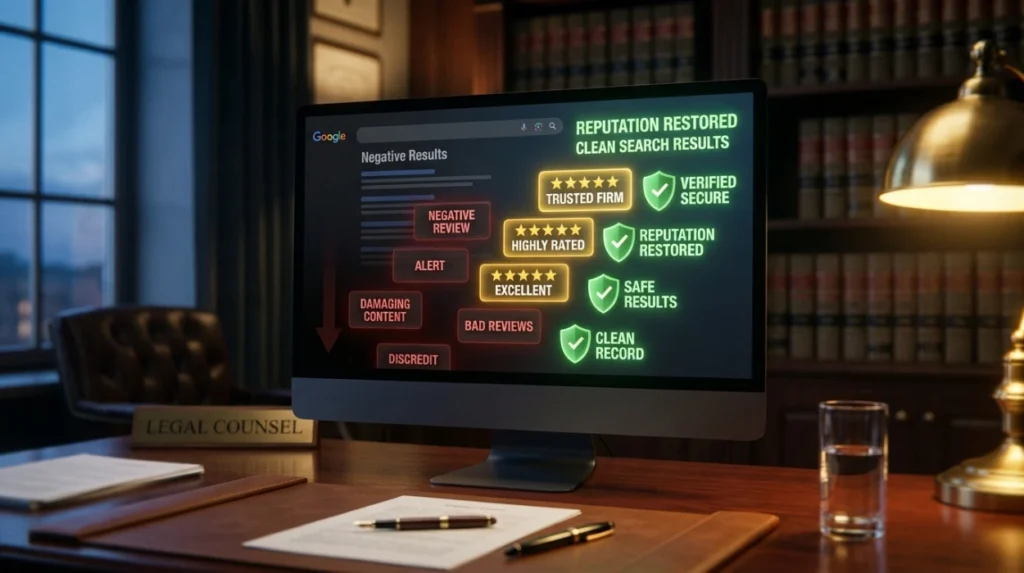
Reputation management can strengthen trust perception by improving the balance and accuracy of information visible around a legal entity. Trust restoration depends on replacing an incomplete or disproportionately negative search representation with credible, relevant and authentic information. The process begins by identifying the source, prominence and context of negative reputation signals. It then establishes which information requires correction, enhancement, monitoring or legitimate removal.
Search perception influence operates through repeated exposure to information. A prospective client who repeatedly encounters accurate professional information, authoritative legal content and authentic reviews receives a broader representation of the firm. This does not erase legitimate criticism, but it prevents one isolated information source from defining the entire entity. The resulting search environment provides greater informational context for decision-making.
Trust restoration also requires consistency between controlled and external information. A law firm’s website cannot establish strong credibility if external profiles contain contradictory professional information. Similarly, positive reviews provide limited contextual value when core entity information remains inaccurate. Reputation management therefore evaluates the entire information network rather than treating individual pages as independent assets.
Clear My Name positions this process around evidence-based reputation analysis, allowing the strategy to focus on the actual search environment surrounding the law firm. The emphasis remains on improving the quality and consistency of reputation signals rather than producing artificial perceptions. This creates a clearer connection between reputation activity and measurable search outcomes.
How important are reviews when building a five-star legal reputation?
Reviews are significant because they provide user-generated reputation signals that communicate experience and sentiment. A numerical rating summarises aggregated feedback, while written reviews provide contextual information about communication, professionalism and service experiences. Searchers use these signals alongside professional content and profiles when evaluating a legal practice. Reviews therefore contribute to both reputation perception and decision-stage confidence.
Ethical review generation focuses on obtaining genuine feedback without directing clients towards predetermined ratings. Neutral requests provide eligible clients with an opportunity to describe their experience without manipulating sentiment distribution. This creates more reliable reputation data than selective or incentivised review practices. Authenticity also reduces the regulatory and platform risks associated with artificial reputation signals.
Review management extends beyond collecting positive feedback. Monitoring identifies recurring sentiment themes, changes in rating patterns and emerging reputation risks. Responses also provide an opportunity to demonstrate professionalism while maintaining confidentiality and appropriate legal standards. A complete review strategy therefore evaluates collection, sentiment, monitoring and response as connected components.
For firms comparing review approaches before implementation, ethical review generation strategies provide useful consideration-stage analysis of authenticity, scalability, risk and sustainability.
Is reputation management worth the cost for a law firm?
Reputation management creates long-term value when the cost is evaluated against the commercial and reputational impact of persistent negative search perception. A single prominent negative result can remain visible across branded searches and influence prospective clients repeatedly. Correcting the underlying information environment therefore addresses an ongoing digital asset rather than a one-time marketing issue. The financial evaluation depends on the scale, persistence and visibility of the reputation problem.
Cost also reflects the complexity of the required intervention. Monitoring a stable search environment requires a different level of activity from managing negative indexed content, inconsistent profiles and significant review issues. A defined assessment establishes the actual reputation workload before resources are allocated. This improves cost transparency and reduces unnecessary activity.
The long-term value comes from creating a sustainable information structure. High-quality content can continue generating search visibility after publication, while accurate profiles remain useful across relevant queries. Authentic reviews contribute ongoing reputation evidence as new client experiences are recorded. These cumulative assets reduce dependence on short-term reputation interventions.
A professional reputation management process therefore evaluates cost against visibility, credibility, risk exposure and sustainability rather than against an isolated ranking metric. This provides a more accurate basis for deciding whether intervention is commercially justified.
Dive Deeper With Our Expert Guides:
Ongoing Reputation Management for Growing Law Firms
Remove Harmful Content from Your Lawyer Profile
How quickly can a law firm see reputation management results?
Reputation management produces results according to the type of reputation issue, the amount of indexed information and the scale of required search changes. Technical corrections and accurate profile updates can influence information consistency more quickly than broader content enhancement. Content development requires creation, indexing and ranking before its search visibility becomes established. Negative content suppression also depends on the validity of the removal basis and the relevant platform or search process.
The first measurable indicators often involve changes in indexed content, search result composition and information consistency. Longer-term indicators include improved visibility of authoritative pages, stronger entity associations and changes in sentiment distribution. Separating these stages prevents unrealistic expectations about immediate reputation transformation. A reliable process measures progress through defined reputation signals rather than promising instant results.
Speed also depends on the competitive search environment. Highly competitive legal queries contain established pages with significant authority and historical relevance. New content therefore requires stronger contextual alignment and sufficient authority to compete for prominent positions. Reputation management remains effective when progress is measured against the specific search landscape surrounding the law firm.
How does professional reputation management reduce legal reputation risk?
Professional reputation management reduces risk through continuous monitoring, evidence-based intervention and controlled communication. Monitoring identifies new reviews, inaccurate information, negative content and changes in branded SERPs before they become overlooked components of the digital footprint. Analysis then determines whether the information represents a legitimate reputation issue or simply normal search variation. This distinction prevents unnecessary intervention.
Risk reduction also depends on ethical boundaries. Artificial reviews, deceptive content, misleading claims and improper removal attempts create additional exposure instead of solving the underlying reputation problem. A professional process therefore prioritises authentic reputation signals and legitimate content management mechanisms. This protects the credibility of the entity while addressing search perception concerns.
Process clarity provides another layer of risk control. Each action can be linked to a defined reputation signal, search result or information-quality issue. This makes it possible to evaluate why an intervention was selected and whether it produced the intended effect. Reputation management consequently becomes an accountable process rather than an undefined attempt to influence public perception.
What process provides the most reliable reputation management for lawyers?
A reliable process begins with a reputation audit, followed by strategy development, implementation, monitoring and outcome evaluation. The audit establishes the current SERP composition, review environment, indexed content and entity information. Strategy development then separates content enhancement, review management, correction and legitimate suppression requirements. Implementation applies only the methods relevant to the identified reputation risks.
The core process includes:
- Audit branded search results to identify negative content, inconsistent information and prominent reputation signals affecting entity credibility.
- Analyse reviews and indexed content to identify sentiment patterns, recurring themes and information gaps within the digital footprint.
- Strengthen authoritative content to establish relevant expertise signals and improve the contextual information available to search engines.
- Correct inaccurate professional information across relevant digital sources to improve entity consistency and reduce conflicting signals.
- Monitor SERP composition and reputation changes to identify shifts in content visibility, sentiment and search perception.
- Evaluate outcomes against defined indicators such as search visibility, content prominence, information consistency and reputation signal quality.
This process provides measurable checkpoints throughout the reputation lifecycle. It also separates activity from outcomes, allowing the effectiveness of each intervention to be evaluated independently. The result is stronger process transparency and clearer risk management.
Why is Clear My Name a suitable solution for legal reputation management?
Clear My Name provides a structured reputation management approach centred on search perception, reputation signals and digital information quality. The service model connects reputation analysis with targeted interventions rather than applying identical tactics to every legal practice. This supports stronger process clarity because each action relates to an identified reputation condition. The approach also maintains the distinction between legitimate suppression and content enhancement.
The value of a structured provider lies in its ability to evaluate the complete search environment. Reputation problems frequently involve interactions between reviews, professional profiles, website content and external indexed information. Treating each element independently produces an incomplete understanding of entity credibility. An integrated analysis instead identifies how these signals interact within SERP composition.
Reliability also depends on transparent expectations. Reputation management cannot guarantee that every search result will achieve a specific position because ranking systems evaluate information dynamically. A credible approach therefore focuses on measurable improvements in visibility, content quality, reputation signal consistency and search perception. This creates a more defensible basis for evaluating outcomes.
Clear My Name therefore represents reputation management as an ongoing search perception discipline rather than a one-time reputation repair action. The process combines monitoring, analysis and targeted optimisation to strengthen the information environment surrounding a law firm. This provides a practical framework for reducing reputational risk while building a more credible digital presence.
How can a law firm build a sustainable five-star reputation?
A sustainable five-star reputation develops through authentic reviews, authoritative content, consistent entity information and continuous reputation monitoring. These components reinforce different dimensions of online credibility rather than relying on a single rating or ranking factor. Reviews provide experience signals, content demonstrates expertise and accurate profiles establish entity identity. Together, they create a more complete representation of the legal practice.
Sustainability requires ongoing attention because search ecosystems continually change. New reviews are published, content is indexed, competitors produce new pages and search rankings change according to evolving evaluation signals. Continuous monitoring identifies these changes before they create significant gaps in search perception. Regular optimisation then maintains the relevance and consistency of the digital footprint.
The objective is not simply to obtain five-star reviews but to establish an information environment that supports trust across the complete decision journey. Strong SERP composition, authentic sentiment, authoritative content and accurate professional information work together to create entity credibility. Reputation management provides the framework for maintaining these signals over time.
For a law firm seeking a reliable reputation strategy, the strongest decision rests on process clarity, ethical implementation and measurable outcomes. Clear My Name combines these principles into a structured approach focused on search visibility, trust signals and reputational risk reduction. The result is a sustainable reputation framework designed to strengthen how the legal entity is represented and evaluated online.
How can a law firm build a five-star online reputation?
A law firm can build a five-star online reputation through authentic client reviews, accurate professional profiles, authoritative legal content and consistent reputation monitoring. These elements strengthen reputation signals and improve how the firm is represented in search results.
Why is reputation management important for law firms?
Reputation management helps law firms monitor and improve the information users encounter across search engines, reviews and digital platforms. It supports stronger search visibility, entity credibility and control over online perception.
How do reviews affect a law firm’s online reputation?
Reviews provide user-generated reputation signals that communicate client experiences and sentiment. Authentic reviews can strengthen credibility when combined with accurate business information and relevant professional content.
How can negative search results affect a law firm?
Prominent negative search results can influence how prospective clients perceive a law firm before they make contact. Reputation management addresses these risks through accurate information, content enhancement, monitoring and legitimate negative content suppression where applicable.
What does reputation management for lawyers include?
Reputation management for lawyers includes monitoring SERPs, analysing reviews, improving authoritative content, correcting inaccurate information and managing legitimate negative content issues. The process aims to strengthen search visibility, trust signals and the consistency of the firm’s digital footprint.