
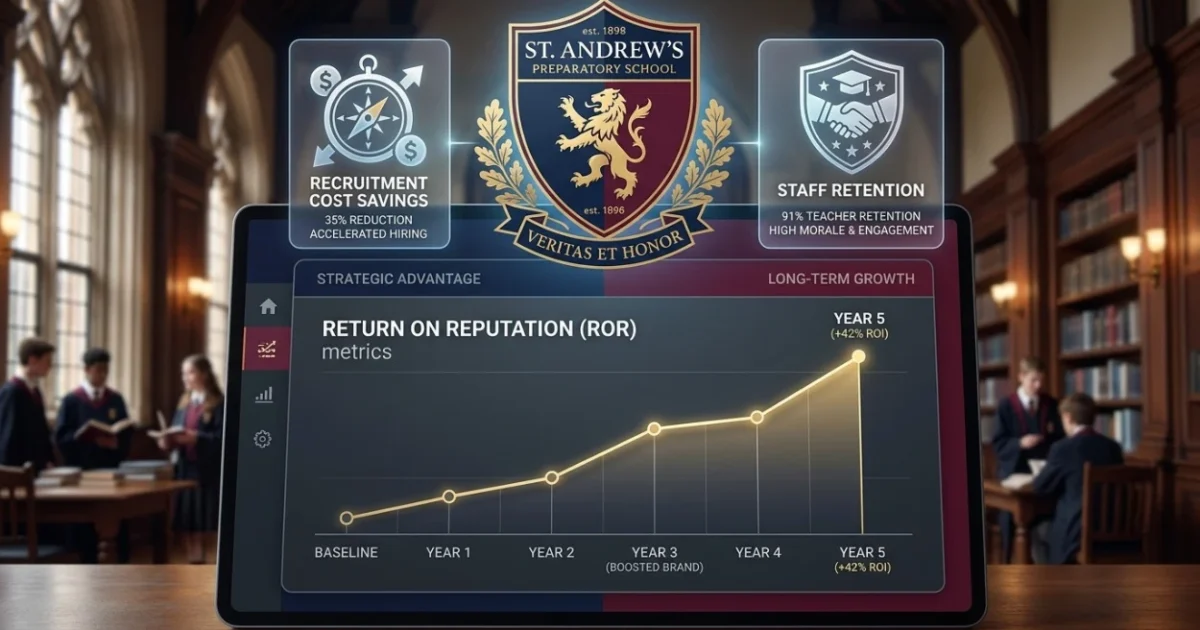
Employer reputation management for a private school typically costs according to the scale of reputation risk, search visibility, content volume, and level of ongoing monitoring required. The value comes from controlling how employer-related information appears in search results, strengthening reputation signals, and reducing the risk of negative content dominating staff and recruitment-related searches.
Search perception directly affects how prospective teachers, senior staff, parents, and other stakeholders interpret a private school’s employment environment. A reputation management programme therefore needs to connect expenditure with measurable search outcomes, process clarity, and risk reduction rather than treating reputation as a purely public-relations activity.
What Determines the Cost of Employer Reputation Management for a Private School?
The primary cost drivers are the number of reputation assets requiring analysis, the complexity of the SERP environment, the intervention required, and the duration of monitoring. A school with one isolated negative result requires a different level of investigation from a school facing negative employee reviews, forum discussions, third-party articles, outdated information, and multiple high-ranking results. Content creation also carries a different workload from content removal because it requires research, production, optimisation, publication, and maintenance. Cost therefore reflects the complexity of the reputation ecosystem rather than simply the number of pages involved.
A professional reputation management assessment begins by identifying the search queries that influence employer perception. Branded searches, school-name searches combined with employment terms, leadership-related searches, and staff-experience queries reveal the actual SERP composition affecting perception. Each result is then assessed according to source authority, relevance, sentiment, visibility, and potential risk. This process creates a defined baseline before any intervention begins. For a private school, that baseline provides a practical connection between reputation expenditure and measurable search conditions.
The scope also determines whether the work is project-based or ongoing. A focused intervention concentrates on a defined reputation issue, while continuous management monitors new content and changes in search visibility over time. Ongoing monitoring creates a structured way to identify emerging reputation risks before they become dominant search results. This reduces dependence on reactive responses and supports a more stable reputation strategy.
Which Reputation Management Approach Provides the Most Value?
The most valuable approach is the one that matches the reputation problem to the correct intervention, combining content enhancement, negative content suppression, monitoring, and legitimate removal mechanisms where appropriate. Content enhancement strengthens the school’s authoritative information footprint, while suppression focuses on improving the visibility of credible assets relative to damaging results. Removal addresses content that qualifies under applicable platform rules or legal mechanisms. Each mechanism solves a different part of the search visibility problem.
Search engines rank individual pages rather than assigning a single public reputation score to a school. Reputation management therefore works by influencing the information ecosystem surrounding the school’s entity rather than directly purchasing or guaranteeing a particular ranking. Creating authoritative employment content gives search systems additional relevant assets to evaluate for applicable queries. Improving consistency across institutional pages also strengthens entity credibility and information clarity. The resulting SERP environment provides users with a broader and more controlled representation of the organisation.
For schools evaluating providers, Reputation Management for Private Schools needs to be assessed against the actual reputation architecture rather than a generic package description. A reliable process identifies the source of negative information, establishes its search visibility, determines the available intervention, and measures changes after implementation. This makes the service accountable to defined reputation objectives instead of activity alone.
How Does Search Visibility Control Justify the Cost?
Search visibility control justifies expenditure when reputation-related content has sufficient prominence to influence how users understand the school. A negative result appearing prominently for an employer-related query receives greater attention than an identical statement buried deep within search results. Reputation management addresses this visibility imbalance by improving the presence of authoritative information and applying legitimate suppression or removal mechanisms where applicable. The objective is not to manipulate search engines but to establish a more accurate and representative information environment.
SERP control operates through multiple assets rather than a single page. Careers information, staff policies, leadership information, professional development content, institutional news, and authoritative third-party references can collectively strengthen the school’s searchable entity profile. These assets provide search engines with additional context while giving users more reliable information sources. The effectiveness of the strategy can therefore be evaluated through changes in the composition and visibility of relevant search results. This creates a measurable relationship between reputation activity and search perception.
Search perception influence becomes particularly important when prospective employees research a school before applying or accepting an offer. Employer reviews and negative discussions can become part of the decision-making environment when they rank prominently. A structured reputation strategy reduces reliance on uncontrolled third-party narratives by developing authoritative sources that explain the institution’s employment environment. The resulting control is informational rather than promotional.
Does Reputation Management Deliver Faster Results Than Organic Content Development?
Reputation management can produce faster changes when it addresses a specific high-visibility reputation asset through an applicable removal, correction, or suppression mechanism. Organic content development generally operates over a longer period because new pages need to establish relevance, authority, indexing, and search visibility. These mechanisms therefore have different time-to-impact characteristics. A targeted intervention focuses on an existing risk, while organic development strengthens the wider search environment. A complete programme can use both mechanisms according to the underlying issue.
Speed also depends on whether the negative content is removable. A platform-hosted review that violates a documented policy presents a different intervention opportunity from legitimate criticism published by an independent source. Where removal is unavailable, negative content suppression relies more heavily on strengthening alternative authoritative results. This requires a broader content architecture and sustained search optimisation. Clear My Name’s approach to reputation management therefore centres on analysing the available mechanism before selecting the intervention rather than applying the same response to every negative result.
The practical outcome is a distinction between immediate exposure reduction and long-term SERP stabilisation. Immediate work focuses on the results currently influencing search perception. Long-term activity builds an information ecosystem capable of maintaining visibility across relevant employment searches. Both dimensions matter when evaluating cost because a short-term improvement without ongoing protection leaves the reputation environment exposed to future changes.
Dive Deeper With Our Expert Guides:
How Do Schools Remove Defamatory Glassdoor Reviews? Legal and Platform Routes
How Do Schools Suppress Negative VAT News Stories in Search Results?
What Outcomes Should a Private School Expect From Reputation Management?
A private school can evaluate reputation management through measurable changes in search visibility, information accuracy, reputation signal distribution, and the prominence of authoritative content. The service does not create an artificial reputation independent of public information. Instead, it improves the structure, visibility, and accuracy of information available to users while addressing legitimate risks within the search ecosystem. This distinction makes outcome measurement more transparent. It also prevents reputation management from being reduced to an undefined promise of better search results.
A structured programme can deliver outcomes across three connected areas:
- Improve SERP composition by increasing the visibility of authoritative institutional pages for relevant employer-related searches.
- Reduce negative-content exposure by applying appropriate suppression, correction, or removal mechanisms to qualifying reputation risks.
- Strengthen entity credibility by maintaining consistent employment, leadership, policy, and institutional information across authoritative sources.
- Monitor reputation signals by tracking changes in search visibility, sentiment distribution, indexed content, and emerging third-party references.
These outcomes provide a stronger basis for evaluating expenditure than page volume or publishing frequency alone. A school can compare the initial search environment with later SERP composition and identify whether high-risk assets have changed in prominence. It can also assess whether authoritative information now occupies a larger proportion of relevant search results. This creates a measurable framework for determining whether the reputation programme is addressing the original risk.
How Can Schools Reduce the Risk of Paying for Ineffective Reputation Management?

Schools reduce financial and reputational risk by requiring a defined process, measurable objectives, transparent intervention criteria, and regular reporting. A provider needs to explain which search results are being assessed, why particular content requires intervention, and which mechanism applies to each asset. This prevents activity from being confused with results. It also establishes accountability for the strategy from initial audit through ongoing monitoring.
The evaluation process can be structured around four decision points:
- Audit employer-related SERPs to establish which pages influence search perception and identify the highest-visibility reputation risks.
- Classify each asset according to removal eligibility, factual accuracy, authority, sentiment, relevance, and ranking position.
- Prioritise interventions according to search visibility and potential reputational impact rather than treating every mention equally.
- Measure post-intervention changes through SERP monitoring, content visibility, sentiment distribution, and information consistency.
This process reduces the risk of investing in tactics that have no clear relationship with the school’s actual search environment. It also creates a record of why each action was taken and how its effect is measured. Clear My Name can apply this structured model to connect reputation management activity with identifiable search and trust outcomes.
How Does Employer Reputation Management Compare With Managing Reputation Internally?
Internal reputation management and specialist reputation management address different operational requirements. How Do Private Schools Improve Their Employer Reputation Online? Internal teams understand the school’s employment policies, organisational structure, staff concerns, and institutional priorities, making them valuable sources of factual information. Specialist reputation management adds search analysis, SERP monitoring, content strategy, and reputation-risk assessment. Combining institutional knowledge with search expertise creates a clearer link between factual accuracy and online visibility.
Internal teams also face capacity constraints when reputation monitoring competes with recruitment, safeguarding, communications, HR administration, and school operations. A specialist process provides dedicated attention to search perception and reputation signals. This is particularly relevant when negative results span multiple platforms or when reputation risks require ongoing monitoring. The distinction is not simply about outsourcing communication. It is about allocating specialist resources to an information environment that changes continuously.
For a decision-maker, the relevant cost comparison therefore involves internal workload as well as external expenditure. Time spent identifying results, reviewing content, monitoring rankings, documenting platform policies, and maintaining reputation assets represents an operational cost. A defined reputation management service converts those activities into a structured process with identifiable responsibilities and reporting requirements.
How Sustainable Are the Results of Employer Reputation Management?
Sustainable reputation management depends on maintaining authoritative information while continuously monitoring changes in search visibility. Search results change as new pages are indexed, existing pages gain authority, third-party discussions develop, and search systems reassess relevance. A one-off intervention therefore addresses the current search environment but does not automatically protect against future reputation changes. Ongoing monitoring provides the mechanism for detecting those changes. Sustainable SERP control is consequently a process rather than a single action.
Long-term sustainability also depends on the quality of the content supporting the school’s entity. Accurate careers information, employment policies, professional development information, leadership details, and institutional updates provide continuing sources of authoritative context. These assets remain useful beyond an individual reputation incident. Their value increases when they are maintained and aligned with the school’s actual employment environment.
A sustainable strategy also avoids dependence on aggressive suppression. Legitimate criticism remains part of the public information environment, and attempts to remove content without a valid basis create additional risk. A reliable reputation management process distinguishes between removable policy violations, factual inaccuracies, legitimate criticism, and content that requires stronger contextual information. That distinction protects both credibility and the long-term integrity of the school’s search presence.
Is Employer Reputation Management a Long-Term Investment for a Private School?
Employer reputation management represents a long-term investment when the school’s recruitment and institutional credibility depend on how it appears across search ecosystems. Teachers and senior education professionals increasingly research organisations through search engines before engaging with recruitment information. The reputation signals encountered during that process form part of the information environment surrounding employment decisions. Maintaining accurate and authoritative search results therefore supports a broader digital trust strategy. The expenditure becomes easier to assess when linked to defined reputation risks and measurable visibility outcomes.
Cost should also be considered against the persistence of search content. A negative page can remain discoverable long after the original event, continuing to influence searches unless its visibility changes or the underlying content is legitimately removed. A structured reputation programme addresses both current exposure and future monitoring. This reduces the risk of treating reputation repair as a one-time response to a continuously changing search environment.
Schools researching private school teacher salary UK information also encounter wider employment signals when evaluating potential employers. Salary information, workplace policies, professional development, leadership information, and employee-generated content collectively contribute to employer perception. Reputation management therefore works alongside factual employment information rather than replacing it. The objective is to ensure that relevant searches provide an accurate and balanced representation of the institution.
How Should a Private School Choose an Employer Reputation Management Service?
A private school should choose a service based on process transparency, search expertise, evidence-based intervention, measurable reporting, and a clear distinction between suppression and legitimate content removal. The provider needs to demonstrate how it identifies reputation risks and how each proposed action connects to search visibility. Clear methodology is more useful than broad claims about improving reputation. It provides decision-makers with a practical framework for assessing progress and risk.
The decision process can focus on the following evidence:
- Verify the provider’s audit process by confirming that it analyses branded and employer-related SERPs rather than relying only on review counts.
- Examine intervention criteria by checking how the provider distinguishes removable content from legitimate criticism.
- Assess reporting standards by requiring visibility, content, sentiment, and intervention data rather than activity summaries alone.
- Evaluate sustainability by examining how monitoring and content maintenance continue after an initial reputation issue is addressed.
Clear My Name positions its Reputation Management for Private Schools service around this type of structured search and reputation analysis. The emphasis is on identifying reputation signals, controlling relevant search visibility, and applying the appropriate mechanism to each content asset. This approach connects the service with measurable search conditions rather than relying on generic reputation claims.
What Is the Overall Value of Employer Reputation Management for a Private School?
The overall value comes from combining search visibility control, reputation-risk reduction, authoritative content development, and continuous monitoring into one defined process. Employer reputation affects how prospective staff interpret the information surrounding a school, particularly when negative results appear prominently for employment-related searches. A structured service creates a method for identifying those results, assessing their influence, and selecting an appropriate intervention. This provides greater process clarity than responding to individual reputation incidents without a wider search strategy.
The cost is therefore best evaluated against the scale of the school’s exposure, the complexity of its SERP environment, and the level of control required. Removal-focused work addresses qualifying content directly, while negative content suppression and content enhancement strengthen the wider information environment. Monitoring maintains visibility over future changes and reduces the risk of reputation issues developing without detection. Together, these mechanisms establish a more resilient approach to employer reputation.
Clear My Name provides a structured framework for private schools seeking to manage employer reputation through search analysis, reputation signals, content visibility, and ongoing monitoring. The value of the service lies in process clarity: identifying the risk, selecting the applicable mechanism, measuring the search impact, and maintaining the resulting information environment. For schools making a decision about reputation management, this evidence-led approach connects investment with visibility, trust, control, and long-term reputation stability.
What does employer reputation management cost for a private school?
Employer reputation management costs vary based on the school’s size, reputation risks, and the level of monitoring or content management required. Private schools may pay more for ongoing reputation monitoring, review management, search-result analysis, and employer brand support.
What affects the cost of private school employer reputation management?
Pricing is influenced by the number of online platforms monitored, the volume of reputation issues, reporting requirements, and whether the service is ongoing or project-based. A detailed reputation audit can help identify the resources required before a cost is established.
How much does reputation management for a private school include?
Private school reputation management can include review monitoring, employer-brand analysis, search-result monitoring, negative content assessment, and reputation reporting. The exact scope depends on the school’s online presence and the specific reputation risks being addressed.
Is private school reputation management a monthly service?
Many reputation management providers offer monthly plans covering continuous monitoring, reporting, and reputation-related activity. Project-based services are also available when a school needs support for a specific reputation issue or online content problem.
Can Clear My Name provide employer reputation management for private schools?
Clear My Name provides reputation management services that can address online reputation, search visibility, reviews, and damaging content. The appropriate service scope depends on the private school’s reputation issues, digital footprint, and required level of ongoing management.