
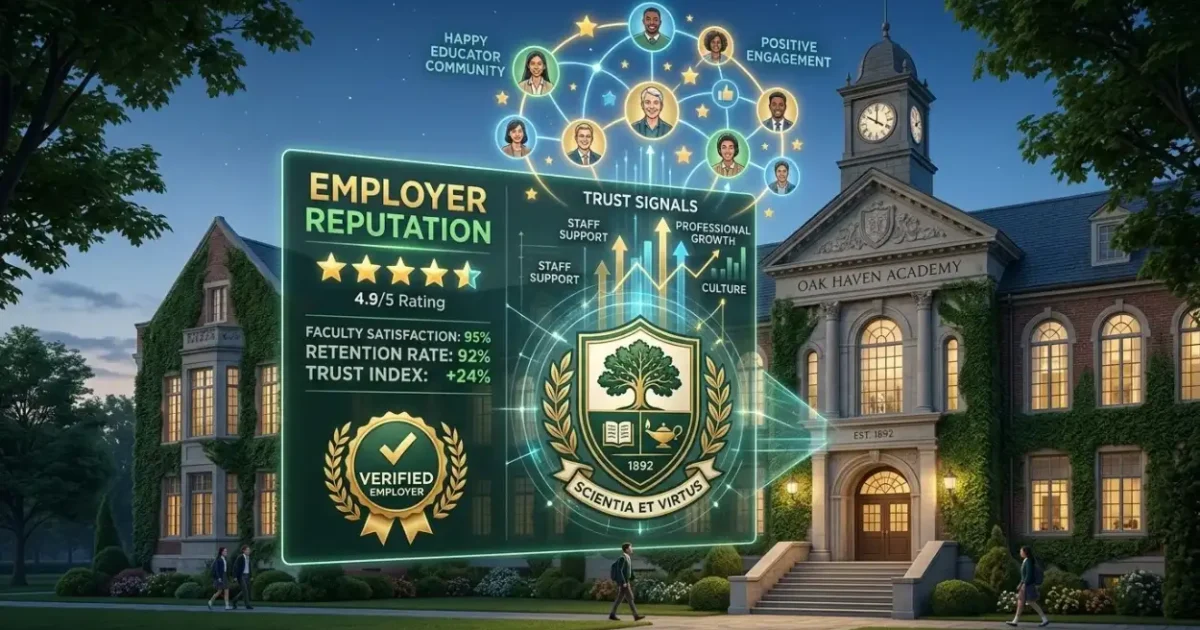
Private schools improve employer reputation online by managing employee-generated content, strengthening credible institutional information, and addressing inaccurate or damaging search results. The most effective approach depends on whether the reputation issue requires content enhancement, content removal, or a combination of both.
Reputation management strategies differ based on the source, persistence, and search visibility of employer-related information. Online reputation control methods are evaluated through reputation signals, entity credibility, search ranking influence, sentiment distribution, and the resulting composition of search engine results pages (SERPs).
Which Employer Reputation Management Methods Are Most Effective for Private Schools?
Content enhancement and content removal address different reputation problems, so their effectiveness depends on the underlying cause of negative search perception. Content enhancement increases the quantity and relevance of credible information associated with a school, while content removal targets information that violates platform rules, contains demonstrably false material, or creates an identifiable legal or policy issue. These methods operate through different mechanisms within the search ecosystem. Enhancement changes the information environment surrounding the school entity, whereas removal reduces the visibility or availability of a specific source. The distinction is important because adding positive information does not automatically eliminate negative pages from search results.
Content creation operates by establishing authoritative pages that provide search engines with additional information about the school, its employment practices, leadership structure, teaching environment, policies, and institutional activities. These assets contribute to entity credibility when they are consistent, accessible, and supported by reliable signals across the web. However, content enhancement does not guarantee displacement of established negative pages. Search ranking influence depends on relevance, authority, query intent, page quality, and the competitive strength of the existing results. This makes content creation more suitable for long-term SERP development than for resolving a specific policy violation.
Content removal operates by reducing the availability of a problematic asset rather than competing with it through additional content. Removal requests can target platform-hosted material when it breaches applicable rules, while legal or copyright mechanisms apply to specific categories of content and evidence. Its strength lies in addressing the source directly rather than attempting to suppress its ranking indirectly. Its limitation is that removal depends on the platform’s policies, evidence requirements, jurisdiction, and ownership of the content. A removal strategy therefore has a narrower application but a more direct mechanism.
How Does Organic Reputation Building Compare With Reactive Reputation Repair?
Organic reputation building provides a continuous framework for developing positive reputation signals, while reactive reputation repair responds to specific negative events or search results. Organic activity includes maintaining accurate institutional information, publishing useful employment-related content, developing authoritative pages, and ensuring consistent entity information across relevant sources. Reactive activity includes responding to negative reviews, investigating inaccurate claims, submitting removal requests, and addressing newly indexed content. The two approaches operate on different timescales. Organic activity influences the broader information environment, while reactive activity focuses resources on identifiable reputation risks.
Organic reputation building has greater scalability because the same institutional content architecture can support multiple employment-related searches. A well-structured careers section, staff information, governance content, policies, and institutional updates can collectively strengthen the school’s searchable entity profile. Reactive work is less scalable because each issue requires assessment of its source, accuracy, policy status, and search visibility. However, reactive management becomes more important when a negative asset achieves strong search visibility or contains information that materially changes perception. Evaluating both approaches therefore requires examining the type and persistence of the reputation risk rather than treating one method as universally applicable.
Reactive reputation repair also carries greater operational risk when the underlying content cannot be removed. Attempts to challenge legitimate criticism without a valid policy or factual basis do not remove the source and can increase attention around the disputed issue. A factual response, correction, or additional authoritative information provides a different mechanism because it adds context without requiring the original material to disappear. This distinction separates legitimate reputation management from attempts to manipulate information availability.
Does Content Creation or Content Removal Have Greater Impact on SERP Composition?
Content creation changes SERP composition by introducing additional relevant assets that compete for visibility around employer-related searches. When a school produces authoritative content around employment policies, teaching standards, professional development, staff support, and institutional governance, those pages create additional candidates for search visibility. The effect depends on whether the pages satisfy search intent and possess sufficient relevance and authority. Content creation therefore works through competition for search positions rather than direct deletion of existing results. Its measurable outcome is a change in the distribution of visible search results associated with the school entity.
Content removal changes SERP composition through a different pathway. If a search engine no longer has access to an indexed source, or if a platform removes the original content, that asset no longer occupies the same position in the information environment. Removal can therefore create a more immediate change when the targeted material is the principal source of negative sentiment. However, removal of one page does not guarantee removal of the underlying narrative. Copies, references, discussions, cached material, or independent reporting can continue to exist elsewhere.
The comparative evaluation therefore centres on source control versus search competition. Content removal addresses an identifiable asset at its source, while content enhancement develops alternative authoritative information. Schools assessing these approaches need to determine whether the reputation problem originates from one removable asset or from a broader distribution of negative information. That distinction determines whether SERP control is primarily a removal problem, an enhancement problem, or a combined problem.

How Do Short-Term and Long-Term Reputation Strategies Differ?
Short-term reputation strategies focus on reducing immediate visibility or correcting an identifiable reputation issue, while long-term strategies focus on changing the overall distribution of reputation signals. Short-term actions include investigating negative reviews, checking search results, correcting inaccurate institutional information, and assessing whether specific content qualifies for removal. These actions provide targeted responses to measurable problems. Their limitation is that they do not necessarily create a durable reputation infrastructure. Long-term activity requires consistent content, accurate entity information, credible institutional references, and ongoing monitoring.
Long-term reputation development has a stronger sustainability profile because it does not depend on a single intervention. Search engines continually reassess pages, entities, links, content quality, and relevance, meaning that reputation signals change over time. A school that maintains a consistent information ecosystem creates more opportunities for authoritative pages to appear for relevant employment searches. This does not prevent negative content from being indexed. Instead, it creates a broader and more balanced SERP environment in which individual negative assets represent a smaller proportion of the visible information.
Short-term repair remains relevant when an issue has unusually high search ranking influence. A single highly visible page can shape perception disproportionately if it appears for the school’s name or employment-related queries. In that situation, waiting for long-term content development does not address the immediate SERP composition. The strategic distinction is therefore between reducing a current exposure and building resilience against future reputation volatility.
How Do Search Engines Interpret Employer Reputation Signals?
Search engines do not operate from a single employer-reputation score that determines how positively or negatively a private school is perceived. Instead, search systems evaluate individual pages, entities, queries, relationships, relevance, authority, and other signals when determining which information appears for a search. Employer reputation therefore emerges partly from the collection of publicly available information associated with the school. Reviews, employment pages, news coverage, institutional documents, professional profiles, and third-party references can all contribute to the information environment. The search results displayed for a query represent a selection of that environment rather than a complete reputation assessment.
Sentiment distribution becomes relevant because repeated positive, neutral, or negative themes can influence the information encountered by users. A single negative statement does not represent the entire sentiment distribution, but a highly visible result can receive disproportionate attention because of its position in the SERP. This creates an important distinction between sentiment volume and sentiment visibility. Reputation analysis therefore examines not only how much positive or negative content exists, but also which assets appear for important searches and how prominently they are presented.
Entity credibility is strengthened when information about the school remains consistent across authoritative sources. Differences in names, institutional descriptions, employment information, leadership details, or organisational relationships can weaken information consistency. Accurate structured information does not guarantee higher rankings, but it provides clearer context for understanding the entity. Reputation analysis therefore connects search visibility with the quality and consistency of the wider information ecosystem.

Which Approach Provides Greater Scalability and Sustainability?

Content enhancement generally provides greater scalability because a single content framework can support multiple search queries and audience needs. A school’s employment policies, professional development information, leadership pages, safeguarding policies, staff benefits, and institutional values can each address distinct search intents. Once established, these assets can continue attracting search visibility without requiring an individual response to every negative mention. Their sustainability depends on accuracy, maintenance, relevance, and continued institutional consistency. Outdated or duplicated content reduces the value of the strategy.
Reactive reputation management is less scalable because each issue requires a separate evaluation. A review requires a different assessment from a news article, forum discussion, employee comment, or third-party directory listing. The process involves identifying the source, checking factual accuracy, assessing policy relevance, measuring search visibility, and selecting an appropriate response. This makes reactive management resource-intensive as the number of reputation assets increases. Its value is strongest when a particular result presents a material and identifiable risk.
A sustainable framework therefore combines monitoring with structured content development and proportionate issue resolution. Monitoring identifies changes in SERP composition and sentiment distribution, while content development strengthens the broader information environment. Removal or correction mechanisms address individual assets where legitimate grounds exist. The resulting framework treats reputation as an evolving search ecosystem rather than as a collection of isolated reviews.
Dive Deeper With Our Expert Guides:
How Do Glassdoor and Indeed Reviews Affect Private School Recruitment?
How Does VAT Media Coverage Shape Public Perception of Private Schools?
How Should Private Schools Evaluate Employer Reputation Strategies?
Private schools can evaluate reputation strategies by comparing the source of the problem, the mechanism available, the expected search effect, and the level of ongoing maintenance required. A useful evaluation framework separates immediate exposure from long-term reputation development. It also distinguishes content that can legitimately be removed from content that requires contextualisation or search competition. This prevents removal, enhancement, and response strategies from being treated as interchangeable.
- Identify the source of the reputation signal by separating employee reviews, editorial coverage, institutional pages, forums, directories, and other third-party content.
- Measure search visibility by recording which reputation assets appear for branded, employment-related, and institution-specific queries.
- Assess removal eligibility by examining whether the content breaches a platform rule, contains demonstrably inaccurate information, or falls within an applicable legal mechanism.
- Compare content enhancement with removal by analysing whether new authoritative assets can realistically change SERP composition or whether the source itself requires direct action.
- Monitor sentiment distribution by tracking recurring themes rather than relying on the volume of individual positive or negative mentions.
- Review sustainability by assessing whether the chosen approach continues producing useful reputation signals after the initial intervention.
This framework connects reputation activity with measurable search outcomes rather than treating online reputation as a purely communications exercise. It also establishes a clear distinction between legitimate reputation management and attempts to remove criticism simply because it is unfavourable. The relevant objective is to improve the accuracy, completeness, and balance of publicly accessible information while responding proportionately to legitimate risks.
What Factors Influence the Cost of Employer Reputation Management for a Private School?
The cost of employer reputation management depends on the number of reputation assets requiring assessment, the complexity of the search environment, the type of intervention required, and the level of ongoing monitoring. A school with a limited number of identifiable issues presents a different workload from an institution with negative reviews, third-party articles, forum discussions, inaccurate directory information, and multiple search results requiring analysis. Content enhancement also creates a different workload from content removal because it involves research, production, optimisation, publication, and maintenance. Reactive work is generally measured by the complexity and number of individual reputation issues.
The distinction between one-off intervention and ongoing management also affects cost structure. A one-off assessment focuses on identifying current risks and selecting appropriate responses, whereas ongoing management involves monitoring SERP changes, evaluating new content, maintaining authoritative assets, and reassessing reputation signals. This makes cost analysis inseparable from scope definition. A meaningful evaluation therefore examines workload, intervention type, monitoring frequency, and the number of search environments covered rather than relying on a single generic price assumption.
Employer reputation management therefore needs to be evaluated as a combination of search analysis, content strategy, risk assessment, and ongoing monitoring. The appropriate method depends on whether the underlying issue involves inaccurate information, negative but legitimate criticism, poor content distribution, or a concentrated high-visibility search result.
What Are the Main Strategic Differences Between Employer Reputation Approaches?
Employer reputation approaches differ primarily in mechanism, timescale, scalability, and risk exposure. Content removal is source-focused and potentially immediate but depends on eligibility and platform or legal requirements. Content enhancement is search-focused and more scalable but requires time to establish sufficient relevance and authority. Reactive management concentrates on existing reputation risks, while organic development builds a broader information environment. Short-term interventions address immediate exposure, whereas long-term strategies focus on sustainability and resilience.
The strongest evaluation framework does not treat one method as universally superior. Instead, it analyses the relationship between the reputation signal, its source, its search visibility, and the available intervention. A negative result that qualifies for removal presents a different strategic problem from legitimate criticism that ranks prominently. Similarly, a school with fragmented institutional information requires a different approach from one facing a single high-ranking third-party page.
Employer reputation online is therefore best understood through SERP composition, reputation signals, entity credibility, and sentiment distribution. Comparing these factors provides a structured basis for determining whether content enhancement, content removal, reactive management, organic development, or a combination of approaches addresses the underlying search environment. The central consideration is not simply whether a strategy produces positive content, but whether it changes the accuracy, visibility, balance, and sustainability of the information associated with the school.
How can private schools improve their employer reputation online?
Private schools can improve employer reputation by maintaining accurate employment information, responding appropriately to employee reviews, and developing authoritative content about workplace policies and staff development. Consistent reputation monitoring also helps identify inaccurate or damaging information affecting search visibility.
What affects a private school’s employer reputation in Google search results?
Employee reviews, news coverage, staff-related content, institutional pages, and third-party websites can all influence the information shown for employer-related searches. Search visibility, content relevance, source authority, and sentiment distribution affect how users encounter the school’s online reputation.
Should private schools remove negative employee reviews or create positive content?
The appropriate approach depends on the nature of the content and whether it qualifies for removal under a platform’s policies. Content enhancement can strengthen authoritative reputation signals, while legitimate removal mechanisms address content that breaches applicable rules or contains demonstrably inaccurate information.
How does reputation management for private schools affect employer perception?
Reputation management for private schools focuses on monitoring search results, evaluating employee-generated content, improving information accuracy, and addressing legitimate reputation risks. These activities can influence the balance and visibility of information users encounter when researching a school as an employer.
How long does it take to improve a private school’s employer reputation online?
The timeframe depends on the number of reputation issues, existing search visibility, content authority, and whether the strategy involves removal, content enhancement, or both. Building sustainable reputation signals generally requires ongoing monitoring and consistent development of accurate, authoritative information.