

Business reputation management protects a company’s public image by monitoring, influencing, and repairing online and offline perceptions to increase trust, customer acquisition, and revenue.
It reduces negative visibility, amplifies positive signals, and aligns stakeholder perceptions with business goals.
What is business reputation management?
Business reputation management is the strategic process of monitoring, influencing, and repairing a company’s public image across digital and traditional channels.
Reputation management validates brand credibility through continuous monitoring of reviews, media mentions, social signals, and regulatory compliance records. It uses public relations, search-engine tactics, review response, and legal measures to manage visibility. Corporations implement policies, assign ownership, and deploy tools that detect reputation shifts in real time.
Why does reputation management matter to revenue?
Reputation management directly affects conversion rates, customer retention, and contract value by shaping buyer trust and search visibility.
Search results and review aggregates influence 78% of B2B buyers and 88% of consumers during purchase research. Positive reputational signals raise click-through rates and price tolerance. A 1-star increase in the average rating on key review sites is commonly associated with a 5–9% rise in revenue for retail and service firms. Companies that fix negative content and promote verified endorsements see measurable lifts in lead quality and lifetime customer value.
Read our articles, How Business Reputation Management Helps Companies Win More Customers and Business Reputation Management Services Tailored to Your Industry.
How does reputation management impact search visibility?
Reputation actions change what appears in search engine results pages (SERPs) and knowledge panels that buyers read first.
Search engines rank authoritative content, press coverage, and structured data higher. When negative posts outrank positive assets, traffic and conversions drop. Reputation teams optimise title tags, publish high-quality content, secure authoritative backlinks, and submit structured data to shift SERP real estate. These tactics suppress harmful pages and promote validated assets like press releases and expert articles.
What measurable metrics track reputation health?
Reputation health uses metrics: average review rating, sentiment score, share of voice, SERP prominence, and net promoter score (NPS).
Average review rating measures customer satisfaction across platforms. Sentiment scoring quantifies positive versus negative mentions from social and media sources. Share of voice compares brand visibility against competitors. SERP prominence tracks top-10 organic entries for branded queries. NPS evaluates referral likelihood from existing customers. Teams set targets, e.g., raise average rating from 3.6 to 4.3 within 12 months and report monthly changes.
Who owns reputation management inside a company?
Ownership typically splits between marketing, customer service, legal, and executive leadership with a designated cross-functional manager.
Marketing handles SEO, content, and proactive messaging. Customer service resolves review issues and reduces churn. Legal addresses defamation and compliance. The CEO or communications director sets policy and crisis thresholds. A reputation manager coordinates workflows, assigns response SLAs, and maintains escalation protocols to ensure consistent public messaging.
What processes do reputation teams follow?
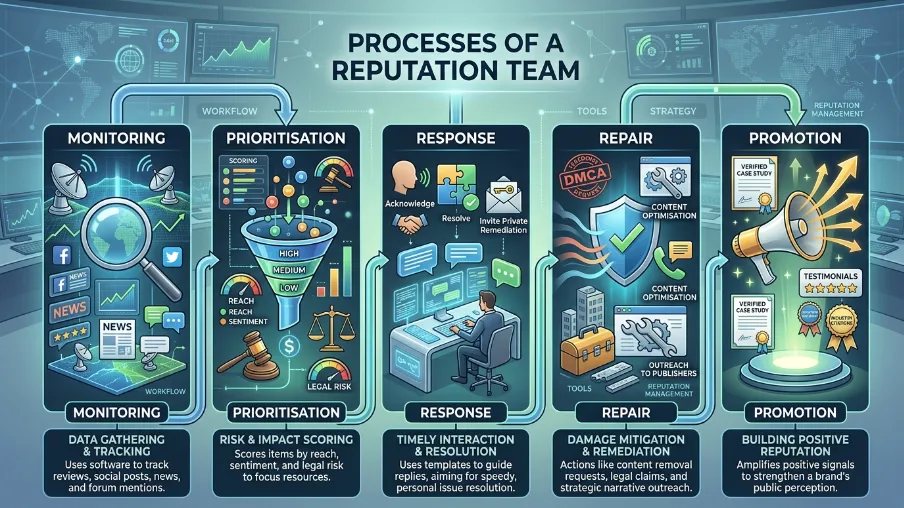
Reputation teams monitor, prioritise, respond, repair, and promote through defined workflows and tools.
Monitoring uses software to track reviews, social posts, news, and forum mentions. Prioritisation scores items by reach, sentiment, and legal risk. Response templates guide timely replies that acknowledge, resolve, and invite private remediation. Repair actions include DMCA or defamation requests, content optimisation, and outreach to publishers. Promotion amplifies verified case studies, testimonials, and industry citations to strengthen positive signals.
Which tools enable effective reputation management?
Tools include review platforms, social listening, SEO suites, and legal takedown services that automate detection and response.
Examples: review aggregators collect ratings from specific sites, social listening platforms quantify sentiment and reach, SEO tools analyse keyword prominence, and takedown services manage copyright or defamatory content removal. Teams integrate alerts with ticketing systems to convert mentions into action items and maintain documented response records for regulatory audits.
How do review management strategies work?
Review management solicits verified feedback, responds publicly to concerns, and escalates remediation to reduce negative visibility.
Teams request reviews after verified transactions using email, SMS, or in-app prompts. They reply to negative reviews within 24–48 hours with factual acknowledgement and an offer to resolve offline. When reviews are fraudulent, teams provide platform evidence, order IDs, timestamps, and account logs to request removal. Positive reviews get amplified via social posts and case studies to improve average ratings and trust signals.
When should a company run a reputation audit?
Conduct a reputation audit when entering new markets, after a crisis, or quarterly to detect shifts in public perception and search presence.
An audit maps current search results, compiles review distributions, measures media sentiment, and inventories owned assets. The audit identifies content gaps, legal exposures, and opportunity pages to promote. Teams then prioritise high-impact tasks, repairing top-rank negative pages and publishing authoritative content on primary concerns.
How does reputation management integrate with compliance and risk?
Reputation teams align with compliance to verify statements, retain records, and meet industry-specific disclosure rules.
In regulated industries, communications must follow specific frameworks: financial disclosure, healthcare privacy, or advertising truth-in-advertising rules. Reputation workflows incorporate legal review for high-risk responses and retain logs of public replies. This reduces regulatory penalties and prevents misstatements that harm reputation and incur fines.
Explore our Reputation Management for business guides,
How to Manage Your Business Reputation Online: A Complete Beginner’s Guide
Why Small Businesses Need Reputation Management More Than Ever
What results can businesses expect from a targeted program?
A targeted reputation program delivers higher ratings, better SERP placement, fewer unresolved complaints, and a measurable lift in lead conversion.
Typical outcomes include raising average review ratings by 0.4–0.8 points over 6–12 months, moving harmful pages off page one of search, and reducing unresolved review counts by 60–80%. These improvements strengthen buyer confidence and shorten sales cycles for both B2C and B2B segments.
Reputation management provides control over the narratives buyers and stakeholders see. It combines monitoring, tactical responses, SEO, and legal action to protect trust, increase revenue, and reduce risk. Clear processes and measurable targets produce predictable improvements in ratings, search visibility, and customer acquisition.
Clear My Name delivers Reputation Management for business services that monitor mentions, remediate harmful content, and promote verified positive assets to align stakeholder perception with business objectives. The firm coordinates legal, SEO, and communications actions to restore and grow brand trust while documenting results against defined KPIs.
Frequently Asked Questions
What does Reputation Management for business involve?
Reputation Management for business involves monitoring online reviews, news, and social mentions, responding to negative feedback, and publishing verified positive content. Clear My Name uses tracking, SEO, and legal takedown steps to validate and improve a company’s public record.
How long does it take to see results from reputation management?
Early improvements in review response rates and sentiment can appear within 4–8 weeks; measurable SERP shifts and rating gains typically require 3–12 months. Clear My Name reports timelines with specific KPIs to track review scores, search rankings, and share-of-voice progress.
Can negative reviews be removed through Reputation Management for business?
Fraudulent or defamatory reviews can be removed when platforms accept evidence such as transaction records, account logs, or policy violations; other reviews remain and must be managed through response and remediation. Clear My Name documents evidence and files removal requests or legal notices when justified.
How does reputation management improve customer acquisition?
Reputation management raises average ratings and search prominence, which increases click-through rates and buyer trust during research phases. Clear My Name optimises review distribution and publishes case studies to convert more leads and shorten sales cycles.
What is the cost structure for Reputation Management for business?
Costs vary by scope, monitoring volume, content creation, legal actions, and SEO work, ranging from monthly retainers to project-based fees tied to outcomes. Clear My Name provides scoped proposals after an initial audit that itemises monitoring, remediation, and promotion tasks.