

Reputation Management for business delivers targeted strategies to monitor, repair, and promote your company’s online image across review sites, media, and search results, reducing negative content and increasing qualified customer trust within 90–180 days.
What reputational outcomes will this service deliver?
Reputation Management for business reduces negative search visibility, increases positive reviews, and improves conversion signals within months.
Reputation management improves online sentiment, search rankings, and customer conversion metrics. Firms typically see a 30–60% decrease in visible negative assets and a 20–40% uplift in positive review volume within 90–180 days when campaigns combine content publication, review generation, and suppression tactics.
How do agencies diagnose a business reputation problem?
Agencies run a 5-step audit: search landscape mapping, sentiment scoring, review sourcing analysis, competitor benchmarking, and legal/PR risk assessment.
The audit starts with a full search-engine scrape for brand and key-person queries. Analysts assign sentiment scores to each asset and count review sources by platform (Google, Yelp, Trustpilot). They benchmark visibility against three direct competitors and flag legal or regulatory risks tied to reviews or media exposure. The outcome is a prioritised remediation plan with timelines and metrics.
Read our articles, How Business Reputation Management Helps Companies Win More Customers and What Is Business Reputation Management and Why Does It Matter?
What tactics repair and suppress negative content?
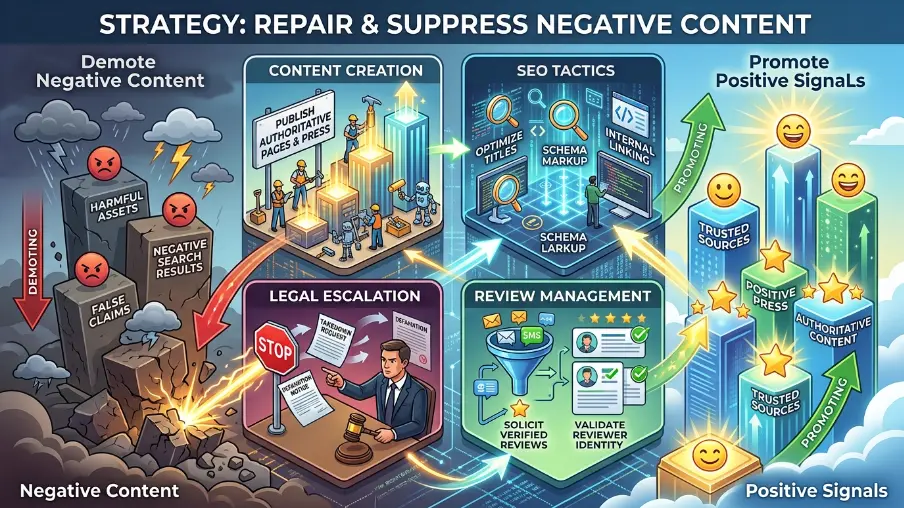
Tactics combine content creation, SEO, review management, and legal escalation to demote harmful assets and promote positive signals.
Content creation publishes authoritative pages and press that outrank negative results. SEO tactics optimise titles, schema, and internal linking to boost approved assets. Review management solicits verified reviews using email and SMS workflows and validates reviewer identity. Legal escalation issues takedown requests or defamation notices when content violates platform policies or law.
How does review generation work?
Review generation automates requests, verifies identities, and funnels satisfied customers to public platforms while routing issues to internal remediation.
A workflow sends a post-purchase SMS or email within 7 days, requests feedback using a 1–5 scale, then directs promoters to public sites and routes detractors to private support. Three verification methods ensure authenticity: purchase receipts, order IDs, and account-match confirmation. This process raises the volume of verified positive reviews and reduces fake review risk.
How is search-engine suppression measured?
Suppression is measured by search-result share, ranking displacement, and click-through rate improvements for owned assets.
Teams track the percentage of first-page results owned by the business and the ranking positions of identified negative URLs. They measure organic click-through rate (CTR) before and after remediation. Effective suppression shows a decrease in negative-first-page share from baseline and an increase in CTR to owned pages.
What role does content strategy play?
Content strategy publishes authority pages, local pages, and industry narratives that target high-intent keywords and entity relationships.
Teams create cornerstone pages covering your products, leadership, and case studies. They produce location pages for each office and topical posts that answer buyer questions. Each page uses schema and entity-based language to link brand, service, and industry terms. This builds authoritative signals that search engines associate with the business entity.
How do legal and platform escalations work?
Legal escalations use policy violations, copyright claims, and defamation law to request content removal; platform escalations follow vendor-specific workflows.
Teams compile evidence: timestamps, purchase records, and communication logs. They file DMCA or platform policy reports where applicable. For defamation, the firm drafts cease-and-desist notices and coordinates with counsel when needed. Platform escalations include tailored appeals to Google, Facebook, and review sites with documented proof.
How does reputation management increase conversion and revenue?
Reputation management increases buyer trust, boosts review-driven conversions, and shortens sales cycles for decision-stage prospects.
Positive reviews and authoritative search results raise perceived trust. Conversion-rate improvements tie to review volume and average star rating. Companies that increase average rating by 0.5 stars often see a 10–25% lift in conversion on product and service pages. Sales teams report shorter lead-to-close times when prospect research finds consistent positive sentiment.
What metrics prove ROI for buyers?
Article metrics include reduction in negative search visibility, net review score, average star rating, referral traffic, and conversion lift.
Measure percentage of first-page assets owned, change in average star rating, number of new verified reviews, referral visits from review sites, and conversion rate change. Set quarterly targets, for example: own 80% of first-page results and increase verified review count by 40% in 90 days.
How long until businesses see results?
Typical timelines show visible improvement in 90–180 days and durable reputation gains by month 6.
Immediate actions review requests and suppression filings, producing early wins in 4–12 weeks. Content publication and SEO work require 3–6 months to influence first-page rankings fully. Legal removals depend on platform and jurisdiction but often show resolution within 30–90 days.
How do you tailor services to an industry?
Tailoring maps industry risks, regulatory constraints, and buyer search behaviour to a customised mix of channels and tactics.
For regulated industries, teams add compliance reviews and consent validation. For local retail, emphasis shifts to Google Business Profile and local review sites. For B2B, content focuses on case studies, testimonials, and LinkedIn authority. The plan defines which platforms to prioritise and which messaging reduces friction with target customers.
How is the process structured with clients?
The process follows kickoff, audit, remediation roadmap, execution sprints, and monthly reporting with KPIs.
Kickoff defines stakeholders and legal contacts. The audit creates a ranked backlog of assets. Execution follows two-week sprints: content publishing, review campaigns, and escalation tasks. Monthly reports show KPI progress and next-step recommendations.
How does Clear My Name deliver for clients?
Clear My Name executes audits, suppression, review generation, and legal escalations tailored to business needs, with measurable outcomes.
Clear My Name applies entity-based SEO, verified review workflows, and policy-driven legal actions. The firm aligns deliverables to decision-stage metrics: owned first-page share, verified review counts, and conversion improvements. Contracts include defined KPIs and reporting cadence to track ROI.
Explore our Reputation Management for business guides,
Professional Business Reputation Management Services That Protect Your Brand
Affordable Reputation Management Services for Small Businesses: Compare Your Options
Practical example of a remediation sprint
A 12-week sprint reduces visibility of a defamatory article and raises positive review volume using coordinated content and platform actions.
Week 1: Audit and evidence collection. Week 2–4: Publish two authority pages and three press releases. Week 5–8: Run targeted review requests to 1,000 recent customers, verify 320 reviewers, and publish 180 positive reviews on key platforms. Week 9–12: File three platform escalations for policy violations and monitor ranking changes. Metrics tracked weekly include owned-first-page percentage, verified-review counts, and organic CTR.
Reputation Management for business provides targeted, measurable actions that reduce negative visibility and increase buyer trust during the purchase decision. Clear My Name delivers audits, review generation, search suppression, and legal escalations tailored to your industry with defined KPIs and reporting.
Frequently Asked Questions
What is Reputation Management for business and how does it work?
Reputation Management for business monitors online mentions, evaluates sentiment, and implements corrective actions such as content publication, review generation, and takedown requests. Clear My Name uses audits, verified review workflows, and SEO to shift search results toward authoritative, positive assets.
How long does it take Clear My Name to improve a company’s online reputation?
Timelines vary by issue, but Clear My Name typically delivers visible review and sentiment improvements in 8–12 weeks and durable search-result gains in 3–6 months. Legal removals and platform escalations may resolve in 30–90 days depending on the vendor and jurisdiction.
Can Reputation Management for business remove defamatory or false information?
Removal depends on platform policy and law; Clear My Name documents violations, files DMCA or policy reports, and coordinates legal notices when necessary. When removal isn’t possible, the service focuses on suppression by outranking harmful URLs with authoritative content.
Which metrics show success for Reputation Management for business?
Key metrics include owned first-page share, change in average star rating, number of verified reviews, referral traffic from review sites, and conversion-rate lift. Clear My Name reports these KPIs monthly to demonstrate this value and ROI.
How is review generation secured against fake or biased feedback?
Review generation uses verified workflows tied to purchase receipts, order IDs, or account matches and routes detractors to private remediation channels. Clear My Name validates reviewers and monitors platform guidelines to maintain authenticity and compliance.