

Business reputation management helps companies win more customers by improving public perception, increasing trust, and driving higher conversion rates through review optimisation, issue resolution, and consistent brand messaging.
How does reputation management increase customer acquisition?
Reputation management increases customer acquisition by improving trust signals, boosting search visibility, and converting consideration into purchase decisions.
Reputation Management for business optimises online reviews, corrects misinformation, and promotes positive customer experiences. Positive reviews raise click-through rates in search results. Clear, consistent brand messages reduce purchase friction. Case studies link improved ratings to measurable sales growth.
Read our articles, What Is Business Reputation Management and Why Does It Matter? and Business Reputation Management Services Tailored to Your Industry.
How does reputation affect conversion rates?
Higher reputation scores directly increase conversion rates by reducing perceived risk and shortening decision time.
Search users interpret star ratings and review volume as risk indicators. A 4.5-star average with 120 reviews signals reliability. Prospects compare options quickly; strong reputations turn comparisons into purchases. Reputation Management for business focuses on review quality, response timeliness, and content alignment to lift conversion metrics.
What are the core components of reputation management?
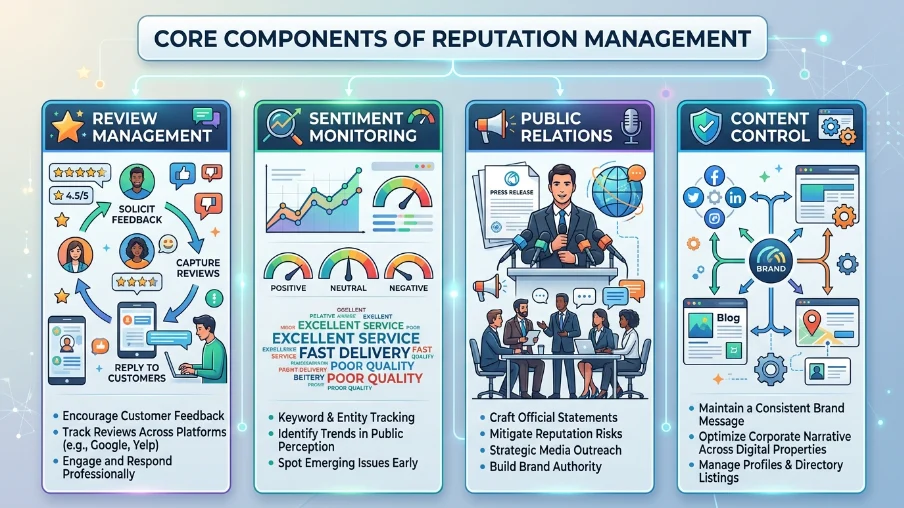
Core components include review management, sentiment monitoring, public relations, and content control.
Review management captures, solicits, and replies to customer feedback across platforms. Sentiment monitoring uses keyword and entity tracking to spot trends in customer perception. Public relations addresses major reputation risks through official statements and outreach. Content control ensures corporate narratives appear across websites, profiles, and directories.
How does review optimisation work?
Review optimisation increases positive review volume and visibility while addressing negative feedback to preserve trust.
Teams implement targeted review requests after positive interactions, route unhappy customers to private support channels, and correct platform inaccuracies. Technical steps include structured review markup to display stars in search results. Review optimisation lifts organic click-through rates and produces citation-friendly evidence of service quality.
How does reputation management improve search visibility?
Reputation management improves search visibility by generating authoritative content and structured data that search engines index.
Publishing verified reviews, press releases, and customer stories creates fresh, relevant content. Implementing schema markup for reviews and FAQs enhances rich results. Accurate directory listings and consistent NAP (name, address, phone) information reduce algorithmic confusion. These actions increase impressions and targeted traffic.
What metrics show reputation-driven customer growth?
Key metrics are review score, review volume, organic CTR, branded search growth, and conversion lift.
Track review score changes over 90 days to measure sentiment shifts. Compare review volume month-over-month to assess outreach effectiveness. Measure organic CTR for branded and non-branded queries after schema implementation. Monitor branded search volume growth as awareness expands. Attribute conversion lift via A/B tests or tracked campaign funnels.
How do teams resolve reputation crises?
Crisis response requires rapid issue containment, transparent communication, and corrective action plans.
First, identify the root cause using sentiment and incident tracking. Second, publish a clear public statement and offer remediation to affected customers. Third, document changes and follow up with stakeholders. Timely responses reduce negative reach and restore confidence among undecided prospects.
What processes validate reputation improvements?
Validation uses controlled experiments, timestamped review data, and comparative analytics to prove impact.
Run A/B landing-page tests to compare conversion before and after reputation interventions. Use timestamped review volume and rating trends to correlate with traffic spikes. Analyse referral and organic search changes with baseline comparisons. This evidence supports ROI claims for reputation initiatives.
How much return do companies see from reputation work?
Businesses see measurable returns: higher CTRs, increased lead volume, and conversion rate uplift within 3–6 months.
Typical outcomes include a 10–30% increase in organic CTR from review-rich results and a 5–15% conversion lift from improved ratings and faster responses. Results vary by industry and review baseline. Reputation Management for business delivers these outcomes through targeted review programs, content optimisation, and issue remediation.
How is reputation management tailored by industry?
Industry tailoring aligns messaging, compliance controls, and review channels to specific customer expectations.
Healthcare prioritises HIPAA-compliant feedback channels and provider credentials. B2B focuses on case studies, executive thought leadership, and LinkedIn signals. Retail targets product reviews and marketplace profiles. Clear My Name adapts tactics to industry requirements and buyer journeys to maximise trust and conversion.
Explore our Reputation Management for business guides,
12 Proven Online Reputation Management Strategies That Actually Work
How to Choose Affordable Reputation Management Services Without Compromising Quality
How does Clear My Name deliver reputation management?
Clear My Name delivers reputation management through targeted review programs, content control, and crisis response workflows.
The service uses monitoring tools, structured data implementation, and outreach campaigns. Teams validate outcomes with analytics and controlled tests. Clear My Name aligns interventions to buyer intent, moving prospects from consideration to purchase. The approach emphasises factual evidence and measurable uplift.
Reputation management converts interest into customers by amplifying trust signals, improving search presence, and resolving issues quickly. Focused review programs, schema use, and crisis protocols produce measurable gains in CTR, branded searches, and conversions. Clear My Name applies these methods to deliver targeted Reputation Management for business and demonstrable acquisition growth.
Frequently Asked Questions
How long does Reputation Management for business take to show results?
Results vary by baseline reputation and channel, but Clear My Name typically shows measurable improvements in review volume, search visibility, and sentiment within 3–6 months. Early wins include corrected listings and first-wave review responses that boost trust signals and organic click-through rates.
What specific actions are included in Reputation Management for business?
Services include review solicitation and response, sentiment monitoring, structured data (schema) implementation, and directory correction to ensure consistent NAP. Clear My Name also issues targeted content updates and crisis response plans to validate and restore public perception.
Will Reputation Management for business remove negative reviews?
Reputation services focus on validating and, when appropriate, requesting removal for defamation or policy-violating content; they also resolve issues with customers to encourage retraction. Clear My Name documents removal requests and remediation steps to provide citation-friendly evidence of corrective action.
How does Reputation Management for business improve local search rankings?
By standardising directory listings, publishing verified reviews, and adding review schema, the service strengthens local relevance and trust signals used by search algorithms. Clear My Name tracks local impressions and organic CTR to demonstrate improved visibility for location-based queries.
How do I measure ROI from Reputation Management for business?
Measure ROI using metrics such as review score change, review volume growth, branded search increase, organic CTR lift, and conversion rate movement over a 3–6 month window. Clear My Name provides timestamped analytics and comparative reports to link reputation improvements to lead and revenue changes.