

Professional reputation management support becomes relevant when reputation signals across search results, review platforms, news coverage, social profiles, and indexed content create measurable effects on trust, visibility, or credibility.
Reputation management strategies differ based on the source of reputation risk, the composition of search results, and the type of digital assets associated with an individual. Online reputation control methods are evaluated through their impact on search visibility, sentiment distribution, entity credibility, and long-term sustainability within search ecosystems.
Which Reputation Challenges Require Strategic Reputation Management Rather Than Basic Monitoring?
Strategic reputation management becomes relevant when negative reputation signals influence search result composition, brand associations, or public perception at scale. Basic monitoring is the process of tracking mentions and sentiment, while reputation management is the structured modification of digital reputation signals. Monitoring identifies issues, whereas management alters the visibility and authority of information across search ecosystems. The distinction becomes important when reputation concerns extend beyond observation and require intervention. Search engines continuously evaluate entity relationships, authority signals, and content relevance. A reputation issue affecting these signals requires more than simple tracking.
Search visibility challenges often emerge through negative articles, unfavourable reviews, outdated information, misleading associations, or high-authority content ranking prominently for branded searches. These issues alter how search engines interpret entity credibility and contextual relevance. Monitoring tools measure sentiment trends and content mentions, but they do not directly influence ranking structures. Reputation management operates by introducing corrective mechanisms that affect search result composition. The effectiveness of intervention depends on authority distribution, content ownership, and indexing behaviour.
Risk exposure also differentiates monitoring from management. Monitoring provides awareness of reputation deterioration. Management addresses existing search ranking influence through strategic content actions, removal processes, optimisation frameworks, and authority enhancement techniques. The greater the concentration of negative sentiment within prominent search positions, the stronger the requirement for structured reputation management.
How Does Content Suppression Compare with Content Enhancement Strategies?
Content suppression and content enhancement represent two distinct reputation management approaches. Content suppression focuses on reducing the visibility of unwanted search results, while content enhancement increases the visibility of positive or neutral assets. Both methods influence SERP composition but operate through different mechanisms.
What Is Content Suppression?
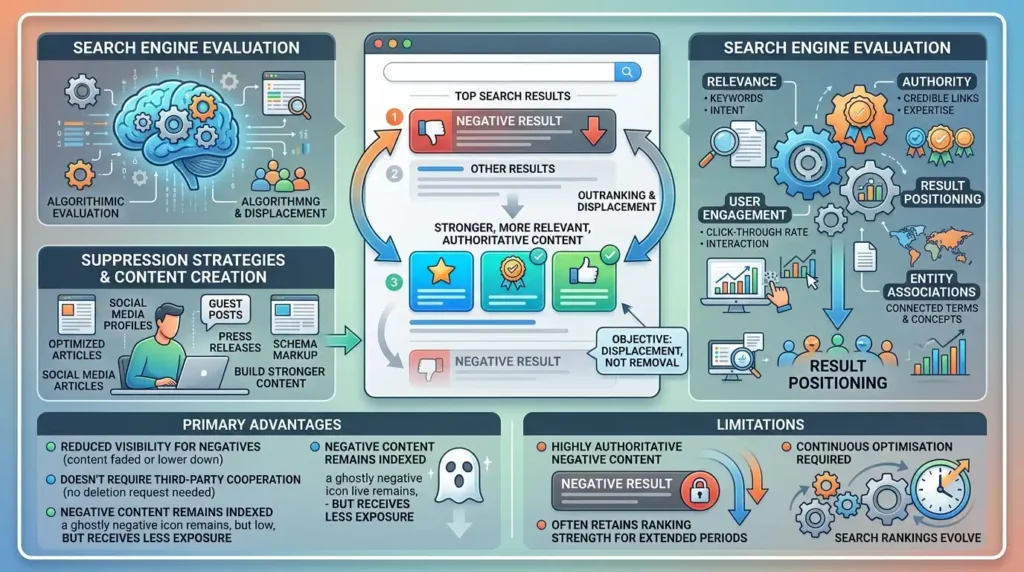
Content suppression is a reputation management method that operates by creating stronger, more relevant, and authoritative content capable of outranking negative search results. The objective is not removal but displacement. Search engines evaluate relevance, authority, user engagement, and entity associations when ranking content. Suppression strategies target these ranking factors to alter result positioning.
The primary advantage of suppression lies in its ability to reduce visibility without requiring third-party cooperation. Negative content remains indexed but receives less exposure. The limitation is that highly authoritative negative content often retains ranking strength for extended periods. Suppression campaigns also require continuous optimisation because search rankings evolve over time.
What Is Content Enhancement?
Content enhancement is the process of improving existing positive or neutral digital assets to strengthen entity credibility signals. This method focuses on owned and controllable content such as professional profiles, publications, interviews, biographies, and authoritative contributions. Search engines interpret enhanced content as stronger evidence of entity relevance.
Content enhancement provides greater sustainability than suppression because it builds long-term authority. The limitation is that enhancement alone does not directly reduce the visibility of damaging content. Its effectiveness depends on the quality of the digital footprint and the authority of the enhanced assets. From a sustainability perspective, enhancement generates stronger long-term reputation signals than suppression.
How Effective Are Content Removal Strategies Compared with Search Result Management?
Content removal and search result management address reputation concerns through fundamentally different mechanisms. Removal eliminates content from the searchable ecosystem, while search result management modifies visibility patterns without removing content.
Content removal is the most direct approach when information violates platform policies, legal standards, privacy regulations, or publishing guidelines. The mechanism involves requesting deletion, de-indexing, correction, or platform enforcement actions. Search engines respond to content removal by updating their indexes and recalculating rankings. The effectiveness is immediate when successful because the content no longer contributes to sentiment distribution.
Search result management becomes relevant when removal is unavailable. Many published materials remain legally compliant and therefore continue to exist online. In these situations, reputation management focuses on influencing ranking structures rather than pursuing deletion. Search engines evaluate relevance and authority rather than reputational fairness. As a result, management efforts concentrate on creating stronger competing signals.
Removal provides higher immediate impact but lower scalability because each case requires individual assessment. Search result management provides broader scalability because it addresses multiple ranking outcomes simultaneously. The choice depends on content ownership, legal considerations, platform policies, and search ecosystem dynamics.
How Do Organic Reputation Management Approaches Compare with Reactive Interventions?
Organic reputation management and reactive reputation management differ in timing, objective, and risk profile. Organic approaches focus on building reputation assets before issues emerge. Reactive interventions respond after negative signals become visible.
Organic reputation management is a preventative framework. It operates by establishing authoritative content, maintaining accurate profiles, publishing credible information, and strengthening entity associations. Search engines interpret consistent authority signals as evidence of credibility. This creates resilience against future reputation disruptions. Organic approaches improve entity recognition and reinforce positive search ranking influence over time.
Reactive interventions address existing reputation problems. The objective is damage containment and sentiment correction. Reactive methods often involve suppression strategies, removal requests, corrective content, and search result restructuring. The advantage is direct response to visible issues. The limitation is that intervention occurs after reputational effects already exist.
From a risk evaluation perspective, organic approaches reduce future exposure while reactive interventions address current exposure. Organic strategies generally produce stronger sustainability because authority accumulates gradually. Reactive methods often require higher resource allocation because they compete against established search results and existing sentiment patterns.
How Do Search Engines Interpret Reputation Signals for Individuals?

Search engines interpret reputation through collections of signals rather than single indicators. Reputation signals include content authority, source credibility, review sentiment, engagement metrics, publication quality, consistency of information, and entity associations.
Entity credibility is a search concept describing the trustworthiness and contextual relevance of a person across indexed sources. Search engines compare references, citations, profiles, publications, and third-party mentions to evaluate credibility. Consistent positive references strengthen confidence in entity identification and authority.
Sentiment distribution influences perception but does not function as a direct ranking factor. Search engines primarily rank content according to relevance and authority. However, highly authoritative negative content often gains visibility because of engagement, citations, and user interest. This creates indirect search ranking influence.
Reputation management strategies operate by strengthening favourable credibility signals and reducing the prominence of weak or damaging associations. The effectiveness of any strategy depends on how search engines interpret authority relationships within the broader digital ecosystem. Search visibility improves when positive and neutral content contributes stronger relevance signals than negative alternatives.
Which Reputation Management Methods Deliver Stronger Long-Term Results?
Long-term effectiveness depends on sustainability, authority accumulation, and resistance to ranking fluctuations. Different methods produce different outcomes when evaluated over extended periods.
The following framework compares long-term performance:
- Build authoritative content through expert publications and verified profiles to strengthen entity credibility.
- Enhance existing assets by improving relevance, structure, and search optimisation signals.
- Maintain information consistency across platforms to reinforce entity recognition.
- Address inaccurate content through correction and verification processes.
- Monitor sentiment distribution to identify shifts in reputation signals before they affect visibility.
Authority-building approaches generally outperform short-term visibility tactics because search engines continuously reward trusted and relevant content. Enhanced authority contributes to durable search ranking influence. Suppression techniques remain effective when supported by strong authority assets but lose effectiveness when new content is not maintained.
Temporary reputation improvements often result from isolated actions rather than systematic signal development. Sustainable reputation management relies on continuous reinforcement of credibility indicators across multiple digital environments. Search engines evaluate cumulative evidence rather than isolated reputation events.
How Should Reputation Management Strategies Be Evaluated Before Seeking External Support?
Evaluation begins with identifying the source of reputation risk. Different problems require different mechanisms. A negative review profile requires a different response than outdated content, adverse media coverage, or inaccurate search associations.
The first evaluation factor is visibility. Content appearing on the first page of branded search results influences perception more directly than content buried within deeper search pages. Search result prominence determines practical impact. Reputation management efforts focus on areas where visibility intersects with credibility.
The second factor is authority. High-authority content possesses stronger ranking durability than low-authority content. Understanding authority levels helps determine whether suppression, enhancement, or removal provides the most effective outcome. Search ecosystems reward authority consistency, making authority assessment essential for strategy selection.
The third factor is sustainability. Short-term fixes produce temporary outcomes, while authority-building frameworks generate enduring improvements. Evaluating sustainability reveals whether a strategy improves entity credibility or merely alters temporary visibility patterns. Reputation management approaches differ substantially in their capacity to maintain results over time.
Discover More from Our Guide Library:
How Negative Search Results Influence Professional Opportunities
12 Personal Reputation Metrics Worth Monitoring Every Month
Professional reputation management support becomes relevant when reputation signals materially influence search visibility, entity credibility, or public perception. The effectiveness of any approach depends on the structure of search results, the authority of existing content, and the nature of the reputation challenge.
Content suppression and content enhancement operate through different mechanisms, while removal strategies and search result management address separate aspects of visibility control. Organic reputation management focuses on preventative authority building, whereas reactive interventions concentrate on correcting existing reputation issues. Search engines evaluate credibility through interconnected authority signals, making long-term reputation outcomes dependent on sustainable digital footprint development rather than isolated actions.
Within this evaluation framework, topics related to:
Reputation Management Consultants for Individuals connect directly to the assessment of external expertise, strategic implementation, and reputation signal management across search ecosystems.
Answers to Key Questions
How does reputation management for individuals improve search results?
Reputation management improves search results by enhancing positive content, optimising authoritative profiles, and reducing the visibility of outdated or negative information. This helps create a more balanced and accurate online presence.
When should someone consider reputation management for individuals?
Individuals often consider reputation management when negative search results, inaccurate information, online reviews, or unwanted content affect personal or professional credibility. Early action helps maintain stronger control over digital reputation.
Can negative online content be removed through reputation management?
Reputation management may involve content removal requests when information violates platform policies or legal requirements. When removal is not possible, strategies often focus on content enhancement and search result optimisation.
What is the difference between reputation monitoring and reputation management?
Reputation monitoring tracks mentions, reviews, and online discussions, while reputation management takes action to improve reputation signals and search visibility. Clear My Name explains that monitoring identifies issues, whereas reputation management addresses them through strategic digital footprint optimisation.