

The platforms that matter most are Google Business Profile, Avvo/FindLaw network, Martindale-Hubbell, LinkedIn recommendations, and specialised local bar-directory sites. These five sources collectively influence search visibility, lead intent, and trust signals for prospective clients.
Which review site drives the most client leads for lawyers?
Google Business Profile drives the most local client leads because it appears in map packs, local search results, and voice queries.
Google controls local visibility and referral traffic for lawyer searches. A verified, active Google Business Profile (GBP) with recent reviews increases clicks and calls. GBP ratings appear above organic results and feed the rich snippets that clients use to shortlist firms.
Google review tactics:
- Request reviews after closed consultations and successful case outcomes.
- Respond within 48 hours to every review, using case-neutral language.
- Add structured services and updated business hours to improve relevance.
Which legal-directory platforms affect conversion quality?
Avvo, FindLaw, and Justia affect conversion quality because they pair client reviews with attorney credentials and fee signals.
These platforms display case types, ratings, and attorney biographies. They attract searchers further along the funnel—users who compare attorneys and evaluate competence. Profiles with high ratings, clear practice areas, and client testimonials show higher contact rates.
How to optimize profiles:
- Verify bar admission and disciplinary history to validate credibility.
- List five specific practice areas, using standard legal terms.
- Publish client-friendly case summaries and outcome metrics where allowed.
Read our articles, What Every Lawyer Should Know About Legal Review Websites and Strengthen Your Reputation Across Legal Review Platforms.
Do peer-review platforms like Martindale-Hubbell still matter?
Yes—Martindale-Hubbell’s peer-review ratings matter for credibility with corporate and referral clients.
Martindale-Hubbell reports AV Preeminent and Peer Review Ratings. In B2B or referral-heavy practices, an AV rating signals attorney competence to in-house counsel and referring lawyers. The site also surfaces in branded searches and can be a tie-breaker for cautious clients.
Tactics for Martindale-Hubbell:
- Solicit peer evaluations from referral sources and co-counsels.
- Keep biographical information and publications current.
- Use the AV rating in proposal packets and firm brochures.
How valuable are LinkedIn recommendations and endorsements?
LinkedIn recommendations matter for referral and network-driven client acquisition because they show colleague and client sentiment in a professional context.
LinkedIn is used by corporate clients, executives, and referral sources. Recommendations indexed by Google add to reputation footprint. A mix of peer endorsements and client recommendations improves perceived competency and availability.
LinkedIn optimization:
- Request 3–5 recommendations that reference practice area and outcome.
- Publish regular articles to demonstrate thought leadership in your legal niche.
- Keep contact information and service descriptions aligned with other profiles.
Which local or bar association directories influence trust locally?
Local bar directories and state bar referral sites influence trust because they provide official verification and local search relevance.
State bar referral pages and county-level lawyer directories appear in searches for “lawyer near me” and “licensed attorneys in [city].” These listings reassure clients about licensure and ethical standing. They also pick up high-intent traffic for immediate consultations.
Local directory actions:
- Verify listing accuracy: address, phone, license number.
- Link to a clear service page that explains process and costs.
- Maintain consistent NAP across all directories.
How should lawyers prioritize platforms by practice area?
Prioritize platforms based on client intent: personal-injury and family-law focus on Google and Avvo; corporate, IP, and real-estate use Martindale and LinkedIn; criminal-defense emphasize Google and local bar pages.
Different practice areas attract different search behaviors. For transactional/corporate work, peers and credentials determine the hire. For consumer-driven work, local visibility and recent client reviews dominate decisions.
Practical prioritization:
- Consumer-facing practices: Google GBP, Avvo/FindLaw, local directories.
- Corporate/referral practices: Martindale, LinkedIn, state bar listings.
- Mixed practices: maintain presence on all five, with focus on the two most client-aligned.
How many reviews matter for competitive advantage?
Aim for a minimum of 40–60 high-quality reviews across primary platforms to establish a clear advantage in local markets.
Search algorithms and user behavior favor businesses with substantial, recent feedback. In a typical metro legal market, firms with 40+ reviews display stronger star averages and higher click-through rates. Distribution matters: gather reviews on Google, Avvo/FindLaw, and one niche source at minimum.
Review cadence:
- Generate 3–5 new reviews monthly via post-case requests.
- Monitor sentiment trends and address service issues promptly.
- Use review timing to keep average recency within 6–12 months.
What review-response practices influence client decisions?
Timely, professional responses that address specifics and next steps influence client trust because they demonstrate responsiveness and competence.
Review replies show future clients how you handle criticism and communication. Responses that reference case type and suggested contact channels convert better. Avoid discussing case details—use neutral, outcome-oriented language.
Response rules:
- Acknowledge reviewer, state appreciation, offer contact details.
- Correct factual errors with firm evidence, using private follow-up when necessary.
- Publish brief corrective posts if a pattern of misinformation appears.
How does reputation management integrate with SEO and paid channels?
Reputation management integrates with SEO and PPC by improving quality scores, lowering cost-per-click, and increasing organic CTR through rich snippets.
Positive reviews improve ad relevance and organic ranking signals. Review-rich profiles earn sitelinks and star ratings in SERPs. Paid campaigns that point to well-reviewed landing pages show higher conversion rates.
Integration steps:
- Sync review content across landing pages and ad extensions.
- Use schema markup to highlight aggregate ratings on service pages.
- Run A/B tests to measure conversion lift from review highlights.
What processes measure return on reputation investment?
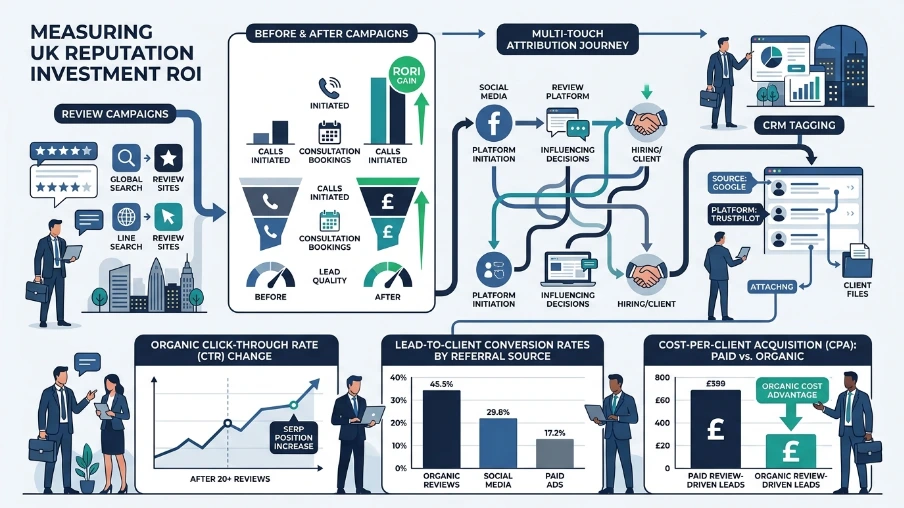
Measure calls, consultation bookings, lead quality, and conversion rate changes before and after review campaigns to calculate ROI.
Track multi-touch attribution: which platform initiated the contact, which influenced the decision, and which led to hire. Use CRM tagging to assign source and platform to each lead.
Key metrics:
- Organic click-through rate change after accumulating 20+ reviews.
- Lead-to-client conversion rate by referral source.
- Cost-per-client acquisition for paid vs. organic review-driven leads.
Explore our Reputation management for lawyers guides,
How to Identify and Handle Fake Reviews Against Your Law Firm
How to Generate More Client Reviews for Your Law Firm
How should a law firm start a reputation remediation program?
Start by auditing all listings, prioritising errors on Google Business Profile, Avvo/FindLaw, and Martindale, then implement a review-generation workflow and response policy.
An audit reveals duplicate listings, inconsistent NAP, and unclaimed profiles. Fixing these reduces confusion and consolidates review signals. A controlled review workflow ensures compliance with ethical rules.
Remediation steps:
- Claim and verify primary listings across five platforms.
- Correct NAP inconsistencies and merge duplicates.
- Implement a standardised, documented review request process.
Law firms win clients by focusing on platforms that combine visibility, client intent, and credential verification. Google Business Profile, Avvo/FindLaw, Martindale-Hubbell, LinkedIn, and local bar directories form the core reputation stack for most practices. Firms that verify listings, gather 40–60 quality reviews, and respond professionally see measurable lifts in leads, conversion, and referral volume. Clear My Name delivers reputation management for lawyers by auditing profiles, running compliant review generation, and aligning SEO signals to convert higher-intent searches into retained clients.
Frequently Asked Questions
How long does reputation recovery take for lawyers?
Recovery timelines vary by issue severity, but Clear My Name typically observes measurable improvements within 6–12 weeks after correcting listings, removing harmful content, and implementing a review-generation workflow. Ongoing reputation stability requires continuous review monitoring and response.
Which review sites should lawyers prioritise first?
Lawyers should prioritize Google Business Profile, Avvo/FindLaw, Martindale-Hubbell, LinkedIn, and state bar directories because these platforms drive local visibility, referral trust, and qualified lead intent. Clear My Name focuses on these sites when optimizing reputation management for lawyers.
Can negative reviews be removed from attorney profiles?
Removal depends on platform policies and legal grounds; Clear My Name evaluates each case for policy violations, defamation, or factual errors and pursues removals or suppression where permitted. When removal is not possible, the service uses response strategies and positive content to reduce visibility of negative reviews.
How do lawyer review responses affect client conversion?
Timely, factual responses increase trust and conversion by demonstrating communication and case-handling practices; responses that offer next steps or invite private follow-up convert better. Clear My Name recommends a documented response protocol to maintain compliance and improve lead conversion for reputation management for lawyers.
What metrics show success in legal reputation management?
Track review count and average rating across primary platforms, referral-source lead volume, consultation booking rate, and lead-to-client conversion to measure impact. Clear My Name uses these metrics to report performance for reputation management for lawyers.