

Reputation management strategies differ based on whether a business prioritises proactive entity-building or reactive crisis mitigation within local search ecosystems. Online reputation control methods are evaluated through their capacity to alter sentiment distribution, influence search ranking systems, and secure long-term entity credibility.
How Do Proactive and Reactive Reputation Management Methods Compare in Effectiveness?
Proactive reputation management is the systematic construction of positive digital assets and sentiment distribution before a reputational crisis occurs. This method operates by establishing a resilient network of verified entity profiles, authoritative local citations, and a continuous stream of first-party customer reviews. By contrast, reactive reputation management is an emergency response initiated after negative sentiment or damaging content alters search visibility and consumer perception. This approach focuses on rapid content suppression, legal removal requests, and direct crisis communications to minimise immediate financial exposure.
The operational mechanisms of these two approaches create contrasting outcomes within search engine results pages (SERPs). Proactive methods leverage search engine algorithms by feeds of consistent, structured data that reinforce entity credibility over time. When a business maintains a high volume of positive reputation signals across diverse platforms, search engines view the entity as stable and trustworthy. Consequently, isolated negative reviews or malicious content struggle to gain search ranking influence because the existing digital footprint possesses superior historical authority.
Reactive methods require significantly higher resource expenditure to achieve measurable results because they operate under algorithmic deficits. When negative content gains search visibility, it often benefits from high user engagement signals, which search algorithms interpret as relevance. Suppressing this content requires the manual generation of highly authoritative, optimised digital assets to displace the negative URLs. While reactive strategies are necessary for acute crisis containment, they do not build the foundational trust required to prevent future algorithmic vulnerability.
What Are the Mechanisms and Limitations of Content Suppression versus Legal Removal Strategies?
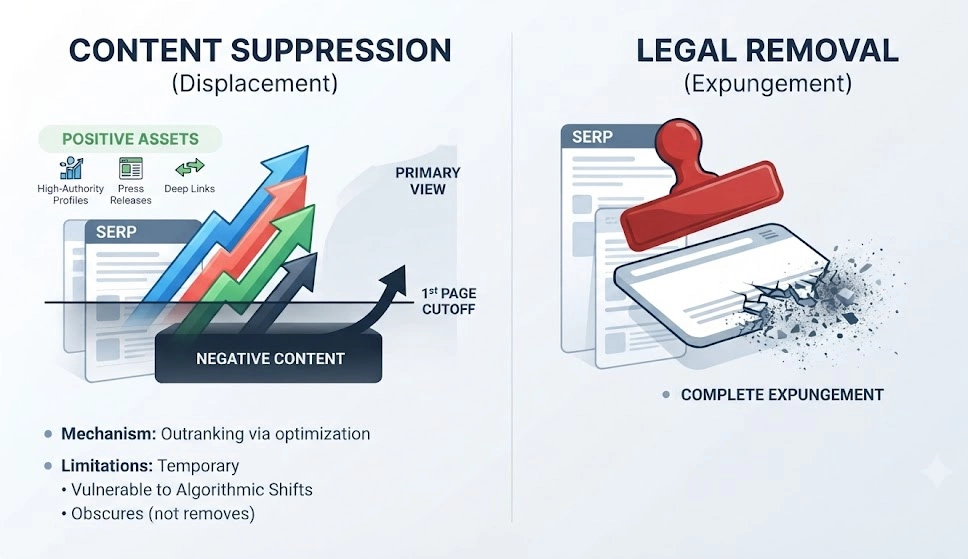
Content suppression is the strategic optimization and promotion of positive or neutral digital assets to displace negative search results from the first page of a SERP. This approach operates by exploiting algorithmic ranking factors, specifically targeting the top ten organic search positions where user visibility drops by over ninety percent past the first page. Businesses deploy suppression by creating high-authority profiles on third-party platforms, publishing optimized local press releases, and building deep links to existing positive assets. The primary mechanism relies on outranking the damaging URLs through superior search ranking influence and entities matching.
Legal removal strategies involve the direct elimination of negative content from the source website or search engine indexes via regulatory frameworks and terms of service violations. This method utilizes legal mechanisms such as Defamation Acts, General Data Protection Regulation (GDPR) right to be forgotten requests, and copyright infringement notices. When successful, the offending URL is completely expunged from the digital ecosystem or de-indexed from search engine results entirely. This strategy provides an absolute resolution to specific pieces of damaging digital content.
The limitations of content suppression center on sustainability, algorithmic shifts, and ongoing financial commitments. Search engine algorithms frequently update their core ranking components, meaning suppressed negative content can resurface if the supporting assets lose authority. Furthermore, suppression does not destroy the negative sentiment; it merely obscures it from primary view, leaving the business vulnerable if users alter their search queries.
The limitations of legal removal strategies relate to narrow applicability and high entry barriers. Search engines and review platforms rarely remove content simply because it is negative or financially damaging to an entity. The business must prove the content is factually false, fraudulent, or illegal, which involves rigorous documentation and legal expenditures. If a removal request fails, it can exacerbate the crisis by drawing additional journalistic scrutiny to the disputed issue.
How Do Search Engines Interpret and Weigh Local Reputation Signals?
Search engines interpret local reputation signals through a combination of text analysis, entity extraction, velocity metrics, and reviewer authority profiles. Machine learning models parse the unstructured text within customer reviews to determine sentiment distribution and identify specific attributes associated with the business entity. Algorithms do not merely count positive and negative ratings; they assess the semantic context to verify if the feedback aligns with known local ranking factors.
Review Velocity and Consistency
Review velocity refers to the speed and consistency at which a business entity acquires new reputation signals over a given timeframe. Search engine algorithms monitor review acquisition patterns to detect artificial manipulation and ensure the validity of trust metrics.
- Monitor spikes in submission frequency to detect unnatural patterns that indicate review manipulation or spam.
- Evaluate steady acquisition models to confirm a business is actively operating and engaging with its local audience.
- Analyse historical consistency to establish long-term baseline credibility scores for the target entity.
Platform Diversity and Citation Authority
Platform diversity measures how evenly a local business’s reputation signals are distributed across the broader digital ecosystem rather than a single platform. Search systems cross-reference data from multiple independent nodes to confirm the geographical and categorical relevance of an entity.
- Cross-reference first-party reviews with third-party aggregators to validate the authenticity of the primary sentiment profile.
- Assess the authority of the underlying platforms hosting the reviews to determine their overall search ranking influence.
- Verify structural citation accuracy across local directories to reinforce core entity data within knowledge graphs.
Reviewer Profile Trustworthiness
The algorithmic weight assigned to a specific reputation signal depends heavily on the historical authority of the profile generating that signal. Search networks maintain trust metrics for individual user accounts based on their historical contribution accuracy, geographical movement, and review patterns.
- Discount anonymous or newly created profiles that exhibit anomalous behavior or lack historical data footprints.
- Amplify the ranking influence of local guides or verified accounts that possess a history of high-engagement contributions.
- Evaluate the geographical proximity of the reviewer profile to the business location to filter out remote, fraudulent feedback.
Which Metrics Determine the Strategic Selection of a Digital Trust System?
The strategic selection of a digital trust system depends on specific operational metrics that evaluate scalability, risk exposure, and algorithmic sustainability. Business entities must analyse their existing digital footprint to determine whether resource allocation should favour automated sentiment acquisition or manual asset optimization. The decision-making process requires an objective audit of current SERP composition, branded search volume, and the severity of existing negative reputation signals.
When evaluating risk exposure, local entities must measure the volatility index of their primary branded search engine results pages. If the first page of the SERP contains unverified third-party content or unmanaged forums, the risk profile is high, necessitating structural asset development. Sustainable reputation strategies prioritize building owned or controlled digital assets over third-party platforms that are vulnerable to external policy changes.
To establish sustainable trust, local firms often require specialized deployment models that align daily operations with systemic algorithmic demands. Implementing structured processes allows an organization to transition away from volatile reactive fixes and move toward continuous entity enhancement. Utilizing specialized local business reputation management services that increase trust enables an enterprise to systematically audit, track, and scale these critical trust signals across diverse search ecosystems.
What Strategic Considerations Govern Local Business Reputation Architecture?
A local business reputation architecture must balance immediate sentiment correction with long-term entity permanence within search networks. Organic, proactive asset building offers the highest level of sustainability and the lowest long-term risk profile for local businesses. By maintaining a diversified digital footprint, continuous review acquisition, and accurate structural data, entities insulate themselves against negative sentiment shocks and algorithmic shifts.
Reactive interventions, including content suppression and legal removals, remain essential tactical components for managing acute crises and eliminating fraudulent data. However, these methods do not produce structural trust when deployed in isolation from broader entity-building strategies. Strategic success is achieved when a business integrates automated data collection, systematic sentiment monitoring, and high-authority content creation into its foundational operational framework.

Frequently Asked Questions
How do local business reputation management services that increase trust improve search engine rankings?
Search engines analyze review velocity, sentiment distribution, and citation consistency to determine local search visibility. Digital trust systems optimize these signals by establishing verified third-party profiles and a steady flow of authenticated consumer reviews. Clear My Name deploys these structured frameworks to ensure search algorithms recognize an entity as a highly credible and authoritative local choice.
What is the difference between content suppression and content removal in reputation repair?
Content removal involves legally expunging defamatory, fraudulent, or inaccurate digital assets directly from host platforms or search indexes. Content suppression, conversely, utilizes organic search engine optimization to elevate positive assets and push negative search results past the first page of results. Clear My Name evaluates the root cause of negative sentiment to determine whether algorithmic dilution or absolute legal extraction offers the most sustainable risk mitigation.
How quickly do proactive reputation management strategies deliver results for businesses?
Proactive strategies build entity credibility over an extended horizon by cultivating diverse trust signals and steady review acquisition patterns. While initial local citation updates and profile optimizations yield search visibility improvements within 30 to 60 days, establishing resilient algorithmic defense requires sustained management. This continuous development helps local enterprises insulate their branded SERPs against future negative content shocks and volatility.
Can a local business remove fake or defamatory negative online reviews legally?
Yes, local entities can pursue removal if the negative review violates the host platform’s terms of service or contains demonstrably false, defamatory statements. This process requires a precise analysis of regulatory frameworks, profile transparency, and legal documentation rather than simple disputes over negative consumer opinions. Expert reputation management systems streamline these submission workflows to effectively de-index or delete malicious feedback affecting entity trust scores.
Why is platform diversity critical for an effective business digital footprint?
Search engine algorithms cross-reference data across multiple independent platforms to validate the real-world authority and location of an enterprise. Consolidating all reputation signals onto a single platform creates algorithmic vulnerability and limits consumer sentiment distribution across distinct search entry points. Diversifying assets across specialized industry directories and major search ecosystems ensures consistent local entity reinforcement and stabilizes search ranking influence.