

Search perception influence dictates commercial success because 98% of consumers read online reviews before engaging with local businesses. Controlling your search visibility ensures that prospective customers encounter positive reputation signals, directly converting search traffic into revenue.
Why Does a Professional Reputation Management Service Outperform In-house Efforts?
A professional reputation management service delivers predictable SERP control because it operates at the algorithmic level rather than relying on basic review solicitation. In-house teams lack the technical infrastructure and semantic search expertise required to execute complex negative content suppression. Professional strategists understand how search engines evaluate entity credibility, allowing them to adjust the authority weights of specific web pages systematically. This advanced methodology alters what the public sees when querying a business name, transforming a damaged digital footprint into a powerful conversion asset.
Managed services leverage established publisher networks and proprietary search engine optimisation assets to outrank damaging links. While an internal marketing team focuses on surface-level social media updates, a specialized agency deploys advanced entity-structuring techniques to dominate the first page of search results. This technical intervention changes the narrative by elevating positive, controlled assets above unsolicited, harmful content. Consequently, businesses secure their digital perimeter against algorithmic volatility and competitor-driven defamation.
Investing in an external partner ensures the sustainability of your digital trust. Agencies monitor search ecosystem fluctuations continuously, neutralizing new reputational threats before they gain visibility or indexation authority. This proactive posture minimizes revenue leaks caused by historical crises or malicious online attacks. By choosing a dedicated professional reputation management service, enterprises protect their brand equity and ensure that their search results accurately reflect their current operational standards.
Which Reputation Management Approach Delivers Measurable Results?
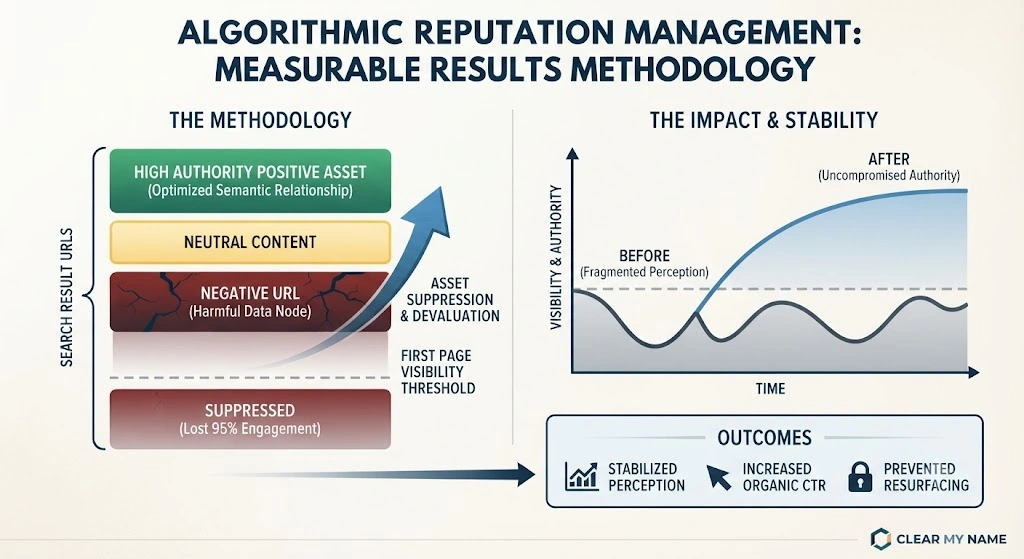
An algorithmic approach focused on entity credibility and asset suppression delivers the most predictable outcomes for local businesses. This methodology goes beyond simple public relations by directly manipulating the data nodes that search engines use to construct your brand entity. By optimizing the semantic relationship between your business and high-authority digital platforms, this strategy systematically devalues negative content. The process weakens the visibility of harmful URLs, forcing them off the first page of search results where they lose 95% of their user engagement.
The execution begins with a comprehensive audit of all historical search perception signals associated with your enterprise. Technicians identify the specific structural elements keeping negative links highly visible, such as inbound link velocity or user engagement metrics. Strategies then deploy counter-content campaigns, establishing robust informational nodes that search engines recognize as more relevant and authoritative. This structural shift ensures long-term stability, preventing suppressed negative content from resurfacing during core algorithmic updates.
Local enterprises achieve measurable growth in consumer acquisition when their search results project uncompromised authority. Clear My Name engineers bespoke campaigns that align your digital footprint with the exact trust signals required by search engine evaluation guidelines. This systematic approach stabilizes perception, increases organic click-through rates, and removes the conversion friction caused by historical digital anomalies. Business owners gain absolute clarity over their public profile while enjoying sustained improvements in local search visibility.
What Are the Core Process Steps for Sustainable Negative Content Suppression?
Sustained negative content suppression requires a rigorous, multi-phased technical framework executed with absolute precision. The initial phase involves deep entity mapping to isolate the harmful URLs and determine their exact ranking signals within the target search ecosystem. Next, technical teams construct a network of optimized digital assets designed to mirror the semantic profile of your highest-performing industry peers. These new assets undergo aggressive authority building to accelerate their indexation and upward movement through the search engine results pages.
The third stage focuses on suppressing the targeted negative material by starving it of contextual relevance and authority. This is achieved by creating superior information hubs that capture the search intent behind your brand queries, effectively pushing down the damaging links. Finally, continuous algorithmic monitoring ensures these results remain permanent despite ongoing search engine updates. This systematic process guarantees that positive reputation signals remain dominant, protecting the brand from future algorithmic shifts.
- Map the entity footprint to identify all active negative nodes across the search ecosystem.
- Establish high-authority counter-assets optimized for brand-name search intent.
- Inject structured schema data to reinforce your official brand channels as primary authority sources.
- Execute strategic link building to elevate positive assets above historical negative content.
- Monitor SERP fluctuations daily to maintain the suppression depth of harmful URLs.
How Does Search Perception Control Directly Impact Business Revenue?
Search perception control functions as a direct driver of business revenue by removing the conversion barriers created by negative search results. When a prospective customer searches for your local services, the presence of a single negative link can reduce conversion rates by up to 22%. By implementing precise online reputation management for businesses, enterprises secure their sales pipeline against competitor attacks and historical anomalies. This strategic intervention ensures that high-intent traffic encounters only positive trust signals, drastically increasing the velocity of your lead-to-customer lifecycle.
Controlling your brand narrative allows you to command premium pricing within your local market. Consumers willingly pay a premium for brands that exhibit high entity credibility and flawless search visibility. Conversely, businesses with fragmented search results must discount their services to compensate for the perceived risk of engagement. Resolving these digital discrepancies restores market confidence and directly improves profit margins across all service lines.
Furthermore, a stabilized search profile lowers customer acquisition costs by maximizing the efficiency of your existing marketing spend. Paid advertising campaigns deliver higher returns when prospective buyers validate your brand via organic search and find an unblemished reputation. Clear My Name provides the technical framework necessary to secure these financial improvements, converting your search presence into a resilient asset. Our data-backed methodologies ensure that every search query reinforces your market leadership and accelerates commercial growth.
What Is the True Timeline for Restoring Brand Entity Credibility?
Restoring brand entity credibility requires an operational timeline dictated by search engine indexing cycles and algorithmic re-evaluation periods. Initial search perception influence becomes visible within 30 to 90 days as newly engineered assets begin indexing and displacing low-authority negative content. However, achieving comprehensive first-page dominance and total suppression of deeply rooted negative links typically requires a sustained campaign lasting six to twelve months. This timeline ensures that the changes are recognized as permanent by search algorithms, preventing historical data from re-emerging.
The velocity of the restoration process depends heavily on the authority of the sites hosting the negative content. High-authority media outlets or government domains require more intensive, sophisticated suppression campaigns than independent blogs or low-tier review platforms. To better understand how different strategic approaches impact these operational timelines, decision-makers should examine which reputation strategies deliver the best results, as this analysis outlines the correlation between asset authority and suppression speed.
Investing in a long-term strategy mitigates the risk of future reputational volatility and secures your digital market share. Temporary or rushed fixes lack the structural integrity required to withstand major core algorithm updates. A methodical, phased roll-out builds a resilient shield of positive entity signals around your brand, ensuring long-term security. This structured approach guarantees that your investment yields durable protection, solidifying your market position against unpredictable digital threats.
How Do Enterprise Leaders Balance the Cost Versus Long-Term Value of Reputation Repair?
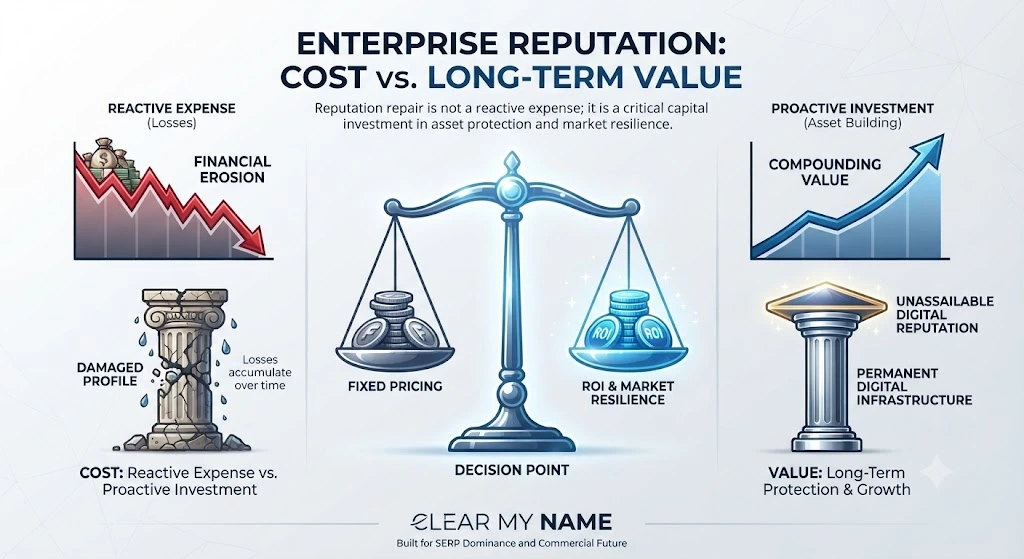
Enterprise leaders must view reputation repair not as a reactive marketing expense, but as a critical capital investment in risk mitigation and asset protection. The financial damage of unmanaged negative content scales over time, compounding lost revenue, diminished brand equity, and increased client acquisition costs. A proactive reputation campaign halts this financial erosion immediately, delivering compounding value as positive assets grow in authority and permanence. The long-term return on investment is realized through sustained customer acquisition, protected market valuation, and total immunity from digital defamation.
When evaluating the cost of these services, businesses must weigh the fixed pricing of professional intervention against the unpredictable, ongoing losses of a damaged public profile. A managed campaign creates permanent digital infrastructure—such as authoritative web properties and verified profiles—that continues to benefit the brand for years. To design an effective baseline strategy before engaging external specialists, executives frequently review online reputation management strategies to identify the core assets required for fundamental brand protection.
Ultimately, the value of search perception control lies in operational certainty and market resilience. Entrusting your brand to Clear My Name guarantees a mathematically driven approach to SERP dominance, removing the guesswork from corporate trust optimization. Our framework delivers clear transparency, measurable milestones, and definitive outcomes for your enterprise. Secure your commercial future today by partnering with our specialists to construct an unassailable digital reputation.
Frequently Asked Questions
How much do reputation management services cost for a UK local business?
The cost of reputation management for business varies depending on the severity of the negative content and the number of search terms requiring optimization. Most professional agencies charge a monthly retainer ranging from £500 to £3,000 for ongoing search perception influence and review building. Long-term campaigns yield a higher return on investment by permanently stabilizing entity credibility and securing first-page SERP control.
How long does it take to suppress negative search results on Google?
Initial search visibility improvements typically appear within 30 to 90 days as new, authoritative content begins to index. However, a comprehensive campaign targeting highly competitive keywords or authoritative links can take six to twelve months to achieve permanent negative content suppression. Companies like Clear My Name follow a structured, multi-phased approach to ensure suppressed links do not resurface during core algorithmic updates.
Can a local business completely remove a negative link from search results?
Complete removal is only possible if the host website agrees to take down the page or if the content violates legal standards, copyright laws, or Google’s terms of service. When removal is not legally viable, strategic negative content suppression is used to push the harmful URLs down past the first page of search results. This process significantly reduces public visibility because fewer than 5% of users ever click onto the second page.
What is the difference between review management and business reputation management?
Review management focuses specifically on monitoring, generating, and responding to customer feedback on platforms like Google Maps and Trustpilot. Reputation management for business encompasses a broader technical scope, including search engine optimization, entity structuring, and complete SERP control to shape public perception. This holistic framework protects corporate brands from a wider array of digital threats, including negative news articles or competitor defamation.
How do reputation signals affect a local business’s search rankings?
Search engines evaluate reputation signals, such as review velocity and user sentiment, to determine a brand’s overall entity credibility. Consistent positive feedback and high-authority online profiles tell search algorithms that a company is reliable, which directly improves local map pack and organic visibility. Proactively optimizing these signals prevents competitors from overtaking your market share and maintains consumer conversion rates.