

Company culture appears in customer buying decisions because public information increasingly exposes how organisations operate, treat people and establish professional standards. Reputation management is the systematic process of monitoring, evaluating and influencing the information that shapes how an organisation is perceived across digital environments.
What is company culture within an online reputation?
Company culture is the set of organisational values, behaviours, working practices and internal standards associated with how a business operates. Within online reputation systems, company culture refers to information that helps search users interpret an organisation beyond its products, services or pricing. This information includes employer reviews, leadership statements, employee experiences, corporate policies, media coverage and published organisational content. Search engines index these signals across different sources and associate them with the business entity. As a result, cultural information becomes part of the broader digital footprint surrounding an organisation.
Online reputation refers to the collective perception formed from publicly accessible information about a business. Company culture contributes to this perception because customers increasingly encounter organisational information during independent research. A customer searching for a company does not only encounter commercial landing pages but also reviews, news articles, professional profiles and third-party discussions. Each indexed source contributes contextual information to the entity represented in search results. Reputation therefore develops through the interaction between organisational identity, external information and search visibility.
Why does company culture influence customer buying decisions?
Company culture influences buying decisions because it provides additional information for evaluating organisational credibility and behavioural consistency. Customers use available information to understand whether an organisation’s stated values align with observable practices. This evaluation extends beyond traditional product attributes such as price, functionality and availability. Cultural information provides context about leadership, employee treatment, corporate responsibility and operational standards. When these elements appear prominently in search results, they become part of the information environment surrounding a purchasing decision.
Search visibility determines which cultural signals receive exposure during customer research. Content appearing on the first page of a search engine results page (SERP) receives greater visibility than information buried deeper in the results. Search engines evaluate relevance, authority, content quality and other signals when determining ranking positions. This creates an information hierarchy in which some descriptions of a company become more prominent than others. Customer perception therefore reflects both the existence of cultural information and its position within the search ecosystem.
How do search engines interpret company culture signals?
Search engines interpret company culture through indexed content associated with an organisation, its people and related entities. A search ecosystem connects information through entities, topics, attributes and relationships rather than treating every webpage as an isolated document. Corporate statements, reviews, news coverage and professional profiles can therefore contribute contextual signals around the same business entity. Content indexing makes these sources discoverable and enables search systems to evaluate their relevance to queries. The resulting SERP composition provides users with a structured representation of information associated with the organisation.
Entity perception develops from the consistency and context of information connected to a business. An organisation described consistently across authoritative sources presents a clearer entity structure than one represented through contradictory or poorly sourced information. Search systems analyse textual relevance, source relationships and other ranking signals to determine which content is useful for a query. Company culture becomes relevant when users search for information concerning workplace standards, leadership, ethics, employee experiences or corporate values. These searches connect cultural attributes with the broader entity representing the organisation.
How do employee reviews affect customer perceptions of company culture?
Employee reviews provide third-party information about organisational practices and therefore function as reputation signals. These reviews can describe management practices, communication standards, workplace policies, professional development and operational conditions. Customers encountering this information can use it as supplementary evidence when evaluating the organisation behind a product or service. Review platforms also create structured environments where repeated themes and sentiment patterns become visible. The informational value of reviews therefore extends beyond employee recruitment and enters wider reputation evaluation.
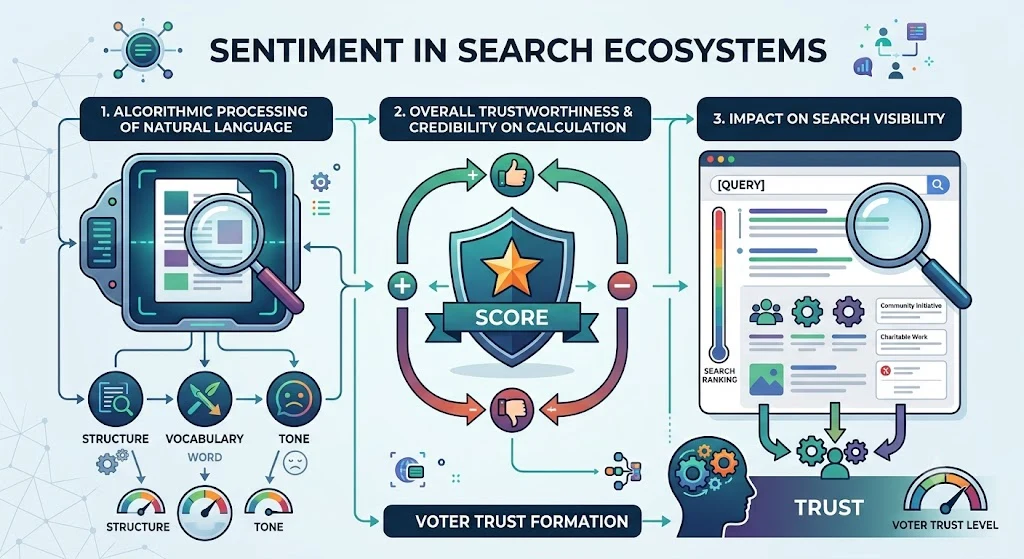
Sentiment interpretation adds another layer to how review information affects perception. Search users frequently assess recurring positive or negative themes rather than relying on a single statement. Search engines also process language and contextual relationships when determining the relevance of pages to specific queries. A concentration of reviews discussing the same organisational attribute creates a stronger topical association around that attribute. This does not mean that search algorithms simply calculate reputation from sentiment scores; instead, reviews form part of the wider information environment through which users evaluate an entity.
What role does content play in communicating company culture?
Content communicates company culture by documenting organisational values, policies, leadership perspectives and operational practices. Corporate websites, reports, interviews, professional publications and social profiles create identifiable information about how an organisation describes itself. Third-party content provides an external perspective that adds independent context to those organisational claims. Together, these sources contribute to the digital footprint associated with the business. The distinction between self-published and independently sourced information remains important when evaluating credibility.
Content quality also affects how cultural information is interpreted. Specific documentation provides stronger informational context than broad statements without supporting evidence. For example, a published policy defines an organisational practice more precisely than a general claim about commitment or responsibility. Search engines evaluate content according to relevance and other ranking characteristics, while users evaluate whether the information appears credible and consistent. Effective reputation analysis therefore examines both what content communicates and how that content exists within the broader search ecosystem.
How do authority and trust signals affect cultural information?
Authority and trust signals influence how cultural information contributes to entity perception because source credibility affects the interpretation of published claims. An established news organisation, professional body or recognised publication provides a different evidential context from an anonymous webpage. Search engines use multiple signals to assess content quality and relevance rather than assigning credibility through a single universal reputation score. Users also apply their own assessment when comparing sources. This creates a layered system in which source authority, content relevance and contextual consistency interact.
Trust is therefore not represented by one isolated ranking factor. It emerges from the relationship between information, source quality, consistency and user interpretation. A business described consistently across authoritative sources has a clearer informational profile than one surrounded by conflicting descriptions. Search visibility determines which of these sources become most accessible to users. Reputation analysis consequently evaluates both the content itself and the authority structure surrounding that content.
How does company culture become part of the digital footprint?
A digital footprint is the accumulated body of information associated with an organisation across online platforms and indexed sources. Company culture becomes part of this footprint when organisational behaviours, policies, employee experiences and leadership statements are published or discussed online. Each relevant page contributes another piece of contextual information connected to the business entity. Search engines index these pages according to their technical and semantic characteristics. Over time, this creates an interconnected information environment that users encounter during research.
The digital footprint is not controlled by a single webpage or platform. It consists of corporate-owned content, third-party publications, review platforms, professional networks, directories and other publicly accessible sources. This distribution means that reputation perception depends on the composition of information across multiple environments. Content ranking dynamics determine which elements become prominent for specific searches. Company culture therefore becomes visible through the cumulative structure of the organisation’s online presence.
Dive Deeper With Our Expert Guides:
How Chargeback and Scam Accusations Undermine Online Stores
Why Trade Association Membership Signals Business Credibility
Can company culture affect branded search results?
Company culture can affect branded search results when cultural topics become sufficiently relevant to searches involving the organisation. Branded searches are queries containing a company name or other identifying entity information. Users conducting these searches frequently encounter a mixture of official pages, reviews, news coverage, professional profiles and third-party references. Cultural information becomes part of the SERP when these sources are indexed and considered relevant to the query. The resulting search landscape provides users with a broader representation of the organisation.
SERP evaluation examines the composition, relevance and context of these results rather than focusing solely on individual rankings. A result discussing employee treatment has a different informational function from a product page, while a news article provides another form of external context. Together, these sources influence the information available during customer research. Search perception is therefore shaped by the balance of commercial, informational and third-party content appearing for relevant queries.
How does company culture relate to reputation management?
Reputation management is the structured evaluation of information, reputation signals and search perception surrounding an individual, organisation or brand entity. Within business reputation, company culture forms one informational category among broader signals such as customer reviews, leadership reputation, media coverage and corporate conduct. Analysing these categories helps identify how different information sources contribute to the overall digital footprint. The process focuses on understanding information visibility rather than treating reputation as a single measurable attribute. Search performance and content context provide the basis for this evaluation.
Cultural information also connects internal organisational behaviour with external perception. Employees generate first-hand observations, customers interpret external behaviour and publishers create independent coverage. These perspectives can converge or diverge across digital sources. Reputation analysis evaluates the resulting information structure to determine which themes are visible, authoritative and consistently associated with the organisation. This makes company culture a relevant component of modern search perception analysis.
How can businesses evaluate culture-related reputation signals?
Businesses can evaluate culture-related reputation signals by examining the sources, themes, rankings and entity relationships associated with organisational information. The evaluation begins with identifying relevant queries and documenting the SERP composition for each query. Analysts then assess the type of content appearing, the authority of its sources and the cultural attributes represented. Review sentiment and recurring topics provide additional context for understanding how organisational practices are discussed publicly. Content indexing and ranking positions complete the visibility assessment.

A structured evaluation can be organised into five stages:
- Identify culture-related search queries and record the information users encounter around the business entity.
- Classify indexed content according to source type, cultural topic, authority and informational purpose.
- Evaluate review signals by examining recurring themes, sentiment patterns and source context.
- Compare organisational claims against independently published information to assess consistency.
- Monitor SERP changes to measure how the visibility and composition of reputation-related information develops.
This process separates reputation perception from assumptions about customer behaviour. It establishes an evidence-based view of which cultural signals are visible, where those signals originate and how they relate to the organisation’s broader digital footprint.
Why is company culture increasingly connected with digital trust?
Company culture is increasingly connected with digital trust because customers use publicly available information to evaluate the organisations behind commercial transactions. Digital trust refers to confidence formed through observable information, source credibility, consistency and perceived organisational reliability. Cultural signals contribute to this evaluation when they provide evidence about how an organisation operates. Search engines make these signals accessible by indexing and ranking relevant content. The result is a purchasing environment where organisational identity extends beyond conventional product information.
The relationship between culture and trust therefore operates through information rather than through culture alone. A company’s internal practices become externally relevant when they are documented, reviewed, reported or discussed online. Search visibility determines how easily customers encounter those signals, while source authority affects how they interpret them. Consistency across the digital footprint strengthens the clarity of the entity representation. This makes company culture an increasingly significant component of reputation-related search analysis.
What does company culture mean for the future of customer research?
Company culture represents an increasingly visible information layer within customer research because digital discovery exposes more organisational attributes before a purchasing decision. Customers can evaluate products alongside leadership information, employee reviews, corporate policies, media coverage and public statements. Search engines organise these sources into SERPs according to query relevance and ranking signals. The resulting information structure influences which aspects of an organisation become visible during research. Reputation consequently extends into areas that were previously less connected with commercial search behaviour.
Understanding this relationship requires separating organisational claims from independently observable information. Showcasing Company Culture to Win Trust in the Buying Journey describes the content relationship between cultural information and customer trust while remaining connected to the broader reputation framework. The underlying principle is that search perception develops through indexed information, source authority, entity consistency and user interpretation rather than through one isolated reputation signal.
Company culture now appears in customer buying decisions because organisational information has become increasingly accessible through search engines, review platforms and third-party publications. Reputation management provides a framework for analysing how this information is created, indexed, ranked and interpreted across digital ecosystems. Employee reviews, cultural content, authority signals and entity consistency each contribute distinct information to the wider digital footprint. SERP composition determines which signals become visible during customer research, while source quality influences their interpretation. Understanding these mechanisms allows company culture to be analysed as a measurable component of online reputation and digital trust.
Why does company culture affect customer buying decisions?
Company culture can influence how customers perceive a business’s values, ethics, and treatment of employees. When these factors align with customer expectations, they can contribute to trust and purchasing decisions.
How does company culture influence brand reputation?
A company’s internal culture can affect employee behaviour, customer experiences, and public perception. A positive workplace culture can support a stronger brand reputation, while cultural problems may create reputational risks.
Do customers care about a company’s workplace culture?
Many customers increasingly consider how businesses treat employees, communities, and other stakeholders. Company culture can therefore become one factor customers assess alongside price, quality, service, and brand reputation.
Can company culture impact customer trust?
Yes, company culture can influence customer trust when a business consistently demonstrates values such as transparency, fairness, and accountability. Public information about workplace practices can also shape perceptions of corporate credibility.
How can businesses protect their reputation when company culture is discussed online?
Businesses should monitor relevant search results, respond accurately to legitimate concerns, and ensure their public information is factual and consistent. Reputation management approaches, such as those offered by Clear My Name, can help organisations understand and manage how company-related information appears online.