

Multilingual clients search for lawyers differently because language affects query formulation, content interpretation, local relevance, and the reputation signals visible in search results. Reputation management is the systematic management and analysis of information that influences how a lawyer or legal entity is perceived across digital search ecosystems.
Online reputation refers to the collective perception formed from indexed content, reviews, professional information, authoritative references, and other digital signals associated with a legal entity. For lawyers serving multilingual audiences, this reputation exists across language-specific search environments where identical legal needs generate different queries, terminology, and expectations.
Why does language change how clients search for lawyers?
Language changes lawyer searches by altering the terminology, intent, legal vocabulary, and contextual signals used to retrieve information. A multilingual searcher does not simply translate an English query word for word because legal concepts are expressed through jurisdiction-specific terminology and culturally established language patterns. Search queries therefore contain linguistic signals that help search engines determine the subject, location, legal service, and intended outcome. These signals influence which entities, pages, reviews, and professional references appear within the SERP. Reputation signals gain relevance when the indexed content accurately connects the lawyer’s entity with the terminology used by a particular audience.
Search behaviour also reflects differences between everyday language and formal legal terminology. A person searching in one language can use a colloquial description of a legal problem, while another searcher uses a formal legal term for the same underlying issue. Search engines analyse these linguistic relationships through semantic associations rather than relying only on exact keyword matching. This creates different retrieval pathways for pages that discuss the same legal expertise. The resulting search visibility depends on how clearly the available content establishes relationships between the legal entity, service category, jurisdiction, and language.
How do multilingual search queries affect lawyer reputation?
Multilingual search queries affect lawyer reputation by determining which information becomes visible to a particular language audience. A lawyer’s digital footprint consists of the indexed pages, profiles, reviews, publications, directories, references, and other online information connected with the entity. When searchers use different languages, search engines evaluate the available information through language-specific relevance and semantic relationships. Content that ranks for one language query does not automatically represent the complete reputation landscape for another language query. This creates distinct SERP compositions around the same lawyer or legal organisation.
The relationship between query language and indexed content also affects entity perception. If authoritative information exists in one language but limited information exists in another, searchers receive different evidence when evaluating the same entity. The difference is not necessarily a change in the underlying reputation; it is a change in the information exposed through retrieval. SERP evaluation therefore needs to distinguish between the actual digital footprint and the portion of that footprint surfaced for a specific language. This distinction provides a more accurate framework for analysing multilingual reputation.
How do search engines interpret multilingual legal content?
Search engines interpret multilingual legal content through semantic relationships involving language, entities, topics, terminology, location, and user intent. A page establishes topical relevance through its words, concepts, contextual relationships, structured information, and connections with other authoritative resources. Search systems analyse these signals to determine whether a document answers the underlying query. In legal search, the relationship between terminology and jurisdiction is particularly important because similar words can represent different legal systems or procedures. Accurate entity associations therefore form part of how legal content is evaluated.

Content indexing creates the foundation for this process. When a multilingual page is indexed, its subject matter becomes available for retrieval against relevant searches in the supported language. The page also contributes contextual information about the legal entity, practice area, jurisdiction, and expertise it represents. Consistency across these signals helps search engines establish clearer relationships between the lawyer and the topics associated with the entity. Poorly aligned terminology creates weaker semantic connections and reduces the clarity of the entity’s digital representation.
How does multilingual content influence search visibility?
Multilingual content influences search visibility by creating additional language-specific pathways through which an entity becomes discoverable. Search visibility refers to the extent to which a legal entity and its associated content appear for relevant searches within a particular search environment. Each indexed language version introduces terminology and contextual relationships that correspond to the searches performed in that language. This does not mean that simply adding translated pages produces equivalent visibility across languages. Search ranking depends on relevance, content quality, authority, technical accessibility, and the strength of the semantic relationship between the query and the document.
Language also influences the interpretation of topical authority. A legal website containing detailed information in English can establish strong associations with English-language legal queries. A separate language audience receives a different information set when relevant content is absent or poorly contextualised. Search engines then have fewer indexed documents from which to establish topic and entity relationships in that language. Multilingual search visibility therefore forms part of the broader digital footprint rather than functioning as an isolated translation exercise.
How do reviews affect multilingual lawyer reputation?

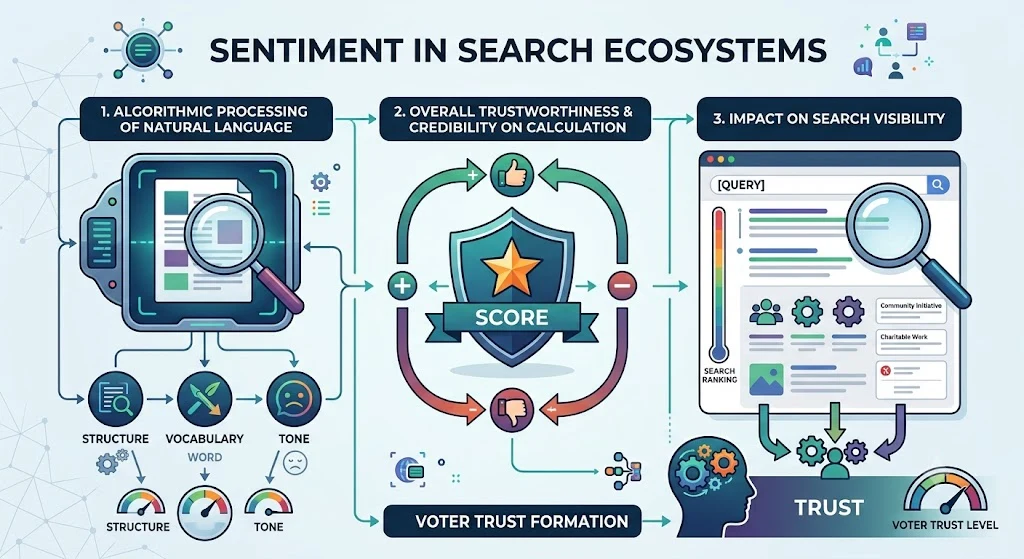
Reviews affect multilingual lawyer reputation by contributing sentiment, experience, service-related terminology, and entity associations to the digital information environment. Review signals provide search ecosystems with user-generated information connected to a lawyer, law firm, location, or legal service. The language of a review adds additional semantic context because it determines how service descriptions and sentiment expressions are interpreted. Searchers also encounter these reviews as part of the visible reputation surrounding an entity. Review content therefore participates in both perception and information retrieval.
Sentiment interpretation involves identifying whether review language expresses positive, neutral, or negative evaluations and what subjects those evaluations concern. A review containing terms associated with communication, professionalism, responsiveness, or legal expertise creates different reputation signals from a review focused on administrative matters. Multilingual reviews add another layer because equivalent sentiment can be expressed through different linguistic structures. Search systems process these textual signals alongside other information rather than treating review language as an isolated ranking factor. The resulting SERP composition reflects the combination of review evidence, entity information, relevance, and authority.
How do authority and trust signals shape multilingual legal search?
Authority and trust signals shape multilingual legal search by providing evidence that supports the identity, expertise, legitimacy, and topical relevance of a legal entity. Authority signals include professional publications, reputable references, recognised legal information sources, institutional profiles, and consistent professional information. Trust signals relate to the accuracy, consistency, transparency, and reliability of information associated with the entity. Search engines evaluate these signals as part of broader systems for determining relevance and quality. Searchers also use visible authority indicators when interpreting the credibility of results.
For multilingual audiences, authority becomes more complex because evidence can exist across different languages and geographic information environments. A professional reference written in one language establishes evidence within that language context, while a local-language publication establishes a different retrieval connection. Consistency between the entity name, legal expertise, location, professional details, and external references strengthens entity clarity. Inconsistent information introduces ambiguity into the digital footprint and affects how the entity is interpreted. Multilingual authority therefore depends on the coherence of evidence across language-specific information sources.
How does the digital footprint affect multilingual entity perception?
The digital footprint affects multilingual entity perception because searchers construct their understanding of a lawyer from the information presented across indexed sources. Digital footprint refers to the total collection of online information associated with an individual, organisation, or professional entity. This footprint includes owned content, third-party references, reviews, professional profiles, directories, publications, and other indexed resources. Each source contributes a different type of reputation signal to the overall information environment. Search engines organise these signals into results that form the observable search presence of the entity.
Entity perception is shaped by the consistency and relevance of this information. When professional identity, expertise, location, and supporting references align across sources, search engines have clearer evidence for connecting documents to the same entity. When information differs between language environments, the perceived entity can appear less consistent even when the underlying professional information is identical. Multilingual reputation analysis therefore examines both information accuracy and information distribution. The objective is to understand how the same entity is represented across different search contexts.
Dive Deeper With Our Expert Guides:
How Podcast and Webinar Appearances Build a Lawyer’s Authority
Why Law Firm Glassdoor Reviews Affect Client Trust Too
How does SERP composition differ between languages?
SERP composition differs between languages because search engines retrieve and rank documents according to query relevance, language, location, entity relationships, and available indexed information. A search results page represents a selected information environment rather than the entire digital footprint of a lawyer. Different languages retrieve different combinations of websites, professional profiles, reviews, directories, publications, and other resources. The authority and relevance of those sources influence their position within the results. This creates language-specific reputation landscapes around the same legal entity.
SERP evaluation analyses these differences systematically. The evaluation considers which entities appear, which content types dominate, how frequently the target entity appears, what sentiment is visible, and which authoritative sources provide supporting information. It also examines whether the search results accurately represent the legal expertise and professional identity associated with the entity. Comparing SERPs across languages therefore reveals differences in information exposure rather than simply differences in keyword rankings. This provides a more complete understanding of multilingual search reputation.
How does content indexing influence multilingual reputation signals?
Content indexing influences multilingual reputation signals by determining which language-specific information is available for search retrieval. Indexed content provides search engines with documents from which they establish relationships between queries, topics, entities, and supporting concepts. A multilingual page contributes signals associated with its language, subject matter, terminology, and entity references. If relevant information is not indexed, it does not participate in ordinary organic retrieval. Indexing therefore forms a foundational layer of multilingual search visibility.
The quality of indexed information also affects the clarity of the digital footprint. Duplicate, poorly structured, incomplete, or semantically weak content creates less useful evidence about the entity. Conversely, clearly structured content establishes stronger relationships between the lawyer, legal topic, jurisdiction, and audience language. These relationships contribute to the broader knowledge environment surrounding the entity. Building Multilingual Reputation Assets to Reach Diverse Clients therefore involves understanding how language-specific information becomes part of an entity’s searchable reputation system.
What does multilingual reputation reveal about online credibility?
Multilingual reputation reveals online credibility by showing how consistently an entity is represented across different search environments. Online credibility refers to the degree to which available information provides coherent and authoritative evidence about an entity. It is not determined by a single webpage, review, ranking position, or language. Instead, credibility emerges from the combined relationship between professional information, authority references, reviews, content quality, entity consistency, and search visibility. Multilingual analysis exposes whether these signals remain coherent when search behaviour changes between languages.
The central distinction is between reputation as an underlying information system and reputation as a visible search result. Search engines determine which indexed evidence becomes visible for each query, while searchers interpret that evidence according to relevance, authority, sentiment, and context. A lawyer can therefore have one underlying digital footprint while presenting different visible reputation patterns across language-specific SERPs. Understanding this distinction prevents multilingual search behaviour from being reduced to translation alone.
Multilingual lawyer searches demonstrate how language interacts with reputation systems, search visibility, content indexing, and entity perception. Search engines evaluate linguistic, topical, geographic, and authority signals to determine which information becomes visible for a specific query. Reviews contribute sentiment and service-related evidence, while professional references and consistent entity information strengthen authority and trust signals. SERP evaluation reveals how these signals combine differently across language environments.
Multilingual reputation is therefore an information-distribution issue as well as a language issue. The underlying digital footprint contains multiple forms of evidence, but each search environment exposes a particular subset of that evidence. Analysing query language, indexed content, reputation signals, authority, sentiment, and SERP composition provides a structured way to understand how lawyers are represented to diverse audiences online.
Why do multilingual clients search for lawyers differently online?
Multilingual clients use different legal terminology, search phrases, and language-specific queries when looking for lawyers. These differences affect which legal websites, profiles, reviews, and reputation signals appear in search results.
How does multilingual content affect a lawyer’s online reputation?
Multilingual content expands the digital footprint of a lawyer across different language-based search environments. Clear, relevant content helps search engines associate the lawyer with specific legal topics, locations, and client search queries.
Do reviews in different languages affect lawyer reputation?
Yes, reviews in different languages contribute to the overall online reputation of a lawyer by providing sentiment, service-related information, and entity associations. Search engines and users can interpret these signals as part of the broader reputation landscape.
How do search engines rank multilingual legal content?
Search engines evaluate multilingual legal content through relevance, language, search intent, topical context, authority, and entity relationships. Content indexing allows relevant pages to become eligible for language-specific search queries and SERPs.
What reputation signals matter when multilingual clients search for lawyers?
Important reputation signals include professional references, consistent entity information, reviews, authoritative publications, relevant legal content, and search visibility. Together, these signals influence how a lawyer’s credibility and expertise are represented across multilingual search results.