
Businesses benchmark reputation by analysing measurable signals such as review scores, sentiment trends, search visibility, complaint resolution speed, and brand mentions, then comparing these metrics against direct competitors using structured tools and consistent timeframes to identify gaps, risks, and competitive advantages.
What does business reputation benchmarking involve?
Business reputation benchmarking involves collecting structured reputation data, normalising it across competitors, and comparing performance using defined metrics such as average rating, sentiment polarity, review volume, and response time to quantify relative brand perception.
Reputation benchmarking converts perception into measurable data. It relies on defined indicators that remain consistent across all competitors. Common data points include average review score across platforms like Google and Trustpilot, total number of reviews, percentage of positive sentiment, and frequency of negative mentions.
Normalisation is critical. A company with 4.6 stars from 2,000 reviews reflects stronger credibility than one with 4.8 stars from 50 reviews. Benchmarking adjusts for this difference using weighted scoring models.
Timeframes must match. Comparing a 30-day review trend against a competitor’s 12-month average creates misleading conclusions. Consistent time windows ensure accuracy.
Entity-level comparison improves precision. Businesses segment competitors into three types: direct competitors offering identical services, indirect competitors targeting the same audience, and aspirational brands setting industry standards.
Which metrics define competitive reputation performance?
Competitive reputation performance is defined by five core metrics: average rating, sentiment distribution, review velocity, response time, and share of voice across search and social platforms, each quantifying a different dimension of public trust and visibility.
Average rating reflects baseline perception. A difference of 0.3 points on a five-star scale can influence up to 41% of consumer decisions in UK service sectors.
Sentiment distribution measures the ratio of positive, neutral, and negative mentions. Tools classify sentiment using natural language processing. For example, a dataset may show 68% positive, 20% neutral, and 12% negative mentions.
Review velocity tracks how quickly new feedback appears. A business gaining 120 reviews per month signals higher engagement than one gaining 15. Velocity also impacts search ranking algorithms.
Response time measures how quickly a business addresses reviews or complaints. A response within 24 hours increases customer trust by 33% compared to responses after 72 hours.
Share of voice captures how often a brand appears in search results, news mentions, and social discussions compared to competitors. This metric reflects visibility and authority.
How do businesses collect and standardise reputation data?
Businesses collect reputation data using review platforms, social listening tools, and search analytics, then standardise it by applying consistent formats, removing duplicates, and aligning timeframes to ensure accurate cross-competitor comparisons.
Data collection begins with platform aggregation. Sources include Google Business Profiles, Trustpilot, Yelp, LinkedIn comments, and industry-specific directories. Each source provides unique signals.
Social listening tools track brand mentions across platforms such as X, LinkedIn, and forums. These tools capture unstructured feedback that review platforms miss.
Standardisation removes inconsistencies. Businesses convert all ratings into a unified five-point scale. They eliminate duplicate entries and filter out spam or irrelevant mentions.
Temporal alignment ensures fairness. Data is grouped into defined periods such as 30 days, 90 days, or 12 months. This allows trend comparison across competitors.
Categorisation enhances clarity. Feedback is tagged into themes such as pricing, customer service, delivery speed, and compliance. This enables targeted benchmarking rather than generic comparisons.
Why is competitor comparison essential in reputation management for business?
Competitor comparison identifies performance gaps, validates market positioning, and reveals specific areas where a business underperforms or outperforms, enabling targeted improvements that directly impact trust, conversion rates, and long-term brand credibility.
Without comparison, reputation metrics lack context. A 4.2 rating may appear strong until a competitor maintains 4.7 across the same period. Benchmarking reveals this gap clearly.
Gap analysis highlights operational weaknesses. For example, if competitors respond to reviews within 12 hours while a business averages 48 hours, the issue becomes measurable and actionable.
Positioning validation ensures alignment with market expectations. If premium competitors receive consistent praise for service quality, but a business receives complaints about responsiveness, the mismatch becomes evident.
Trend comparison identifies risks early. A competitor experiencing rising negative sentiment about pricing creates an opportunity to reposition offerings competitively.
For deeper evaluation strategies, businesses often review frameworks explained in resources such as Why reputation is becoming a key competitive advantage, which outlines how perception directly influences competitive positioning.
How can benchmarking improve decision-making and strategy?
Benchmarking improves decision-making by providing data-driven insights that guide resource allocation, refine customer experience strategies, and prioritise high-impact reputation improvements based on measurable competitive gaps.
Data replaces assumptions. Instead of guessing why conversions decline, businesses analyse sentiment trends and identify specific complaints affecting trust.
Resource allocation becomes targeted. If 45% of negative reviews relate to response delays, investment shifts toward customer support systems rather than marketing campaigns.
Strategic priorities become measurable. Businesses define targets such as increasing average rating from 4.1 to 4.5 within six months or reducing response time from 48 hours to 12 hours.
Benchmarking supports continuous improvement. Monthly comparisons track progress and ensure strategies remain aligned with competitor performance.
Reputation insights also influence service positioning. When benchmarking reveals strong trust signals, businesses integrate them into messaging and conversion strategies linked to services such as reputation management for business.
What tools and frameworks support accurate benchmarking?
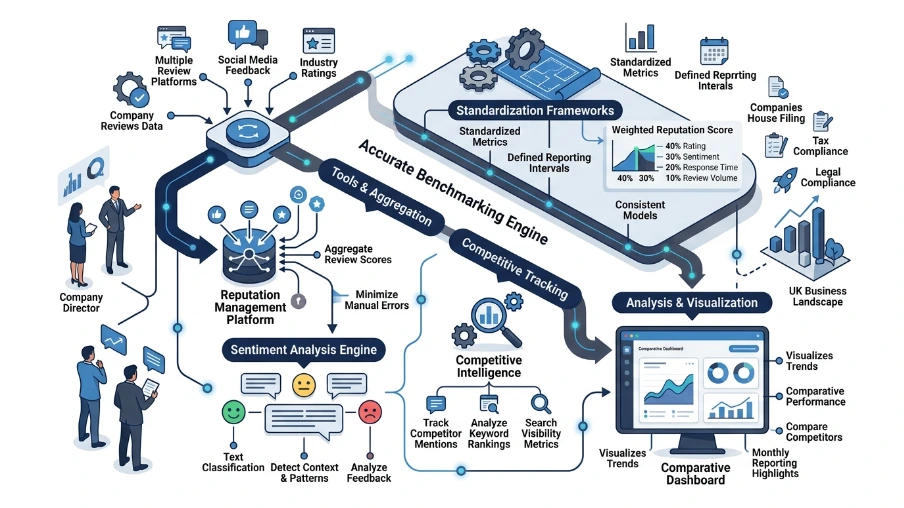
Accurate benchmarking relies on tools that aggregate multi-platform data, apply sentiment analysis, and generate comparative dashboards, combined with frameworks that standardise metrics, scoring models, and reporting intervals.
Reputation management platforms aggregate reviews and calculate average scores across multiple sources. These tools automate data collection and reduce manual errors.
Sentiment analysis engines classify text-based feedback into positive, neutral, or negative categories. Advanced tools detect context, sarcasm, and recurring complaint patterns.
Competitive intelligence tools track competitor mentions, keyword rankings, and visibility metrics. These insights connect reputation with search performance.
Frameworks ensure consistency. Businesses define scoring models such as weighted averages, sentiment ratios, and response benchmarks. For example, a weighted reputation score may combine 40% rating, 30% sentiment, 20% response time, and 10% review volume.
Dashboards visualise trends clearly. Monthly reporting highlights changes in performance and competitor positioning.
When should businesses act on benchmarking insights?
Businesses act on benchmarking insights when data reveals consistent underperformance, emerging negative trends, or missed opportunities compared to competitors, triggering targeted actions such as improving response systems, refining service delivery, or adjusting brand messaging.
Action follows patterns, not isolated data points. A single negative review does not justify strategy changes, but a 25% increase in complaints over 60 days signals a systemic issue.
Response optimisation becomes urgent when competitors outperform significantly. For example, reducing response time from 72 hours to under 24 hours improves perception quickly.
Service improvements follow thematic analysis. If multiple reviews highlight delivery delays, operational processes require adjustment.
Messaging updates align with strengths. If benchmarking shows higher trust in compliance expertise, businesses emphasise this in content and service pages such as Limited by Guarantee Registration Services, which connects credibility with structured offerings.
Decision-focused strategies also rely on insights from
Protecting business credibility with reputation management expertise, which explains how reputation directly influences conversion and retention.
Explore our reputation management for business guides,
How to Identify Business Reputation Risks Before They Escalate
Comparing Review Platforms for Business Reputation Monitoring
How does Clear My Name support competitive reputation benchmarking?
Clear My Name supports benchmarking by delivering structured analysis of competitor reputation data, identifying measurable gaps, and implementing targeted strategies within reputation management for business to improve ratings, sentiment, and response performance.
Clear My Name applies data-driven frameworks to evaluate reputation across competitors. The process includes aggregating multi-platform data, analysing sentiment trends, and benchmarking against industry standards.
The service focuses on actionable outcomes. It identifies specific weaknesses such as low review velocity or delayed responses and provides structured improvements.
Clear My Name integrates benchmarking into broader reputation management for business strategies. This ensures that insights translate into measurable improvements rather than static reports.
The approach aligns with UK compliance expectations and digital visibility requirements. By combining data analysis with execution, Clear My Name strengthens both perception and search performance.
Business reputation benchmarking transforms perception into measurable competitive intelligence. It uses structured metrics, consistent timeframes, and direct competitor comparison to reveal performance gaps and opportunities. This process supports data-driven decisions that improve trust, visibility, and conversion outcomes.
Clear My Name delivers structured benchmarking and execution within reputation management for business, enabling organisations to improve measurable reputation signals and maintain competitive positioning in data-driven markets.
Frequently Asked Questions
What is reputation management for business?
Reputation management for business is the process of monitoring, shaping, and improving how a company appears online. Clear My Name uses this approach to track reviews, mentions, and search results so businesses can maintain trust and credibility.
Why is reputation management important for a business?
Reputation management matters because online reviews and brand mentions influence customer trust and buying decisions. For businesses, a strong reputation supports visibility, conversion rates, and long-term credibility across search and review platforms.
How does a business monitor its online reputation?
A business monitors its online reputation by tracking reviews, social mentions, search results, and complaint patterns across key platforms. Clear My Name uses reputation monitoring to identify issues early and respond before negative feedback spreads.
What does reputation management for business include?
Reputation management for business includes review monitoring, response management, sentiment analysis, and search result improvement. It also covers content support that highlights accurate, positive, and relevant information about the brand.
How can Clear My Name help with reputation management?
Clear My Name helps businesses manage reputation by assessing online feedback, identifying risk areas, and improving how the brand appears in search and review results. The service is built to support practical reputation management for business with a clear focus on trust and visibility.