

Professional business reputation management services protect your brand by improving search visibility control, strengthening trust signals, and reducing reputational risk across search engines and digital platforms. Businesses that actively manage reputation signals achieve stronger search perception, higher customer confidence, and greater control over the information influencing purchasing decisions.
Which professional reputation management service delivers measurable business protection?
Professional reputation management for business delivers measurable protection because it strengthens the digital signals that influence search engines and customer decisions simultaneously. Every search result, review, news mention, business profile, and third-party citation contributes to entity credibility and shapes public perception before a customer contacts your business. A structured reputation strategy ensures positive, authoritative assets gain greater visibility while negative or outdated content loses prominence through ethical optimisation and negative content suppression. This creates stronger SERP control and improves confidence during every stage of the customer journey. Businesses benefit from improved trust, stronger brand consistency, and greater resilience against reputational threats.
Unlike reactive crisis management, professional reputation management operates as an ongoing search ecosystem strategy. Search engines evaluate relevance, authority, freshness, and consistency across multiple digital assets. Reputation specialists optimise these factors by publishing authoritative content, strengthening branded search results, improving review signals, and reinforcing entity relationships. The result is a search environment that accurately reflects business quality and supports commercial growth. This systematic approach delivers sustainable visibility instead of temporary improvements.
For organisations seeking long-term digital trust, a:
professional reputation management service provides the highest level of strategic control because it integrates technical SEO, digital PR, review management, content optimisation, and search perception influence into one coordinated process.
Why does search visibility determine business reputation today?
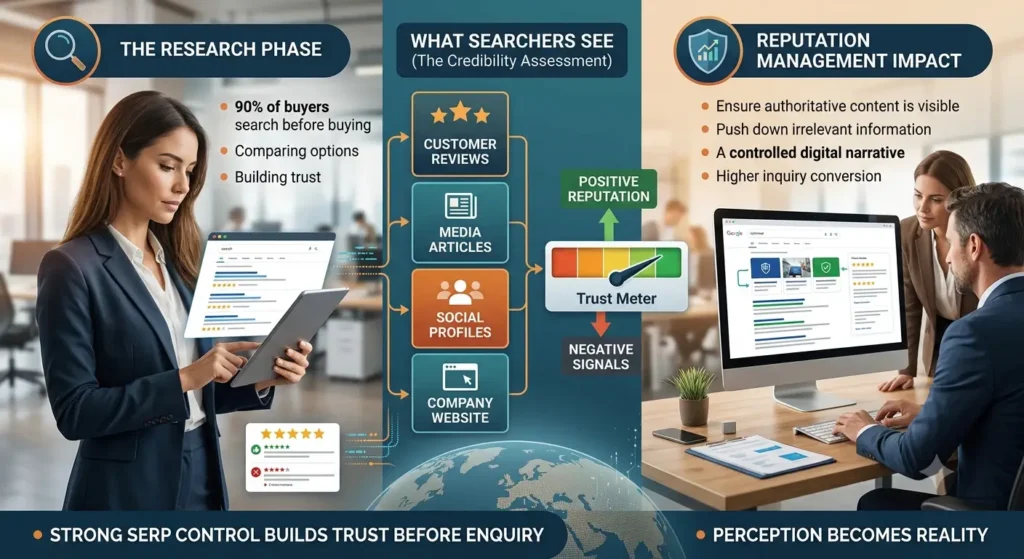
Search visibility determines business reputation because customers research companies before making purchasing decisions. The first page of search results acts as a public credibility assessment where reviews, media coverage, business directories, social profiles, and company websites collectively establish trust. Positive reputation signals improve confidence, while outdated or negative content weakens perceived reliability regardless of actual business performance.
Professional reputation management strengthens search ecosystems by ensuring authoritative content occupies the most visible positions. High-quality branded assets reinforce entity credibility and reduce exposure to misleading or harmful information. Search perception influence becomes stronger as consistent messaging appears across every trusted platform. Instead of allowing random search results to define the brand, businesses maintain a controlled and accurate digital narrative.
Decision-makers increasingly compare businesses using search results before requesting quotations or making enquiries. A well-managed reputation therefore improves conversion opportunities by reducing uncertainty during evaluation. Strong SERP control supports trust before direct interaction begins.
How does a structured reputation management process improve search perception?
A structured reputation management process improves search perception by strengthening positive authority signals while reducing the visibility of harmful or outdated information. Every optimisation activity contributes towards a more trustworthy digital footprint that aligns with business objectives and customer expectations.
Core stages that deliver measurable outcomes
- Audit every branded search result to identify reputation signals affecting visibility and customer confidence.
- Strengthen authoritative content that reinforces entity credibility across search engines and trusted platforms.
- Optimise review profiles to improve quality, consistency, and customer trust indicators.
- Suppress negative content through ethical negative content suppression supported by stronger relevant assets.
- Monitor reputation changes continuously to maintain SERP control and identify emerging risks before they escalate.
- Measure performance using branded search visibility, review sentiment, authority growth, and conversion-related metrics.
Each stage contributes to long-term stability instead of isolated improvements. Search engines reward consistent authority development, while customers respond positively to transparent, trustworthy information appearing throughout the buying journey. This integrated process reduces uncertainty and creates stronger commercial outcomes.
Which outcomes justify investing in professional business reputation management?
Professional reputation management delivers commercial value because reputation directly influences enquiries, conversions, customer retention, recruitment, and partnership opportunities. Businesses with stronger reputation signals experience improved trust throughout competitive purchasing decisions.
The investment creates measurable operational advantages beyond search rankings alone. Higher-quality branded search results reduce hesitation during evaluation and strengthen confidence before customers engage. Positive review ecosystems improve local visibility, while authoritative content reinforces expertise within the industry. Entity credibility becomes stronger across search engines, business directories, review platforms, and media references.
Long-term value significantly exceeds reactive reputation repair after reputational damage occurs. Preventative reputation management reduces future recovery costs by maintaining strong authority signals before negative events influence search perception. Businesses preserve market confidence while protecting future growth opportunities.
How does negative content suppression reduce reputational risk?
Negative content suppression reduces reputational risk by increasing the prominence of accurate, authoritative information instead of attempting to erase legitimate content. Ethical suppression strategies focus on improving stronger assets that search engines recognise as more relevant, authoritative, and valuable to users.
Professional optimisation strengthens official websites, trusted publications, knowledge assets, business profiles, and positive editorial coverage. As authoritative content grows in relevance, negative or outdated pages naturally lose search prominence through improved competition within branded search results. This strengthens overall SERP control while maintaining compliance with search engine quality standards.
Risk reduction also depends upon continuous monitoring. New reviews, media mentions, customer feedback, and competitor activity influence search perception daily. Ongoing management ensures emerging issues receive rapid attention before they gain significant visibility. Businesses therefore maintain consistent trust signals rather than reacting after reputational damage becomes widespread.
Why is long-term reputation management more valuable than short-term fixes?
Long-term reputation management creates sustainable authority because search ecosystems reward consistency, relevance, and credibility over time. Temporary campaigns generate isolated improvements, whereas continuous optimisation strengthens entity credibility across every digital touchpoint.
Authority compounds through ongoing content development, review acquisition, media visibility, technical optimisation, and consistent business information. These cumulative signals reinforce one another, creating a stronger overall reputation profile that becomes increasingly resilient against future challenges. Search perception influence therefore improves steadily instead of fluctuating after isolated marketing activities.
Businesses also gain greater forecasting capability. Regular reputation monitoring identifies declining sentiment, emerging search trends, and visibility changes early enough for proactive intervention. This stability protects customer confidence and reduces operational uncertainty during periods of growth or market change.
What concerns should businesses evaluate before choosing a reputation management provider?
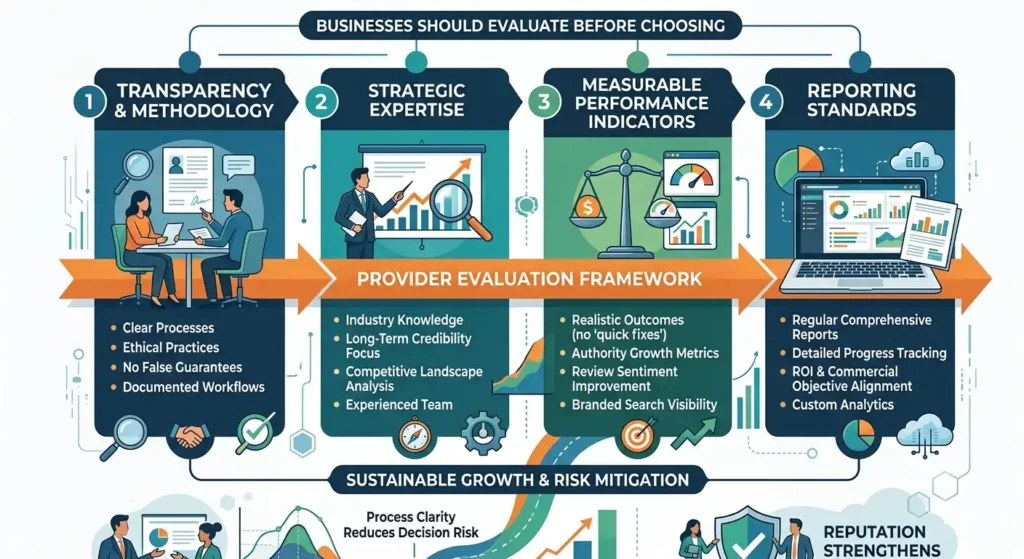
Businesses should evaluate transparency, methodology, reporting standards, and strategic expertise before selecting a provider. Clear processes demonstrate reliability because they explain how visibility improvements, reputation signals, and search perception influence develop over time.
Reliable providers establish realistic performance indicators based upon measurable outcomes instead of unrealistic guarantees. Progress reporting includes branded search visibility, authority growth, review sentiment improvements, content performance, and SERP control indicators. Businesses therefore understand exactly how reputation investment contributes towards commercial objectives.
Process clarity also reduces decision risk. Ethical optimisation techniques support sustainable search performance without exposing organisations to unnecessary compliance or algorithmic risks. Choosing an experienced provider ensures every activity strengthens long-term credibility rather than pursuing temporary visibility gains.
How does Clear My Name deliver reliable reputation management for businesses?
Clear My Name applies structured reputation management strategies that align search optimisation, reputation signals, and digital trust into one coordinated service. Every engagement begins with comprehensive analysis to identify visibility challenges, authority gaps, review performance, and search perception risks. This evidence-based approach creates a clear roadmap focused on measurable improvements rather than isolated tactics.
The service strengthens branded search ecosystems by improving authoritative content, reinforcing entity credibility, enhancing review profiles, and supporting ethical negative content suppression. Each activity contributes towards stronger SERP control and improved customer confidence throughout the buying journey. Progress remains transparent through measurable performance indicators that demonstrate how reputation improvements influence commercial visibility.
Businesses benefit from consistent strategic management rather than fragmented marketing activities. This integrated process improves long-term resilience while ensuring reputation remains aligned with organisational objectives and evolving search behaviour.
Businesses comparing providers often benefit from first understanding:
How to Manage Your Business Reputation Online: A Complete Beginner’s Guide before evaluating advanced solutions. Foundational knowledge helps decision-makers understand how reputation signals influence search ecosystems and why structured management delivers stronger long-term outcomes.
For organisations ready to implement proven strategies:
12 Proven Online Reputation Management Strategies That Actually Work provides additional insight into the practical methods that strengthen search visibility, improve trust, and reinforce entity credibility before selecting a managed service.
Which business reputation solution delivers the strongest long-term return?
The strongest long-term return comes from reputation management strategies that integrate search optimisation, review management, authoritative content development, entity credibility enhancement, and continuous monitoring into one structured process. These activities strengthen digital trust while reducing reputational risk across the entire search ecosystem.
Businesses achieve greater commercial resilience because customer confidence develops through consistent reputation signals rather than isolated marketing campaigns. Stronger SERP control improves branded search visibility, supports conversion rates, and reinforces competitive positioning over time. Sustainable optimisation ensures positive reputation assets continue strengthening while emerging risks receive immediate attention.
Dive Deeper With Our Expert Guides:
What Makes Clear My Name Different From Other Reputation Agencies
Protecting Business Credibility With Reputation Management Expertise
Clear My Name provides a structured, transparent approach that prioritises measurable outcomes, ethical optimisation, and long-term search perception influence. By combining reputation expertise with evidence-driven processes, businesses gain reliable protection for their digital presence while maintaining stronger trust throughout every customer decision.
Answers to Key Questions
What is reputation management for business?
Reputation management for business is the process of improving how a company appears across search engines, review platforms, news websites, and social media. It focuses on strengthening positive reputation signals, managing customer feedback, and improving search visibility.
Why is business reputation management important for search results?
Search results often create the first impression of a business. Effective reputation management improves positive content visibility, strengthens trust signals, and reduces the impact of outdated or negative information in branded search results.
How long does reputation management for business take to show results?
The timeframe depends on the current reputation, competition, and search landscape. Businesses typically see gradual improvements as positive content, review profiles, and authoritative pages gain stronger visibility over time.
Can negative search results be reduced without removing them?
Yes. Ethical reputation management uses content optimisation, digital PR, and SEO to strengthen authoritative assets, helping positive pages rank higher while reducing the visibility of negative content through search result optimisation.