

Business reputation is increasingly shaped by search visibility, content indexing, review ecosystems, and entity perception across digital platforms. UK companies are experiencing significant shifts in how search engines evaluate credibility, authority, and trust signals.
Reputation management is the process of monitoring, analysing, and understanding how information influences public perception within digital ecosystems. Online reputation refers to the collection of indexed content, reviews, mentions, and authority signals that define how an organisation is interpreted by search engines and users.
What Is Driving Business Reputation Changes in UK Search Ecosystems?
Business reputation trends are being driven by changes in search engine evaluation systems, content discovery mechanisms, and digital trust assessment models.
Search engines increasingly evaluate organisations as entities rather than isolated websites. Entity perception is formed through interconnected signals such as reviews, citations, media references, business information consistency, and topical relevance. These signals contribute to search visibility and influence how organisations appear within SERPs.
The growing emphasis on credibility assessment means that search engines analyse information quality alongside traditional ranking factors. Reputation signals now function as indicators of trustworthiness, helping algorithms determine which entities deserve greater visibility within competitive search environments.
How Are Search Engines Evaluating Reputation Signals More Closely?
Search engines are analysing reputation signals through entity-based evaluation systems that connect information across multiple sources.
A reputation signal is any piece of information that contributes to credibility assessment within search ecosystems. Reviews, citations, author references, customer feedback, business profiles, and content quality all serve as reputation signals. Algorithms evaluate consistency between these signals to establish confidence in an entity.
The increased sophistication of SERP evaluation means contradictions between sources become more visible. When information conflicts across indexed assets, search engines receive weaker trust signals. Consistency across digital properties therefore plays a larger role in search visibility than isolated optimisation activities.
Why Is Entity Perception Becoming More Important?
Entity perception is becoming more important because search engines organise information around identifiable entities rather than individual webpages.
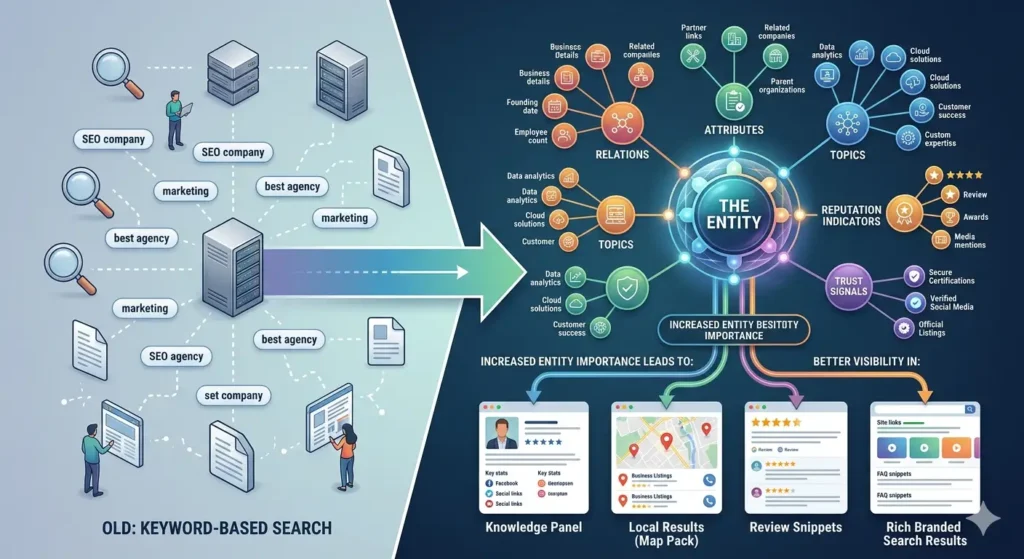
An entity is a distinct subject recognised within a knowledge system. Search engines associate entities with attributes, relationships, topics, and reputation indicators. This framework allows algorithms to understand organisations beyond simple keyword matching.
Entity perception influences how businesses appear across search features, including knowledge panels, local results, review snippets, and branded search results. Positive entity associations strengthen credibility signals, while inconsistent associations create uncertainty during search evaluation processes.
How Are Review Ecosystems Influencing Reputation More Than Before?
Review ecosystems are influencing reputation because user-generated feedback provides direct trust and credibility indicators.
A review ecosystem refers to the network of platforms where users publish opinions, ratings, and experiences. Search engines analyse review quantity, review recency, sentiment distribution, and thematic consistency when assessing reputation quality.
Review content contributes to entity understanding because it introduces recurring topics associated with an organisation. Positive themes reinforce credibility, while recurring negative themes influence perception patterns. Search algorithms interpret these patterns as measurable trust indicators within ranking and visibility systems.
What Role Does Sentiment Interpretation Play in Reputation Assessment?
Sentiment interpretation plays a critical role because search systems increasingly analyse the meaning and context behind published content.
Sentiment refers to the positive, neutral, or negative characteristics expressed within text. Search engines use natural language processing to identify recurring sentiment patterns across reviews, articles, discussions, and indexed content.
Sentiment interpretation extends beyond individual mentions. Algorithms evaluate sentiment consistency across large datasets to understand broader reputation trends. This process helps define entity perception and contributes to overall credibility assessment within search environments.
Why Is Digital Footprint Expansion Affecting Reputation Visibility?
Digital footprint expansion affects reputation visibility because every indexed asset contributes to search engine understanding.
A digital footprint is the collection of online information associated with an entity. This includes websites, reviews, directory listings, social profiles, news references, and publicly accessible content. Each indexed asset provides additional context for search evaluation.
As digital footprints grow, search engines gain greater confidence in entity identification and topic relevance. However, larger footprints also increase the volume of reputation signals being assessed. Search visibility, therefore, becomes increasingly connected to information consistency across all indexed properties.
How Is Content Indexing Influencing Reputation Formation?
Content indexing influences reputation formation because indexed content becomes part of an entity’s searchable identity.
Content indexing is the process through which search engines discover, store, and categorise information. Indexed content contributes directly to SERP evaluation because it forms the evidence base used to assess authority, expertise, and trustworthiness.
Every indexed page adds contextual information about an entity. Search engines compare topics, themes, language patterns, and relevance signals to build comprehensive reputation profiles. This process demonstrates why content quality remains central to online credibility assessment.
Why Are Authority Signals Receiving Greater Attention?
Authority signals are receiving greater attention because search systems increasingly prioritise evidence-based credibility indicators.
Authority signals refer to references that demonstrate expertise, trustworthiness, and recognition within a topic area. Examples include authoritative citations, high-quality backlinks, trusted references, and consistent topical coverage.
Search engines evaluate authority through relationship analysis. When authoritative sources repeatedly associate an entity with a topic, stronger trust signals emerge. These signals influence ranking decisions and contribute to positive reputation formation within search ecosystems.
How Are Branded Search Results Becoming Reputation Indicators?

Branded search results are becoming reputation indicators because they provide a consolidated view of entity perception.
A branded search occurs when users search specifically for an organisation or entity name. The resulting SERP often contains reviews, profiles, articles, images, videos, and knowledge-based information connected to that entity.
Search engines use branded result composition as part of reputation assessment. Positive and relevant results strengthen credibility signals, while fragmented or inconsistent results weaken entity understanding. The composition of branded SERPs therefore reflects broader reputation dynamics.
What Is the Impact of Information Consistency on Trust Signals?
Information consistency has a direct impact on trust signals because algorithms compare data across multiple sources.
Consistency refers to the alignment of factual information, business details, messaging, and topical associations throughout a digital footprint. Search engines evaluate whether information remains stable across websites, directories, reviews, and other indexed resources.
Consistent information strengthens entity recognition and improves confidence during search evaluation. Inconsistent information introduces ambiguity, reducing the effectiveness of reputation signals. Trust formation within search ecosystems depends heavily on reliable and verifiable information structures.
How Is AI-Driven Search Changing Reputation Evaluation?
AI-driven search is changing reputation evaluation by improving contextual understanding and semantic interpretation.
Artificial intelligence systems analyse relationships between entities, topics, and information sources. Rather than relying solely on keywords, these systems evaluate meaning, context, and topical relevance when assessing credibility.
This development increases the importance of semantic consistency. Search engines can identify patterns across large information networks and use these insights to evaluate trustworthiness. Reputation formation is therefore becoming more dependent on contextual accuracy than isolated optimisation signals.
Why Are Third-Party Mentions Becoming Stronger Reputation Signals?
Third-party mentions are becoming stronger reputation signals because they provide independent credibility indicators.
A third-party mention is a reference originating from an external source rather than the entity itself. Search engines often treat independent references as stronger evidence because they introduce additional validation layers.
These mentions contribute to entity association networks. When reputable sources repeatedly reference an organisation within relevant contexts, stronger authority and trust signals emerge. This process influences both reputation assessment and search visibility outcomes.
How Are Knowledge Graph Relationships Affecting Reputation?
Knowledge graph relationships affect reputation because they define how entities connect within search engine databases.
A knowledge graph is a structured information framework that stores entities and their relationships. Search engines use these relationships to understand identity, relevance, and contextual connections.
Strong knowledge graph associations improve entity recognition and support accurate reputation assessment. Clear relationships between topics, attributes, and references help search systems evaluate credibility with greater precision. This trend continues to influence how reputation is interpreted across SERPs.
Why Is Reputation Risk Detection Becoming a Priority?
Reputation risk detection is becoming a priority because search ecosystems react quickly to negative information patterns.
Reputation risk refers to any signal capable of reducing trust, credibility, or visibility. Risks often emerge through negative reviews, inaccurate information, harmful content, sentiment shifts, or authority loss. Search engines continuously analyse these indicators as part of entity evaluation processes.
Early identification improves understanding of changing reputation signals.
The analytical framework discussed in:
How to Identify Business Reputation Risks Before They Escalate demonstrates how monitoring content indexing, sentiment patterns, authority signals, and entity associations helps evaluate emerging risks before they become dominant perception factors.
How Is Search Visibility Becoming a Reputation Metric?
Search visibility is becoming a reputation metric because visibility reflects how search engines evaluate trust and relevance.
Search visibility refers to the prominence of an entity across search results for relevant queries. High visibility often indicates strong authority signals, positive entity perception, and consistent credibility indicators.
Visibility is not merely a traffic metric. It represents the outcome of search engine evaluations regarding trustworthiness, relevance, and information quality. As search systems become more sophisticated, visibility increasingly functions as a measurable indicator of digital reputation strength.
Dive Deeper With Our Expert Guides:
9 Online Trust Signals Customers Evaluate Before Buying
Why 68% of Consumers Research Brands Before Contacting Them
Business reputation is increasingly defined by how search engines interpret information, evaluate trust signals, and construct entity perception. Review ecosystems, content indexing, authority signals, sentiment interpretation, and knowledge graph relationships all contribute to reputation formation within modern search environments.
The current reputation landscape demonstrates a shift from isolated website evaluation toward comprehensive entity assessment. Search visibility, credibility indicators, digital footprint consistency, and contextual relevance now work together to influence how organisations are perceived across SERPs. Understanding these reputation trends provides a clearer view of how digital trust is created, interpreted, and maintained within evolving search ecosystems.
Answers to Key Questions
What is reputation management for business?
Reputation management for business is the process of monitoring, analysing, and improving how a company is perceived online. It focuses on search results, customer reviews, media mentions, and digital trust signals that influence public perception.
Why is business reputation important for online visibility?
Business reputation affects how customers, stakeholders, and search engines evaluate credibility. Strong reputation signals, such as positive reviews and consistent business information, can support better search visibility and trust.
How do online reviews impact business reputation?
Online reviews contribute to reputation signals used by both consumers and search engines. Review quality, sentiment, and recency influence how a business is perceived across search results and digital platforms.
What are common business reputation risks?
Common reputation risks include negative reviews, inaccurate business information, misleading content, and harmful online mentions. Identifying these issues early helps organisations maintain credibility and consistent entity perception.