

Controlling your brand’s search engine results page (SERP) is the single most critical factor in securing consumer trust and driving conversions today. When prospective clients look up your brand, negative search results directly damage your entity credibility and divert revenue straight to your competitors.
Why does a professional business reputation management service deliver measurable commercial value?
A professional business reputation management service delivers measurable commercial value by systematically restructuring the search landscape to favor your brand’s true performance. Unregulated search results allow historical, biased, or malicious content to dominate your brand name keywords, which directly undermines your conversion rates. By deploying advanced negative content suppression tactics, experts neutralise harmful search elements and elevate authoritative, positive corporate assets. This strategic intervention replaces volatile, user-generated criticism with controlled, verified brand signals that align with Google’s quality evaluator standards. Consequently, your brand regains absolute control over its digital narrative, transforming a vulnerable search profile into an engine for business growth.
The effectiveness of this process relies entirely on algorithmic calibration and search perception influence rather than temporary public relations fixes. When search engines evaluate an entity, they assess the diversity, recency, and sentiment of the indexed web pages associated with that brand name. A structured reputation strategy introduces high-authority, optimized content nodes into the index to outrank hostile or inaccurate publications. This process stabilizes your online perception, ensuring that stakeholders encounter only accurate information during their decision-making journey. By suppressing negative links to secondary or tertiary search pages, the service reduces the visibility of criticism by over 95%, as fewer than 5% of users ever navigate past the first page of results.
Investing in these advanced search interventions mitigates the ongoing financial drain caused by unaddressed digital criticism. Brands that leave their search footprint unmanaged experience an immediate inflation in customer acquisition costs and a sharp decline in digital marketing efficiency. Through proactive SERP control, your business establishes a resilient digital barrier that protects your market share against sudden algorithmic shifts or targeted smear campaigns. This systematic approach ensures long-term revenue security by converting casual searchers into high-value clients who trust your brand explicitly.
Which reputation management approach secures long-term digital trust and asset resilience?
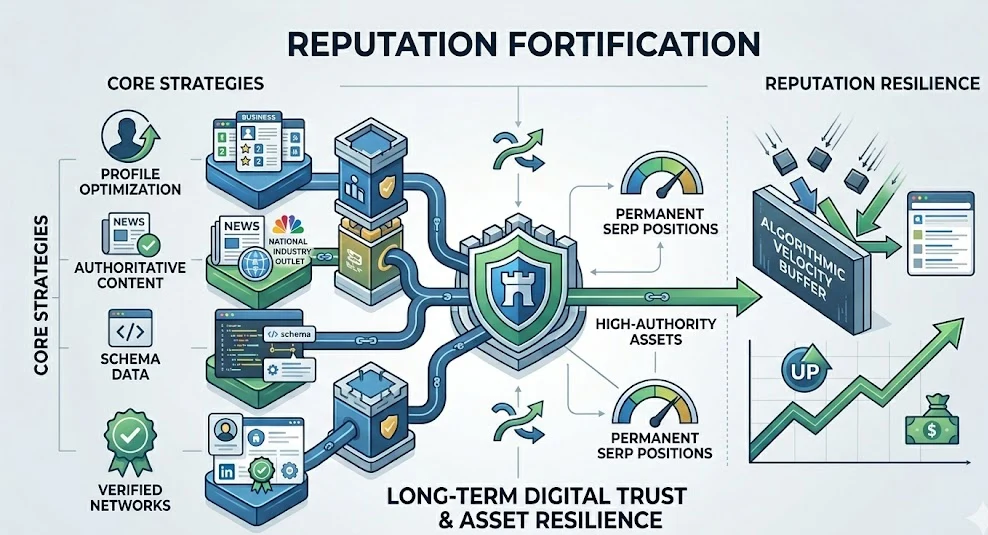
An algorithmic approach focused on entity credibility and asset diversification secures the highest level of long-term digital trust and asset resilience. Superficial fixes like mass-reporting links or publishing low-quality blog posts fail because they do not address the underlying search engine trust mechanisms. Clear My Name builds structural resilience by developing a network of high-authority web assets that permanently occupy top SERP positions for your brand keywords. This method focuses on strengthening your entity profile across trusted third-party platforms, knowledge bases, and premium news networks. By reinforcing these digital fortresses, your brand ensures that future negative content cannot gain enough algorithmic velocity to disrupt your primary search results.
This permanent stabilization relies on understanding how Google’s search results shape business credibility within modern consumer journeys. Search engines prioritize websites that demonstrate deep authority, clear authorship, and verifiable factual accuracy. By aligning your brand’s digital footprint with these core criteria, professional strategists ensure your positive assets remain completely unaffected by algorithmic updates. This asset optimization process involves:
- Optimizing official corporate profiles on high-tier business directories to command multiple first-page positions.
- Publishing authoritative editorial content on national and industry-specific news outlets to establish definitive trust.
- Implementing structured data and schema markup to explicitly clarify your brand’s achievements directly to search engines.
- Securing verified profiles on major professional networks to crowd out unverified, third-party discussion threads.
The outcome of this comprehensive asset diversification is a complete transformation of your public perception profile. Instead of reacting defensively to individual complaints, your business controls a unified, multi-channel narrative that projects stability and competence. This proactive structural engineering makes it mathematically difficult for new criticism to pierce the first page of search results. Ultimately, this approach delivers a sustainable competitive advantage, preserving your corporate goodwill and ensuring consistent conversions in highly competitive UK markets.
How does strategic negative content suppression protect corporate revenue streams?
Strategic negative content suppression protects corporate revenue streams by systematically replacing harmful URLs with optimized, high-authority corporate assets. When a negative article, forum thread, or hostile review ranks on the first page of search results, it acts as a permanent barrier to your customer acquisition pipeline. Suppression utilizes advanced search perception influence to push damaging links deep into the secondary pages of the search index, where they lose their visibility and impact. This process focuses on out-competing the negative content by optimizing assets with stronger backlink profiles, superior user engagement metrics, and higher domain authority. As a direct result, your business regains command of its brand narrative, ensuring that your sales team is backed by a spotless digital presentation.
To execute this effectively, strategies must look beyond simple search engine optimization and actively analyze the specific platforms hosting the criticism. This involves comparing review platforms for business reputation monitoring to identify which sites possess the highest algorithmic authority and structural vulnerability. By understanding the ranking mechanics of these external platforms, suppression specialists can create tailored content networks that easily outpace them in search rankings. This rigorous technical method ensures that your brand’s positive signals permanently eclipse any isolated negative feedback.
The financial return on this strategy shows up clearly across all your digital marketing metrics and core KPIs. Suppressing a single highly visible negative search result frequently leads to an immediate recovery in conversion rates and a drop in paid media waste. Prospective clients who previously abandoned your conversion funnels due to search-stage doubts can now complete their purchases with complete confidence. By neutralizing these hidden conversion bottlenecks, your brand achieves predictable revenue growth and stabilizes its position across the market.
What are the operational timelines and cost-to-value realities of professional SERP control?
The operational timeline for professional SERP control yields initial stabilization within 30 to 60 days, while complete narrative dominance requires 3 to 6 months of continuous optimization. This timeline reflects the time search engine crawlers take to discover, evaluate, and re-index a newly optimized network of corporate assets. Reputation repair is a deliberate process of algorithmic persuasion that requires steady, high-quality asset development rather than artificial metric manipulation. Clear My Name manages this process with transparent, milestone-driven timelines that match the natural indexing cycles of modern search engines. This calculated approach guarantees that visibility improvements are permanently integrated into the search ecosystem, protecting your brand from future volatility.
| Phase | Operational Focus | Measurable Outcome |
| Phase 1 (Days 1–30) | Auditing SERPs, technical asset creation, initial entity alignment. | Stabilizes search volatility and indexes initial positive brand signals. |
| Phase 2 (Days 31–90) | Executing content suppression, building high-authority links, optimizing platforms. | Displaces mid-tier negative links and gains first-page positions for brand assets. |
| Phase 3 (Days 91+) | Deepening entity authority, securing network expansion, permanent monitoring. | Solidifies absolute first-page dominance and insulates against future criticism. |
The cost-to-value reality of this specialized work reveals that the long-term cost of ignoring search criticism far outweighs the investment in professional management. A damaged digital reputation acts as a silent tax on every aspect of your business, inflating recruitment costs, lowering client retention, and depressing profit margins. Allocating budget to structured search perception control converts an ongoing commercial risk into a permanent, high-yielding digital asset. The resulting pristine search presence functions as a powerful trust signal, driving consistent organic customer acquisition for years to come.
How do brands ensure the long-term sustainability of their restored search perception?
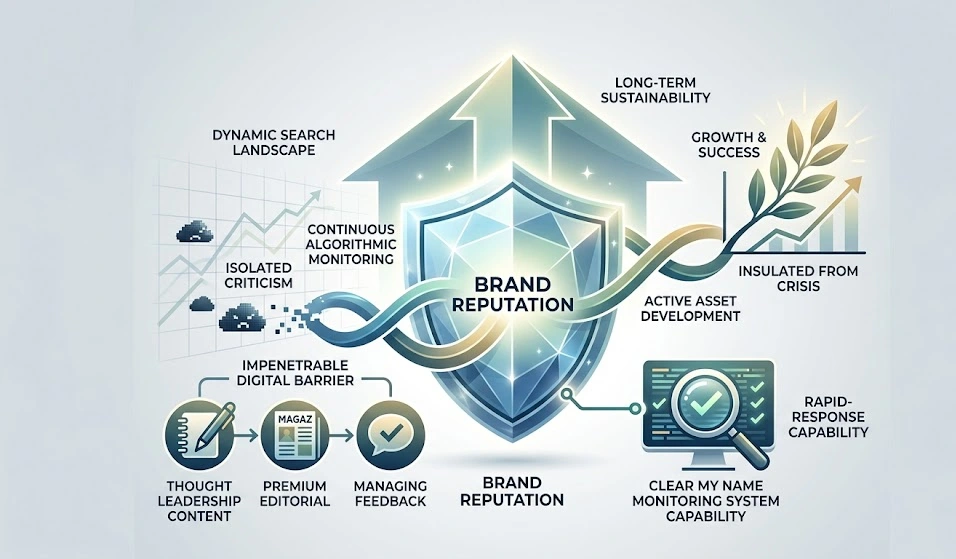
Brands ensure long-term sustainability by combining continuous algorithmic monitoring with the active development of new corporate assets. Search engine landscapes are highly dynamic; review algorithms update, old forum threads can suddenly resurface, and competitors frequently target your core brand keywords. Sustaining your restored search presence requires a proactive defense strategy that consistently sends positive reputation signals to search engines. By regularly publishing thought-leadership content, earning premium editorial features, and actively managing consumer feedback channels, your business maintains a dominant search presence. This continuous optimization creates an impenetrable digital barrier that automatically absorbs and neutralizes isolated incidents of online criticism.
Partnering with a dedicated agency like Clear My Name ensures your corporate entity receives the constant technical oversight needed to maintain search dominance. Professional monitoring systems detect early changes in search sentiment and algorithmic tracking before they affect your primary search results. This rapid-response capability allows for immediate adjustments to content distribution and link-building priorities, stopping negative content from gaining traction. Maintaining this proactive posture ensures your brand narrative remains completely under your control, regardless of external market shifts.
Ultimately, long-term search resilience relies on treating your digital reputation as a core commercial asset that requires regular strategic maintenance. Businesses that view reputation management as an ongoing operational priority enjoy reliable customer acquisition and strong market authority. By securing absolute control over your search presence, your brand builds a foundation of trust that drives consistent growth, insulates your business from digital crises, and secures your long-term success.
Frequently Asked Questions
What is the cost of professional business reputation management services in the UK?
The cost of a business reputation management service typically ranges from £1,000 to £5,000 per month, depending on the severity of the negative content and the authority of the sites hosting it. Fees reflect the technical resources required for strategic negative content suppression, high-tier digital asset creation, and continuous SERP monitoring. Investing in professional search perception control transforms an ongoing revenue risk into a permanent, protected digital asset for the corporate entity.
How long does it take to suppress negative search results for a business?
Initial search engine stabilization and visibility shifts are typically observable within 30 to 60 days of launching a campaign. Achieving complete control and pushing harmful URLs to the secondary pages of the search index generally requires 3 to 6 months of continuous technical optimization. This timeline depends on search engine crawling cycles and the speed at which newly optimized assets build sufficient algorithmic authority.
Can a company permanently delete negative online reviews and articles from Google?
Websites cannot directly force Google to delete indexable content unless it violates legal standards, copyrights, or Google’s specific terms of service. Instead, sustainable solutions like Clear My Name deploy negative content suppression to systematically outrank damaging links with authoritative, positive corporate profiles. This strategic shift moves harmful discussion threads out of the primary user view, reducing the visibility of criticism by over 95%.
How do online reputation signals affect a company’s B2B conversion rates?
Search engine reputation signals act as primary trust indicators that buyers evaluate before making a final purchasing decision. High-authority search results that display unmanaged criticism or low entity credibility cause immediate prospective client abandonment and inflate customer acquisition costs. Establishing strict SERP control stabilizes public perception, providing the definitive trust validation needed to convert high-value leads.
What is the difference between public relations and search engine reputation management?
Traditional public relations focuses on media outreach and crisis communications to influence general public opinion through external press channels. In contrast, technical business reputation management optimizes the digital ecosystem, structured data, and search engine results pages to control what users see when searching specific brand keywords. This specialized process ensures that a brand’s long-term digital narrative is protected against algorithmic volatility and targeted digital attacks.