

Business reputation risks become visible before a crisis occurs through changes in reputation signals, sentiment distribution, search visibility patterns, and stakeholder-generated content. Early identification depends on evaluating search results, review ecosystems, media references, and digital footprint consistency.
Reputation management strategies differ based on the source of risk, the speed of escalation, and the visibility of negative signals across search ecosystems. Online reputation control methods are evaluated through their impact on search ranking influence, entity credibility, sentiment distribution, and long-term perception management.
Which Reputation Signals Provide the Earliest Warning of Escalating Business Risks?
The earliest warning indicators emerge from measurable changes in digital reputation signals across search engines, review platforms, social discussions, and media coverage. Reputation signals are digital indicators that search systems and users interpret when assessing organisational credibility.
Search engines evaluate entities through information consistency, brand mentions, review sentiment, content freshness, and authority associations. A negative shift in these signals often appears before widespread reputational damage becomes visible. For example, declining review sentiment creates a measurable change in perception long before media attention develops.
Review ecosystems often expose operational weaknesses faster than search result changes. Customer complaints, unresolved feedback, and recurring service concerns contribute to a negative sentiment distribution. Search engines interpret these patterns as indicators of entity quality and trustworthiness.
Media references represent another early-stage signal. Increased discussion of regulatory concerns, customer disputes, or operational failures creates a growing reputation footprint. Even when negative content remains outside the first page of search results, its accumulation contributes to future search ranking influence.
How Does Proactive Reputation Monitoring Compare with Reactive Reputation Management?
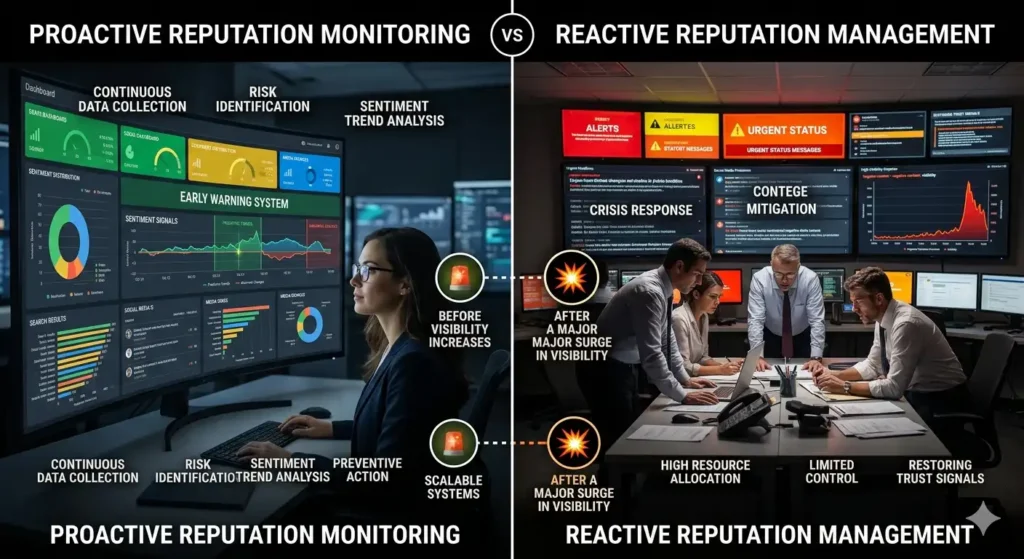
Proactive monitoring identifies risks before public perception changes significantly, whereas reactive reputation management focuses on mitigating damage after visibility has increased. The distinction influences both cost efficiency and long-term sustainability.
Proactive monitoring operates by continuously measuring reputation signals across search engines, review platforms, social channels, and media sources. This approach identifies abnormal changes in sentiment distribution before search result composition becomes negatively affected. Monitoring systems focus on trend analysis rather than crisis response.
Reactive reputation management begins after negative content achieves visibility or stakeholder attention. The primary objective becomes limiting exposure and restoring trust signals. Reactive approaches often require greater resource allocation because search engines have already indexed and associated negative content with the entity.
From an effectiveness perspective, proactive monitoring provides stronger risk prevention capabilities. Reactive strategies remain important for crisis containment but operate under existing perception constraints. Once search ecosystems establish negative associations, reversing those signals requires substantially more effort.
Scalability also differs between the two approaches. Monitoring frameworks scale efficiently across multiple digital channels, while reactive interventions require issue-specific responses. As organisational visibility grows, proactive systems maintain broader coverage with greater consistency.
Which Sources Create the Highest Reputation Risk Exposure?
Review platforms, search engine results, news publications, and social media environments generate different levels of reputation risk exposure. Their influence depends on visibility, authority, and search ecosystem integration.
Review platforms create persistent reputation signals because they directly influence user decision-making and local search visibility. Negative reviews contribute to sentiment distribution and affect perceived trustworthiness. Search engines frequently integrate review data into business-related search experiences, increasing visibility.
News publications generate a different form of risk exposure. Authoritative media sources possess strong indexing authority and search ranking influence. Negative articles often achieve long-term search visibility because they inherit domain authority and attract external references.
Social media platforms accelerate risk propagation through content amplification mechanisms. A complaint that receives significant engagement creates immediate perception changes. However, social content often experiences a shorter visibility lifecycle compared with indexed news content.
Search engine result pages remain the most influential risk environment because they aggregate information from multiple sources. When negative reviews, media articles, and social discussions appear simultaneously within search results, users encounter a concentrated negative sentiment distribution that influences perception rapidly.
How Do Content Enhancement and Content Suppression Strategies Compare?
Content enhancement strengthens positive reputation signals, while content suppression reduces the visibility of negative content within search ecosystems. Both approaches influence SERP composition through different mechanisms.
Content enhancement operates by creating authoritative, relevant, and high-quality assets that strengthen entity credibility. Search engines evaluate these assets based on relevance, authority, user engagement, and semantic relationships. As positive content gains visibility, it contributes additional trust signals.
Content suppression focuses on reducing the prominence of negative search results through competitive ranking mechanisms. The objective is not content removal but visibility reduction. Search engines reorder results according to relevance and authority, allowing stronger assets to occupy more prominent positions.
From a sustainability perspective, content enhancement provides stronger long-term benefits. New authoritative content continuously reinforces entity credibility and expands digital footprint coverage. This creates durable search ranking influence over time.
Content suppression produces faster visible changes in SERP composition but depends heavily on competitive search dynamics. Negative content remains indexed and can regain visibility if competing assets lose relevance or authority. Therefore, suppression often requires ongoing maintenance.
How Does Search Engine Interpretation Influence Reputation Risk Development?
Search engines act as reputation aggregators by collecting and evaluating signals from multiple digital sources. Their interpretation directly influences visibility, trust, and perception.
Entity credibility is assessed through consistency, authority relationships, sentiment indicators, and content quality. Search systems compare information across multiple sources to determine reliability. Contradictory information weakens credibility signals and increases risk exposure.
Search ranking influence emerges when content accumulates authority through links, engagement, topical relevance, and user interactions. Negative content that receives significant attention gains stronger ranking signals and becomes more difficult to displace.
Knowledge panels, review integrations, news results, and featured content contribute additional layers of perception analysis. Search users often form opinions based on visible search elements before visiting external websites. Consequently, search result composition functions as a reputation evaluation environment.
Reputation risks escalate when search engines identify recurring negative patterns across independent sources. Consistent negative sentiment across reviews, media references, and social discussions reinforces search system confidence in those associations, increasing visibility and persistence.
Which Risk Assessment Frameworks Deliver the Most Accurate Reputation Analysis?
Structured evaluation frameworks provide more accurate risk identification than isolated monitoring activities. Effective frameworks analyse visibility, authority, sentiment, and stakeholder impact simultaneously.
A reputation risk framework typically includes:
- Measure sentiment distribution across reviews, media references, and social discussions.
- Evaluate search visibility for positive, neutral, and negative content assets.
- Assess authority levels of sources influencing public perception.
- Track entity associations appearing across search ecosystems.
- Compare historical reputation signal trends against current performance indicators.
Sentiment analysis identifies directional changes in stakeholder perception. However, sentiment alone provides incomplete insights because visibility determines actual exposure. Negative content with limited visibility generates lower risk than moderately negative content occupying prominent search positions.
Authority analysis strengthens risk assessment accuracy. Content published on authoritative domains possesses greater search ranking influence and persistence. Understanding source authority helps organisations prioritise response strategies effectively.
Trend evaluation introduces predictive capability. By analysing changes over time, organisations identify escalation patterns before they influence broader public perception. This approach transforms reputation management from reaction-based activity into measurable risk governance.
How Do Short-Term and Long-Term Reputation Protection Strategies Differ?
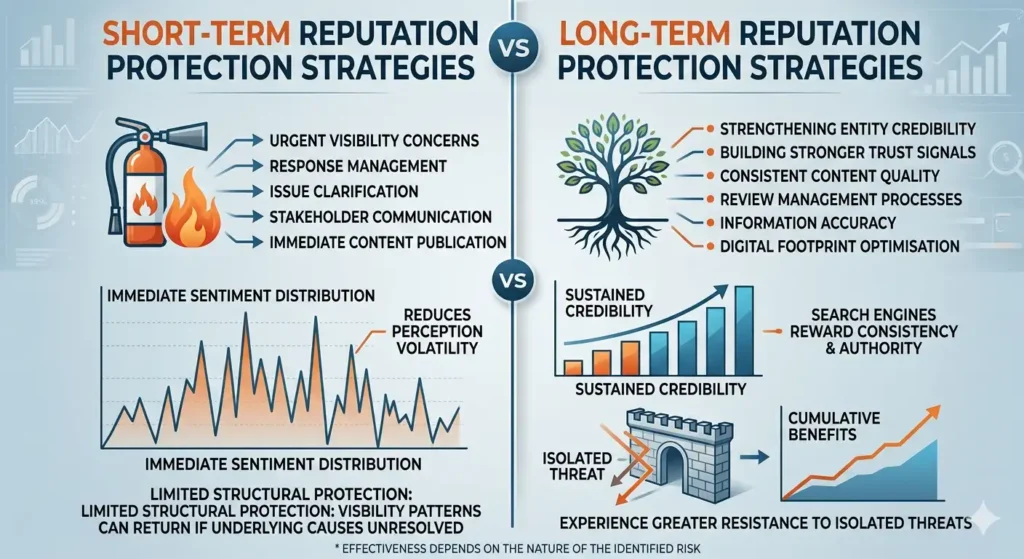
Short-term strategies focus on immediate visibility control, whereas long-term strategies concentrate on strengthening entity credibility and reputation resilience. Their effectiveness depends on the nature of the identified risk.
Short-term approaches operate by addressing urgent visibility concerns. These include response management, issue clarification, stakeholder communication, and immediate content publication. The objective is reducing perception volatility during active risk events.
Long-term strategies operate by building stronger trust signals over time. Consistent content quality, review management processes, information accuracy, and digital footprint optimisation contribute to sustained credibility. Search engines reward consistency through stronger authority associations.
Short-term interventions influence immediate sentiment distribution but provide limited structural protection. Once active management decreases, visibility patterns can return to previous states if underlying causes remain unresolved.
Long-term strategies create cumulative benefits. Search ecosystems continuously evaluate historical authority, consistency, and relevance. Organisations with strong entity credibility experience greater resistance to isolated reputation threats because positive signals outweigh temporary negative events.
Dive Deeper With Our Expert Guides:
7 Reputation Gaps That Reduce Customer Trust
How Negative Search Results Affect Lead Generation Performance
What Indicators Show That a Reputation Risk Is Escalating Towards a Crisis?
Escalating reputation risks display measurable changes across search visibility, sentiment distribution, engagement velocity, and content authority. These indicators reveal increasing exposure levels before full-scale crises develop.
The first indicator is expanding negative visibility. Additional negative content sources begin appearing across search engine result pages. This diversification increases perceived credibility because users encounter similar narratives from independent locations.
The second indicator is accelerating engagement. Complaints, discussions, and media references receive increasing interaction levels. Search engines interpret engagement as a relevance signal, contributing to stronger visibility.
The third indicator involves authority amplification. High-authority publishers, industry publications, or influential commentators begin referencing the issue. Their involvement increases search ranking influence and broadens audience exposure.
The final indicator is sentiment consolidation. Instead of isolated criticism, multiple stakeholder groups express similar concerns. Search systems identify these recurring patterns and reinforce associations between the entity and the emerging issue, increasing long-term reputation risk exposure.
Identifying business reputation risks before escalation depends on evaluating reputation signals, sentiment distribution, search visibility patterns, and entity credibility indicators. Proactive monitoring provides stronger prevention capabilities than reactive intervention, while structured risk assessment frameworks improve detection accuracy.
Content enhancement and content suppression influence SERP composition through different mechanisms, with content enhancement providing stronger long-term sustainability. Search engines interpret reputation signals through authority, relevance, consistency, and sentiment indicators, making search visibility a central factor in perception management.
Short-term reputation protection focuses on immediate visibility control, whereas long-term strategies strengthen credibility and resilience. Effective reputation risk analysis therefore requires continuous evaluation of search ecosystems, authority sources, stakeholder sentiment, and emerging visibility trends before negative signals become entrenched within public perception.
For deeper insight, explore:
How Clear My Name Helps Organisations Respond to Reputation Threats
Answers to Key Questions
How can businesses identify reputation risks early?
Businesses can identify reputation risks by tracking review sentiment, search engine results, social media discussions, and media coverage. Early monitoring helps detect negative trends before they affect trust, visibility, and customer perception.
Why do search results matter in reputation management for business?
Search results often form a customer’s first impression of a company. Positive and accurate search visibility strengthens credibility, while negative content can influence trust and purchasing decisions.
What are the most common business reputation risks?
Common reputation risks include negative reviews, customer complaints, inaccurate online information, poor media coverage, and social media criticism. These factors can affect brand perception and search visibility if left unaddressed.
How does reputation management support long-term business credibility?
Reputation management supports credibility by maintaining accurate information, improving sentiment distribution, and strengthening trust signals across digital platforms. Consistent reputation monitoring helps organisations build and protect their online presence over time.