

Online reputation refers to the collective digital footprint, sentiment signals, and algorithmic evaluation that define an entity’s credibility within search ecosystems. Reputation management is the systematic process of monitoring, influencing, and structuring digital content to control how search engines index and display information about a specific brand or individual.
What Is Search Reputation and How Do Algorithms Evaluate Local Entities?
Search reputation is the algorithmic assessment of a brand’s trustworthiness, authority, and relevance based on distributed data points across the web. Search engines utilise natural language processing (NLP) and machine learning models to parse text, extract entity relationships, and determine the sentiment associated with a specific local business.
This process relies heavily on named entity recognition (NER), where the search engine identifies the business as a distinct node within its knowledge graph. The algorithm maps connections between the business name, address, phone number (NAP data), website, and third-party mentions to verify identity and legitimacy.
Algorithmic evaluation processes unstructured data from reviews, news articles, and social media profiles to calculate a sentiment score. This score directly affects the entity perception within the search engine’s database. If the system detects a high volume of negative sentiment or conflicting data points, it reduces the trust score of the entity.
Consequently, a lower trust score diminishes search visibility in localized results, such as the map pack or localized organic listings. Maintaining a consistent, positive digital footprint ensures that algorithmic evaluation aligns with the intended brand identity.
Why Do Review Signals Impact Local Search Visibility?
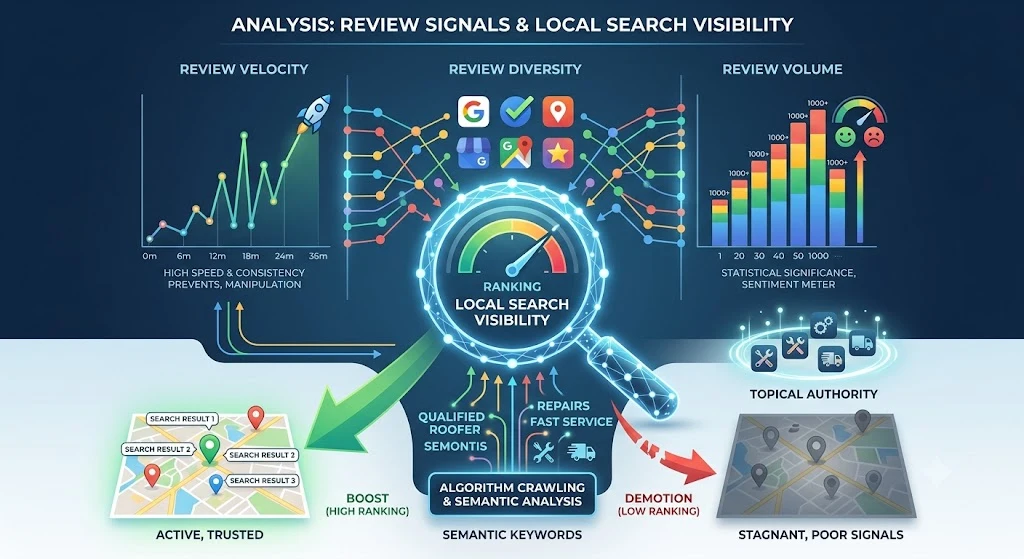
Review signals serve as primary ranking factors because they provide crowd-sourced validation of an entity’s operational history and customer satisfaction levels. Search engines analyse reviews across three specific vectors: velocity, diversity, and volume.
Review velocity measures the speed and consistency at which a business acquires new feedback, signaling ongoing market activity. Review diversity evaluates whether a business receives commentary across multiple platform types, which prevents algorithmic manipulation on a single channel. Volume establishes statistical significance for the calculated sentiment score.
When an algorithm crawls a review platform, it extracts semantic keywords to understand the specific attributes of the business. For instance, consistent mentions of specific services or product categories within user reviews reinforce the topical authority of the business profile.
The presence of high-quality, keyword-rich reviews alerts the algorithm that the entity actively satisfies user intent. Conversely, a sudden drop in review velocity or an influx of low-rating signals indicates operational instability, which triggers an algorithmic demotion in search perception.
How Does Information Architecture Influence Digital Trust?
Information architecture defines the structural organization, labelling, and navigation scheme of a digital asset to facilitate efficient content indexing and user comprehension. Within search ecosystems, a logical information hierarchy allows search engine crawlers to map the relationship between different topics and services effectively.
When a local business structures its digital assets clearly, it demonstrates topical authority and completeness to the ranking algorithms. This structural clarity builds digital trust by reducing crawl friction and ensuring accurate information extraction.
Algorithms assess the internal linking structure of a website to determine which pages hold the highest value and contextual relevance. A site map that categorizes localized services into distinct, dedicated URLs prevents topical dilution.
Each localized page must contain structured schema markup to communicate clear entity attributes directly to the search engine. This explicit data delivery minimizes machine ambiguity, strengthens the entity’s profile in the knowledge graph, and protects the SERP evaluation from misclassification or ranking suppression.
Which Reputation Strategies Deliver the Best Results for Local Businesses?
The determination of which reputation strategies deliver the best results for local businesses depends on the systematic deployment of technical optimization, proactive sentiment management, and structured footprint expansion. Local entities must treat search engine results pages (SERPs) as the definitive boundary of their public perception. Control over these pages requires a multi-layered approach to content indexing and sentiment control.
- Optimize structured data profiles to provide explicit entity verification across major search engine databases and mapping platforms.
- Standardize data alignment across all directory networks to eliminate conflicting identity signals regarding business name, physical address, and contact numbers.
- Cultivate multi-platform feedback to build a diversified portfolio of consumer sentiment that buffers against targeted negative campaigns.
- Implement automated monitoring tools to detect mentions of the brand entity immediately across social webs and unindexed forums.
- Publish localized resource content to establish topical expertise and capture informational search intent within specific geographic areas.
- Publish press releases via authoritative channels to generate high-trust backlinks and secure prominent placement in news aggregation algorithms.
- Audit third-party review platforms regularly to identify and report fraudulent content that violates platform terms of service.
- Configure branded search queries to ensure that self-owned digital assets occupy the top positions of the primary results page.
- Develop comprehensive knowledge bases to answer consumer queries directly, thereby securing rich snippet features and voice search compatibility.
- Analyze sentiment trends quarterly to identify systemic operational weaknesses before they manifest as critical search liabilities.
- Secure exact-match social handles to prevent digital identity hijacking and build supplementary nodes in the entity knowledge graph.
- Engage in community-driven digital PR to associate the business entity with recognized local institutions and events.
- Structure user-generated content sections with appropriate moderation filters to prevent spam indexing from degrading page authority.
- Maintain an active digital publication schedule to demonstrate ongoing entity relevance and encourage frequent algorithmic recrawling.
- Deconstruct competitor reputation footprints to identify gaps in local authority and exploit unserved informational needs in the market.
How Do Citation Networks Validate Brand Authenticity?
Citation networks act as a distributed ledger that search engines use to cross-reference and validate the real-world existence of a local business. A citation consists of any mention of the business entity across online directories, localized databases, or professional association registries.
The mechanism relies on consistency; the algorithm expects perfect alignment between the data stored in the primary knowledge graph and the data discovered on external nodes. Discrepancies in data disrupt this validation process and introduce entity ambiguity.
If a search engine encounters multiple variations of a business address or telephone number, it cannot determine which information is accurate. This uncertainty reduces the trust score of the entity, as the algorithm prioritizes user experience and avoids displaying unreliable data.
A verified, consistent citation network serves as a powerful trust signal, confirming that the business is legitimate and operational. This foundational verification is essential for maintaining stable search visibility within competitive local markets.
How Does Sentiment Analysis Change Search Perception Control?
Sentiment analysis is the algorithmic translation of subjective text into objective data points, classifying user commentary as positive, negative, or neutral. Search engines apply these natural language understanding (NLU) models to user reviews, social media discussions, and editorial content.
This analysis transforms qualitative feedback into quantitative metrics that influence how the system prioritizes search listings. Perception control relies on understanding that algorithms read the emotional tone and descriptive adjectives within content, not just the numerical ratings.
The impact on search perception is direct; algorithms utilize sentiment trends to predict user satisfaction. For instance, if text analysis reveals recurring phrases associated with poor service or defective products, the search engine modifies the entity perception score accordingly.
This modification can lead to the suppression of the business in query results that demand high-trust recommendations. Proactive management of the digital footprint involves altering the text-based sentiment balance across the web to align the algorithmic evaluation with positive brand attributes.
How Do Uncontrolled Digital Footprints Create Search Vulnerabilities?
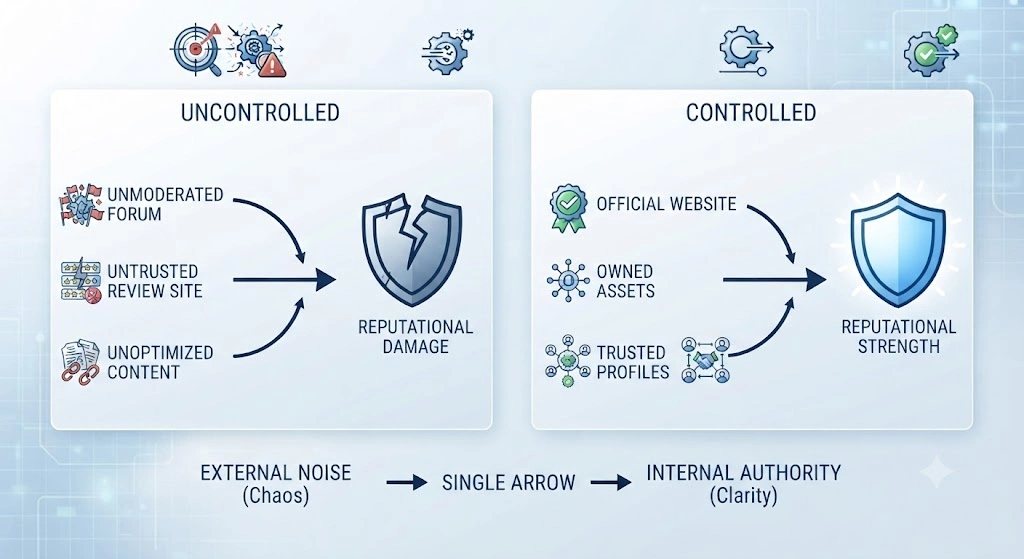
An uncontrolled digital footprint occurs when an entity allows third-party platforms, unmoderated forums, or unoptimized assets to dominate its search landscape. Within search ecosystems, search engines aim to present a comprehensive overview of an entity when a user executes a branded search query.
If the business has not populated the SERP with authoritative, self-owned digital assets, the algorithm fills the void with available third-party data. This reliance on external content exposes the entity to significant search vulnerabilities.
Unmonitored forums, legacy blog posts, or independent review portals can rank highly for branded terms if they possess sufficient historical authority. Negative information or inaccurate data hosted on these authoritative third-party sites can permanently damage the search reputation of a business.
Because the business lacks direct control over the hosting architecture, altering or removing this content is difficult. Establishing a robust, self-owned network of digital assets ensures that the search engine indexes controlled information, thereby minimizing the surface area for reputational risk.
Understanding online reputation requires a clear perception of search engines as complex algorithmic systems that measure digital trust, entity relationships, and consumer sentiment. Local entities cannot rely on passive visibility; they must actively manage the structure, consistency, and sentiment of their digital footprint. By systematically stabilizing citation data, diversifying review profiles, and optimizing information architecture, a business ensures that algorithmic evaluations remain positive. Controlling search perception ultimately depends on the strategic orchestration of high-authority content nodes that validate the authenticity, relevance, and credibility of the business across the entire search ecosystem.
Frequently Asked Questions
What is the difference between PR and online reputation management for businesses?
Public relations focuses on building brand awareness and media visibility through external communications and editorial placements. Online reputation management manages the search engine results pages (SERPs) and digital signals that define an entity’s credibility. Clear My Name deploys technical search engine optimization and sentiment control to actively shape how algorithms index and display local business profiles.
How long does it take to see results from a business reputation management strategy?
Algorithmic updates and content re-indexing timelines dictate that structural visibility shifts generally require three to six months. Initial data corrections across core citation networks can register within a few weeks, but shifting overall sentiment scores requires sustained review velocity. Clear My Name establishes baseline entity authority early in the cycle to accelerate how search engines interpret trust signals.
Can a local business completely remove a negative Google review?
A business cannot directly delete a review unless the content violates Google’s explicit terms of service regarding spam, harassment, or conflicts of interest. Flagging non-compliant reviews initiates an algorithmic and manual policy review for removal. For legitimate consumer feedback, the primary mitigation strategy involves accelerating positive review velocity to dilute the impact on the overall sentiment score.
Why do consistent business listings affect local search rankings?
Search engines cross-reference business name, address, and phone number (NAP) data across independent directories to validate entity authenticity. Discrepant information introduces machine ambiguity, which lowers the trustworthiness score within the knowledge graph. Clear My Name ensures data alignment across citation networks to prevent ranking suppression and maintain stable local map pack visibility.
How does sentiment analysis impact search perception for corporate entities?
Search engines utilize natural language processing (NLP) models to evaluate the emotional tone of user-generated content and third-party articles. Negative descriptive phrases alter the entity perception metric, which can suppress the business profile for high-intent queries. Proactive footprint management shifts the semantic balance toward positive trust signals to ensure favorable algorithmic evaluation.