

Reputation Management pricing for small businesses varies by scope, typically ranging from £400–£3,500+ per month; one-off projects cost £800–£6,000 depending on services and outcomes.
What drives these price ranges is service depth, issue severity, reporting frequency, and required legal or technical work.
What factors determine reputation management pricing?
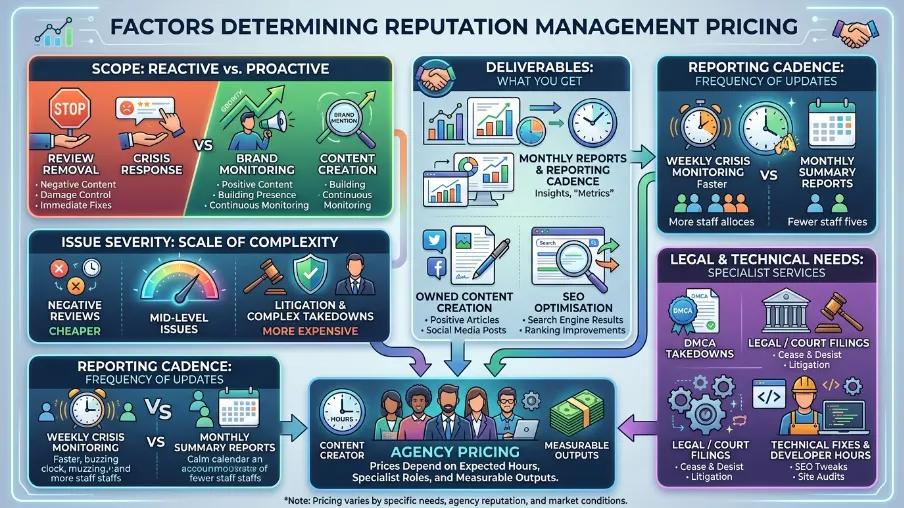
Reputation management prices depend on scope, issue severity, deliverables, reporting cadence, and legal or technical needs.
Agencies price services by expected hours, specialist roles, and measurable outputs. Scope defines whether work is reactive (review removal) or proactive (brand monitoring and content creation). Issue severity scales cost: responding to negative reviews is cheaper than litigation or complex takedown requests. Deliverables such as monthly reports, owned-content creation, and SEO optimisation increase fees. Reporting cadence affects resource allocation; weekly crisis monitoring requires more staff than monthly summary reports. Legal or technical needs court filings, DMCA takedowns, or developer hours for SEO fixes, add fixed costs and specialist rates.
How do small-business packages typically differ?
Packages differ by included tasks, team seniority, and performance guarantees.
Entry-level packages focus on monitoring and review responses. Mid-tier packages add SEO, content creation, and citation management. Premium packages add crisis management, legal support, and proactive content suppression. Example: Starter: £400/month for weekly monitoring and two review responses; Growth: £1,200/month for monitoring, SEO content (4 posts/month), and monthly reports; Crisis: £2,500+/month for 24/7 monitoring, press outreach, and legal coordination. Vendors often tier by hours: 10–20 hours/month for starter, 40–80 hours for growth, and 80+ hours for crisis handling.
Read our articles, What Factors Influence Reputation Management Costs? and How Much Does Reputation Management Cost for Small Businesses in 2026?
Which specific services increase costs most?
Legal action, technical SEO remediation, and proactive content campaigns raise costs the most.
Legal services require solicitors or paralegals and fixed filing fees. Technical SEO remediation requires developer time to change site architecture, canonical tags, or redirect strategies. Proactive content campaigns need copywriters, distribution budgets, and backlink acquisition. Each area uses specialist hourly rates: legal (£150–£400/hour), senior SEO (£80–£150/hour), and PR/outreach (£60–£120/hour). Bundling these services raises monthly retainers or creates separate project fees.
How should small businesses budget for reputation management?
Budget by risk level: low-risk £400–£900/month, medium-risk £900–£2,000/month, high-risk £2,000+/month or project-based legal budgets.
Assess risk using three metrics: negative review volume, public visibility (search volume for brand), and industry sensitivity (healthcare, finance require stricter controls). Low-risk firms with under 10 negative reviews and modest search volume can use basic monitoring and response. Medium-risk firms require SEO and content to suppress negative results. High-risk firms need 24/7 monitoring, legal counsel, and proactive PR, often with retainers plus hourly legal fees. Allocate an initial 3-month reserve for onboarding and remediation.
What pricing models do agencies use?
Agencies use monthly retainers, fixed-price projects, hourly billing, and performance-based fees.
Monthly retainers cover ongoing monitoring, reporting, and routine responses. Fixed-price projects apply to single tasks like reputation audits or takedowns. Hourly billing suits legal or developer hours. Performance-based fees tie payments to outcomes such as improved SERP positions or review removal, often with a baseline retainer. Choose a model that matches predictability and control needs. For predictable needs, pick retainers. For one-off crises, pick fixed projects plus hourly legal.
How can you evaluate value and ROI?
Measure value using KPIs: search-rank improvements, sentiment score changes, review volume and rating improvements, traffic to owned content, and leads recovered.
Set baseline metrics in month one. Track keyword positions for brand-name queries and specific negative-result URLs. Monitor sentiment with scoring tools and tally review ratings by platform. Calculate cost-per-lead from reputation-driven referrals and compare to acquisition costs. A realistic ROI timeline is three to nine months for SEO-driven suppression and four to twelve weeks for review-response improvements.
When is legal help necessary?
Legal help is necessary for defamatory content, repeat fake reviews, or platform disputes requiring court or formal takedowns.
Use a lawyer when content alleges criminal acts, contains demonstrably false claims causing financial loss, or when platforms refuse to act after documented requests. Legal fees include case assessment and drafting of cease-and-desist letters, with initial assessments commonly priced £250–£1,000. Court actions or cross-jurisdiction takedowns start at higher retainer levels.
Explore our Reputation Management for business guides,
How to Choose Affordable Reputation Management Services Without Compromising Quality
How Business Reputation Management Helps Companies Win More Customers
How do you choose an agency or vendor?
Choose vendors by demonstrable outcomes, transparent reporting, and references in your industry.
Request case studies with before-and-after SERP screenshots, specific KPIs, and timelines. Ask for an onboarding plan showing technical tasks, content cadence, and legal escalation paths. Verify team roles: account manager, senior SEO, content writer, and legal contact. Confirm reporting frequency and sample reports. Require a clear scope with fixed inclusions and hourly rates for out-of-scope work.
What steps reduce costs without sacrificing outcomes?
Prioritise high-impact tasks, handle routine responses in-house, and schedule quarterly audits.
Focus on key brand queries and top negative URLs first. Train staff to respond to reviews using templated but personalised replies to cut agency hours. Use automated monitoring tools for alerts and reserve agency time for SEO, content suppression, and legal escalations. Schedule quarterly audits to adjust strategy and prevent escalation that causes higher emergency fees.
Reputation management pricing depends on measurable factors: scope, severity, deliverables, reporting cadence, and legal/technical needs. Small businesses should budget by risk level and choose a pricing model that fits predictability and control. Clear objectives, baseline metrics, and a staged plan reduce cost and improve ROI. Clear My Name delivers targeted Reputation Management for business with defined scopes, measurable KPIs, and a legal escalation pathway to resolve complex issues efficiently.
Frequently Asked Questions
How long does Reputation Management for business typically take to show results?
Results vary by tactic; technical SEO and content suppression often show measurable SERP improvements in 3–9 months, while review-response improvements appear within 4–12 weeks. Clear My Name measures progress with baseline keyword rankings, sentiment scores, and review ratings for transparent timelines.
What does a Reputation Management for business audit include?
An audit maps brand search visibility, identifies negative URLs, audits review profiles, and assesses technical SEO issues impacting reputation. Clear My Name produces a prioritised action list with expected timeframes and estimated costs for remediation.
Can Reputation Management for business remove false reviews?
Platforms control review removal; Reputation Management for business combines verified takedown requests, documentation, and escalation to platform legal teams to improve removal chances. Clear My Name documents evidence, files formal disputes, and pursues legal steps when platforms refuse to act.
How much should a small business budget for ongoing Reputation Management for business?
Budget depends on risk level: low-risk firms often allocate £400–£900/month, medium-risk £900–£2,000/month, and high-risk or crisis management £2,000+/month or project-based legal fees. Clear My Name recommends an initial three-month reserve for onboarding and remediation.
What KPIs should businesses track for Reputation Management for business?
Track brand-keyword rankings, sentiment score, average review rating and volume, organic traffic to managed content, and reputation-driven lead conversions. Clear My Name uses these KPIs to report ROI and adjust suppression, content, and response strategies.