
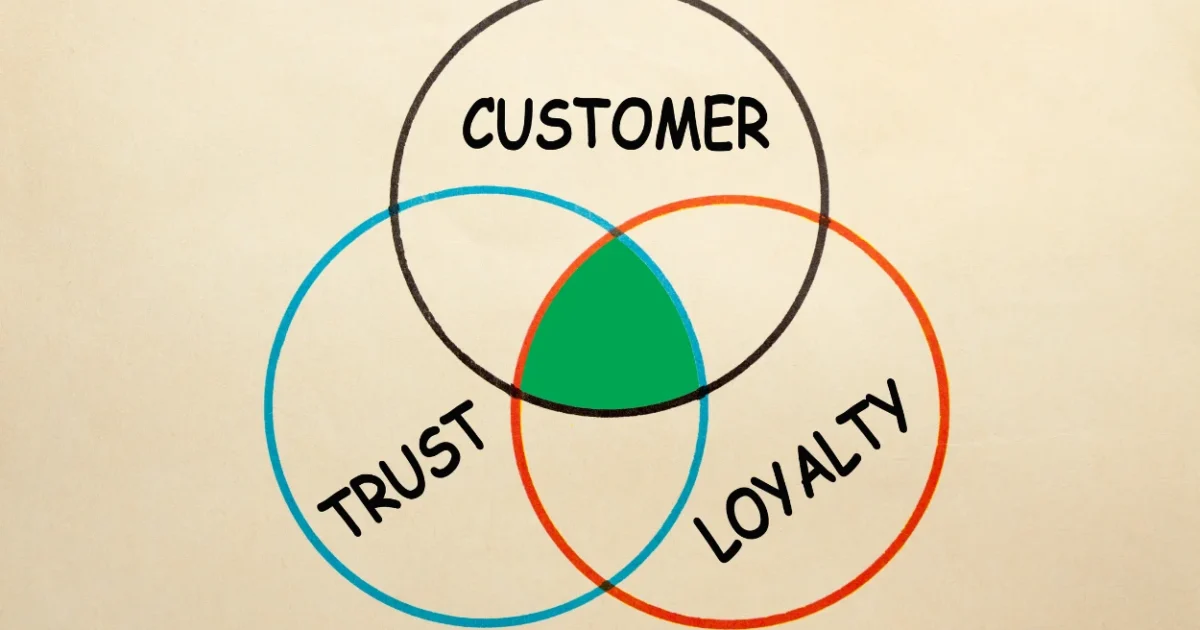
Customer trust declines when reputation gaps create inconsistencies between public perception, search visibility, and actual business performance. These gaps weaken reputation signals, reduce entity credibility, and alter sentiment distribution across search ecosystems.
Reputation management strategies differ based on how organisations identify, measure, and address trust-related weaknesses across digital touchpoints. Online reputation control methods are evaluated through their influence on search ranking signals, SERP composition, review sentiment, content visibility, and long-term perception management.
What Makes Reputation Gaps More Influential Than Isolated Negative Feedback?
A reputation gap is a disconnect between expected credibility signals and the information visible to users during evaluation. Unlike isolated negative comments, a reputation gap affects multiple trust indicators simultaneously. Search engines process these indicators as part of an entity’s overall credibility profile. When conflicting signals appear across reviews, search results, social profiles, and third-party mentions, trust erosion becomes measurable.
Negative feedback operates as a single data point, while reputation gaps influence sentiment distribution across an entire search ecosystem. Search engines compare consistency, authority, freshness, and relevance when evaluating reputation signals. A single complaint has limited ranking influence, but recurring gaps across multiple sources alter perception at scale. This distinction explains why some entities maintain trust despite criticism while others experience sustained reputation decline.
The evaluation of reputation gaps focuses on visibility rather than criticism volume. A highly visible trust gap generates stronger perception effects than numerous low-visibility complaints. Search engines analyse prominence, engagement, and source credibility when interpreting these signals. This process directly influences search visibility and user confidence during decision-making.
How Does Inconsistent Search Visibility Create a Trust Deficit?
Inconsistent search visibility reduces confidence because users encounter fragmented information about an entity. Search results function as a validation environment where users compare signals before forming opinions. When authoritative information appears incomplete or outdated, credibility weakens.
Content enhancement and content suppression represent two distinct approaches for addressing visibility inconsistencies. Content enhancement operates by increasing the presence of accurate and authoritative assets across search results. Content suppression operates by reducing the visibility of unfavourable content through stronger competing assets. Both approaches influence SERP composition differently.
Content enhancement provides greater sustainability because it increases informational depth and entity coverage. Content suppression delivers faster SERP adjustments but depends on continuous content competition. Search engines reward relevance, authority, and engagement rather than suppression intent. As a result, enhancement strategies generally produce stronger long-term search ranking influence.
Trust deficits emerge when users encounter missing business information, inactive profiles, or contradictory search results. These conditions reduce entity credibility because verification becomes more difficult. Search ecosystems favour consistency, making visibility alignment a core reputation management consideration.
Why Does Review Sentiment Distribution Matter More Than Average Ratings?
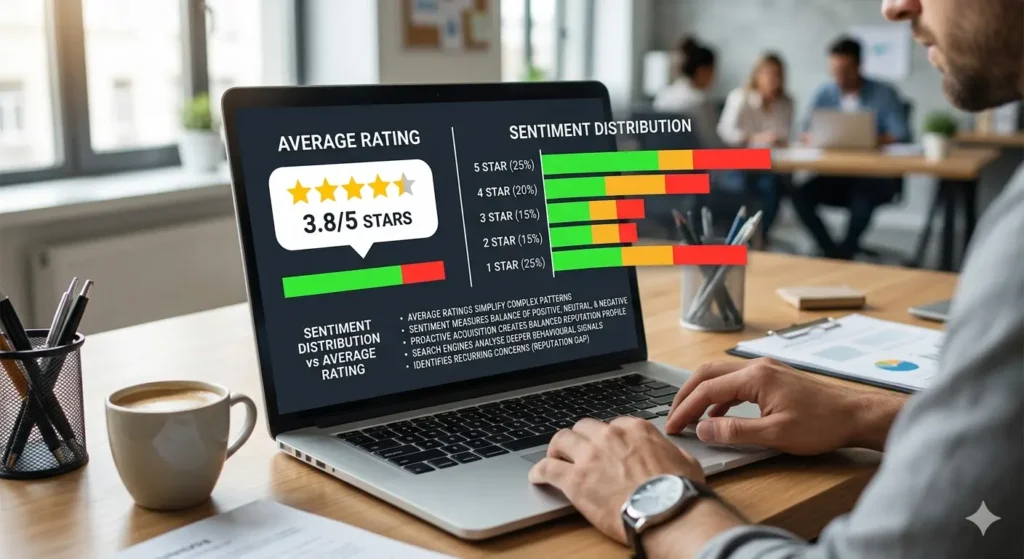
Sentiment distribution provides a broader evaluation framework than average ratings because it measures the balance of positive, neutral, and negative experiences. Average ratings simplify complex sentiment patterns into a single metric. Search engines and users analyse deeper behavioural signals.
Review management approaches generally compare reactive response models with proactive sentiment development models. Reactive approaches address existing reviews after publication. Proactive approaches operate by encouraging consistent customer feedback generation over time. Each method affects sentiment distribution differently.
Reactive management improves issue visibility and demonstrates accountability. However, it does not significantly alter sentiment ratios without ongoing review acquisition. Proactive sentiment development expands the volume of positive and neutral signals, creating a more balanced reputation profile. Search engines interpret consistent review activity as evidence of ongoing relevance and engagement.
A reputation gap forms when rating scores appear acceptable while review narratives reveal recurring concerns. Sentiment analysis identifies these discrepancies more effectively than numerical averages. Consequently, sentiment distribution serves as a stronger indicator of long-term trust sustainability.
Which Creates Greater Risk: Negative Content Presence or Positive Content Absence?
Positive content absence creates broader reputation exposure because it limits contextual balance within search results. Negative content presence attracts attention, but the absence of authoritative positive assets prevents users from evaluating alternative perspectives.
Content removal and content creation represent two commonly compared reputation management approaches. Content removal focuses on eliminating harmful information where legal, policy, or platform criteria permit action. Content creation focuses on expanding authoritative content that strengthens entity credibility. These approaches operate through different mechanisms.
Content removal provides immediate visibility reduction when successful. However, removal eligibility remains limited by platform policies and legal standards. Content creation scales more effectively because it increases content diversity and strengthens topical authority. Search engines evaluate authority through breadth, depth, and relevance rather than removal activity.
Risk exposure increases when search ecosystems lack sufficient positive context. Users interpret informational gaps as uncertainty. Consequently, positive content absence often generates a more persistent trust deficit than the existence of isolated negative references.
How Do Outdated Digital Assets Affect Entity Credibility?
Outdated digital assets weaken credibility because they introduce uncertainty into evaluation processes. Websites, profiles, directories, and knowledge references contribute to entity verification. When information becomes inconsistent, trust signals deteriorate.
Organic reputation maintenance differs from reactive reputation correction in its operational structure. Organic maintenance involves continuous updates, monitoring, and information consistency management. Reactive correction addresses issues after discrepancies become visible. Both approaches influence entity credibility, but their outcomes differ.
Organic maintenance supports stable search visibility by preserving information accuracy. Reactive correction restores damaged credibility but requires additional effort to regain trust signals. Search engines favour freshness and consistency because these characteristics improve information reliability.
Entity credibility declines when users encounter obsolete contact details, inactive profiles, outdated leadership information, or inaccurate descriptions. These inconsistencies generate verification friction. Search ecosystems interpret such friction as reduced reliability, influencing both perception and visibility outcomes.
What Is the Difference Between Short-Term Reputation Repair and Long-Term Reputation Strengthening?
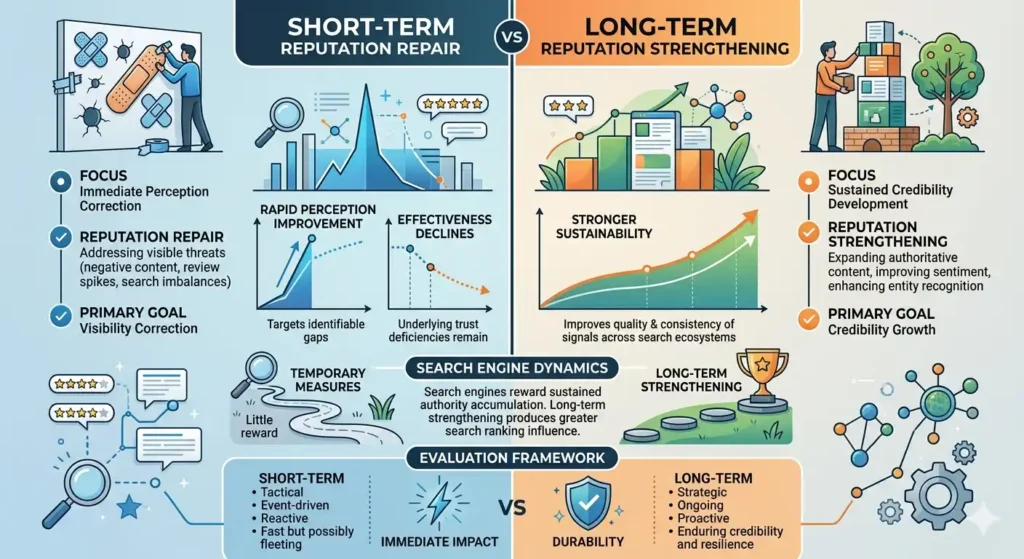
Short-term reputation repair focuses on immediate perception correction. Long-term reputation strengthening focuses on sustained credibility development. These approaches differ in objectives, mechanisms, and measurable outcomes.
Reputation repair operates by addressing visible reputation threats such as negative content, review spikes, or search result imbalances. The primary goal is visibility correction. Reputation strengthening operates by expanding authoritative content, improving sentiment distribution, and enhancing entity recognition. The primary goal is credibility growth.
Short-term methods often produce rapid perception improvements because they target identifiable reputation gaps. However, their effectiveness declines when underlying trust deficiencies remain unresolved. Long-term methods generate stronger sustainability because they improve the quality and consistency of reputation signals across search ecosystems.
Search engines reward sustained authority accumulation. As a result, long-term strengthening generally produces greater search ranking influence than temporary corrective measures. Evaluation frameworks therefore compare immediate impact against durability when assessing reputation management effectiveness.
How Does Reputation Monitoring Compare With Reputation Intervention?
Reputation monitoring is the process of observing reputation signals across search environments. Reputation intervention is the process of actively modifying those signals through strategic actions. Both functions contribute to reputation management, yet they serve different purposes.
Monitoring operates by collecting data related to reviews, mentions, sentiment shifts, search visibility, and content performance. Intervention operates by responding to identified risks through content updates, review engagement, visibility optimisation, or correction strategies. Monitoring provides intelligence, while intervention provides execution.
Monitoring offers scalability because data collection systems operate continuously. However, monitoring alone does not alter perception outcomes. Intervention changes reputation signals directly but depends on accurate intelligence. Effective reputation management combines both functions to maintain situational awareness and strategic responsiveness.
Search ecosystems evolve continuously through new content, user feedback, and algorithmic updates. Monitoring identifies emerging reputation gaps before visibility damage expands. Intervention addresses those gaps through measurable corrective actions. Their combined effectiveness exceeds the performance of either approach alone.
Which Reputation Gaps Have the Greatest Influence on Customer Trust?
The most influential reputation gaps are those that affect verification, consistency, and information quality simultaneously. Trust formation depends on coherent reputation signals across multiple digital environments. When contradictions appear, entity credibility weakens.
The highest-impact gaps typically include:
- Identify inconsistent business information across search platforms and directories.
- Measure sentiment distribution rather than relying solely on average ratings.
- Evaluate content absence alongside visible negative content.
- Monitor outdated assets that reduce information reliability.
- Compare short-term corrective actions against long-term strengthening initiatives.
- Analyse SERP composition to understand visibility balance.
- Track reputation signal consistency across all public touchpoints.
These gaps influence both user perception and search engine interpretation. Search systems evaluate authority through interconnected signals rather than isolated data points. Consequently, trust reduction occurs when credibility indicators lose consistency across the wider digital ecosystem.
Dive Deeper With Our Expert Guides:
Business Reputation Audit Checklist for UK Companies
10 Signs Your Online Reputation Is Costing You Customers
Reputation gaps reduce customer trust by weakening consistency, credibility, and visibility across search environments. The evaluation of reputation management approaches reveals clear differences between content enhancement and content suppression, proactive and reactive strategies, monitoring and intervention models, and short-term repair versus long-term strengthening.
Search engines interpret reputation signals through entity credibility, sentiment distribution, content authority, and information consistency. Approaches that improve these signals produce stronger sustainability, while methods focused solely on immediate visibility correction deliver narrower outcomes. Understanding the mechanisms, limitations, and search ranking influence of each approach provides a clearer framework for analysing reputation performance and identifying trust-related vulnerabilities.
For deeper insight explore:
Why Growing Companies Invest in Professional Reputation Protection
Answers to Key Questions
How does reputation management affect customer trust?
Reputation management influences customer trust by improving the accuracy, consistency, and visibility of information about a business. Strong reputation signals help customers verify credibility during their decision-making process.
Why are online reviews important in reputation management for business?
Online reviews contribute to sentiment distribution and public perception. Search engines and potential customers use review content, ratings, and response activity to evaluate business credibility and service quality.
How can businesses improve their online reputation?
Businesses can improve their online reputation by maintaining accurate information, encouraging authentic customer feedback, and publishing relevant content. Consistent management of reputation signals helps create a stronger digital presence.
What are the main challenges in reputation management for business?
Common challenges include negative search results, inconsistent business information, outdated content, and poor review sentiment. Effective reputation management requires ongoing monitoring and analysis to identify and address these issues.