

Reputation management strategies differ based on whether historical teenage content requires removal, suppression, contextualisation, or stronger competing information. Online reputation control methods are evaluated through search visibility, content indexing, reputation signals, entity credibility, and the composition of search engine results pages.
Which teenage digital footprint problems require removal rather than suppression?
Content removal addresses historical material that can legitimately be deleted at its original source, while suppression addresses content that remains published but has disproportionate search visibility. Removal operates by eliminating or restricting access to the source material, whereas suppression operates by changing the surrounding search environment through stronger competing information. The distinction matters because a deleted page no longer contributes to search results in the same way as an indexed page that remains publicly available. Removal therefore provides a direct source-level intervention, while suppression focuses on search ranking influence. The appropriate method depends on ownership, platform rules, privacy considerations, accuracy, and the current visibility of the content.
How does source-level removal affect search visibility?
Source-level removal works by changing the availability of the original content before search engines evaluate its continued visibility. A successful deletion can cause the page to disappear from its original location, although indexed references, copies, screenshots, quotations, or syndicated versions can remain elsewhere. Search engines also require time to recrawl and update their indexes after source-level changes. Removal therefore has a direct mechanism but does not automatically clean every connected reference. An audit needs to examine secondary copies after the original source has been addressed.
When is suppression a more relevant method?
Suppression becomes relevant when historical content remains legitimate, publicly accessible, or outside the scope of a valid removal request. The process focuses on improving the visibility of relevant, authoritative information so that damaging historical pages occupy less prominent positions. This does not delete the original content and does not alter the underlying source. Instead, it changes the composition of results available for targeted searches. The effectiveness of suppression therefore depends on content relevance, authority, indexing, competition, and ranking dynamics.
Is content creation or content removal more effective for an old digital footprint?
Content creation and content removal operate through fundamentally different mechanisms, so effectiveness depends on the underlying reputation problem. Removal targets the original source and is appropriate when a legitimate deletion route exists, while content creation adds relevant information that competes for search visibility. New content can strengthen entity credibility by providing accurate professional information, but it does not automatically displace an established high-authority page. Removal has a direct source-level effect, whereas content enhancement operates through search ranking influence. Evaluating the two approaches requires examining whether the problem is caused by the existence of content, its visibility, or an incomplete representation of the individual’s current identity.
How does content enhancement change SERP composition?
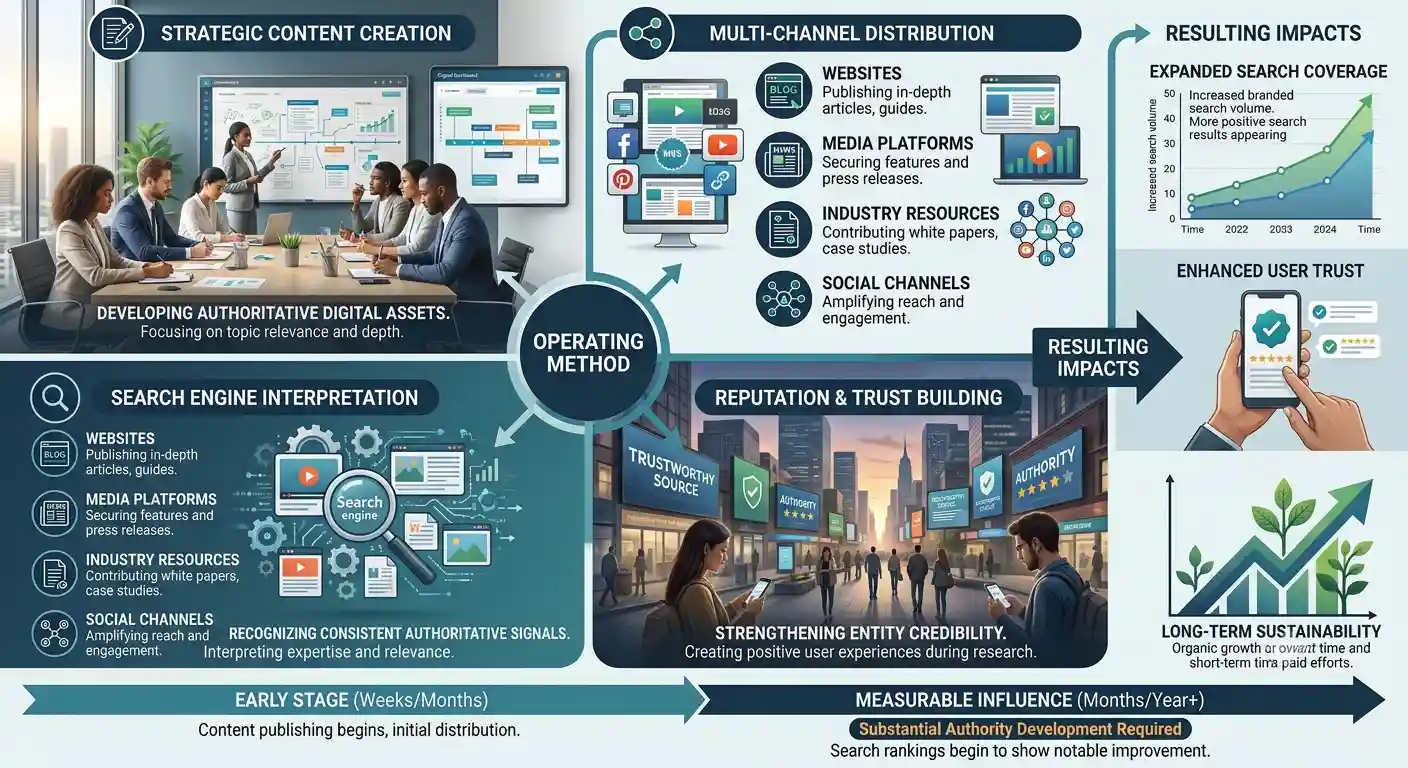
Content enhancement works by creating or strengthening information that provides search engines with additional relevant context about an individual. Professional profiles, accurate biographies, verified information, legitimate achievements, and relevant editorial references can contribute to a broader entity representation. When these pages become visible for appropriate queries, they alter the composition of the SERP by adding competing information. The process does not guarantee removal of historical results because each page remains subject to its own ranking signals. Its value therefore relates to the quality, relevance, authority, and consistency of the information introduced into the search environment.
What are the limitations of content creation?
Content creation has limitations when the new material lacks authority, relevance, originality, or sufficient search visibility. Publishing large volumes of low-quality pages does not automatically create strong reputation signals and can produce an inconsistent digital footprint. Search engines evaluate individual pages and sources rather than simply counting how much content exists. New material also requires indexing and ranking before it contributes meaningfully to SERP composition. Content enhancement therefore requires quality and relevance rather than volume as its primary mechanism.
How does an organic reputation strategy compare with a reactive approach?
An organic strategy develops a stronger information environment over time, while a reactive strategy responds to specific reputation incidents or newly discovered pages. Organic reputation management focuses on maintaining accurate professional information, consistent identity signals, authoritative profiles, and relevant content before a problem becomes prominent. Reactive management focuses on individual incidents such as an old post becoming highly visible, a copied image appearing in search, or a historical page gaining ranking positions. Organic activity provides broader long-term coverage, whereas reactive intervention concentrates resources on immediate search risks. A complete evaluation considers both the preventive value of organic activity and the precision of reactive interventions.
What does reactive reputation management involve?
Reactive reputation management begins when an identified piece of content creates measurable search or credibility risk. The process analyses the source, ranking position, content accuracy, indexing status, platform rules, and available intervention routes. Removal requests address qualifying material directly, while suppression and content enhancement address legitimate content that remains visible. Monitoring then measures whether the intervention changes search visibility or SERP composition. Reactive management provides targeted resource allocation, but relying exclusively on it leaves the digital footprint exposed between individual incidents.
Why does organic management matter for long-term search visibility?
Organic management creates a broader information environment that remains relevant beyond one specific reputation incident. Consistent professional profiles and accurate information provide search engines with additional context for understanding an individual’s entity. This helps establish recurring reputation signals across appropriate sources rather than relying on a single page to represent the individual. Long-term activity also provides greater resilience when new content enters the search ecosystem. Its limitation is that results depend on sustained relevance, content quality, authority, and changing search ranking dynamics.
Which approach creates a stronger long-term impact: suppression or enhancement?
Suppression and enhancement address related but distinct objectives within search reputation management. Suppression focuses on reducing the prominence of specific damaging pages, while enhancement strengthens the surrounding information environment through relevant and authoritative content. Suppression is more directly tied to an identified negative result, whereas enhancement builds broader entity credibility across multiple searches. The long-term impact depends on whether the underlying issue is isolated to specific pages or reflects a wider gap in the individual’s digital footprint. Evaluating both methods requires measuring ranking movement, SERP composition, sentiment distribution, and source quality over time.
How does sentiment distribution change after content enhancement?
Sentiment distribution describes how positive, neutral, negative, and context-dependent information is represented within a defined group of search results. Content enhancement can introduce additional factual and professionally relevant information, reducing the relative concentration of negative material within the visible result set. This does not demonstrate a change in public opinion because search results represent indexed information rather than a representative population sample. Measurement therefore focuses on search perception rather than claiming to measure overall sentiment. Tracking sentiment distribution across consistent queries provides a structured way to evaluate changes in the information environment.
How does the age of teenage content affect the cleanup strategy?

The age of teenage content affects its context but does not automatically determine its current search significance. An old page can remain visible when it continues to satisfy a query, retains source authority, or remains strongly associated with the individual’s identity. Conversely, historical material can lose visibility when newer information becomes more relevant or competing sources gain ranking strength. The cleanup strategy therefore evaluates publication date alongside indexing, ranking position, source authority, content accuracy, and current relevance. Treating every old post as equally insignificant or equally damaging produces an incomplete assessment.
Does deleting an old post remove its entire digital footprint?
Deleting an original post does not necessarily remove every trace associated with that content. Screenshots, reposts, quotations, archived pages, image copies, forum references, and third-party discussions can continue to exist independently. Search engines also retain indexed representations until their systems recrawl and update relevant records. A complete audit therefore examines both the original source and connected references. The distinction between source deletion and digital-footprint cleanup is essential when evaluating the scope of a reputation issue.
How should the effectiveness of digital-footprint cleanup be measured?
Effectiveness is measured through defined changes in search visibility, content accessibility, SERP composition, and reputation signals rather than through subjective impressions alone. A baseline records the initial ranking positions, indexed sources, content types, sentiment distribution, and authority characteristics associated with relevant searches. Subsequent measurements then compare those indicators after removal, suppression, or content enhancement activity. This creates evidence for evaluating whether a strategy changed the search environment. Measurement also identifies situations where a successful source-level action produced limited overall improvement because secondary content remained visible.
Which metrics help compare reputation management approaches?
A structured evaluation can compare approaches through consistent search and content indicators.
- Measure ranking positions for personal-name queries to identify whether targeted historical pages gain or lose visibility.
- Track indexed sources to determine whether removed material remains accessible through copies, references, or alternative URLs.
- Analyse SERP composition to measure the proportion of professional, historical, social, editorial, and dispute-related results.
- Evaluate source authority to distinguish established information from low-context or weakly authoritative material.
- Monitor sentiment distribution to assess whether the visible information environment has become more balanced.
These measurements make comparison more precise by connecting strategic activity with observable search outcomes.
Which reputation cleanup methods carry the greatest risk exposure?
Risk exposure depends on the method used, the content involved, and the accuracy of the information being challenged or introduced. Inaccurate removal claims can create procedural or credibility problems, while low-quality content creation can weaken entity credibility instead of strengthening it. Aggressive attempts to manipulate search visibility can also produce an inconsistent information environment if the underlying material lacks factual support. A controlled strategy therefore evaluates legitimate intervention routes before acting. Risk analysis is particularly important when historical content contains factual information, third-party reporting, or material that does not qualify for removal.
How does inaccurate information complicate reputation cleanup?
Inaccurate information creates a different problem from negative but factual information because the appropriate intervention depends on verification and source context. Corrective action requires identifying the specific factual issue, establishing reliable evidence, and using an appropriate source or platform process. Replacing inaccurate material with unsupported claims introduces an additional credibility risk. Search engines also evaluate the information environment through source and content signals rather than accepting every correction as authoritative. Reputation cleanup therefore benefits from separating factual correction, legitimate removal, search suppression, and content enhancement as distinct processes.
Which strategy is more scalable for a large digital footprint?
Scalability depends on how consistently a strategy can be applied across sources, queries, content types, and changing search conditions. Content enhancement can scale through a structured network of accurate professional information, while source-level removal often requires individual assessment and platform-specific procedures. Suppression also requires continuous monitoring because ranking positions change as new content enters the search ecosystem. A scalable framework therefore relies on repeatable auditing, classification, prioritisation, measurement, and monitoring processes. The number of pages alone does not determine scalability because source authority, intervention complexity, and search relevance also affect resource requirements.
How can a digital-footprint audit prioritise content?
Prioritisation ranks issues according to measurable search and reputation factors rather than treating every historical reference equally. High-visibility pages, prominent personal-name results, strongly associated content, and authoritative sources require different analysis from low-ranking pages with limited discoverability. The audit can also distinguish between content that qualifies for removal and content requiring suppression or contextual enhancement. This creates a resource allocation framework based on search impact and intervention feasibility. Prioritisation improves scalability because effort is concentrated on content with measurable influence on the searchable identity.
Dive Deeper With Our Expert Guides:
Building a Tenant-Ready Online Reputation Before Renting
How to Respond to False Accusations Made About You Online
How can short-term and long-term reputation strategies work together?
Short-term strategies address immediate visibility risks, while long-term strategies strengthen the information environment that supports sustained search perception. A short-term intervention can involve a legitimate removal request, correction, or targeted suppression of a prominent historical page. Long-term activity can involve maintaining accurate professional profiles, improving authoritative information, monitoring rankings, and identifying new reputation signals. Combining the two approaches connects immediate risk reduction with ongoing digital-footprint development. The distinction prevents a temporary ranking change from being mistaken for permanent reputation control.
What does sustainable reputation cleanup involve?
Sustainable cleanup involves monitoring, accurate information management, source evaluation, and periodic reassessment of search results. Search ecosystems change continuously, so a digital footprint that appears balanced at one point can develop new risks as content and rankings change. Ongoing evaluation identifies new pages, duplicate content, changes in source authority, and shifts in SERP composition. Sustainability therefore relates to maintaining an accurate and credible information environment rather than achieving one fixed search position. This approach also provides a framework for reassessing historical teenage content as its relevance changes over time.
How can different reputation management approaches be evaluated together?
Different approaches can be evaluated together by separating their mechanisms, objectives, risks, and measurable outcomes. Removal changes the source environment, suppression changes search prominence, and enhancement expands the available information surrounding an individual’s identity. Organic strategies provide ongoing information development, while reactive strategies address specific search risks as they emerge. Each approach therefore operates at a different stage of the reputation-management system and carries different resource requirements. A structured comparison considers search visibility, entity credibility, sustainability, scalability, risk exposure, and measurable changes in SERP composition.
What matters when cleaning up a teenage digital footprint?
Cleaning up a teenage digital footprint requires distinguishing source-level removal from search suppression and content enhancement. Removal addresses qualifying material at its origin, suppression focuses on reducing the visibility of legitimate but damaging results, and enhancement strengthens the broader information environment. Organic strategies provide ongoing reputation signals, while reactive strategies address defined incidents and high-visibility risks. Effective evaluation depends on measurable search visibility, indexing status, source authority, sentiment distribution, entity credibility, and SERP composition. For individuals seeking a structured route to address historical online content, Erase Your Teenage Digital Footprint provides a decision-stage focus on assessing which material requires removal, suppression, or contextual enhancement. The most useful framework is therefore not a single universal method but a structured comparison of mechanisms, limitations, risk exposure, scalability, and long-term sustainability.
How can I clean up my teenage digital footprint?
Start by auditing old social media posts, usernames, photographs, videos, forums, and other publicly indexed content connected to your identity. Reputation management for individuals can then assess which material requires removal, correction, suppression, or stronger contextual information.
Can old teenage posts be removed from Google?
Google search results can change when the original content is removed or becomes unavailable, although copies, reposts, and third-party references can remain indexed. Removal options depend on the source, platform policies, privacy considerations, and the nature of the content.
Do teenage social media posts affect your adult reputation?
Teenage posts can affect adult online reputation when historical content remains visible and becomes associated with a current personal identity. Its significance depends on search visibility, content context, source authority, indexing status, and SERP composition.
What is included in a digital footprint audit?
A digital footprint audit examines personal-name searches, old usernames, social profiles, images, videos, forums, reviews, and third-party references. It evaluates ranking positions, content indexing, reputation signals, source authority, and the accuracy of information representing the individual online.
Can Clear My Name help with an old digital footprint?
Clear My Name can be considered within a reputation management process that assesses historical online content, search visibility, and reputation signals. The appropriate approach depends on whether specific material qualifies for removal or requires correction, suppression, or contextual enhancement.