

Building a consistent reputation across multiple franchise locations requires coordinated reputation signals, accurate local information and consistent entity relationships.
Reputation management strategies differ based on how centralised brand information and independent local signals are monitored, evaluated and improved across search ecosystems.
Why is reputation consistency difficult across multiple franchise locations?
Reputation consistency is difficult because each franchise location operates as a distinct local entity while remaining connected to a wider brand structure. Every location generates its own reviews, listings, website information, customer feedback and external references. Search engines evaluate these signals according to location, relevance and entity relationships rather than treating the entire franchise as one identical business. A consistent reputation therefore requires coordination without removing legitimate differences between individual locations.
The central challenge is controlling information without creating artificial uniformity. Corporate standards establish shared business attributes, while local information establishes geographic and operational relevance. Differences in opening hours, services, contact details or business descriptions can create conflicting reputation signals when they are not properly managed. These inconsistencies affect both entity credibility and the clarity of information available to users.
Reputation consistency also involves sentiment distribution. One location can accumulate predominantly positive reviews while another develops recurring negative themes. Combining these signals into a single brand-level reputation can conceal location-specific issues. Effective evaluation therefore requires analysis at both the franchise-network level and the individual-location level.
How does centralised reputation management compare with local reputation management?
Centralised reputation management focuses on shared brand standards, while local reputation management focuses on the individual signals associated with each franchise location. Centralised management operates by establishing consistent naming, information, content and reputation policies across the network. Local management evaluates reviews, listings, content and search visibility for each branch independently. Both approaches address different parts of the same reputation ecosystem.
Centralisation provides stronger governance and scalability. A central framework can define how locations represent business information, manage reviews and structure local pages. This reduces variation between branches and creates a consistent baseline for entity recognition. Its limitation is that centralised standards do not capture every local customer experience or search condition.
Local management provides greater contextual accuracy. A location-level review profile reflects the actual customer experiences associated with that branch, while local search results reflect its geographic relevance. The limitation is operational complexity because every location creates additional information requiring monitoring. A scalable franchise reputation model therefore connects central standards with local evaluation rather than selecting one approach exclusively.
Is content creation more effective than content removal for franchise reputation?
Content creation and content removal serve different reputation objectives, making their effectiveness dependent on the underlying problem. Content creation operates by adding relevant, authoritative information to the search ecosystem. Content removal operates by addressing specific information that qualifies for legitimate deletion or suppression under applicable rules. Creation expands the information environment, while removal reduces the visibility or presence of qualifying problematic content.
Content enhancement provides a stronger long-term mechanism when the problem involves insufficient authoritative information. New location pages, useful local resources and accurate business information create additional indexed assets that explain the franchise entity. These assets contribute to relevance and contextual clarity over time. However, content creation does not automatically resolve inaccurate or policy-violating information elsewhere.
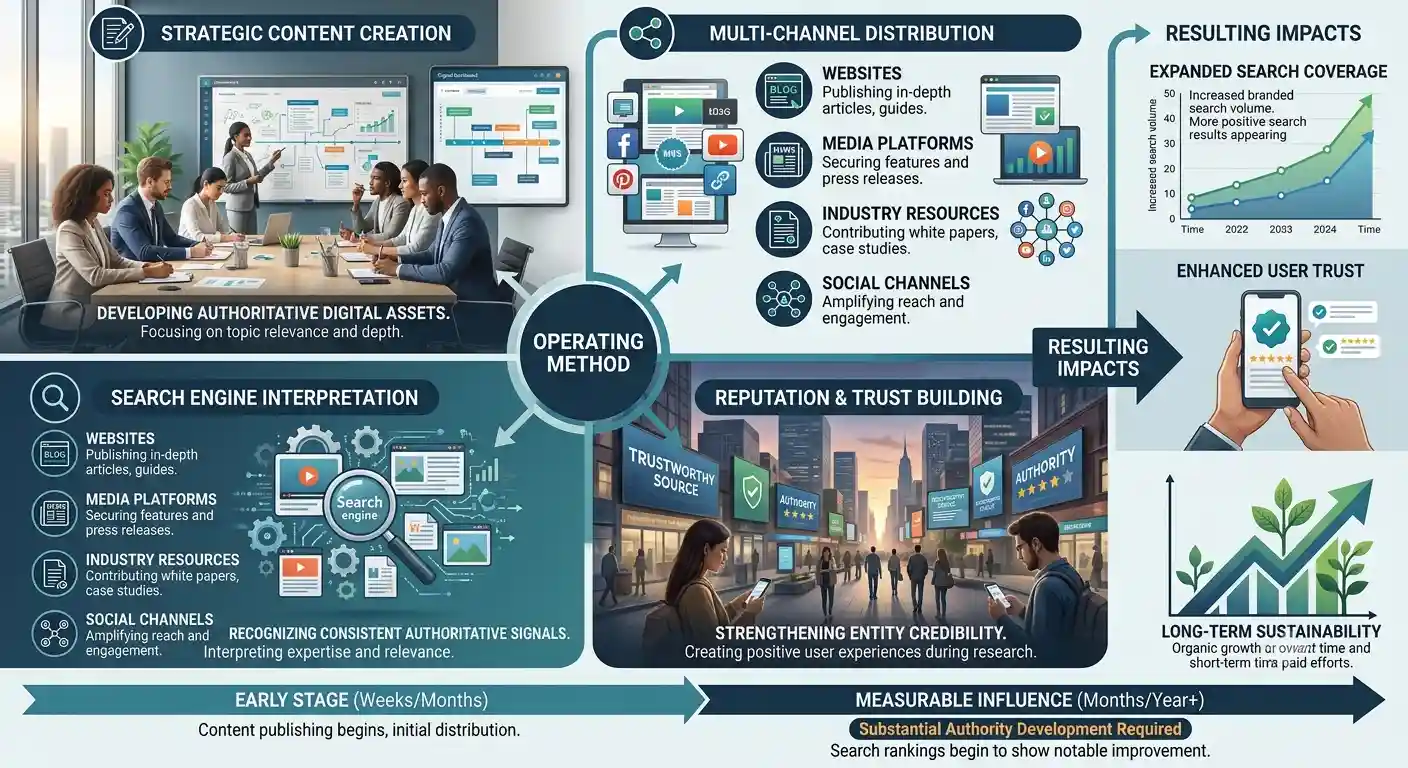
Removal strategies provide a more direct response when specific content has a legitimate basis for removal. Their limitation is that not every negative result qualifies for removal simply because it affects perception. Legitimate criticism and accurate customer feedback remain part of the reputation ecosystem. A balanced evaluation therefore distinguishes between content suppression and content enhancement according to the nature of the reputation issue.
How do organic and reactive reputation approaches differ?
Organic reputation development is a proactive approach that builds reputation signals continuously, while reactive reputation management responds to defined reputation problems. Organic activity includes maintaining accurate listings, developing relevant content and monitoring reviews before significant issues emerge. Reactive activity addresses events such as inaccurate information, sudden negative search results or significant changes in sentiment distribution. The main difference is whether reputation activity operates continuously or in response to a specific trigger.
Organic development creates cumulative value because new content, reviews and accurate information continually expand the digital footprint. This creates a broader information structure through which search engines can understand the franchise and its locations. Its limitation is that it does not directly resolve an existing harmful result. Reactive management addresses individual problems more directly but provides less value when used without an ongoing reputation framework.
Search visibility reflects both approaches differently. Organic activity influences the wider set of information available for indexing and ranking, while reactive activity targets defined information or search conditions. A franchise network therefore benefits from evaluating proactive and reactive methods as complementary rather than interchangeable. Sustainability depends on maintaining the underlying reputation structure after an individual issue has been addressed.
Which reputation signals matter most for franchise locations?
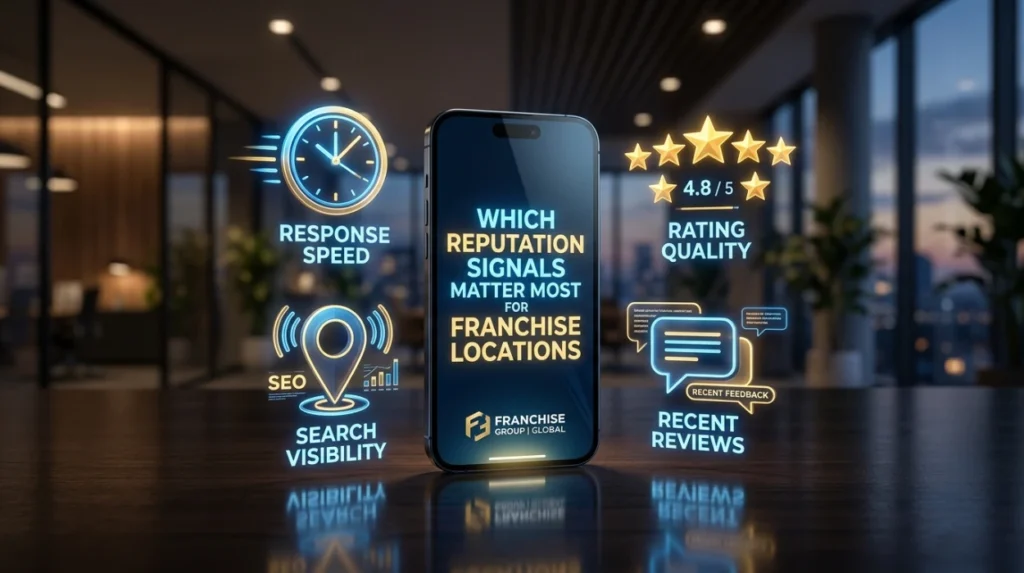
The most useful reputation signals are those that establish entity identity, customer sentiment, relevance, authority and information accuracy. Reviews provide experience and sentiment signals, while local listings establish essential business attributes. Website content provides contextual information about services and locations, and external references contribute additional authority signals. Search engines interpret these signals through relationships between the location, parent entity and relevant topics.
Reviews become particularly important because they represent customer-generated information. Rating patterns provide structured sentiment data, while written feedback establishes recurring associations with aspects of the customer experience. A location with a high rating but inconsistent business information still presents a fragmented entity profile. Reputation evaluation therefore requires review signals to be considered alongside factual and contextual information.
Authority signals operate differently from review signals. Relevant content and reputable external references provide evidence about the entity’s subject relevance and credibility. They do not replace customer feedback, but they provide a different dimension of information for search evaluation. A consistent franchise reputation therefore depends on combining user-generated, business-controlled and externally referenced signals.
How does inconsistent local information affect SERP composition?
Inconsistent local information can fragment the way search engines interpret individual franchise entities. Differences in names, addresses, telephone numbers, opening information and services create conflicting attributes across indexed sources. Search engines then encounter multiple representations that require entity resolution. This can affect which pages, listings and other information appear for location-specific queries.
SERP composition reflects the information available to search systems for a particular query. When local information is accurate and consistent, relevant pages and listings have clearer relationships with the corresponding location. When information conflicts, search engines have weaker contextual evidence about which source best represents the entity. The result is a less predictable search environment.
The impact also extends to user perception. Searchers encountering different information across search results can interpret the franchise location as less reliable or less established. This perception does not depend exclusively on review sentiment. Factual consistency itself functions as a trust signal within the wider digital footprint.
Dive Deeper With Our Expert Guides:
How to Earn and Protect Trustpilot and Feefo Verified Status
Turning Employee Advocacy Into a Reputation Asset for Your Company
Is a standardised franchise content strategy better than individual location content?
A hybrid content structure provides stronger balance than relying exclusively on standardised or completely independent location content. Standardised content establishes shared brand information and consistent entity relationships. Individual location content establishes local relevance through accurate information about each branch. The two approaches therefore perform different functions within the search ecosystem.
Excessive standardisation creates duplication. If every location page contains substantially identical information, search engines receive limited evidence that distinguishes one location from another. This reduces the informational value of local pages because geographic and operational differences remain underrepresented. Standardisation therefore works best for shared attributes rather than complete page replication.
Individualised content provides stronger local relevance when it contains genuinely useful location-specific information. Opening details, local services, branch information and relevant geographic context help search engines associate the page with a specific entity. The limitation is governance because inaccurate local content can introduce inconsistencies. A scalable strategy therefore standardises core information while allowing accurate local differentiation.
How should franchise businesses compare short-term and long-term reputation strategies?
Short-term reputation strategies focus on resolving immediate search or information problems, while long-term strategies build a stable reputation infrastructure. Short-term interventions include correcting inaccurate listings, addressing qualifying removal requests and responding to significant reputation changes. Long-term activity includes content development, review monitoring, information governance and continuous SERP evaluation. Their effectiveness depends on whether the objective is immediate risk reduction or sustained reputation stability.
Short-term activity provides faster visibility into a specific reputation problem. Correcting an inaccurate business detail, for example, directly addresses the conflicting signal causing the issue. However, a short-term correction does not prevent future inconsistencies from appearing. Without ongoing monitoring, the same category of reputation problem can return.
Long-term activity creates cumulative reputation value. Consistent information, authoritative content and authentic review signals strengthen the digital footprint over time. This approach requires continuous evaluation because search ecosystems change as new content is indexed and new customer feedback appears. Sustainable reputation therefore requires both immediate intervention and long-term information governance.
How can franchise businesses evaluate reputation management effectiveness?
Franchise businesses can evaluate reputation management effectiveness by measuring changes in information consistency, search visibility, sentiment distribution and entity credibility. A useful evaluation framework separates activity metrics from actual reputation outcomes. Publishing content, updating listings or responding to reviews measures activity, while changes in SERP composition and reputation signals measure outcomes. This distinction provides a more accurate assessment of strategic effectiveness.
A structured evaluation process includes:
- Audit local listings by comparing names, addresses, contact details and operating information across indexed sources.
- Analyse review sentiment by identifying rating patterns, recurring themes and differences between franchise locations.
- Measure search visibility by tracking the presence and prominence of relevant location and brand results for defined queries.
- Evaluate content quality by assessing whether local pages provide unique, accurate and relevant information for each franchise entity.
- Monitor reputation changes by identifying new reviews, external references and shifts in SERP composition over time.
- Compare locations by identifying significant differences in reputation signals that require local investigation rather than network-wide assumptions.
This framework creates measurable evidence for comparing reputation approaches. It also prevents a franchise network from judging success solely through aggregate review scores. Location-level differences provide essential information about where reputation signals are strengthening or weakening. Evaluation therefore needs both network-level and local-level measurement.
How does reputation monitoring improve scalability across franchise locations?
Reputation monitoring improves scalability by creating a repeatable process for evaluating information across multiple locations. Without structured monitoring, each branch can develop its own approach to listings, reviews and content, increasing information inconsistency. A central monitoring framework establishes common evaluation criteria while retaining location-specific data. This creates operational consistency without removing local context.
Technology can support monitoring by organising information from multiple sources into a unified evaluation structure. Review changes, listing discrepancies and search-result changes can then be assessed according to defined categories. Human analysis remains important because reputation signals require contextual interpretation. A sudden rating change, for example, has different implications depending on the underlying review content.
Scalability therefore depends on process design rather than simply increasing the volume of monitoring. Standardised criteria reduce repetitive analysis, while location-level segmentation preserves useful differences. This combination allows franchise networks to identify patterns across locations without treating every reputation issue as identical. The result is a more efficient method for maintaining reputation consistency at scale.
What role does trust play in a consistent franchise reputation?
Trust is created through repeated evidence that an entity is accurately represented across relevant information sources. Consistent business details establish factual reliability, authentic reviews provide experience-based evidence and authoritative content provides contextual credibility. Search engines and users interpret these signals together when evaluating the entity. Trust therefore emerges from consistency across the digital footprint rather than from one reputation metric.
Franchise networks face an additional trust requirement because the parent brand and local branches must remain logically connected. A user needs to understand which information belongs to the corporate entity and which information relates to a specific location. Clear entity relationships reduce ambiguity and improve the coherence of the digital presence. Inconsistent relationships weaken the overall information structure.
Trust also develops over time. Repeatedly accurate information and authentic feedback create a stable reputation pattern, while recurring inconsistencies create contradictory evidence. This makes long-term monitoring important even when current reputation signals appear favourable. Sustainable trust depends on maintaining information quality as the franchise network evolves.
Which strategy provides the most sustainable reputation consistency?
A coordinated strategy combining central governance, local optimisation, authentic review management, content enhancement and continuous monitoring provides the strongest basis for sustainable reputation consistency. Central governance establishes shared information standards, while local optimisation preserves geographic accuracy. Review management monitors customer-generated sentiment, and content enhancement strengthens contextual relevance. Continuous monitoring connects these activities into an ongoing reputation process.
The comparison between approaches demonstrates that no single method controls every reputation signal. Content creation expands relevant information, while legitimate removal addresses qualifying problematic information. Organic reputation development creates cumulative value, while reactive management addresses immediate risks. Standardisation improves scalability, while local differentiation preserves entity accuracy.
The most sustainable model therefore treats franchise reputation as a connected information system. Each location remains an independent entity with its own reputation signals, while shared standards create consistent relationships with the wider franchise brand. Search engines evaluate these relationships through content indexing, ranking dynamics and entity interpretation. A consistent reputation emerges when the information ecosystem remains accurate, relevant and coherent across both local and central levels.
What is the key consideration when building a multi-location reputation?
The key consideration is the balance between centralised consistency and local authenticity. A franchise network requires shared information standards to establish a coherent identity, but each location also requires independent reputation analysis because customer experiences and local search conditions differ. Treating every location identically creates inaccurate uniformity, while treating every location independently creates fragmented brand information. Effective reputation management connects these two levels.
The long-term objective is not to create identical reputations across every branch. It is to create a consistent information framework in which each location is accurately represented and connected to the wider franchise entity. This framework allows reviews, content, listings and authority signals to contribute without creating unnecessary contradictions. Search perception then reflects a clearer relationship between the local entity and the broader franchise.
For a deeper decision-stage analysis of this model, unifying a multi-location franchise reputation provides a framework for evaluating how centralised reputation control and local signals can operate together.
The central insight is that franchise reputation consistency depends on information architecture, not simply on achieving similar review ratings across locations. Search visibility, sentiment distribution, entity credibility and content indexing all contribute to the final perception. Comparing centralised, local, organic and reactive approaches reveals different strengths, limitations and risk profiles. Sustainable reputation consistency therefore requires coordinated governance, location-level evaluation and continuous measurement across the search ecosystem.
How can franchise businesses build a consistent reputation across multiple locations?
Franchise businesses can build consistency by standardising core business information while maintaining accurate, location-specific content and reviews. Coordinated reputation management helps align local reputation signals with the wider franchise entity.
Why is reputation management important for franchise locations?
Reputation management helps monitor reviews, listings, content and search results associated with individual franchise locations. It supports consistent entity information while identifying local reputation risks that affect search visibility and customer perception.
How do reviews affect the reputation of franchise locations?
Reviews create location-specific sentiment signals based on customer experiences, ratings and written feedback. Monitoring these signals helps franchise businesses identify differences in sentiment distribution and maintain a clearer understanding of local reputation.
Should franchise businesses use the same content for every location?
Franchise businesses benefit from standardised core information combined with unique, relevant local content. Identical content across locations can reduce local relevance, while accurate location-specific information strengthens entity recognition and search visibility.
How can franchise businesses manage reputation consistently at scale?
Franchise businesses can use centralised reputation standards, local monitoring and structured evaluation processes to manage multiple locations efficiently. This approach improves information consistency while preserving location-level reputation signals and search context.