

High-converting video testimonials strengthen a law firm’s search visibility by adding credible, structured reputation signals that support trust at the point of decision. Clear My Name combines testimonial content with reputation management for lawyers to improve SERP control, strengthen entity credibility and reduce the visibility impact of damaging search results.
Search perception directly influences how prospective clients evaluate a law firm before making contact. Branded searches frequently expose reviews, professional profiles, legal publications, social content and third-party references within the same search ecosystem. A strong reputation strategy therefore needs more than testimonial production; it requires deliberate control over how positive, neutral and negative content interact within the SERP. Video testimonials provide valuable positive signals because they communicate client experience through spoken language, visual context and identifiable attribution. When these assets are correctly structured and distributed, they become part of a wider reputation system designed to stabilise perception and reinforce trust.
Why Do Video Testimonials Deliver Stronger Reputation Signals for Law Firms?
Video testimonials deliver stronger reputation signals because they combine client statements with visual and auditory evidence that written reviews do not contain. A written review primarily communicates through text, while a video communicates through language, voice, expression and presentation context. This richer information helps prospective clients assess credibility during a high-consideration legal purchasing decision. Search engines also gain additional contextual information when videos are supported by transcripts, captions, titles, descriptions and relevant webpage content. The result is a reputation asset that operates across both human perception and machine-readable search signals.
The commercial value comes from the relationship between trust and search visibility. A prospective client who encounters positive, relevant testimonial content alongside a law firm’s core pages receives a more coherent entity representation. This reduces the prominence of isolated negative references by increasing the presence of authoritative and relevant positive content. The objective is not to manufacture sentiment but to establish genuine evidence that accurately represents client experience. That distinction protects credibility while creating stronger search perception influence.
A structured approach to video testimonials for law firms also improves the quality of the information surrounding a professional entity. Each testimonial can address a defined aspect of client experience, including communication, responsiveness, clarity, professionalism or service delivery. These themes create semantic relationships between the firm, its expertise and the experience associated with its services. When distributed through relevant pages, the content contributes to a broader reputation architecture rather than functioning as an isolated video. This makes testimonial deployment particularly useful within a wider search perception strategy.
How Does Reputation Management Improve the Visibility of Positive Testimonial Content?
Reputation management improves testimonial visibility by connecting content creation with technical optimisation, entity relevance and SERP monitoring. A professional reputation management service does not rely on publishing a video and assuming that search engines will automatically prioritise it. The process evaluates the target queries, existing SERP composition, competing pages, domain authority and the contextual relationship between the testimonial and the law firm entity. This establishes where positive content has the strongest opportunity to contribute to search perception. The strategy then aligns publication and optimisation with those identified search conditions.
Search visibility depends on relevance and authority rather than publication alone. A testimonial page with a clear title, accurate transcript, relevant supporting content and strong internal relationships provides search engines with more information about its subject. Structured content also helps separate a genuine client-experience asset from generic promotional material. This distinction is particularly important when a law firm’s reputation is being evaluated through branded searches. The objective is to increase the proportion of useful, relevant and credible content visible to prospective clients.
Clear My Name applies this principle by treating testimonial assets as components of a broader reputation management process rather than standalone marketing material. The strategy connects positive content with search perception analysis, allowing visibility changes to be evaluated against defined reputation objectives. This creates greater process clarity because each asset has a measurable purpose within the wider SERP environment. The resulting approach focuses on visibility control rather than superficial content volume. It also creates a clearer basis for assessing whether the investment is producing meaningful reputation value.
Dive Deeper With Our Expert Guides:
Control Court Docket and Case-Outcome Search Results With Clear My Name
Activate Alumni-Network Reputation Signals With Clear My Name
Which Reputation Management Approach Provides the Strongest SERP Control?
A combined enhancement and suppression strategy provides the strongest SERP control because it addresses both positive content visibility and harmful content exposure. Content enhancement increases the number and relevance of positive reputation assets, while negative content suppression focuses on reducing the search prominence of damaging material through legitimate optimisation and platform-specific processes. Neither mechanism replaces the other because they solve different visibility problems. Enhancement strengthens the surrounding reputation environment, while suppression directly targets content that creates disproportionate reputational risk. The combination creates a more complete search perception strategy.
Negative content suppression is particularly important when an unfavourable result occupies a prominent position for a branded query. The first page of search results can shape perception before a prospective client examines deeper sources. A single damaging result can therefore carry disproportionate influence when positive alternatives lack equivalent visibility. Suppression focuses on changing this balance by improving the competitiveness of relevant positive assets and addressing removable or controllable sources where appropriate. This approach reduces dependence on a single ranking outcome.
The strongest strategy also distinguishes legitimate removal from search suppression. Removal requires an applicable basis such as policy violation, inaccurate information, privacy concerns or another recognised ground. Suppression addresses visibility through competing content and stronger search assets when removal is unavailable or inappropriate. This distinction reduces operational risk because the strategy remains aligned with the mechanism actually available for each content type. It also produces clearer expectations regarding what reputation management can achieve.
How Can Law Firms Reduce Risk When Using Client Video Testimonials?
Law firms reduce testimonial risk through controlled consent, factual accuracy, confidentiality safeguards and transparent editing practices. Legal client experiences frequently involve sensitive circumstances, making privacy governance essential before publication. A testimonial needs to communicate genuine experience without exposing unnecessary information about a client’s matter. Consent documentation establishes the permitted scope of publication and distribution. Content review then confirms that the final version accurately represents the client’s statement without misleading editing.
Risk management also extends to the surrounding webpage and metadata. A testimonial title that makes an unsupported claim creates a different reputational risk from a factual title describing client experience. Descriptions and transcripts need to represent the content accurately rather than adding claims absent from the original recording. This protects entity credibility while improving semantic clarity for search systems. The same principle applies when testimonials are adapted for social platforms, professional profiles or other third-party environments.
The strongest reputation process therefore treats compliance and optimisation as connected functions. Accurate information improves trust, while structured information improves discoverability. Clear governance prevents a search visibility strategy from creating new reputational exposure. This is especially important for professional services where credibility depends on precision and responsible handling of client information. Risk reduction consequently becomes part of the measurable value of reputation management rather than an administrative afterthought.
How Does Search Perception Influence a Prospective Client’s Decision?
Search perception influences decision-making by shaping the information available before a prospective client evaluates the firm’s services directly. A branded search can expose positive testimonials, reviews, professional profiles, legal commentary and negative references within seconds. Users form an initial assessment from the combined pattern of these results rather than from one isolated webpage. Reputation signals therefore influence perceived credibility before a direct conversation takes place. Controlling this information environment creates a more accurate representation of the firm’s professional standing.
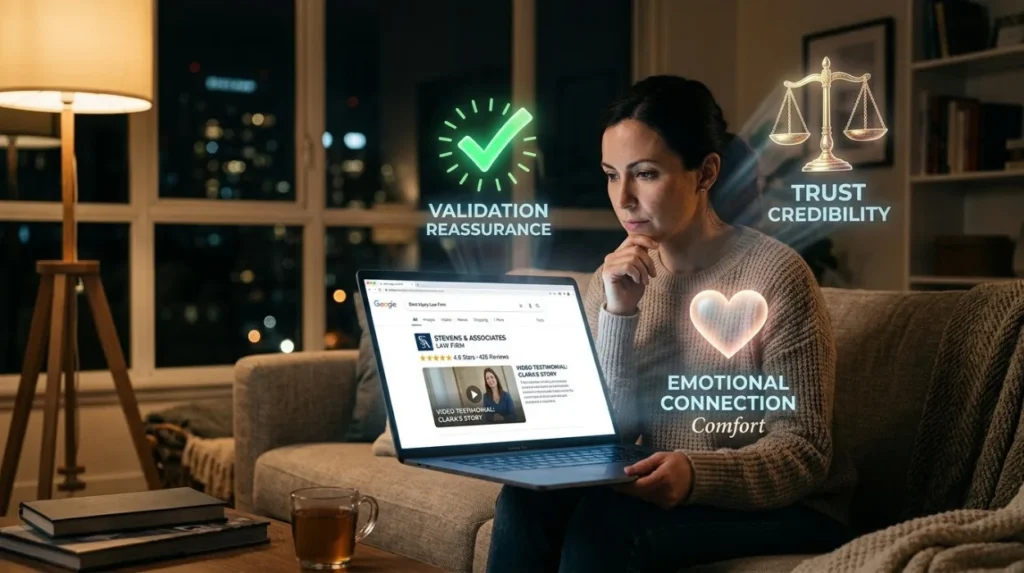
Video testimonials contribute to this process by adding identifiable client experiences to the search ecosystem. They demonstrate that the firm has produced content capable of communicating real service experiences rather than relying exclusively on self-authored claims. When testimonial content aligns with other trustworthy sources, the combined reputation signals become more coherent. This strengthens entity credibility because different content types reinforce related professional attributes. Search perception influence therefore comes from consistency across the ecosystem rather than from video alone.
For firms assessing whether to invest in reputation management, this distinction is critical. The objective is not simply to generate additional positive material but to improve the information balance encountered during decision-making searches. A successful strategy measures changes in visibility, sentiment distribution and content prominence alongside engagement. These indicators reveal whether the search environment is becoming more controlled and representative. The investment therefore gains value when it produces measurable improvement in the information architecture surrounding the firm’s name.
What Process Delivers Reliable Video Testimonial Reputation Results?
A reliable process begins with reputation assessment, followed by testimonial planning, content optimisation, controlled deployment and ongoing SERP measurement. The initial assessment identifies the queries, pages and reputation signals influencing the firm’s current search perception. Testimonial planning then defines the client-experience themes that provide useful evidence without introducing unnecessary risk. Production creates authentic video assets, while optimisation adds transcripts, metadata and relevant contextual content. Deployment places those assets within channels capable of generating useful visibility.
A structured process can be evaluated through five operational stages:
- Audit branded search results to identify negative content, existing positive assets and gaps in reputation coverage.
- Capture client testimonials around specific experience themes such as communication, clarity and professional responsiveness.
- Optimise each video with accurate transcripts, descriptive metadata and relevant supporting webpage content.
- Deploy testimonials across controlled and authoritative digital properties to expand positive content visibility.
- Measure SERP changes, content prominence and sentiment distribution to evaluate reputation improvement over time.
This process creates accountability because every stage has a defined mechanism and measurable purpose. It also prevents reputation management from becoming a collection of disconnected content activities. Search visibility data informs deployment decisions, while reputation analysis determines which assets require further development. Continuous measurement then establishes whether the SERP environment is stabilising. The result is a repeatable framework rather than an isolated campaign.
For firms evaluating the underlying methodology in greater detail, capturing and deploying video testimonials provides the analytical foundation for understanding production, optimisation and distribution. That consideration-stage framework helps establish why transcripts, contextual relevance and channel selection influence testimonial performance. It also clarifies the difference between creating a video and deploying a reputation asset designed for search visibility. Decision-making becomes stronger when production choices are evaluated against measurable search outcomes.
Is Reputation Management Worth the Cost for a Law Firm?
Reputation management creates long-term value when it addresses search visibility problems that affect trust, client acquisition and professional credibility. Cost evaluation therefore needs to consider the commercial impact of unmanaged reputation signals rather than treating the service as a simple content-production expense. A negative search result can remain visible across repeated branded searches, influencing prospects long after the original event. Building authoritative positive assets creates an enduring digital resource that continues contributing to the firm’s reputation ecosystem. The financial assessment consequently centres on risk reduction and sustained search perception rather than the cost of individual videos.
The value also increases when the process prevents repeated reactive expenditure. A firm that waits for damaging content before building positive reputation assets operates from a weaker position. An established testimonial library provides additional evidence that can support search perception when new reputation challenges arise. This does not eliminate future risks, but it creates greater resilience within the digital ecosystem. Sustainability therefore becomes an important part of the investment calculation.
A professional reputation management process also creates operational efficiency through prioritisation. Not every search result requires the same intervention, and not every testimonial requires identical distribution. Resources are directed towards pages, queries and reputation signals with the greatest strategic relevance. This prevents unnecessary content production while concentrating effort on measurable visibility outcomes. The result is a more defensible cost structure based on search impact rather than content quantity.
How Quickly Can Video Testimonials Influence Online Reputation?
Video testimonials can influence perception as soon as prospective clients encounter them, while measurable search visibility changes depend on indexing, ranking competition and existing SERP authority. Human-facing trust impact therefore operates on a different timescale from organic search impact. A testimonial displayed prominently on a relevant webpage can immediately contribute to the information available to users. Search engines then require time and ranking signals to evaluate the asset within the wider index. Speed of impact must therefore be measured separately across perception and search visibility.
A reliable strategy tracks specific branded and reputation-sensitive queries rather than relying on assumptions about rapid ranking movement. Monitoring reveals whether testimonial pages become indexed, gain visibility and contribute to changes in first-page composition. It also identifies competing pages that continue to influence perception. This creates a factual basis for adjusting the content and distribution strategy. Measurement replaces unsupported time guarantees with observable search behaviour.
The practical advantage of professional reputation management is process control rather than an artificial promise of instant results. Each intervention is connected to a defined reputation problem, measurable search query or identifiable content asset. This allows progress to be assessed through evidence such as ranking position, page visibility, sentiment distribution and content prominence. Firms therefore gain a clearer understanding of what has changed and why. That transparency is central to reliable reputation management.
Why Is Clear My Name a Suitable Solution for Lawyer Reputation Management?
Clear My Name provides a structured reputation management approach that connects testimonial content with search visibility control, reputation signals and risk reduction. The focus remains on the complete search ecosystem rather than on isolated content creation. Assessment identifies the reputation assets affecting branded searches, while optimisation strengthens relevant positive content and suppression techniques address damaging visibility where appropriate. This creates a process aligned with the actual mechanisms influencing online reputation. The emphasis on measurable search outcomes also provides a clearer basis for evaluating effectiveness.
The service is particularly relevant to lawyers because professional reputation depends on a combination of expertise, trust, client experience and public information. Search results need to communicate these attributes consistently across the firm’s digital footprint. Video testimonials provide direct client evidence, while supporting pages and other reputation assets reinforce the surrounding entity signals. A coordinated strategy ensures that these elements contribute to the same search perception objective. This creates stronger narrative consistency without relying on exaggerated claims.
At the decision stage, the most important consideration is whether the reputation process has a defined mechanism, measurable outcomes and appropriate risk controls. Clear My Name addresses these requirements through reputation assessment, content enhancement, search visibility analysis and ongoing monitoring. The approach treats SERP control as an evidence-led process rather than a one-time content exercise. This provides a credible framework for improving visibility, strengthening trust signals and stabilising public perception. The result is a reputation strategy built around control, transparency and measurable progress.
How Can Video Testimonials Create Sustainable Search Perception Influence?
Sustainable search perception influence comes from integrating testimonials into a broader network of authoritative, relevant and consistently structured content. A single video provides limited coverage, while a well-developed testimonial ecosystem creates repeated evidence across related topics and search surfaces. Each asset can address a distinct client-experience theme while reinforcing the same law firm entity. This creates semantic consistency without duplicating identical claims. Sustainability therefore depends on the quality and diversity of reputation signals rather than publication volume.
Long-term SERP control also requires continuous monitoring because search results change as competing content is published, updated or re-ranked. Reputation management remains effective when the strategy responds to these changes through measured optimisation rather than reactive assumptions. Positive content needs to retain relevance and authority as the wider search environment evolves. Negative content also requires monitoring because visibility can change independently of the firm’s own publishing activity. Continuous analysis therefore protects the stability of the reputation ecosystem.
The strategic outcome is a stronger and more representative digital footprint. Video testimonials contribute client-generated evidence, supporting pages provide contextual depth, and search optimisation improves discoverability. Together, these elements strengthen entity credibility while reducing reliance on individual search results. The objective is controlled search perception built through evidence rather than manufactured sentiment. That makes sustainability a product of process discipline, measurement and consistent reputation signals.
How Can Law Firms Secure More Reliable Search Reputation Control?
High-converting video testimonials work best when they operate inside a structured reputation management system that connects authentic client evidence with search visibility, SERP control and risk management. Their value extends beyond video production because transcripts, metadata, contextual pages and distribution determine how effectively the content contributes to the search ecosystem. Content enhancement strengthens positive reputation signals, while negative content suppression addresses harmful visibility through appropriate mechanisms. Together, these approaches create a more controlled and credible search environment.
Clear My Name provides this structured approach through reputation assessment, testimonial optimisation, content deployment and ongoing search perception analysis. The process gives law firms clearer visibility into which reputation signals influence branded searches and which interventions address those signals. Measurable outcomes include stronger positive content visibility, improved entity credibility, more balanced sentiment distribution and greater control over search perception. Process clarity also reduces risk by separating legitimate content removal from suppression and enhancement strategies. This creates a reliable foundation for long-term reputation improvement.
For firms ready to strengthen the role of video within their wider reputation strategy, professional reputation management for lawyers provides the appropriate service-level framework for addressing search visibility, trust and reputation risk together. The emphasis remains on evidence, measurable outcomes and sustainable SERP control rather than unsupported promises. When testimonial content is authentic, technically accessible and strategically deployed, it becomes a durable reputation asset. That combination provides the strongest basis for stabilising online perception and protecting professional credibility.
How do video testimonials improve a law firm’s online reputation?
Video testimonials strengthen reputation signals by combining client feedback with voice, visual context and authentic communication. They can improve perceived trust and support stronger search visibility when accompanied by transcripts and relevant webpage content.
Can video testimonials improve a lawyer’s Google search results?
Video testimonials can support improved SERP visibility when they are hosted on relevant, authoritative pages with structured text and contextual information. Their search impact depends on relevance, authority, indexing and competition for branded queries.
What makes a video testimonial effective for a law firm?
An effective legal testimonial focuses on specific client experiences such as communication, professionalism, responsiveness and clarity. Authentic statements supported by accurate transcripts and appropriate metadata create stronger trust and reputation signals.
How does reputation management for lawyers use video testimonials?
Reputation management for lawyers uses video testimonials as positive content assets that strengthen entity credibility and improve the balance of reputation signals in search results. The strategy can combine testimonial enhancement with monitoring and negative content suppression where appropriate.
Is Clear My Name suitable for managing a law firm’s online reputation?
Clear My Name applies reputation management techniques that focus on search visibility, content prominence, entity credibility and reputation risk. The approach can incorporate video testimonials alongside broader reputation monitoring and search perception strategies.