
Ticketing and refund complaints can damage an artist’s name because repeated negative content creates adverse reputation signals across search results, review platforms and social discussions. Reputation management is the process of understanding, monitoring and influencing how information about an entity is interpreted across digital environments.
Why do ticketing and refund complaints affect an artist’s online reputation?
Ticketing and refund complaints affect an artist’s online reputation because search ecosystems associate recurring negative information with the artist entity, even when the underlying dispute involves a promoter, venue or ticketing provider. Online reputation refers to the collection of information, opinions, reviews and discussions that shape how an entity is perceived across digital platforms.
A complaint becomes a reputation signal when it is published in an environment that search engines can discover, index and associate with an identifiable entity. The association depends on contextual relationships such as the artist’s name, event details, venue, promoter, location and language used in the complaint. Repeated references create a stronger topical relationship between the artist and the underlying issue. This relationship influences entity perception when users encounter the information through search results.
The distinction between responsibility and association is therefore important. An artist can have limited control over ticketing policies while still becoming the subject of complaints because consumers often describe the entire event experience through the most recognisable entity involved. Search systems evaluate available information rather than assigning legal responsibility for each complaint. As a result, reputation signals can develop from association even where operational responsibility sits elsewhere.
How do refund complaints become reputation signals?
Refund complaints become reputation signals when their content is published, indexed and repeatedly connected with an artist’s identifiable entity. A reputation signal is any piece of information that contributes to the perceived credibility, reliability or quality of an entity within a digital information environment.
Search engines process textual relationships between names, topics and entities. A refund complaint containing an artist’s name alongside terms such as “refund”, “cancelled”, “tickets” or “money back” establishes a semantic relationship between the artist and those concepts. If similar pages repeat the same relationship, the topic becomes more prominent within the surrounding information environment. This gives the complaint greater relevance when users perform related searches.
Content indexing also determines whether a complaint becomes visible within search ecosystems. Indexed pages enter the pool of documents that search engines evaluate for relevant queries. Their ranking depends on factors including relevance, authority, content quality, freshness and relationships between entities and topics. An indexed complaint therefore has a different reputation impact from an unindexed private communication because it participates in public search evaluation.
The accumulation of complaints also affects sentiment interpretation. Search systems can identify recurring language and topical associations across documents without treating every statement as an independently verified fact. Repetition establishes a measurable content pattern, while the context and authority of each source influence how that pattern is evaluated.
How does negative ticketing content influence search results?
Negative ticketing content influences search results by introducing adverse documents into the set of pages available for queries involving an artist’s name. Search engine results pages, or SERPs, organise information according to relevance and other ranking signals, meaning complaints become significant when their content matches the intent behind searches associated with the artist.
An artist-name search is an entity-oriented query because the user is seeking information about a specific person or public identity. If ticketing complaints consistently appear in documents associated with that name, those documents become part of the entity’s visible search environment. The effect is not simply a numerical reduction in reputation. It changes the composition of information presented to searchers.
Search visibility also depends on query formulation. A broad search for an artist’s name produces a different result set from a query such as an artist’s name plus “refund” or “tickets”. The second query has stronger topical alignment with complaint-related content. Consequently, negative ticketing information can become particularly visible for users investigating an event, purchasing tickets or assessing the reliability of an artist-related experience.
SERP evaluation also considers competing documents. Positive interviews, official information, music publications, event pages and other authoritative sources compete with complaint-related pages for visibility. The reputation effect therefore depends on the relative strength, relevance and authority of the information surrounding the artist entity.
Why does repeated complaint content have a stronger reputation effect?
Repeated complaint content has a stronger reputation effect because repetition reinforces the semantic connection between an artist entity and a specific negative topic. A single complaint represents one document and one perspective, while repeated references create a broader content pattern distributed across the information ecosystem.
Search engines do not simply count identical complaints as votes against an artist. Instead, repeated content contributes to the overall information environment surrounding an entity. If independent pages discuss cancelled events, disputed refunds or ticketing failures using consistent terminology, those concepts become more closely associated with the artist’s searchable identity.
Source diversity also matters. A complaint published on a recognised publication, review platform, forum and social network creates a different information structure from multiple copies of the same statement on low-authority pages. Independent sources provide distinct documents that search engines can evaluate separately. This increases the breadth of the topic rather than simply increasing the number of words mentioning it.
Content duplication creates a different mechanism. When the same complaint is copied across websites, search engines can recognise similarities between documents and determine which versions provide the strongest result. The original or most authoritative source can therefore receive greater visibility than derivative copies. Reputation analysis requires distinguishing repetition caused by independent reporting from repetition caused by syndication or duplication.
How do reviews affect an artist’s reputation after ticketing disputes?
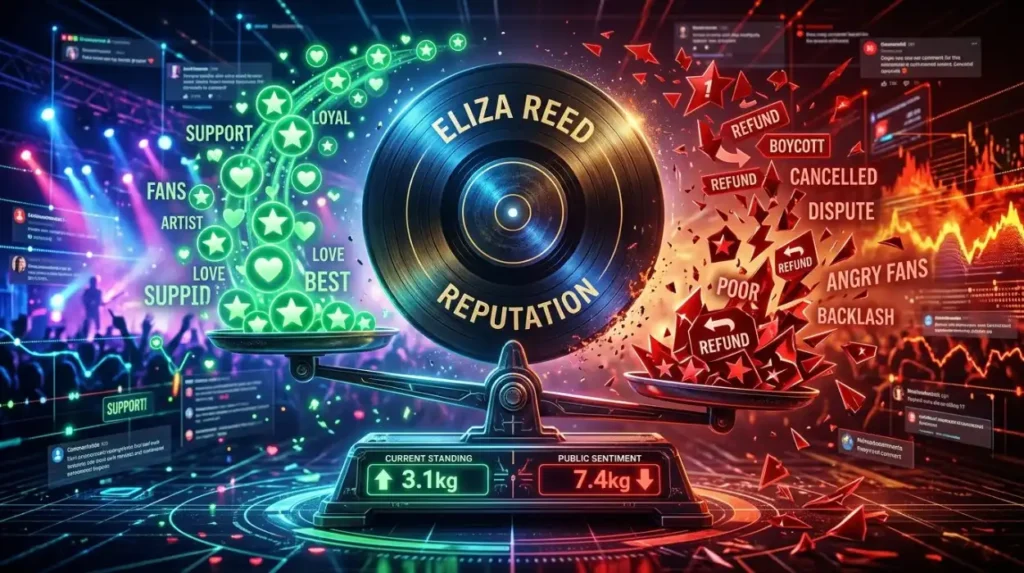
Reviews affect an artist’s reputation by converting individual experiences into publicly accessible sentiment signals associated with the artist or event. Review content refers to user-generated information that evaluates an experience, transaction or service and provides search engines with additional language for interpreting an entity.
Ticketing disputes frequently generate reviews because users use review platforms to document dissatisfaction with an event experience. A review that mentions an artist’s name can create an entity relationship even when the complaint concerns ticket processing, venue administration or refunds. The wording of the review determines which topics become connected to the artist within the searchable environment.
Sentiment interpretation adds another layer. Positive and negative language provides contextual evidence about how users describe an entity or experience. Terms associated with reliability, communication, refunds, cancellations and customer treatment can contribute to the broader sentiment profile surrounding an artist.
Review authority also influences visibility. Platforms with established domain authority and strong indexing frequently have greater capacity to rank for artist-name searches than isolated personal pages. A negative review on an indexed platform therefore has greater potential search visibility than an equivalent statement that remains inaccessible to search engines.
Can ticketing complaints affect how search engines understand an artist entity?
Ticketing complaints can affect entity perception because search engines build contextual understanding from relationships between names, topics, organisations, places and published information. An artist entity is not represented only by an official biography. It exists within a wider network of documents describing the person, their work, events, audiences and associated organisations.
Entity perception develops through repeated contextual relationships. If an artist appears alongside music-related topics, professional achievements and authoritative publications, those relationships contribute to a broader understanding of the entity. If the same entity repeatedly appears alongside refund disputes and ticketing complaints, those topics also become part of its searchable context.

This process does not mean that search engines determine that every complaint is true. Search algorithms evaluate documents and relationships rather than conducting human investigations into every allegation. The resulting search environment therefore reflects the availability, relevance and authority of information rather than a definitive judgement about the artist.
This distinction is essential when analysing reputation. Search perception is concerned with what information users encounter and how that information is structured around an entity. It is separate from determining legal, contractual or operational responsibility for the underlying complaint.
What makes ticketing complaints more damaging in search results?
Ticketing complaints become more damaging when they combine strong entity association, clear negative terminology, high search relevance and authoritative publication environments. The reputation impact depends on the interaction between content characteristics and search behaviour rather than the mere existence of criticism.
Four mechanisms are particularly important:
- Establish the entity relationship — Connect the complaint directly to the artist’s name through titles, text, event references or structured information, creating a stronger semantic association.
- Increase topical relevance — Repeat relevant concepts such as refunds, cancelled events or ticket disputes within context, making the content closely aligned with complaint-related searches.
- Strengthen publication visibility — Publish the information on indexed and authoritative platforms, increasing its capacity to compete within SERP evaluation.
- Create persistent search demand — Associate the complaint with queries users continue to perform, allowing the negative document to remain relevant beyond the original event.
The mechanism is therefore cumulative rather than purely chronological. A complaint published years ago can remain visible if its page retains authority and continues matching relevant searches. Conversely, newer information does not automatically outrank established content simply because it is more recent.
How does an artist’s digital footprint influence complaint visibility?
An artist’s digital footprint influences complaint visibility because the broader collection of online information determines how easily search engines connect new content with the artist entity. A digital footprint is the accumulated set of publicly accessible digital references associated with a person, including websites, profiles, interviews, reviews, event pages and social content.
A well-defined digital footprint gives search engines more contextual information about the entity. This context helps establish relationships between the artist, music releases, performances, venues, publications and audiences. Complaint-related pages then enter an existing network of information rather than appearing in isolation.
The structure of the footprint also affects search competition. Strong authoritative pages can occupy prominent positions for branded or artist-name queries, while weaker pages compete for remaining visibility. Where complaint content has stronger topical relevance to a specific query, it can still rank prominently despite the existence of positive material elsewhere.
Digital footprint analysis therefore examines the entire search environment rather than a single result. It evaluates which sources appear, which topics dominate, how entities are connected and how users encounter information across different queries.
Dive Deeper With Our Expert Guides:
How Fake Collaboration Rumours Spread About Musicians
Why Feuds Between Artists Dominate Search Results
Does resolving a ticketing dispute remove its reputation impact?
Resolving a ticketing dispute does not automatically remove its reputation impact because resolution and search visibility operate through different systems. A refund can settle the underlying transaction while the original complaint remains published, indexed and accessible through search results.
Content persistence is central to this distinction. A webpage does not necessarily disappear when an organisation resolves an issue with the person who created it. The page can remain available, retain inbound links and continue receiving search relevance after the practical dispute has ended.
Search engines also operate independently from the underlying ticketing process. A refund provider, venue or promoter can complete a transaction without altering third-party webpages discussing the original problem. The reputation environment therefore requires separate consideration of the underlying event and its digital representation.
This explains why complaint resolution does not equal reputation resolution. The first addresses the substance of a dispute, while the second concerns how information about that dispute remains visible and connected to an entity in search ecosystems.
How can artists understand ticketing complaints without confusing reputation with responsibility?
Artists can understand ticketing-related reputation effects by separating operational responsibility, published information and search perception into distinct analytical layers. This distinction prevents the search presence of a complaint from being interpreted automatically as proof that the artist caused the underlying problem.
Operational responsibility concerns who controlled ticket sales, refund policies, venue operations or event administration. Published information concerns what consumers, journalists and platforms communicate about the event. Search perception concerns how those documents are indexed, ranked and presented when users search for the artist.
These layers interact but do not function identically. A ticketing company can control refunds while an artist remains the most visible entity in consumer discussions. A publication can report the dispute while adding contextual information about the promoter. A search engine can rank the resulting page because it satisfies a user’s query without determining who was contractually responsible.
This layered model provides a more accurate understanding of reputation systems. It demonstrates why reputation analysis focuses on information relationships, content indexing, authority and search visibility rather than treating every complaint as a direct measurement of professional conduct.
How can complaint-related search results be analysed objectively?
Complaint-related search results can be analysed objectively by examining the source, content, entity association, ranking position, sentiment, query intent and persistence of each result. This approach treats reputation as an observable information system rather than an abstract judgement about popularity.
An effective analysis begins with the exact queries producing complaint-related results. It then evaluates whether the results refer directly to the artist, an event, a venue, a promoter or a ticketing provider. The next stage examines how prominently each source ranks and whether the same information appears across independent platforms.
Contextual relevance is also important. A page containing the artist’s name in a passing reference has a weaker entity relationship than a page whose title, headings and primary subject directly concern the artist. Similarly, a factual news report and an anonymous review provide different authority and evidentiary contexts.
A structured analysis therefore considers the complete SERP environment. It evaluates negative content alongside positive and neutral sources, identifies recurring topics and measures how search perception changes across branded, event-related and complaint-specific queries.
What does ticketing complaint analysis reveal about online credibility?
Ticketing complaint analysis reveals that online credibility is shaped by the quality, consistency and context of information surrounding an entity. Online credibility refers to the degree to which an entity is perceived as trustworthy and reliable based on available digital evidence.
Credibility is not determined by positive sentiment alone. Search ecosystems also consider the authority and relevance of the sources providing information about an entity. An artist with strong coverage from established publications, authoritative profiles and consistent professional information has a different digital credibility structure from an entity represented primarily through unverified or fragmented sources.
Complaints become significant when they occupy prominent positions within that structure. Their influence depends on their visibility, topical relevance, source authority and relationship to the artist entity. A single low-authority complaint does not create the same search environment as a recurring topic supported by high-visibility sources.
Understanding these distinctions allows online reputation to be evaluated through measurable information relationships. The objective is not to classify every criticism as harmful, but to determine how published information contributes to entity perception and search visibility.
Why do ticketing and refund complaints hurt an artist’s name?
Ticketing and refund complaints hurt an artist’s searchable reputation when negative information becomes consistently associated with the artist entity across indexed content, reviews, social discussions and authoritative publications. The reputation effect comes from the interaction between content indexing, search relevance, sentiment signals, source authority and user query behaviour.
An artist’s name exists within a wider digital footprint containing positive, neutral and negative information. Search engines evaluate this information through relationships between entities and topics, while users interpret the resulting SERPs as evidence about the person they are researching.
Understanding Handling Ticketing and Refund Complaints Without Backlash therefore requires more than examining individual complaints. It requires analysing how disputes are documented, where they appear, how strongly they connect to the artist entity and how those documents influence search perception over time.
The central principle is that reputation is an information system. Ticketing disputes become reputation issues when their digital representations acquire visibility, relevance and persistent association with an artist’s name.
How do ticketing and refund complaints affect an artist’s online reputation?
Ticketing and refund complaints can create negative reputation signals when they repeatedly associate an artist’s name with cancelled events, refund disputes or poor ticketing experiences. Indexed complaints can influence search visibility and shape how users perceive the artist entity.
Can refund complaints affect an artist’s Google search results?
Yes, refund complaints can affect search results when complaint pages are indexed and closely connected to searches for the artist’s name. Their visibility depends on factors such as content relevance, source authority, search intent and competing results.
Why do repeated ticketing complaints damage an artist’s reputation?
Repeated complaints reinforce the semantic association between an artist and negative topics such as refunds, cancellations or ticketing problems. Consistent references across reviews, forums and other indexed sources can strengthen adverse reputation signals.
Does resolving a ticketing dispute remove its online reputation impact?
Resolving a ticketing dispute does not automatically remove published complaint content from search results. A webpage can remain indexed and visible after a refund or other dispute resolution has taken place.
How can reputation management for musicians address ticketing complaints?
Reputation management for musicians analyses how ticketing complaints are published, indexed and associated with an artist’s name across search ecosystems. Clear My Name can be relevant to understanding these reputation factors, while the underlying responsibility for refunds remains with the appropriate ticketing or event provider.