
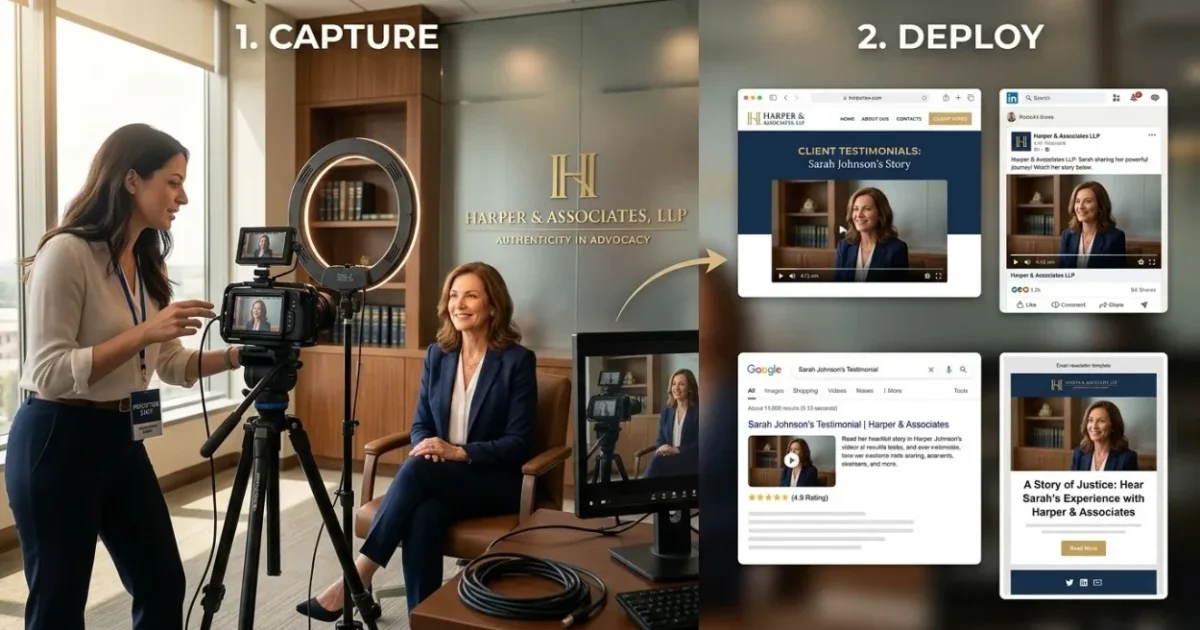
Video testimonials capture client experiences through spoken language, facial expression and contextual detail, creating richer reputation signals than text-only reviews. Their effectiveness depends on how accurately the testimonial reflects client experience, how clearly it connects to the law firm entity, and how effectively it is distributed across relevant search surfaces.
Reputation management strategies differ based on whether the objective involves removing harmful information, enhancing positive content, or improving the balance between competing reputation signals. Online reputation control methods are evaluated through search visibility, entity credibility, sentiment distribution, content relevance and the durability of resulting SERP changes. Video testimonials sit primarily within the content enhancement category, although their value depends on production quality, authenticity, accessibility and distribution rather than video format alone.
How Do Video Testimonials Compare With Written Client Reviews?
Video testimonials provide a higher information density than written reviews because they combine testimonial language with visual and auditory evidence. A written review communicates through indexed text, while a video testimonial communicates through speech, appearance, tone, facial expression and surrounding contextual information. These additional signals contribute to perceived authenticity, although search engines still depend heavily on machine-readable language when interpreting content. A video therefore creates the strongest search value when its spoken content is supported by transcripts, titles, descriptions and relevant page copy. Written reviews retain an advantage in direct crawlability because their primary information is already presented as text. The comparison therefore involves richer human-facing evidence in video against stronger immediate text accessibility in written reviews.
Video testimonials also create a different trust mechanism from conventional review content. A written review primarily provides a statement attributed to a client, whereas video introduces observable communication characteristics that audiences use when assessing credibility. This distinction influences perception even when the underlying factual information is identical. For a law firm, the relevance of these signals increases because legal services involve professional judgement, confidentiality considerations and high perceived risk. Video does not automatically establish credibility, however, because overly scripted language, repetitive production and weak contextual information reduce its evidential value. The format therefore functions as a reputation asset when its content remains specific, verifiable and consistent with the firm’s broader digital identity.
What Makes Video Content More Informative Than Text Alone?
Video content is more informative when it combines substantive testimonial language with contextual evidence that cannot be conveyed fully through written wording. A client describing communication quality, clarity of explanations or responsiveness provides semantic information through speech, while tone and delivery provide additional perceptual signals. Search engines can process portions of this information through transcripts, captions, metadata and associated page content. Human audiences also evaluate presentation characteristics that automated systems do not necessarily interpret in the same way. The resulting reputation signal therefore operates across both machine-readable and human-perceived layers. Effective deployment connects both layers rather than treating video as an isolated media asset.
Is Content Enhancement More Effective Than Content Removal for Law Firm Reputation?
Content enhancement is generally the more sustainable mechanism when harmful content cannot be legitimately removed and the objective is to improve the overall composition of search results. Removal strategies target an existing negative asset by addressing the platform, publisher or legal basis responsible for its continued availability. Enhancement strategies introduce authoritative and relevant content that competes for visibility against existing pages. The two mechanisms therefore address different problems rather than functioning as interchangeable techniques. Removal reduces the presence of a specific reputation signal, while enhancement increases the volume and authority of alternative signals. A robust evaluation measures which mechanism corresponds to the underlying reputation problem before assessing expected impact.
Removal also has a narrower scalability profile because each item requires assessment of ownership, platform rules, factual status, privacy implications or other applicable grounds. Content enhancement can operate across a broader publishing ecosystem because multiple assets can be created around related entities and topics. This does not make enhancement universally superior, since low-quality content adds little ranking influence and can increase reputational risk when it appears manufactured. Search engines evaluate relevance, authority and contextual relationships rather than rewarding content solely because it was recently published. The strongest strategy therefore uses enhancement where genuine information gaps exist and removal where an eligible harmful asset requires direct intervention. The distinction is particularly important for legal professionals because reputational content can remain highly visible when it relates to names, cases, professional roles or public records.
When Does Content Removal Provide a Stronger Reputation Outcome?
Content removal provides a stronger outcome when the problematic material has a legitimate pathway for deletion, correction or de-indexing. The mechanism operates by reducing the availability of a negative reputation signal rather than attempting to outperform it through competing content. This can produce a direct change in SERP composition when the removed page previously occupied a prominent position. The effect is strongest when the targeted asset represents a concentrated source of negative sentiment or inaccurate information. Removal does not automatically eliminate every reference to the same subject because duplicated, cached or independently published versions can remain indexed. Evaluation therefore requires assessment of the wider content network surrounding the original source.
How Do Organic and Reactive Reputation Approaches Differ?
Organic reputation management builds positive reputation signals before a specific reputational problem becomes dominant, while reactive management responds to an identifiable negative event or search result. Video testimonials are primarily an organic asset when collected as part of an ongoing content strategy. Reactive deployment occurs when testimonials are published in response to negative coverage, adverse reviews or an emerging reputation issue. Organic activity creates a broader base of relevant content over time, whereas reactive activity concentrates resources around a defined problem. The distinction affects scalability because a continuous content system distributes production rather than depending on urgent intervention. Both approaches require relevance and authenticity to produce meaningful search influence.
Organic testimonial collection also supports entity consistency because recurring references to the same firm, legal specialisms, client experience themes and service terminology establish a coherent topical environment. Search engines evaluate relationships between entities, topics and content rather than viewing every page as an independent ranking object. Repeated, relevant references can therefore strengthen the semantic association between a law firm and the professional attributes represented in its content. Reactive publishing lacks some of this cumulative advantage when it begins only after negative content has already gained visibility. A balanced strategy treats testimonials as part of an established reputation asset rather than an emergency response mechanism. This improves sustainability while reducing dependence on individual pieces of content.
Which Approach Creates Stronger Long-Term Reputation Signals?
Long-term reputation signals generally emerge from consistent content development because repeated evidence creates a broader and more stable digital footprint. A single testimonial represents one experience, while a structured collection can demonstrate recurring themes such as communication, professionalism and client support. Search engines can encounter these themes across pages, videos, transcripts and third-party references. This creates a wider semantic environment around the firm entity and reduces dependence on one reputation asset. Long-term impact therefore relates to consistency, topical relevance and distribution rather than publishing frequency alone. Sustainable enhancement requires each asset to add distinct information instead of repeating identical promotional statements.
Short-term reputation improvement operates differently because its objective is often to alter the immediate visibility of specific search results. Publishing a highly relevant testimonial page can add another indexable asset, but ranking movement depends on competition, authority, query intent and the existing SERP composition. A testimonial video hosted on a weak or poorly connected page has less search influence than the same asset embedded within a relevant, authoritative content structure. Short-term activity therefore requires measurement against specific search queries rather than general assumptions about increased visibility. Long-term evaluation then examines whether the new content remains discoverable and useful after the initial publication period.
How Do Search Engines Interpret Video Testimonial Reputation Signals?

Search engines interpret video testimonial signals through the surrounding textual, structural and contextual information available to automated systems. Spoken words can become discoverable through transcripts, while titles, descriptions, headings, captions and page copy provide additional semantic context. The video’s relationship with the law firm entity also depends on consistent naming, relevant subject matter and the authority of the hosting environment. These signals help search systems determine what the content concerns and which entities are associated with it. Visual presentation contributes strongly to human perception but does not replace machine-readable contextual information. Effective optimisation therefore connects audiovisual evidence with accessible textual signals.
SERP composition is influenced by the interaction between relevance, authority, intent and competing content. A testimonial can contribute to search visibility when it satisfies an information need associated with the firm, its services or client experience. Its ranking influence remains dependent on the strength of the page and the broader site architecture. Transcripts also create opportunities for relevant phrases to become associated with the firm’s entity without forcing unnatural keyword repetition. This creates a stronger semantic relationship between the testimonial subject and the search topics surrounding the firm. The result is content enhancement based on contextual relevance rather than simple keyword insertion.
How Should Law Firms Evaluate the Effectiveness of Video Testimonials?
Effectiveness is evaluated through measurable changes in visibility, engagement, sentiment distribution and entity association rather than through video views alone. View counts indicate exposure but do not establish whether the testimonial improves search perception or trust. Search performance provides stronger evidence when monitored for branded queries, service-related searches and reputation-sensitive terms. Engagement metrics add context by showing whether users interact with the asset after discovering it. Sentiment distribution measures whether positive reputation signals become more prominent relative to negative or neutral references. Combining these indicators produces a more reliable assessment than relying on a single performance metric.
A practical evaluation framework can assess video testimonials through the following mechanisms:
- Measure branded SERP composition before and after publication to identify changes in the visibility of testimonial-related assets.
- Compare transcript language with target search themes to determine whether the video contains relevant semantic coverage.
- Analyse engagement behaviour to distinguish genuine content interaction from superficial exposure.
- Evaluate sentiment distribution across first-page results to determine whether positive reputation signals have increased.
- Monitor competing pages to identify whether new content gains, retains or loses search visibility over time.
This framework also exposes limitations. A high-performing video can generate substantial engagement without producing meaningful organic ranking influence if the hosting page lacks authority or contextual relevance. Conversely, a modestly viewed testimonial can still provide useful reputation value when it occupies a prominent position for a branded search. Evaluation therefore needs to distinguish audience performance from search performance. It also needs to account for the commercial intent behind each query because informational, navigational and reputation-sensitive searches behave differently. Measurement becomes more reliable when the same query set and evaluation criteria are maintained over time.
Dive Deeper With Our Expert Guides:
Managing How Court Docket and Case-Outcome Sites Rank in Search
Leveraging Alumni and Professional Networks for Reputation Signals
How Can Video Testimonials Be Deployed Without Increasing Reputation Risk?
Video testimonials require stronger governance than text because they contain identifiable voices, faces and potentially sensitive descriptions of legal matters. Risk evaluation therefore includes consent, confidentiality, factual accuracy, editing practices and the context in which the testimonial is published. A testimonial that reveals unnecessary case information can create privacy or professional-risk concerns even when the client has agreed to participate. Editing also requires care because removing context can change the apparent meaning of a client’s statement. These risks make content governance part of reputation management rather than a separate production concern. The safest deployment model preserves authenticity while controlling unnecessary exposure.
Distribution creates another layer of risk because the same testimonial can appear across multiple platforms with different metadata, audience expectations and moderation systems. A central webpage provides greater control over surrounding context, while third-party platforms can offer additional discovery and credibility signals. Social channels increase reach but introduce platform-specific dependencies and changing SERP visibility. Embedding the same video across relevant properties can strengthen consistency, but duplicated deployment without contextual adaptation adds limited semantic value. The strongest approach therefore evaluates each distribution channel according to authority, relevance, discoverability and control.
How Do Short-Term and Long-Term Video Testimonial Strategies Compare?
Short-term testimonial strategies prioritise rapid publication and immediate visibility, while long-term strategies prioritise cumulative authority, semantic consistency and durable reputation signals. Rapid deployment is useful when a firm needs additional positive assets around a branded search, but speed alone does not guarantee ranking influence. Long-term development creates a broader content ecosystem in which testimonials support service pages, professional profiles and relevant educational resources. The short-term model therefore concentrates on immediate SERP composition, while the long-term model focuses on sustained entity credibility. Both require accurate measurement to determine whether the content is actually influencing perception. The difference lies primarily in the time horizon and the depth of the supporting content structure.
A long-term video programme also reduces dependence on individual testimonials. Different clients can address distinct aspects of the firm’s professional experience, creating a more distributed sentiment profile. One testimonial can demonstrate communication quality, another can describe procedural clarity, and another can address responsiveness without relying on identical wording. This creates differentiated reputation signals while maintaining a consistent entity association. Search engines encounter a broader semantic field, while users encounter evidence from multiple perspectives. The resulting content enhancement is more resilient than a strategy centred on one high-performing video.
What Is the Most Balanced Approach to Deploying Video Testimonials?
The most balanced approach combines authentic testimonial acquisition, structured textual accessibility, controlled distribution and continuous measurement. Video functions as a content-enhancement mechanism, while removal strategies remain relevant when specific harmful content has a legitimate pathway for intervention. Organic collection provides cumulative reputation signals, whereas reactive publishing addresses defined visibility gaps. Search optimisation connects transcripts, metadata and surrounding page content to the relevant law firm entity. Risk management controls confidentiality, consent and factual presentation throughout production and distribution. This combination separates content creation from assumptions about guaranteed ranking outcomes.
Video testimonials become most valuable when they form part of a wider reputation architecture rather than operating as isolated promotional assets. Their contribution is measured through changes in SERP composition, entity credibility, sentiment distribution and user perception. Content enhancement creates alternative reputation signals, while content removal addresses individual harmful assets where appropriate. Organic strategies provide greater sustainability through cumulative content development, while reactive strategies offer targeted responses to specific reputation events. The appropriate evaluation therefore depends on the underlying search ecosystem, the type of reputation problem and the strength of competing content.
Which Video Testimonial Strategy Offers the Strongest Reputation Value?
Video testimonials provide a distinct reputation mechanism because they combine spoken evidence, visual context and indexable supporting information. Compared with written reviews, they offer richer human-facing signals but require stronger technical structuring to make their substantive information accessible to search systems. Compared with removal strategies, they enhance the SERP environment rather than eliminating an existing negative asset. Organic collection creates cumulative reputation signals, while reactive deployment targets immediate reputation gaps. Long-term effectiveness depends on consistency, relevance, authority, governance and measurement rather than video format alone.
The strongest strategic assessment therefore treats video testimonials as one component of a broader digital reputation system. Their value increases when transcripts, metadata, page structure and distribution reinforce the same entity and topical associations. Their limitations become clearer when engagement metrics are separated from search visibility, or when content enhancement is used where legitimate removal is the more appropriate mechanism. Evaluating these distinctions enables law firms to select reputation approaches according to mechanism, risk exposure, scalability and sustainability rather than relying on assumptions about content performance.
How do video testimonials help a law firm’s online reputation?
Video testimonials provide richer reputation signals by combining spoken client feedback with visual and auditory context. They can strengthen trust and support positive search perception when supported by relevant transcripts, metadata and surrounding content.
Are video testimonials better than written reviews for law firms?
Video testimonials provide additional authenticity signals through voice, expression and delivery, while written reviews offer highly accessible, indexable text. The most effective approach evaluates both formats based on search visibility, relevance, credibility and audience engagement.
How can a law firm optimise video testimonials for search engines?
Law firms can optimise video testimonials with descriptive titles, accurate transcripts, captions, relevant metadata and supporting webpage content. These elements help search engines understand the video’s subject matter and connect it with relevant law firm and service-related queries.
What should a law firm include in a client video testimonial?
A useful legal client testimonial focuses on specific aspects of the client experience, such as communication, responsiveness, clarity and professional service. Avoiding unnecessary confidential case details helps maintain privacy while keeping the testimonial relevant and credible.
Can video testimonials improve a lawyer’s Google search results?
Video testimonials can contribute to a stronger SERP composition when they are hosted on relevant, authoritative pages and supported by indexable textual content. Their impact depends on factors such as relevance, authority, competition and the overall reputation signals surrounding the lawyer or law firm.