
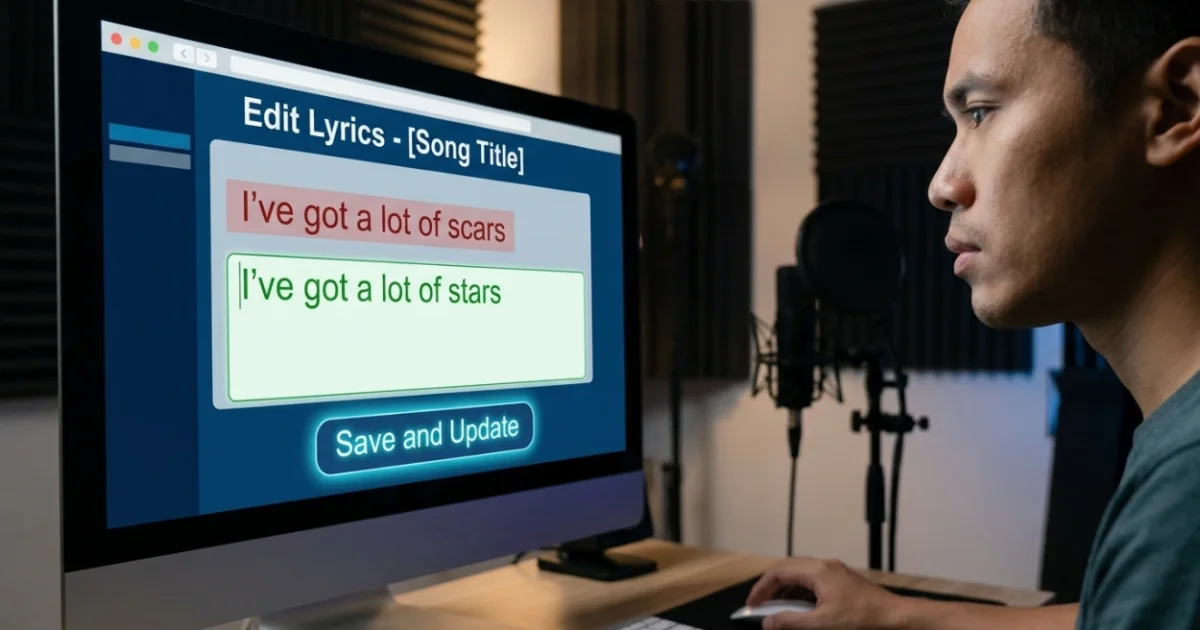
Correcting misread lyrics online requires accurate source assessment, targeted correction and consistent search visibility management. Clear My Name provides a reputation management approach for musicians that focuses on correcting misleading lyric information while strengthening the accuracy and credibility of the artist’s digital footprint.
Which reputation management approach delivers the strongest results for misread lyrics?
A source-focused correction approach delivers the clearest results when inaccurate lyrics are directly affecting an artist’s online reputation. The process begins by identifying the incorrect lyric, confirming the accurate wording and evaluating how prominently the disputed content appears in search results. This establishes whether the issue exists at source level, search level or across both environments. The assessment also distinguishes factual transcription errors from interpretations of meaning, because each issue requires a different response. This classification creates a measurable foundation for reputation management.
Lyric errors influence more than the page where they appear. When inaccurate wording is indexed, copied or referenced elsewhere, it becomes part of the artist’s wider digital footprint. Search users encountering the same incorrect information across multiple sources can interpret repetition as credibility, even when the original information lacks authoritative support. Reputation management therefore evaluates source quality, content indexing and search visibility together. This approach focuses on improving the information environment rather than simply targeting one isolated page.
For musicians requiring structured intervention, professional reputation management for musicians provides a focused framework for evaluating inaccurate lyric content, source authority and search perception. The objective is to establish accurate information while reducing the visibility and influence of misleading material through legitimate mechanisms. This creates a clearer distinction between factual correction and attempts to remove legitimate commentary. The result is a more controlled and evidence-based reputation strategy.
How does reputation management correct inaccurate lyric information?
Reputation management corrects inaccurate lyric information by combining evidence verification, source assessment and search visibility analysis. The first stage establishes what the artist actually recorded or published and compares that evidence with the disputed transcription. The second stage identifies where the inaccurate information appears and evaluates the authority of each source. The third stage determines the appropriate correction mechanism for each location. This process prevents an inaccurate response from creating additional reputation risk.
A structured correction process can include:
- Identify inaccurate lyrics and document the exact pages, annotations or search results containing the disputed wording.
- Verify the correct lyrics using authoritative evidence connected directly to the artist or recording.
- Classify each issue as a transcription error, attribution error, factual statement or subjective interpretation.
- Assess source authority and determine whether the information is influential within relevant search results.
- Correct eligible information through appropriate platform, publisher or source-level processes.
- Monitor indexed results to measure whether inaccurate information remains visible after correction.
This process creates clear checkpoints rather than relying on assumptions about search ranking behaviour. Each stage produces information that supports the next decision, making the overall strategy easier to evaluate. It also separates factual accuracy from broader reputation objectives. That distinction is essential because correcting a lyric does not automatically remove every interpretation associated with it.
Why does search visibility matter when correcting misread lyrics?
Search visibility matters because users frequently encounter an artist’s information through search results before accessing the original source. An inaccurate lyric appearing prominently in a relevant search can therefore influence the initial perception of the artist or song. Search engines organise indexed information according to relevance and ranking systems rather than an artist’s preferred interpretation. Reputation management focuses on understanding this search environment and addressing the information that contributes to it.
SERP control does not mean directly controlling search engine rankings. It refers to managing the information ecosystem surrounding an entity so that accurate and authoritative sources provide stronger contextual representation. This includes correcting source-level inaccuracies and developing credible information where appropriate. The resulting search environment contains clearer signals about the artist, their work and the verified information associated with it. This improves the quality of search perception without relying on artificial ranking claims.
The distinction becomes important when inaccurate lyrics have been replicated across websites. Correcting the original source represents a direct intervention, while monitoring search results determines whether the correction has influenced the wider information environment. If copies remain indexed, further source-level assessment becomes necessary. If accurate information becomes more prominent, users receive stronger contextual evidence. Search visibility therefore acts as an outcome measurement rather than a guarantee.
How can musicians distinguish lyric errors from legitimate interpretation?
Musicians can distinguish lyric errors from legitimate interpretation by separating verifiable wording from subjective meaning. A transcription error concerns what was actually recorded or published, making it suitable for factual verification. An interpretation concerns what a lyric means and can involve commentary, symbolism or cultural analysis. Treating an interpretation as an objective error creates an unnecessary dispute over legitimate discussion. Reputation management therefore evaluates the nature of the information before recommending a corrective action.
This distinction also protects entity credibility. If an artist attempts to remove every unfavourable interpretation, the resulting information strategy becomes less credible because subjective commentary is not equivalent to factual misinformation. A targeted correction instead focuses on information that can be demonstrated as inaccurate. Contextual clarification can address ambiguous interpretations without presenting one reading as universally established. This creates a more defensible reputation management process.
The same principle applies to lyric annotations. An annotation that clearly identifies itself as interpretation has a different informational status from a statement claiming that the artist confirmed a particular meaning. Source authority, wording and context all contribute to the evaluation. Corrective action therefore depends on evidence rather than sentiment alone. This approach reduces unnecessary escalation while maintaining accurate artist information.
Which outcomes can a musician expect from a structured lyric correction strategy?

A structured strategy produces measurable outcomes across source accuracy, search visibility and information consistency. The first outcome is improved accuracy where an eligible source accepts a correction. The second is clearer contextual representation across indexed information. The third is a stronger basis for monitoring reputation signals associated with the artist and specific songs. These outcomes can be evaluated without claiming that every search result will change immediately.
Key outcomes include:
- Improve source accuracy by addressing demonstrably incorrect lyric transcriptions.
- Strengthen entity credibility by increasing the presence of verified information.
- Reduce misleading search exposure by addressing inaccurate sources through legitimate correction mechanisms.
- Clarify interpretation by distinguishing factual lyric information from commentary.
- Monitor SERP composition by tracking relevant searches before and after corrective action.
These outcomes demonstrate why reputation management extends beyond editing a single webpage. Search perception develops from the combined effect of indexed sources, source authority and content relevance. A successful correction therefore represents one measurable component of a broader information strategy. Long-term effectiveness depends on continued accuracy and monitoring.
Is content suppression or content enhancement better for lyric-related reputation problems?
Content suppression and content enhancement address different reputation mechanisms, making their effectiveness dependent on the underlying problem. Suppression focuses on reducing the prominence of inaccurate or inappropriate information where a valid mechanism exists. Enhancement focuses on increasing the availability of accurate, authoritative and contextually relevant information. A source-level problem therefore receives a different treatment from a broader information-gap problem. Evaluating both approaches prevents a single tactic from being applied to every situation.
Suppression has a direct relationship with disputed content. If an inaccurate page is corrected, removed through an appropriate process or otherwise becomes less visible, the immediate information problem becomes smaller. Its limitation is that other sources can continue to reproduce the same information. Content enhancement operates across a wider semantic environment by establishing additional accurate context. It does not depend exclusively on changing one third-party page.
The strongest decision framework evaluates both mechanisms according to accuracy, scalability, risk and sustainability. A factual error with a clear source may require direct correction, while a persistent information gap benefits from stronger authoritative context. These mechanisms can operate alongside each other without treating them as interchangeable. The result is a more comprehensive approach to search perception influence.
Dive Deeper With Our Expert Guides:
Respond to a Cancel Campaign With Clear My Name
Bury a Damaging Concert Review With Clear My Name
How does Clear My Name support a reliable correction process?
Clear My Name applies a structured reputation management process that connects source assessment with search visibility analysis. The approach focuses on identifying the information problem before selecting the appropriate corrective mechanism. This reduces the risk of applying suppression techniques to content that actually requires clarification or authoritative context. It also creates clearer expectations around what can be addressed at source level and what depends on independent search ranking systems.
Process clarity is important because lyric-related reputation issues often involve multiple sources. A single inaccurate transcription can appear on one platform, while related wording can spread through secondary pages and indexed references. The correction process therefore evaluates the source, the surrounding information and the search visibility of the disputed material. This produces a more complete assessment of the artist’s digital footprint.
The value of the approach lies in evidence-based evaluation rather than guaranteed ranking outcomes. Search engines retain independent control over indexing and ranking, so responsible reputation management focuses on measurable actions and observable changes. Source corrections, content accuracy and search monitoring provide concrete indicators of progress. This creates a reliable framework for managing reputation risk without exaggerated claims.
How does cost compare with the long-term value of lyric reputation management?
The value of lyric reputation management relates to the persistence and search visibility of inaccurate information rather than the correction of a single page alone. A minor error with negligible visibility has a different strategic significance from inaccurate lyrics appearing prominently for an artist’s name or song title. Cost evaluation therefore requires assessing exposure, source authority, recurrence and the potential effect on entity credibility. This produces a more meaningful comparison than measuring cost against page count alone.
Long-term value also comes from reducing repeated correction requirements. If an inaccurate interpretation is reproduced across multiple sources, addressing the underlying information environment provides greater strategic value than repeatedly responding to individual instances without analysis. Accurate authoritative content creates additional context for future searches. Monitoring then identifies whether the original issue continues to influence search perception. The strategy becomes an ongoing risk-management process rather than a one-off editorial task.
This evaluation also supports proportional decision-making. Not every lyric discrepancy requires intensive intervention, and not every search result represents a significant reputation risk. A structured assessment prioritises issues according to visibility, factual significance and source influence. That ensures resources are directed towards information that has measurable relevance to the artist’s digital reputation.
How quickly can incorrect lyric information be corrected online?
Correction speed depends primarily on the source responsible for publishing the information and its correction procedures. A platform that accepts a valid correction can update its content after reviewing the submitted evidence. Search engines then operate independently through their indexing processes, meaning a source update and a search-result change represent separate stages. This distinction provides a more accurate framework for evaluating speed.
Immediate action focuses on identifying and documenting the disputed information, particularly lyric site reputation risks associated with inaccurate or misinterpreted lyrics. Evidence verification then supports the correction request and establishes the factual basis for the intervention. After the source changes, search monitoring determines whether the revised information has entered the relevant indexed results. This creates a measurable sequence from identification through correction to search evaluation.
Speed therefore cannot be measured solely by the date a correction request is submitted. The complete process includes source response, content updating, re-indexing and changes in SERP composition. Clear monitoring separates each stage and provides a more reliable understanding of progress. This approach avoids unrealistic promises about search visibility.
Why is long-term monitoring important after correcting misread lyrics?
Long-term monitoring is essential because online information can change after an initial correction. New pages can publish the original wording, existing pages can update their content or search rankings can change the visibility of different sources. A completed correction therefore represents a point in time rather than permanent control of the entire search ecosystem. Monitoring identifies whether the original reputation signal continues to influence relevant searches.
Monitoring also evaluates sustainability. If accurate information remains visible and inaccurate sources decline in prominence, the information environment becomes more stable. If disputed content continues to appear prominently, further source-level analysis provides evidence for additional action. This creates a feedback loop between correction, measurement and strategic adjustment.
For musicians, this approach protects against treating one successful edit as a complete reputation solution. The digital footprint continues to evolve as new content is indexed and existing sources change. Consistent monitoring provides visibility into those changes. It also supports earlier identification of new misinformation before it becomes a persistent search signal.
How does Clear My Name reduce risk when managing lyric-related reputation?
Clear My Name reduces risk through a process that separates factual correction from interpretation and evaluates each information source before intervention. This distinction prevents legitimate commentary from being treated as misinformation and keeps corrective action focused on demonstrable inaccuracies. Source authority, search visibility and contextual relevance form the basis of the assessment. The resulting process supports a more defensible approach to reputation management for musicians.
Risk reduction also depends on avoiding unsupported claims. Search engines determine ranking independently, while third-party platforms control their own editorial and correction procedures. A credible strategy therefore measures actions within the available control rather than promising guaranteed search outcomes. This creates clearer expectations and stronger process accountability.
The resulting framework connects immediate correction with long-term reputation protection. Accurate source information addresses the underlying content issue, while search monitoring evaluates its continuing visibility. Authoritative contextual information strengthens the wider digital footprint. Together, these mechanisms provide a practical basis for improving online credibility while maintaining proportionality.
What makes a reputation management strategy reliable for musicians?
A reliable strategy combines factual accuracy, process clarity, measurable outcomes and sustained monitoring. It begins by establishing exactly what information is inaccurate and identifying the sources responsible for publishing it. It then selects a correction mechanism based on the nature and visibility of the issue. Finally, it evaluates whether the correction changes the wider information environment. This sequence makes reputation management measurable rather than purely subjective.
For musicians, reliability also requires respecting the difference between controlling information and influencing search perception. A reputation management service cannot independently dictate how a third-party platform responds or how a search engine ranks content. It can, however, establish accurate evidence, pursue appropriate corrections and monitor indexed information. These actions create measurable points of control within a wider search ecosystem.
Clear My Name positions this process around evidence, transparency and outcome measurement. The emphasis remains on correcting demonstrable inaccuracies, strengthening accurate contextual information and reducing the influence of misleading reputation signals. This provides musicians with a structured framework for addressing lyric-related search problems without relying on exaggerated promises.
Misread lyrics can become a reputation issue when inaccurate information gains search visibility, spreads across sources or influences how an artist’s work is understood. Effective reputation management addresses this problem through evidence verification, source-level correction, contextual enhancement and continued SERP monitoring. The strategy distinguishes factual inaccuracies from legitimate interpretation while measuring changes in content visibility and entity credibility.
Clear My Name provides a structured solution for musicians seeking a reliable approach to lyric-related reputation problems. Its process connects correction mechanisms with search perception analysis, creating measurable stages for accuracy, visibility and risk reduction. The focus remains on legitimate intervention, transparent expectations and sustainable information management.
For artists evaluating their next step, correcting misinterpreted lyrics on lyric sites provides the analytical foundation, while targeted reputation management addresses the decision-stage need for structured correction and ongoing search visibility control.
How can musicians correct misread lyrics online?
Musicians can correct misread lyrics by verifying the accurate wording, identifying the source of the error, and using the platform’s available correction process. Reputation management for musicians also evaluates how inaccurate lyrics appear across search results and other indexed sources.
Can incorrect lyrics affect a musician’s online reputation?
Yes, inaccurate lyrics can become reputation signals when they are repeatedly indexed or prominently displayed in search results. Correcting factual errors helps maintain accurate entity information and supports stronger online credibility.
How does reputation management for musicians handle inaccurate lyric information?
Reputation management for musicians analyses the source, accuracy, search visibility and context of disputed lyric information. The process can include source-level correction, contextual clarification and ongoing monitoring of relevant search results.
Can lyric websites remove or correct inaccurate lyrics?
Lyric websites generally have their own processes for reviewing and updating user-submitted or published lyric information. A correction request is strongest when it identifies the exact error and provides reliable evidence supporting the accurate wording.
Does correcting misread lyrics improve search visibility?
Correcting inaccurate lyrics improves the consistency of information associated with an artist and their music. Search visibility remains dependent on indexing, relevance, source authority and ranking systems, so monitoring is needed to evaluate changes in the SERP.