
Genius and lyric sites can misrepresent an artist’s message when user-generated annotations, transcription errors, incomplete context and search indexing create interpretations that differ from the artist’s intended meaning. Reputation management is the process of analysing and influencing the information environment surrounding an individual, while online reputation refers to how that information shapes public and search perception.
Lyric interpretation becomes a reputation issue when inaccurate explanations or incomplete annotations become associated with an artist’s digital identity. Search engines index lyric pages, commentary, reviews and related references as separate information sources. These sources then compete for visibility when users search for an artist, song or lyric meaning. The resulting search environment can influence entity perception even when the artist did not create the disputed interpretation. Understanding how this information is created, interpreted and ranked explains why lyric accuracy matters within digital reputation systems.
Why do lyric sites sometimes misrepresent an artist’s intended message?
Lyric sites sometimes misrepresent an artist’s message because interpretation can be separated from the original creative context. A lyric page can contain transcriptions, annotations, explanations and user contributions produced by people other than the artist. Each layer introduces a separate information signal that search systems can index. Readers encountering the page through search results can interpret these signals as representative of the artist’s position. The distinction between authorial intent and third-party interpretation therefore becomes important to online credibility.
Interpretation also changes when individual lines are separated from the wider composition. A lyric can contain metaphor, satire, fictional narration or deliberately ambiguous language that requires contextual analysis. An annotation that treats figurative language as a literal statement changes the semantic meaning of the original work. Repeated references to that interpretation then create additional digital footprint signals. Over time, the interpretation can become associated with the artist even though it originated outside the artist’s own communication.
How does lyric interpretation affect an artist’s online reputation?
Lyric interpretation affects online reputation by creating information that search engines associate with the artist and the relevant creative work. Search visibility is determined at the page and query level, so lyric explanations can appear when users search for an artist’s name alongside questions about meaning or controversy. The page’s prominence gives its interpretation greater exposure. Users then evaluate the artist through the information presented within those search results. This makes contextual accuracy an important part of digital reputation.
The effect becomes stronger when secondary websites repeat the same interpretation. Repetition creates a network of related references that can reinforce a particular semantic association. Search systems evaluate relevance and relationships between content, but repeated claims do not automatically establish factual accuracy. A widely repeated interpretation therefore remains a distinct information signal rather than definitive evidence of authorial intent. Reputation analysis needs to distinguish popularity from authority when evaluating such content.
How do search engines interpret lyric-related reputation signals?
Search engines interpret lyric-related reputation signals through indexed content, relevance, authority, links, query relationships and other ranking systems rather than through a single reputation score. A lyric page can rank because it satisfies a user’s search intent for lyrics or interpretation. Another page can rank because it provides authoritative information about the artist or work. These different pages contribute to the overall SERP composition. Entity perception develops from the combined information users encounter across those results.

The distinction between ranking and factual validation is essential. A high-ranking page is not automatically an authoritative statement of an artist’s intended meaning. Search ranking primarily determines visibility within a query environment. Reputation analysis therefore examines the relationship between visibility, source quality and factual context. This prevents search position from being treated as proof that a particular lyric interpretation is correct.
Why does context matter when interpreting an artist’s lyrics?
Context determines how individual words, phrases and themes relate to the wider creative work. An isolated lyric fragment can carry a different apparent meaning when separated from surrounding lines, the song’s subject, the artist’s wider work or an established fictional perspective. Interpretation therefore requires semantic analysis rather than isolated keyword matching. Context also determines whether a statement is literal, metaphorical, satirical or narrative. Removing that context can create an inaccurate representation of the artist.
Digital platforms add another contextual layer because annotations often explain meaning independently from the original work. A third-party explanation can become more visible than an artist’s own contextual statement. When users search for the meaning of a song, the explanation they encounter first can influence their initial perception. This creates a relationship between content indexing and reputation signals. Accurate context therefore has significance beyond the interpretation of one individual lyric.
How do user-generated annotations influence an artist’s digital footprint?
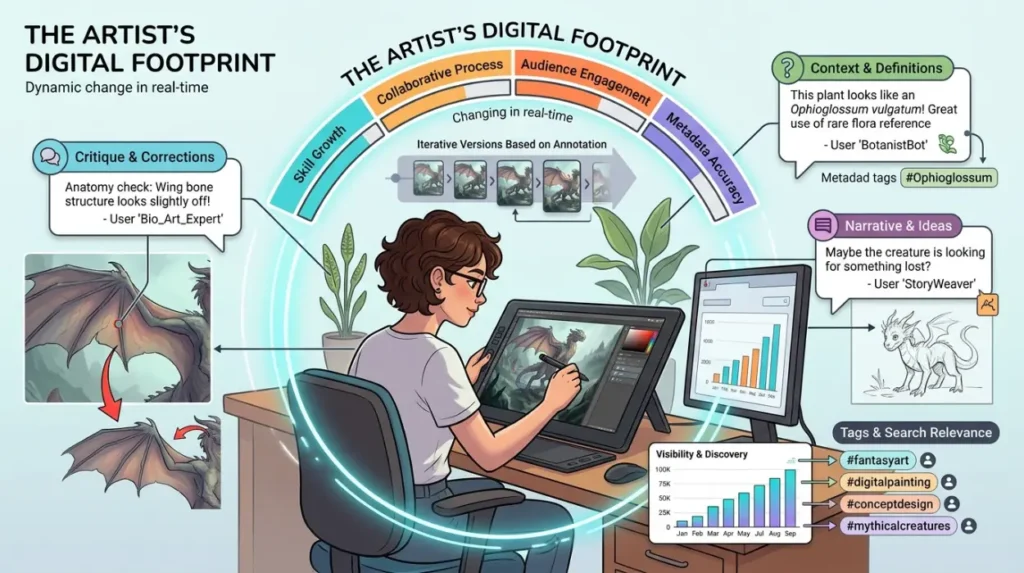
User-generated annotations influence an artist’s digital footprint by adding searchable interpretations to the information associated with the artist and their work. These annotations create additional pages, phrases and semantic relationships that search engines can discover and index. Their visibility depends on relevance and other ranking considerations rather than on direct approval from the artist. A third-party annotation can therefore become part of the searchable information environment around a creative entity. This distinction is important when assessing online credibility.
Annotations also introduce variability in source authority. One contributor can provide a carefully researched explanation, while another can interpret the same material without sufficient context. Search users do not always distinguish between these levels of evidential quality. If an interpretation becomes prominent, it can function as a reputation signal regardless of who originally created it. Reputation analysis therefore evaluates both the content and the authority of its source.
Can inaccurate lyric interpretations become persistent search results?
Inaccurate lyric interpretations can become persistent search results when related pages continue to receive relevance, references and search demand. Content indexing allows information to remain discoverable after the initial publication event. Secondary pages can also reproduce or reference the interpretation, expanding its digital footprint. This creates a longer-lasting association between the interpretation and the artist. Persistence therefore depends on the wider information ecosystem rather than the original annotation alone.
Search visibility also changes as new content enters the index. Fresh authoritative information can alter the composition of results for relevant queries, while established pages can retain visibility when they continue satisfying search intent. A reputation assessment therefore requires monitoring rather than a single snapshot. Tracking the search environment reveals whether an inaccurate interpretation remains prominent or becomes less visible over time. This provides a more precise measure of reputational significance.
What role does source authority play in lyric-related credibility?
Source authority determines the evidential weight that an information source contributes to the wider reputation environment. An official statement from an artist represents a different source category from an anonymous interpretation or an unsourced commentary page. Search systems assess pages according to their own ranking mechanisms, so source authority and search position are related but not identical concepts. Reputation analysis evaluates both dimensions separately. This produces a more accurate assessment of credibility.
Authority also depends on topical relevance. A publication specialising in music criticism provides a different form of expertise from a general discussion forum. Neither category automatically establishes the artist’s intended meaning, but each contributes a different reputation signal. Comparing source quality helps identify which interpretations deserve greater contextual consideration. It also prevents a high volume of low-authority references from being treated as equivalent to direct evidence.
How does sentiment interpretation affect an artist’s reputation?
Sentiment interpretation affects reputation when lyric-related content repeatedly associates an artist with positive, negative or controversial themes. Sentiment analysis examines the language surrounding the entity rather than treating one phrase as a complete representation of the artist. A negative annotation does not automatically establish negative sentiment across the artist’s entire digital footprint. Context, source quality and topical relevance determine the significance of the signal. This prevents isolated interpretations from becoming disproportionate measures of reputation.
The distribution of sentiment also matters. An artist’s search environment can contain reviews, interviews, lyric explanations, news coverage and audience commentary with different perspectives. Evaluating these sources together provides a broader representation of entity perception. A concentrated cluster of negative interpretations can have greater search significance than an isolated comment. Reputation analysis therefore examines sentiment distribution rather than relying on individual statements.
Dive Deeper With Our Expert Guides:
How Cancel Campaigns Target Musicians Overnight
Why a Single Bad Concert Review Spreads Across Fan Forums
How should an artist distinguish factual errors from subjective interpretations?
Factual errors and subjective interpretations require different forms of evaluation. A factual error concerns information that can be verified against an authoritative source, such as an incorrect transcription, attribution or biographical detail. Subjective interpretation concerns an explanation of meaning that does not necessarily have one objectively verifiable answer. Treating interpretation as fact creates unnecessary certainty around creative material. A structured reputation analysis therefore classifies the type of information before evaluating its impact.
The distinction also determines which corrective mechanisms are appropriate. Verifiable inaccuracies can be assessed against reliable evidence and addressed through legitimate correction processes where available. Subjective interpretations require contextual clarification rather than presenting one interpretation as universally factual. This approach maintains analytical credibility while recognising the interpretive nature of creative work. It also reduces the risk of creating further misleading information in an attempt to correct existing content.
How can accurate information influence search perception around an artist?
Accurate information influences search perception by expanding the range of authoritative and contextually relevant material available to users. Artist interviews, official statements, verified biographies and credible editorial sources can provide information that complements third-party lyric interpretations. Search engines independently determine how these pages rank for specific queries. The presence of accurate sources therefore does not guarantee a particular SERP position. It does, however, create additional information within the indexed ecosystem.
This process is better understood as contextual enhancement than automatic suppression. The objective is to provide search users with a more complete information environment. When authoritative sources address the relevant topic, users gain additional evidence for evaluating interpretations. The resulting digital footprint becomes less dependent on one third-party explanation. This supports a more balanced approach to entity perception.
Is lyric content removal different from reputation management?
Lyric content removal and reputation management address different levels of the information ecosystem. Removal focuses on whether a specific page, annotation or piece of information qualifies for a legitimate correction or removal mechanism. Reputation management examines the wider relationship between content, search visibility, source authority and entity perception. Removing one page therefore does not necessarily change the broader digital footprint. Conversely, improving the overall information environment does not necessarily remove the original material.
This distinction prevents a source-level problem from being confused with a search-perception problem. If an inaccurate transcription exists, correction at the source addresses the underlying information. If an interpretation remains online but lacks context, broader authoritative information can address the surrounding information environment. Each mechanism operates differently. Effective analysis begins by identifying which layer requires intervention.
What can artists learn from lyric-related reputation signals?
Artists can use lyric-related reputation signals to understand how their creative work is represented across search ecosystems. Monitoring identifies which interpretations appear for relevant searches, which sources publish them and how prominently they rank. The analysis also identifies recurring inaccuracies and gaps in contextual information. These findings provide a structured view of the artist’s digital footprint. The objective is understanding search perception rather than treating every disagreement as a reputational crisis.
A useful evaluation framework includes:
- Identify indexed lyric pages and interpretations that appear for searches connected with the artist and work.
- Classify each source according to factual accuracy, interpretive nature, authority and topical relevance.
- Compare third-party interpretations with verified information and available artist statements.
- Measure search visibility by tracking the prominence of relevant pages across priority queries.
- Monitor changes over time to determine whether inaccurate associations remain persistent within the SERP environment.
This framework separates information discovery from intervention. It also creates a repeatable method for assessing whether an interpretation represents a significant reputation signal or a low-authority isolated reference. The resulting analysis provides a clearer understanding of online credibility.
How can artists evaluate misinterpreted lyrics without distorting creative meaning?
Artists can evaluate misinterpreted lyrics by separating factual correction from legitimate artistic interpretation. A transcription error represents an accuracy problem, while disagreement about metaphor or symbolism represents an interpretive issue. The two categories require different analytical treatment. Attempting to establish one definitive interpretation for inherently ambiguous creative work can introduce new inaccuracies. A balanced approach therefore prioritises verified facts while acknowledging legitimate interpretive variation.
This distinction also protects the integrity of the artist’s wider digital footprint. Correcting factual information improves accuracy without attempting to control every independent interpretation. Contextual information can explain the artist’s stated perspective where such information exists. Users then have access to both verified material and clearly identified interpretation. This creates a more transparent search environment.
What does the future of lyric-based reputation management involve?
The future of lyric-based reputation management centres on stronger source evaluation, contextual analysis and continuous monitoring of search visibility. As more creative information becomes searchable, third-party interpretations become part of the wider digital footprint surrounding artists. Search systems continue evaluating content according to relevance and authority, while users encounter information through increasingly diverse result formats. Reputation analysis therefore needs to examine relationships between original works, interpretations and indexed references. This creates a more sophisticated model of online credibility.
The central principle remains information accuracy. Artists do not control every interpretation published online, and search systems do not function as arbiters of artistic intent. A sustainable reputation framework instead identifies factual inaccuracies, evaluates source authority and strengthens the availability of accurate contextual information. For readers exploring the strategic side of this issue, correcting misinterpreted lyrics on lyric sites provides a useful next-stage consideration for understanding source-level and search-level responses.
Lyric sites can influence an artist’s digital reputation because third-party transcriptions, annotations and interpretations become searchable information associated with the artist and their work. Search engines evaluate this information through ranking systems, while users interpret prominent results as part of the artist’s online identity. This creates a clear distinction between authorial intent, third-party interpretation and search visibility.
Understanding reputation signals requires analysis of source authority, factual accuracy, contextual relevance, sentiment distribution and content indexing. A single interpretation does not define an artist’s entire digital reputation, and high search visibility does not establish factual authority. The strongest analytical approach evaluates the complete information environment and distinguishes verifiable errors from legitimate creative interpretation.
Why do lyric sites sometimes misrepresent an artist’s message?
Lyric sites can misrepresent an artist’s message through transcription errors, incomplete context, or third-party interpretations. These inaccuracies can influence how users understand the artist when the content appears prominently in search results.
How do inaccurate lyrics affect an artist’s online reputation?
Inaccurate lyrics can create misleading reputation signals when search engines index incorrect transcriptions or interpretations alongside the artist’s name. Repeated references can contribute to an inaccurate digital footprint and affect online credibility.
Can artists correct misinterpreted lyrics on lyric sites?
Artists can address factual inaccuracies through legitimate correction or platform-specific processes where available. Clear contextual information from authoritative sources can also help distinguish the artist’s intended meaning from third-party interpretations.
How do search engines rank lyric and music-related content?
Search engines evaluate lyric-related pages according to relevance, content quality, authority and other ranking signals. A prominent search result is not automatically proof that its interpretation accurately represents the artist’s intended message.
What is reputation management for musicians?
Reputation management for musicians involves monitoring and analysing online information associated with an artist, including lyrics, reviews, media coverage and public commentary. The process focuses on search visibility, source credibility, content accuracy and the overall digital perception of the artist.