
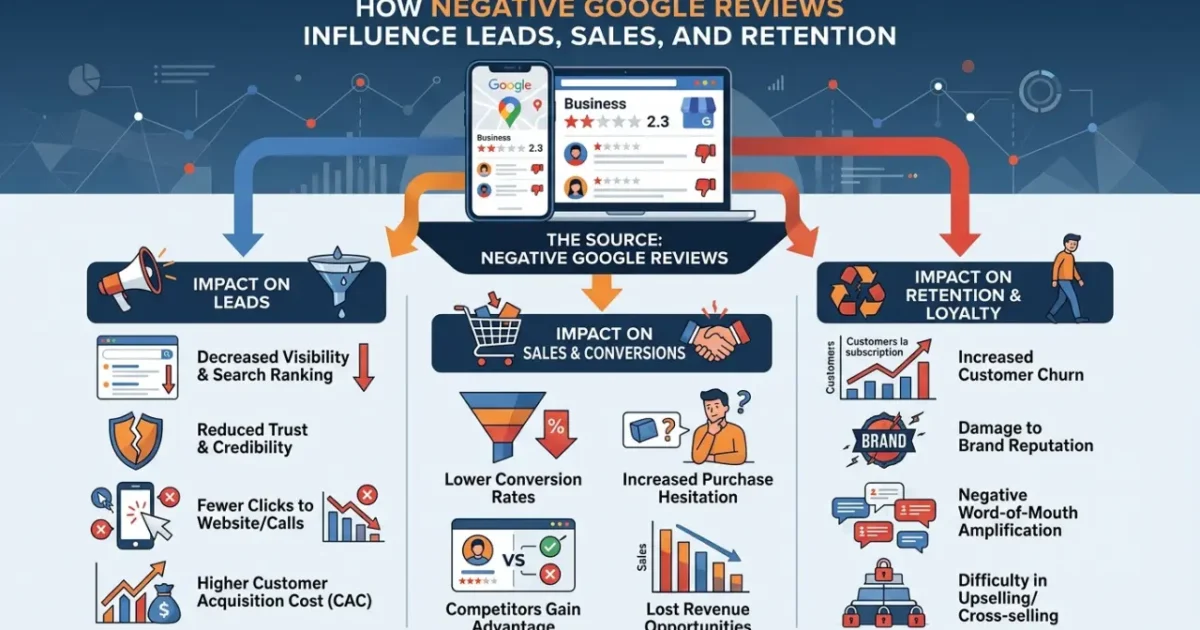
Negative Google Reviews influence lead generation, sales conversion, and customer retention by altering reputation signals, trust evaluation patterns, and local search visibility. Search engines interpret review sentiment, review velocity, and response activity as indicators of entity credibility and consumer satisfaction.
Reputation management strategies differ based on the type of reputation risk, the visibility of negative sentiment, and the structure of the search environment. Online reputation control methods are evaluated through sentiment distribution analysis, SERP composition monitoring, and long-term trust signal stability.
How Do Negative Google Reviews Affect Lead Generation and Search Visibility?
Negative Google Reviews reduce lead acquisition efficiency by weakening local search trust signals and lowering click-through rates from search engine results pages. Search ecosystems interpret repeated negative sentiment as a signal of reduced consumer satisfaction, which affects perception before direct engagement occurs.

Google Reviews operate as publicly indexed reputation assets connected to local search entities. Search engines analyse star ratings, review frequency, keyword relevance, and reviewer engagement patterns to evaluate business legitimacy and consumer trust alignment. Negative sentiment shifts the perceived reliability of an entity, particularly when review clusters reference repeated operational issues.
Search visibility influence differs between isolated negative reviews and sustained negative sentiment distribution. A small number of critical reviews alongside strong review diversity maintains balanced reputation signals. Persistent low ratings, declining review velocity, and unresolved complaints create compounded trust deterioration across local search environments.
Lead generation impact extends beyond rankings. Users evaluate review excerpts, star averages, and response quality directly within search results before website interaction occurs. This process transforms review sentiment into a pre-click qualification mechanism, where negative reviews reduce enquiry intent even when ranking positions remain stable.
Organic reputation stability performs differently from reactive reputation correction strategies. Organic reputation management operates by maintaining continuous review acquisition and consistent customer feedback distribution. Reactive approaches focus on responding after sentiment decline becomes visible. Organic systems improve long-term perception consistency, while reactive systems primarily reduce immediate visibility damage.
Which Reputation Management Approaches Compare Most Effectively Against Negative Reviews?
Content enhancement strategies create stronger long-term reputation resilience than suppression-focused approaches because search engines prioritise sustained entity relevance and engagement consistency. Removal-focused methods address isolated issues but do not improve underlying trust signals.
How Does Content Enhancement Operate?
Content enhancement is a reputation management method that increases the visibility of positive, authoritative, and informative digital assets. It operates by strengthening favourable search signals through high-quality content publication, review generation, and reputation-focused optimisation.
This method improves SERP composition by increasing the prominence of neutral or positive search assets. Search engines interpret active content ecosystems as indicators of entity relevance and operational legitimacy. Positive review acquisition supports sentiment diversification, reducing the proportional impact of isolated negative reviews.
Content enhancement strategies scale effectively because they align with organic ranking systems. Review diversification, FAQ publication, local content optimisation, and profile completeness all contribute to stronger entity credibility. However, this approach requires sustained execution cycles and measurable content governance structures.
How Does Content Suppression Compare?
Content suppression is a reactive reputation control strategy that reduces the visibility of negative assets through competing content creation or legal removal processes. It operates by displacing negative search results rather than improving sentiment distribution itself.
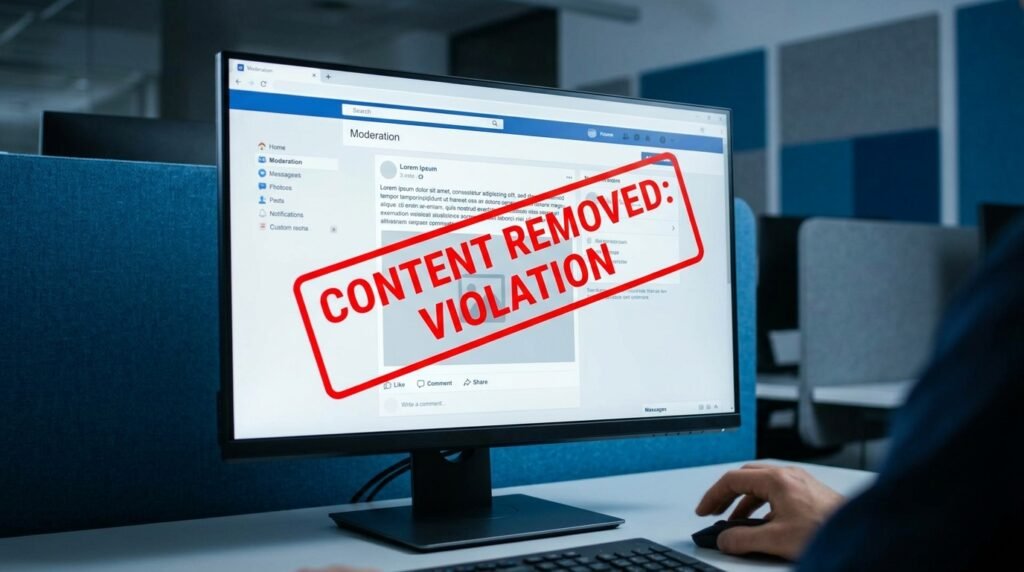
Suppression approaches produce short-term visibility control when negative reviews or complaint pages dominate branded search results. The method performs effectively in cases involving inaccurate information, policy violations, or duplicated reputation attacks. However, suppression mechanisms face sustainability limitations because search algorithms continuously re-evaluate relevance and engagement metrics.
Search ecosystems distinguish between reputation enhancement and artificial visibility manipulation. Excessive suppression activity without supporting positive trust signals creates inconsistent entity credibility patterns. As a result, suppression strategies require integration with broader reputation stabilisation frameworks to maintain long-term SERP balance.
How Do Review Response Strategies Influence Consumer Trust and Retention?
Review response strategies influence customer retention by shaping public perception of accountability, responsiveness, and operational transparency. Search engines and users both interpret response behaviour as a measurable trust signal.
Review responses operate as indexed public communications connected to customer sentiment. Response quality, response timing, and issue resolution language all contribute to reputation interpretation. Neutral, structured responses improve trust stability because they demonstrate active engagement without escalating conflict visibility.
Retention impact differs between defensive and resolution-oriented response frameworks. Defensive responses prioritise reputation protection but often amplify perception risks through confrontational language or denial patterns. Resolution-oriented approaches focus on clarification, remediation, and process transparency, which reduces public trust erosion.
Structured response systems improve long-term reputation sustainability through consistency. Effective frameworks typically:
- Define response timelines to maintain visible engagement continuity.
- Address operational concerns using specific corrective language.
- Separate emotional language from factual clarification mechanisms.
- Monitor recurring complaint themes to identify systemic reputation risks.
Search engines evaluate review ecosystems holistically rather than through isolated sentiment points. High response rates combined with balanced review acquisition patterns create stronger entity credibility signals than inactive profiles with equivalent star ratings. Evaluation frameworks commonly used within Google Review Monitoring and Response Services analyse response consistency, sentiment categories, and engagement timelines to measure public trust stability over time.
What Is the Difference Between Organic Reputation Growth and Reactive Reputation Repair?
Organic reputation growth improves long-term trust equity, while reactive reputation repair focuses on correcting visible reputation decline after negative sentiment exposure. The distinction affects sustainability, scalability, and risk exposure.
Organic reputation growth is a continuous reputation management framework that operates through ongoing customer engagement, review acquisition, content development, and local visibility optimisation. Search ecosystems favour this approach because it produces stable engagement patterns and consistent trust indicators.
Reactive reputation repair operates after visibility damage occurs. This method includes complaint management, negative review responses, suppression campaigns, and crisis communication adjustments. Reactive systems reduce immediate reputational disruption but often require higher operational resources during active reputation decline periods.
Scalability differs significantly between both approaches. Organic systems integrate into standard operational processes, making reputation stability more sustainable over time. Reactive repair frameworks depend on issue severity, sentiment spread velocity, and SERP exposure levels, which increases unpredictability.
Risk exposure also differs between strategies. Organic growth reduces vulnerability to isolated review attacks because sentiment distribution remains balanced. Reactive repair strategies face increased exposure when negative sentiment clusters dominate search environments before corrective mechanisms are implemented.
Search engines interpret consistent positive engagement patterns as indicators of operational legitimacy. As a result, organic reputation frameworks generally create stronger ranking resilience than short-term reactive interventions.
How Do Search Engines Interpret Reputation Signals From Google Reviews?
Search engines interpret Google Reviews through behavioural, semantic, and engagement-based evaluation systems. Reputation signals contribute to local search ranking influence, trust analysis, and entity relationship mapping.
Google Reviews function as structured user-generated content connected to business entities. Search algorithms analyse rating averages, keyword relevance, review freshness, geographic consistency, and reviewer authenticity. Negative sentiment associated with repeated operational failures influences search perception differently from isolated dissatisfaction.
Review velocity operates as a temporal trust signal. Consistent review acquisition patterns indicate ongoing operational activity, while sudden spikes in negative sentiment suggest potential service disruption or reputational instability. Search ecosystems compare historical review behaviour against current activity trends to detect credibility inconsistencies.
Semantic analysis also affects visibility interpretation. Search engines process recurring complaint themes to identify reputation patterns related to customer service, product quality, communication standards, or delivery performance. This process connects sentiment themes to broader trust evaluations.
Entity credibility depends on consistency across multiple reputation sources. Search engines compare Google Reviews with third-party citations, local business data, branded content, and behavioural engagement signals. Contradictory reputation patterns weaken trust stability because the ecosystem identifies inconsistency between claimed authority and public sentiment.
Reputation signal interpretation extends beyond rankings into conversion psychology. Users rely on aggregated review sentiment as a shortcut for evaluating risk exposure before engagement occurs. Negative reviews therefore influence both algorithmic visibility and consumer trust assessment simultaneously.
Which Review Management Mechanisms Create Sustainable Reputation Stability?
Sustainable reputation stability depends on systems that improve review diversity, operational transparency, and sentiment consistency rather than isolated visibility correction tactics. Reputation management mechanisms perform differently based on execution continuity and trust signal alignment.
How Does Review Monitoring Operate?
Review monitoring is a reputation analysis process that tracks sentiment distribution, review frequency, and emerging complaint patterns across search ecosystems. It operates by identifying perception shifts before negative sentiment clusters affect visibility and trust performance.
Monitoring frameworks improve risk management because they detect operational reputation trends early. Search ecosystems respond more favourably to active reputation maintenance than delayed crisis intervention. Early detection reduces escalation exposure and preserves sentiment balance.
Monitoring scalability depends on process automation, categorisation accuracy, and response integration. Systems that classify reviews by complaint category enable operational teams to address recurring issues systematically rather than reactively.
Get Deep Insight:
Comparing 5 Google Review Management Approaches for Local Businesses
7 Warning Signs Your Google Review Profile Needs Immediate Attention
How Does Reputation Response Integration Compare?
Reputation response integration combines review monitoring with operational improvement mechanisms. It operates by connecting public feedback analysis to measurable service adjustments and communication updates.
Integrated frameworks outperform isolated response systems because they address the underlying source of negative sentiment rather than only managing public visibility. Search ecosystems reward consistent operational credibility through stable engagement and review diversity patterns.
Long-term sustainability emerges from alignment between customer experience and public reputation signals. When operational changes reduce recurring complaints, sentiment distribution gradually stabilises, improving both search visibility and retention trust indicators.
How Do Short-Term and Long-Term Reputation Strategies Compare?
Short-term reputation strategies prioritise immediate visibility control, while long-term strategies focus on sustained trust signal development and entity credibility reinforcement. Their effectiveness differs according to search volatility and sentiment persistence.
Short-term strategies include rapid review responses, temporary suppression campaigns, and visibility management during active reputation decline. These methods reduce immediate reputational disruption and limit perception escalation within search environments.
Long-term strategies operate through continuous review acquisition, content ecosystem development, operational transparency, and sentiment diversification. Search engines evaluate these mechanisms more favourably because they demonstrate consistent trustworthiness over time.
Effectiveness comparison depends on measurement criteria. Short-term systems improve immediate SERP composition and reduce visibility exposure to negative assets. However, long-term systems create stronger resilience against future sentiment fluctuations by stabilising reputation signals across multiple search touchpoints.
Sustainability also differs operationally. Short-term interventions require repeated reactive management during recurring reputation disruptions. Long-term frameworks integrate into standard business operations, creating more predictable reputation performance over extended periods.
Search ecosystems continuously reassess entity credibility using engagement consistency and public sentiment analysis. As a result, long-term reputation frameworks generally maintain stronger search ranking influence and retention stability than isolated short-term corrective tactics.
Negative Google Reviews influence leads, sales, and retention by affecting reputation signals, search visibility, and consumer trust evaluation. Search engines interpret review ecosystems as indicators of entity credibility, operational consistency, and customer satisfaction patterns.
Reputation management approaches differ according to their mechanisms, scalability, and sustainability. Content enhancement frameworks strengthen long-term trust signals through review diversification and SERP optimisation, while suppression-focused methods primarily address short-term visibility control. Organic reputation growth produces stronger resilience against sentiment volatility than reactive repair systems because search ecosystems prioritise consistent engagement patterns and operational legitimacy.
Review response strategies, monitoring systems, and integrated operational improvements all influence how search engines and users evaluate public sentiment. Sustainable reputation stability emerges from balanced sentiment distribution, structured engagement, and consistent trust signal reinforcement rather than isolated corrective interventions.
How do negative Google reviews affect customer trust?
Negative Google reviews can reduce customer trust by creating doubts about service quality, reliability, and customer experience. Many users read online reviews before making a purchase decision, so repeated negative feedback may lower conversion rates and lead generation.
Can bad Google reviews reduce sales for local businesses?
Yes, bad Google reviews can directly impact sales by discouraging potential customers from choosing a business. Low ratings and unresolved complaints often influence buying decisions, especially in competitive local search results.
Do negative online reviews affect customer retention?
Negative online reviews can hurt customer retention when existing customers feel concerns are not addressed properly. Businesses that respond professionally to complaints and improve customer service are more likely to maintain long-term customer relationships.
How important is responding to negative Google reviews?
Responding to negative Google reviews is important because it shows accountability and customer care. A professional response can improve brand reputation, rebuild trust, and demonstrate that customer feedback is taken seriously.
Can negative Google reviews impact local SEO rankings?
Negative Google reviews may influence local SEO performance because review quality, quantity, and engagement are ranking signals for local search visibility. Consistent positive reviews and active review management can help improve online reputation and search rankings.