

An emergency online reputation fix refers to immediate actions that reduce the visibility and influence of harmful digital information while preserving accurate, authoritative content within search ecosystems.
Reputation management is the structured process of analysing, organising, and influencing reputation signals that shape search visibility and public perception. Online reputation refers to the collection of indexed content, reviews, mentions, profiles, and digital entities that search engines evaluate to determine credibility and relevance.
Search ecosystems continuously analyse information through crawling, indexing, ranking, and entity evaluation. Every published page, review, news article, social profile, and discussion contributes to an evolving digital footprint. Search engines evaluate these interconnected signals to understand identity, authority, and trust, making online reputation an information architecture issue rather than a purely public relations concept.
What is an emergency online reputation fix?
An emergency online reputation fix is the immediate evaluation and stabilisation of reputation signals after harmful or misleading content gains high search visibility. It focuses on reducing the influence of damaging information by improving the prominence of accurate, authoritative, and relevant content within search ecosystems.
Emergency reputation management begins with identifying indexed content that dominates search engine results pages (SERPs). Search engines organise information according to relevance, authority, freshness, and entity relationships. When negative pages receive strong ranking signals, they influence entity perception because users often interpret top-ranking results as the most credible representation of an individual or organisation.
The urgency arises from search visibility rather than publication alone. A low-ranking page generates limited exposure, while a highly visible result repeatedly shapes perception through frequent impressions. Search engines evaluate engagement patterns, backlinks, topical authority, and structured data when determining ranking positions, making reputation management closely connected to content quality and search relevance.
How is online reputation formed in search engines?
Online reputation is formed through the continuous interpretation of reputation signals collected across multiple indexed sources. Search engines analyse these signals to construct an entity profile that represents trust, expertise, and credibility.
Search engines crawl websites, news publications, review platforms, social profiles, business directories, and publicly accessible documents. Each indexed resource contributes factual information, contextual associations, and topical relevance. Algorithms evaluate these relationships to understand whether multiple sources consistently describe the same entity.
Entity perception develops through semantic consistency rather than isolated documents. Names, organisations, locations, topics, and related entities create interconnected knowledge relationships. Consistent information strengthens entity recognition, while conflicting information introduces ambiguity that affects search interpretation and overall reputation.
Why do negative search results influence online perception?

Negative search results influence online perception because users frequently evaluate credibility according to the order and prominence of search listings. SERP evaluation combines ranking position, headline wording, metadata, publication authority, and visible snippets before any page is opened.
Content appearing on the first page receives the highest visibility because users typically interact with the earliest search results. Search engines present these rankings after evaluating relevance, authority, and quality signals. High-ranking negative content therefore becomes a dominant reputation signal regardless of whether it represents the complete digital identity of an individual or organisation.
Search perception depends on repeated exposure. When identical negative themes appear across multiple indexed pages, search engines recognise topical consistency while users interpret repetition as confirmation. This combination strengthens perceived credibility and influences long-term reputation without requiring direct interaction with every published page.
How do search engines evaluate reputation signals?
Search engines evaluate reputation signals by analysing content quality, source authority, entity relationships, user relevance, and indexing consistency. These signals collectively define digital credibility within search ecosystems.
How content quality contributes to reputation
Content quality is evaluated through topical completeness, factual consistency, semantic relevance, and technical accessibility. Search engines analyse whether information comprehensively explains a topic while maintaining contextual relationships with related entities.
Accurate and well-structured content creates stronger semantic associations. Pages containing clear definitions, logical hierarchy, descriptive headings, and relevant terminology improve search understanding because algorithms interpret structured information more efficiently than fragmented or duplicated material.
How authority signals strengthen credibility
Authority refers to the perceived expertise and reliability of a source within a defined topic. Search engines evaluate publisher reputation, citation patterns, topical consistency, and external references when determining authority.
Authoritative publications generate stronger trust signals because they consistently produce high-quality information. These signals influence ranking decisions and reinforce positive entity perception by demonstrating reliable information across multiple trusted sources.
How indexing consistency affects reputation
Content indexing determines which information becomes available for search evaluation. Search engines regularly revisit indexed pages, analyse updates, and reassess ranking positions according to evolving relevance signals.
Consistent indexing creates stable entity recognition because algorithms repeatedly encounter aligned information across multiple sources. Inconsistent indexing produces fragmented understanding that weakens semantic confidence and affects search visibility.
What is a digital footprint and why does it matter?
A digital footprint is the complete collection of publicly accessible information associated with an individual, organisation, or recognised entity across searchable environments. It represents the measurable evidence search engines use to understand digital identity.
A digital footprint includes websites, profiles, reviews, articles, interviews, directories, public documents, multimedia content, and discussion platforms. Search engines interpret these assets collectively rather than independently, allowing multiple sources to reinforce or contradict one another.
The structure of a digital footprint directly affects search visibility. Consistent factual information strengthens entity perception because algorithms identify stable relationships between names, subjects, and authoritative references. Inconsistent or outdated information weakens semantic clarity and introduces competing interpretations within search results.
Digital footprints also evolve continuously through new indexing events. Fresh content expands the entity profile, while historical information remains searchable if it retains ranking relevance. Reputation therefore reflects accumulated information rather than isolated publications.
How do reviews contribute to online credibility?
Reviews contribute to online credibility by generating measurable reputation signals that search engines and users interpret during SERP evaluation. Reviews combine textual sentiment, structured ratings, freshness, and platform authority into a searchable information source.
Review sentiment provides contextual information rather than isolated numerical ratings. Search engines analyse recurring language, topical relevance, and consistency across multiple reviews to understand overall public evaluation. Positive and negative themes become semantic indicators associated with an entity.
Review platforms also influence trust through structured data. Ratings, timestamps, reviewer activity, and verified information improve algorithmic interpretation because structured information supports clearer indexing and entity association. Consistent review patterns strengthen credibility, while contradictory patterns reduce semantic confidence.
Search visibility benefits from authentic review ecosystems because they expand topical coverage around an entity. Reviews become part of the broader digital footprint and contribute additional context beyond organisational websites or published articles.
How does content indexing affect reputation visibility?
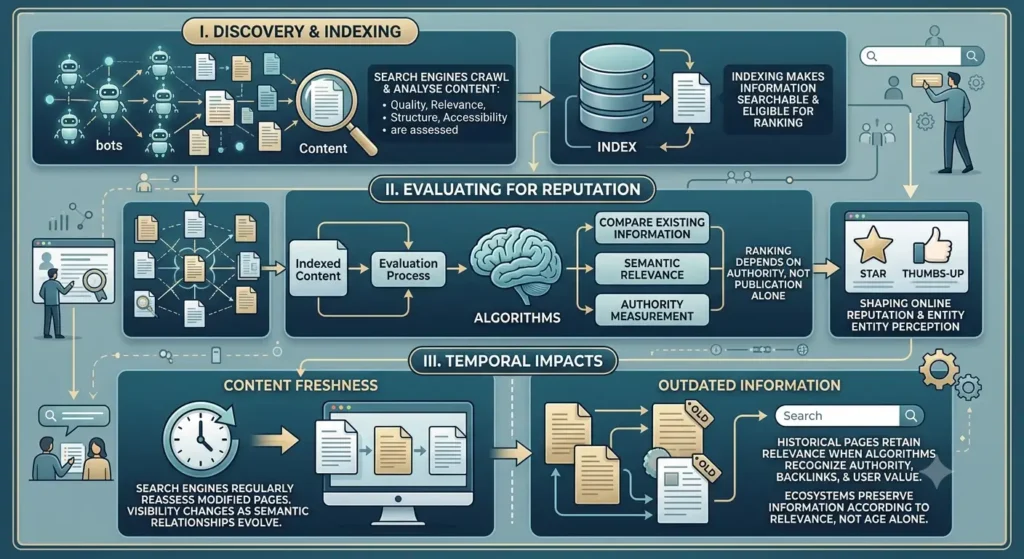
Content indexing determines whether information becomes searchable and eligible for ranking within search engine results. Indexed content enters the evaluation process that shapes online reputation and entity perception.
Search engines first discover content through crawling before analysing quality, relevance, structure, and accessibility. Successful indexing allows algorithms to compare a page with existing information across the web. Ranking decisions then depend on semantic relevance and authority rather than publication alone.
Content freshness influences indexing updates because search engines regularly reassess modified pages. Updated information receives renewed evaluation, allowing search visibility to change as semantic relationships evolve. Reputation therefore depends on continuous indexing rather than a single publication event.
Indexing also explains why outdated information remains visible. Historical pages retain search relevance when algorithms continue recognising authority, backlinks, and user value. Search ecosystems preserve information according to relevance instead of publication age alone.
Why is entity perception important for reputation management?
Entity perception is the structured understanding search engines develop about a recognised person, organisation, or subject through semantic relationships across indexed content. It defines how information is organised and interpreted within search ecosystems.
Entity recognition relies on consistent associations between names, locations, professions, organisations, publications, and related concepts. Search engines compare these relationships to determine whether different documents describe the same identifiable entity.
Strong entity perception improves semantic confidence because algorithms identify repeated factual patterns across authoritative sources. Weak entity perception introduces ambiguity, reducing the clarity of reputation signals and affecting search visibility for relevant queries.
Understanding entity perception also explains why isolated content rarely defines reputation. Search engines evaluate the complete semantic network surrounding an entity, meaning reputation develops from interconnected information rather than individual documents.
Within discussions of reputation analysis, a contextual reference such as Negative Online Content Suppression Services naturally connects broader concepts surrounding search visibility and information management.
How do search ecosystems interpret trust and credibility?
Search ecosystems interpret trust and credibility by comparing consistency, authority, expertise, and contextual relevance across indexed information. Trust emerges through measurable reputation signals rather than subjective judgement.
Algorithms analyse whether authoritative sources describe similar facts, whether content demonstrates topical depth, and whether entities maintain stable semantic relationships over time. Consistent evidence strengthens confidence because repeated factual alignment reduces ambiguity during indexing and ranking.
Credibility also depends on technical quality. Structured headings, descriptive metadata, accessible page architecture, and semantic organisation improve algorithmic understanding. These technical elements complement informational quality by enabling efficient content interpretation during crawling and indexing.
Search engines continuously reassess credibility because the web changes every day. Newly indexed information, updated pages, and evolving entity relationships influence ongoing SERP evaluation, making trust a dynamic property within search ecosystems rather than a permanent status.
Dive Deeper With Our Expert Guides:
How to Recover From Negative Reviews or Online Defamation
What to Do If Someone Posts Negative Content About You Online
Emergency online reputation fixes focus on restoring balanced search visibility through the careful evaluation of reputation signals, indexed information, and entity perception. Search engines interpret credibility by analysing semantic consistency, authority, content quality, reviews, and digital footprints across interconnected sources.
Understanding how content indexing, SERP evaluation, trust signals, and entity relationships operate provides a clearer view of why certain information becomes prominent in search results. Online reputation therefore reflects the structured interpretation of digital information within search ecosystems, where visibility, credibility, and semantic relevance collectively define how individuals and organisations are perceived.
Answers to Key Questions
What are negative online content suppression services?
Negative online content suppression services refer to strategies that improve the visibility of accurate, relevant content so less favourable pages become less prominent in search results. They focus on search visibility and content relevance rather than removing information from the internet.
How do search engines decide which negative content ranks higher?
Search engines rank content based on relevance, authority, content quality, backlinks, and user-focused signals. Pages with stronger ranking signals often appear higher in search results, influencing online reputation and search perception.
Can negative online content be removed from search results?
Not all negative content can be removed because search engines index publicly available information from different sources. In some cases, improving authoritative and relevant content changes search visibility without deleting the original content.
How does Clear My Name approach negative online content suppression services?
Clear My Name focuses on analysing search visibility, reputation signals, and indexed content to understand how information is presented in search results. Negative online content suppression services involve improving the prominence of accurate and authoritative information within search ecosystems.