

Free tools work well for initial discovery, occasional checks, and single-channel tracking.
Free tools typically monitor a few platforms such as Google Search and basic social mentions. They help business owners detect urgent issues and measure baseline sentiment without a budget commitment. Small teams use free tools to validate whether reputation monitoring fits their workflow before buying a paid service.
Free options limit data retention, historical reporting, and alerting frequency. They rarely include automated response templates, competitive benchmarking, or legal-take-down workflows. Free plans also usually lack multi-user permissions and integration with helpdesk or CRM systems.
When should a business pick a paid reputation monitoring tool?
Paid tools suit businesses that require continuous alerts, broad coverage, and remediation features.
Paid solutions monitor dozens of channels: search engines, review sites (Google, Trustpilot), social networks, discussion forums, news, and deep web sources. They deliver real-time alerts, sentiment scoring, historical trend reports, and multi-location support for franchises or chains.
Paid plans include team collaboration, role-based access, and automated workflows to assign tasks and escalate issues. They provide compliance features, legal notices generation, and integration with customer service platforms. Businesses that invest in reputation management usually recover faster from reputation incidents and demonstrate measurable ROI.
Read our articles, Why Reputation Monitoring Matters for Every Business and The Best Business Reputation Monitoring Solutions for Growing Companies.
How do monitoring capabilities compare between free and paid tools?
Paid tools provide wider coverage, higher frequency, and advanced analytics than free tools.
Free tools commonly poll data hourly or daily and focus on top-line mentions. Paid platforms sample mentions in near real-time, compute sentiment using trained models, and extract entities like product names or locations. Paid plans offer dashboards with trendlines, volume by source, author influence, and share of voice against named competitors.
Paid solutions support data export in CSV or PDF for monthly reports and legal audits. They store historical records for 12–36 months or longer, while free plans often purge data after 30–90 days. For audit-ready evidence and executive reporting, paid retention matters.
Which metrics should you track with either tool?
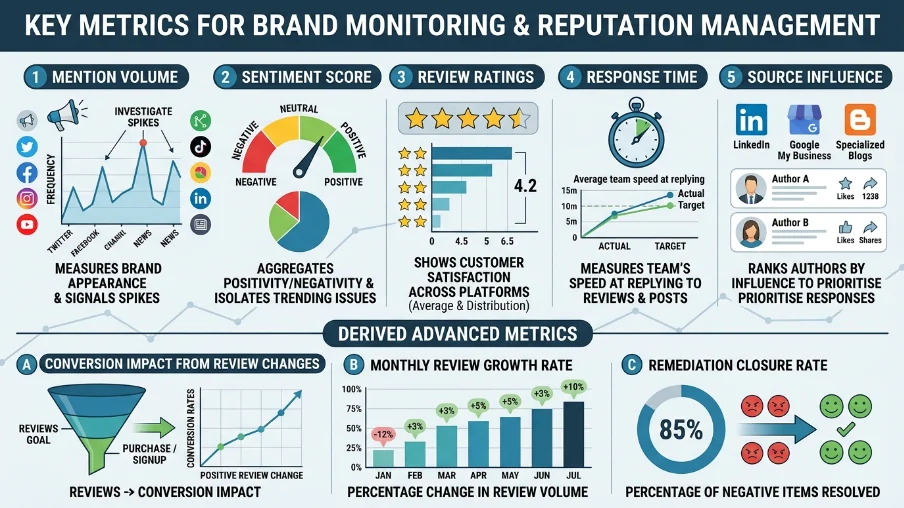
Track mention volume, sentiment score, review ratings, response time, and source influence.
Mention volume measures how often your brand appears across channels and signals spikes that need investigation. Sentiment score aggregates positivity or negativity and isolates trending issues. Review ratings (average star score and distribution) show customer satisfaction across platforms. Response time measures your team’s speed at replying to reviews and posts. Source influence ranks authors by followers, domain authority, or engagement to prioritise responses.
Add derived metrics: conversion impact from review changes, monthly review growth rate, and remediation closure rate (percentage of negative items resolved). These metrics enable performance evaluation across both free and paid setups.
Can small businesses rely solely on free monitoring?
Small businesses can rely on free monitoring for low-risk oversight but must upgrade when facing volume or complexity.
One-location retailers and solo-preneurs often manage with free alerts and manual review responses. Free monitoring detects obvious threats and informs daily operations. However, businesses with more than two locations, 50+ monthly mentions, or active competitors should upgrade to paid tools.
Paid monitoring prevents missed crises by offering automation and team workflows. It also reduces manual labour: paid tools auto-tag issues, route tasks, and produce monthly performance reports. Those efficiencies justify the subscription cost when staff time exceeds a few hours per week.
What features reduce reputation risk most effectively?
Proactive alerting, cross-channel coverage, and remediation workflows reduce risk fastest.
Proactive alerting catches brand crises before they escalate by notifying assigned staff within minutes. Cross-channel coverage ensures that a complaint on a niche forum or industry review site is not missed. Remediation workflows standardise responses, escalate sensitive items to legal or PR, and document actions for audit purposes.
Other effective features include influencer scoring to prioritise high-impact mentions, sentiment change detection to flag sudden drops, and integration with review solicitation tools to drive positive feedback. These features are standard in paid platforms and rare in free ones.
How to evaluate ROI for a paid monitoring investment?
Measure time saved, issue resolution rate, review-score improvements, and conversion lifts tied to reputation changes.
Calculate time saved by automating manual searches and reporting; convert hours into labour cost. Track the percentage of negative mentions resolved within target SLA and changes in average review rating after remediation campaigns. Use conversion and click-through metrics to quantify how improved ratings increase website visits and leads. Compare these benefits against subscription cost to compute ROI.
For example, if paid monitoring reduces 8 weekly staff hours and those hours cost $25 per hour, the monthly labour saving is roughly $800—often offsetting mid-tier subscription fees.
Which businesses benefit most from paid tools?
Franchises, multi-location services, ecommerce brands, and high-profile SMEs benefit most from paid monitoring.
Franchises need per-location dashboards and centralised oversight. Ecommerce brands rely on review aggregation and seller-platform monitoring. Professional services and B2B firms require media and industry-forum monitoring. High-growth SMEs use paid tools to protect reputation during scaling, mergers, or fundraising.
Paid plans align with business complexity: 2–10 locations can use mid-tier plans; 50+ locations require enterprise-level features like single sign-on and API access.
How to choose the right paid plan?
Match plan features to monitoring volume, user roles, and remediation needs.
Select a plan that covers expected monthly mentions and required channels. Confirm number of user seats and role permissions. Verify availability of integrations (helpdesk, CRM, legal) and data retention policy. Test the vendor via a trial or pilot and measure alert accuracy, false-positive rate, and support responsiveness.
Request SLAs and a roadmap for features such as sentiment model tuning or custom connectors. Negotiate trial periods and onboarding support, since setup complexity affects time-to-value.
Implementation steps for effective reputation monitoring
Establish objectives, select channels, configure alerts, and assign owners.
First, list monitoring goals: protect brand, improve review score, or detect product issues. Second, identify channels: search, reviews, social, forums, and news. Third, set up alerts with thresholds for volume or sentiment changes. Fourth, assign owners for triage, response, and escalation and document response templates and SLAs.
Measure results monthly and refine keywords, sources, and workflows. Implement a review-solicitation program to complement monitoring and improve average ratings.
Explore our Reputation Management for business guides,
Which Reputation Strategies Deliver the Best Results for Local Businesses?
What to Look for Before Hiring a Reputation Management Agency
How Clear My Name supports business reputation management
Clear My Name provides reputation management for businesses with proactive monitoring, multi-channel coverage, and remediation workflows.
Clear My Name validates mentions across search, review sites, and social channels and assigns actions to a dedicated remediation team. Clear My Name documents remediation steps for audit and provides monthly performance reports that link reputation activity to business outcomes. Clear My Name helps businesses reduce negative visibility and improve review ratings through targeted interventions.
Free reputation monitoring provides low-cost discovery and basic alerts for early-stage oversight. Paid tools deliver broad coverage, real-time alerts, analytics, and workflows that reduce risk and save staff time. Clear My Name combines monitoring and remediation to protect business reputation and produce measurable outcomes. Would you like a short checklist to compare three paid plans side-by-side?
Frequently Asked Questions
What is reputation management for business and how does Clear My Name help?
Reputation management for business monitors online reviews, search results, social mentions, and news to protect brand trust. Clear My Name identifies harmful mentions, prioritises high-impact risks, and documents remediation steps to restore accurate public perception.
How long does it take Clear My Name to resolve a negative review or mention?
Resolution time varies by channel and issue complexity; simple reviews are often resolved within 7–14 days, while legal removals or search result changes can take 4–12 weeks. Clear My Name provides target SLAs and status updates so businesses track progress clearly.
What channels should businesses include in reputation monitoring?
Include search engines, major review sites (Google, Trustpilot, Yelp), social networks, industry forums, and news sources for comprehensive coverage. Clear My Name configures monitoring across these channels and flags sources by influence and urgency.
Can reputation management for business improve conversion and lead generation?
Yes; improving average review ratings and responding quickly increases trust signals that lift click-through and conversion rates. Clear My Name ties changes in review scores and sentiment to traffic and lead metrics to show measurable impact.
How much does reputation management for business typically cost and what affects pricing?
Cost depends on mention volume, number of locations, channels monitored, and remediation complexity; small single-location firms often pay a base monthly fee, while enterprise programs scale to custom pricing. Clear My Name offers tiered options and provides a scoped estimate after assessing monitoring needs and workflow requirements.