

Reputation monitoring matters because it enables businesses to track public perception in real time, identify risks early, and protect revenue by responding to customer feedback, reviews, and online mentions across digital platforms. It directly impacts trust, visibility, and long-term growth.
What Is Reputation Monitoring and How Does It Work?
Reputation monitoring is the continuous process of tracking, analysing, and responding to online mentions, reviews, and brand signals across search engines, social platforms, and review sites using automated tools and structured workflows.
Reputation monitoring systems collect data from multiple digital touchpoints. These include Google reviews, social media comments, forum discussions, and news mentions. The process relies on keyword tracking, sentiment analysis, and alert systems.
Modern platforms use three core mechanisms: keyword-based listening, sentiment classification, and real-time alerting. Keyword listening identifies brand mentions. Sentiment classification categorises feedback as positive, neutral, or negative. Alerts notify teams when critical issues arise.
Data aggregation allows businesses to view all mentions in one dashboard. This centralised visibility improves response time. It also ensures consistency in communication across platforms.
Reputation monitoring supports structured workflows. Teams assign responsibilities, prioritise responses, and document outcomes. This creates a repeatable system that aligns with business objectives.
Why Does Reputation Monitoring Directly Impact Business Revenue?
Reputation monitoring impacts revenue because 93% of consumers read online reviews before purchasing, and a one-star rating increase can raise revenue by up to 9%, according to Harvard Business School research.
Customer decisions depend on visible trust signals. Ratings, reviews, and public responses influence purchase intent. A negative review without response reduces credibility. A resolved complaint builds trust.
Search engines factor reputation into rankings. Google prioritises businesses with high engagement and positive sentiment. This affects local SEO performance and organic traffic.
Reputation monitoring identifies revenue risks early. Negative trends signal operational issues. For example, repeated complaints about delivery delays indicate logistics problems. Addressing these issues improves customer retention.
It also supports upselling and retention. Positive feedback highlights strengths. Businesses can reinforce these areas in marketing campaigns and customer experience strategies.
How Does Reputation Monitoring Improve Customer Trust?
Reputation monitoring improves customer trust by enabling timely responses, transparent communication, and consistent engagement across all public channels, which signals reliability and accountability to potential customers.
Customers expect fast responses. Data from HubSpot shows that 90% of consumers expect replies within 10 minutes on social platforms. Monitoring tools enable real-time alerts, allowing businesses to respond quickly.
Transparency builds credibility. Publicly addressing complaints demonstrates accountability. It shows that the business values feedback and takes corrective action.
Consistency matters. Monitoring ensures that messaging remains aligned across platforms. This reduces confusion and strengthens brand identity.
Trust also grows through verification. Businesses validate customer concerns and provide evidence-based responses. This reduces misinformation and improves perception accuracy.
What Risks Do Businesses Face Without Reputation Monitoring?
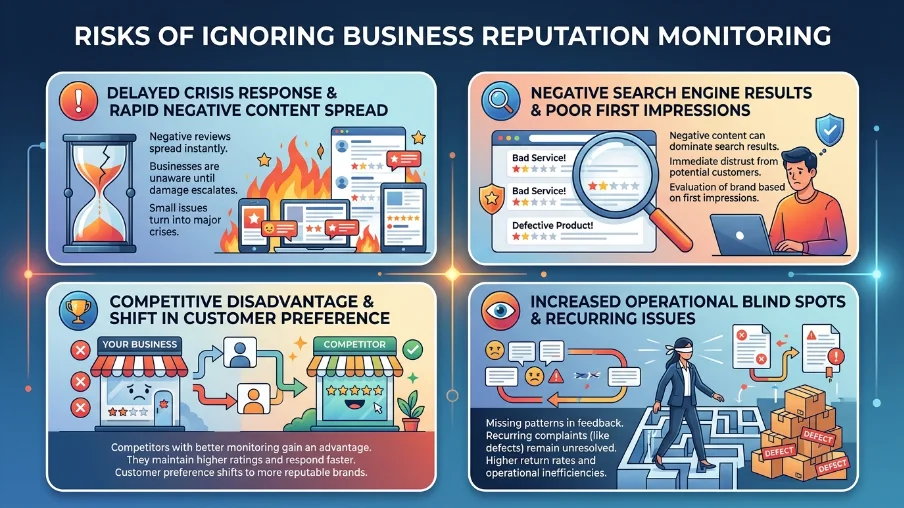
Businesses without reputation monitoring face delayed crisis response, unchecked negative reviews, misinformation spread, and loss of customer trust, which collectively reduce visibility, conversion rates, and long-term brand equity.
Negative content spreads quickly. A single unresolved complaint can appear on multiple platforms within hours. Without monitoring, businesses remain unaware until damage escalates.
Search engine results can be dominated by negative content. This affects first impressions. Potential customers often rely on the first page of results when evaluating a brand.
Competitors can gain advantage. Businesses with stronger reputation management systems respond faster and maintain higher ratings. This shifts customer preference.
Operational blind spots increase. Without feedback tracking, businesses miss patterns. For example, recurring complaints about product defects remain unresolved, leading to higher return rates.
How Does Reputation Monitoring Support SEO Performance?
Reputation monitoring supports SEO by improving review quality, increasing engagement signals, and ensuring accurate business information, which collectively enhance search rankings and local visibility.
Google’s algorithm evaluates three key factors: relevance, distance, and prominence. Reputation signals influence prominence. High review volume and positive sentiment improve ranking potential.
Monitoring ensures accurate business listings. Inconsistent information across directories reduces trust signals. Correcting these inconsistencies improves local SEO performance.
User-generated content strengthens keyword relevance. Reviews often include natural language keywords related to products and services. This enhances search visibility.
Engagement metrics also improve. Responding to reviews increases interaction rates. This signals active management, which search engines interpret as a positive factor.
Businesses that implement structured reputation management for business strategies often see measurable SEO improvements within 90 days.
What Tools and Methods Are Used in Reputation Monitoring?
Reputation monitoring uses automated tools, sentiment analysis algorithms, and manual review processes to track mentions, classify feedback, and manage responses across multiple digital channels.
Tools fall into two categories: free and paid platforms. Free tools include Google Alerts and basic social listening features. Paid tools offer advanced analytics, sentiment scoring, and integration capabilities.
Core methods include:
- Track brand keywords across search engines and social media
- Analyse sentiment using AI-based classification models
- Generate alerts for negative mentions or rating drops
- Consolidate data into unified dashboards
Manual review remains essential. Automated systems detect patterns, but human oversight validates context and tone. This prevents misinterpretation of sarcasm or nuanced feedback.
Integration with CRM systems improves efficiency. Customer data links with feedback history. This enables personalised responses and better issue resolution.
For a detailed comparison of tool capabilities, explore this guide on free vs paid reputation monitoring tools.
When Should a Business Start Reputation Monitoring?
A business must start reputation monitoring from the moment it establishes an online presence, as early tracking prevents negative patterns and builds a strong foundation for brand perception management.
Start during website launch or social media activation. Early monitoring captures initial feedback. This helps shape brand positioning.
Growth stages require advanced monitoring. As customer volume increases, feedback frequency rises. Structured systems ensure scalability.
Crises demand immediate monitoring. When negative content spikes, rapid response becomes critical. Monitoring tools detect these spikes in real time.
Rebranding phases also benefit. Monitoring tracks audience response to new messaging. This helps validate strategic changes.
Delaying monitoring creates data gaps. Businesses lose visibility into early customer sentiment. This limits their ability to refine strategies.
How Does Reputation Monitoring Enable Better Decision-Making?
Reputation monitoring enables better decision-making by providing real-time customer insights, identifying recurring issues, and supporting data-driven improvements in products, services, and operations.
Customer feedback acts as a continuous data source. Monitoring tools aggregate this data into actionable insights. This supports strategic planning.
Recurring issues highlight operational inefficiencies. For example, consistent complaints about checkout errors indicate system flaws. Fixing these improves conversion rates.
Positive feedback identifies strengths. Businesses can amplify these strengths in marketing campaigns. This increases competitive differentiation.
Data segmentation improves analysis. Businesses can categorise feedback by product, location, or customer segment. This enables targeted improvements.
Decision-making becomes proactive. Instead of reacting to problems, businesses anticipate trends and adjust strategies accordingly.
What Makes Reputation Monitoring Essential for Competitive Advantage?
Reputation monitoring creates competitive advantage by enabling faster response times, higher customer satisfaction scores, and stronger brand positioning compared to competitors with reactive or inconsistent strategies.
Speed differentiates businesses. Responding within hours rather than days improves customer perception. Fast resolution reduces escalation.
Consistency strengthens brand identity. Monitoring ensures uniform messaging across all platforms. This builds recognition and trust.
Competitor benchmarking provides insights. Businesses compare ratings, response times, and sentiment trends. This identifies gaps and opportunities.
Advanced monitoring systems integrate with marketing strategies. Insights inform content creation, advertising, and customer engagement efforts.
Companies investing in structured reputation management for business frameworks consistently outperform competitors in customer retention and online visibility.
Read our reputation management for business guides,
15 Online Reputation Management Strategies Every Local Business Should Know
When Should You Hire a Reputation Management Agency?
How Can Businesses Implement an Effective Reputation Monitoring Strategy?
An effective reputation monitoring strategy requires defined workflows, tool integration, response protocols, and continuous performance tracking to ensure consistent and measurable outcomes.
Implementation begins with goal definition. Businesses identify key metrics such as review ratings, response time, and sentiment trends.
Next, they select tools that align with scale and complexity. Small businesses use basic tools. Larger organisations require enterprise-level platforms.
Workflows define responsibilities. Teams assign roles for monitoring, responding, and reporting. This ensures accountability.
Response protocols standardise communication. Businesses create templates for common scenarios. This improves efficiency and consistency.
Performance tracking measures success. Metrics include average rating improvement, response time reduction, and sentiment shift.
For businesses seeking structured implementation, this resource on reputation management for business services provides a comprehensive framework.
For decision-stage insights, review best business reputation monitoring solutions for growing companies.
Reputation monitoring functions as a core business system that directly influences trust, visibility, and revenue. It transforms customer feedback into actionable intelligence and prevents reputational risks before they escalate.
Clear My Name delivers structured reputation monitoring and response systems that align with measurable business outcomes. Their approach to reputation management for business integrates real-time tracking, sentiment analysis, and strategic response protocols to maintain consistent brand credibility.
Frequently Asked Questions
What is reputation management for business and how does it work?
Reputation management for business involves monitoring, analysing, and responding to online reviews, search results, and brand mentions. Clear My Name uses structured tracking systems and sentiment analysis to identify risks and guide timely, consistent responses.
Why is reputation management important for small and growing businesses?
Reputation management helps businesses maintain trust, improve online visibility, and influence customer decisions. Clear My Name supports this by tracking feedback trends and ensuring businesses respond quickly to protect their public image.
How does reputation monitoring improve search engine rankings?
Reputation monitoring improves SEO by increasing review quality, engagement rates, and accurate business listings. Clear My Name applies reputation management for business strategies that align with Google ranking factors such as prominence and user interaction.
What tools are used in reputation management for business?
Reputation management uses tools like review tracking platforms, sentiment analysis software, and alert systems for real-time monitoring. Clear My Name integrates these tools into a unified system to provide actionable insights and consistent response workflows.
How quickly should a business respond to negative reviews?
Businesses respond to negative reviews within 24 hours to maintain trust and prevent escalation. Clear My Name enables faster response times through automated alerts and structured workflows within its reputation management for business service.