

The most effective reputation strategies for local businesses combine proactive review acquisition, rapid review response, consistent local SEO signals, and targeted customer service improvements to increase trust and search visibility.
These strategies deliver measurable gains in review volume, average rating, local search rankings, and conversion rates.
Which mix of tactics produces the best results for local businesses?
A coordinated program of review generation, review response, local citation management, Google Business Profile optimisation, and customer recovery produces the best results.
Local businesses that implement these five tactics see faster rating improvements, higher local rankings, and increased customer trust.
A focused review-generation system increases review volume by 30–200% within 6 months. Rapid responses to reviews (under 48 hours) increase customer retention and prompt additional positive feedback. Precise citation management prevents NAP (name, address, phone) fragmentation that otherwise drops local rankings. Optimising Google Business Profile fields and categories raises the chance of appearing in the local pack. Customer recovery processes convert dissatisfied buyers into advocates and reduce negative review growth.
Read our articles, 15 Online Reputation Management Strategies Every Local Business Should Know and Local Business Reputation Management Services That Increase Trust.
How does proactive review acquisition impact local rankings and revenue?
Proactive review acquisition increases review volume and star-average reliably, improving local search relevance and conversion rates.
Search engines treat recent, relevant reviews as strong local relevance signals. Increasing review volume by 50% on average raises the chances of local-pack placement for 3–5 targeted keywords. Higher star averages directly improve click-through rates; a 0.5-star increase can lift CTR by about 10–15%.
Tactics include request timing tied to transaction completion, offering multiple verification methods (email link, SMS code, QR at POS), and segmenting requests by customer satisfaction score. Ask satisfied customers within 48 hours of a positive interaction. Use explicit, concise wording that requests feedback about a specific product or service. Tracking the source of each review request enables performance testing and continuous improvement.
How quickly must businesses respond to reviews to protect reputation?
Respond to negative reviews within 24–48 hours and acknowledge positive reviews within 72 hours to stabilise reputation signals and customer sentiment.
Fast responses signal to search engines and users that the business is active and customer-focused. For negative reviews, open with a concise acknowledgement, validate the complaint, offer a corrective action, and invite offline resolution. For positive reviews, thank the reviewer and mention a related product or location to reinforce relevance.
Use templated replies that adapt per issue to maintain consistency and speed. Track response time metrics and aim to resolve 80% of disputed cases through documented follow-ups. Documented recovery increases the likelihood of review updates or removals.
What role does Google Business Profile optimisation play in reputation outcomes?
Google Business Profile optimisation aligns business attributes, services, categories, and images with search queries to increase visibility and map-pack placement.
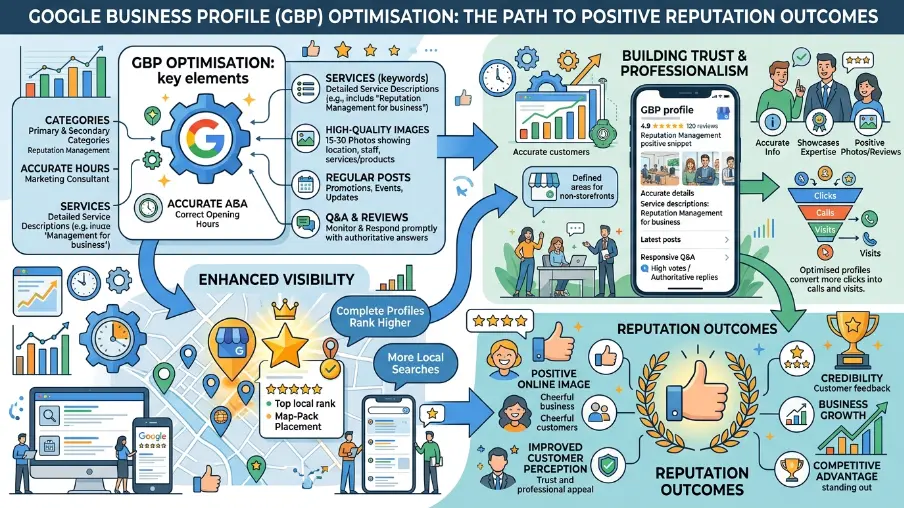
Complete profiles rank higher in local searches. Include primary and secondary categories, accurate opening hours, services with keywords, and 15–30 high-quality images that show location, staff, and products. Add service-area definitions for non-storefront local businesses. Use short, factual service descriptions that include the service name “Reputation Management for business” where relevant.
Regularly publish posts about promotions, events, or updates. Monitor the Q&A section and add authoritative answers to common queries. Optimised profiles convert more clicks into calls and visits.
How important is citation and NAP consistency across directories?
Consistent NAP data across local directories and industry sites preserves local search authority and prevents ranking dilution.
Discrepancies cause search engines to distrust location signals. Audit top 50 directories, update NAP to match legal business registration, and validate phone numbers and addresses with phone verification or postal confirmation. Remove duplicate listings and merge listings where possible. For franchises, maintain unique local pages and consistent corporate-to-local linkage.
Include examples of verification methods: business license validation, phone verification calls, and utility-bill address checks. These methods authenticate listings and reduce the risk of incorrect migration of citations.
How should local businesses handle negative reviews to limit damage?
Address negative reviews with a documented recovery workflow that resolves issues offline and requests review updates when appropriate.
Acknowledgement within 24–48 hours prevents escalation. Offer a specific remediation: refund, re-service, appointment, or escalation to a manager. After resolution, invite the reviewer to update their review with a short, factual message. Track resolution outcomes and classify cases by root cause to reduce recurring problems.
Log each case in a CRM for trend analysis. Use the data to fix operational issues that cause repeated complaints. Operational fixes reduce negative review incidence and improve overall rating trends.
Which measurement KPIs prove reputation strategy ROI?
Track review volume, average rating, response time, local ranking positions, and conversion rate from local listings to measure ROI.
Set quarterly targets: increase review volume by 25%, raise average rating by 0.3 stars, reduce average response time to under 48 hours, and gain top-3 local-pack presence for 3 priority keywords. Use UTM-tagged links on profile posts to measure conversion from profile views to website actions. Correlate changes in conversion and phone-call volume with review and ranking improvements.
Report outcomes using clear before/after snapshots and trend lines. Show tangible business impact like increased bookings or revenue per location.
How do businesses scale reputation programmes across multiple locations?
Standardise review requests, response templates, citation audits, and reporting while allowing local customisation for staff names and location details.
Create a centralised playbook for review acquisition cadence, response SLAs, and escalation routes. Automate review requests through POS or CRM integrations. Run monthly local-citation audits for each location. Provide local managers with scripts and a single reporting dashboard that compares locations on consistent KPIs.
Use role-based access so head-office staff can view aggregated data while local managers execute responses. Scaling reduces variance and enforces consistent brand signals across search.
What tools and processes validate review authenticity and compliance?
Use review monitoring platforms, IP and device analytics, and verified-purchase flags to authenticate reviews and comply with platform policies.
Require verified-purchase or transaction IDs for review invitations. Monitor IP clusters and timestamp anomalies to detect suspicious review patterns. Flag and report fraudulent reviews with platform-specific evidence, such as order numbers or communication logs. Maintain audit trails for each report. Comply with platform terms to avoid penalties and removals.
Use proprietary or third-party platforms that integrate with Google Business Profile and major review sites to centralise signals and alerts.
Explore our Business Reputation Management Services guides,
How Business Reputation Management Helps Companies Win More Customers
Reputation Management Pricing Explained for Small Businesses
How does reputation management tie to customer experience improvements?
Reputation management provides feedback loops that identify service gaps, enabling targeted operational fixes and staff training.
Aggregate negative-feedback themes and prioritise fixes by frequency and revenue impact. For example: if 42% of negative comments mention late delivery, redesign logistics and set new delivery SLAs. After fixes, measure reduction in related complaints and improvement in ratings.
Embed these feedback loops into weekly operations and staff training programs to make reputation work an ongoing business improvement mechanism.
A structured reputation programme that combines review generation, rapid responses, Google Business Profile optimisation, citation consistency, and recovery workflows produces the best results for local businesses. These tactics improve rating, local visibility, and conversion. Clear My Name implements these elements through outcome-driven processes and transparent reporting to increase trust and search performance through Business Reputation Management Services.
Frequently Asked Questions
How long does Reputation Management for business typically take to improve local search rankings?
Reputation Management for business usually shows measurable ranking improvements within 8–12 weeks when review volume, Google Business Profile optimisation, and citation fixes are implemented together. Clear My Name measures progress with weekly rank checks and review-volume reports to validate outcomes.
Can Reputation Management for business remove false or fraudulent reviews?
Platforms rarely allow outright removal without policy breaches, but Reputation Management for business documents evidence, files formal takedown requests, and requests review re-evaluation. Clear My Name collects transaction records, timestamps, and communication logs to support removal requests.
What metrics should I track for Reputation Management for business ROI?
Track review volume, average star rating, response time, local-pack ranking for target keywords, and conversion rate from local listings. Clear My Name uses these KPIs to link reputation activity to calls, bookings, and revenue.
How do I ask customers for reviews without violating platform rules?
Request reviews only after a verified transaction, avoid offering incentives, and use neutral language that invites honest feedback on specific services. Clear My Name recommends verified-purchase review links and documented opt-in requests to remain compliant.
Is Reputation Management for business effective for multi-location companies?
Yes; Reputation Management for business scales with standardised review request flows, centralised citation audits, and location-level reporting. Clear My Name implements role-based access and automated requests to maintain consistency across dozens or hundreds of locations.