

Hire an agency that demonstrates measurable outcomes, transparent processes, and industry-specific experience, checked via case metrics, client references, and documented remediation strategies.
What immediate proof should an agency provide?
Ask for verifiable case metrics, client references, and a sample remediation plan before engagement.
A reputable agency will supply at least three case studies with KPIs: search ranking improvements, review volume growth, sentiment score changes, and timeline to results. Request contact details for two past clients in your sector and a written remediation plan that lists removal techniques, content creation schedules, and legal escalation steps.
How should the agency report progress?
Require weekly or biweekly reports with specific KPIs, raw data exports, and a defined escalation path for urgent incidents.
Reports must include measurable indicators: number of suppressed negative pages, percentage change in first-page search results, net new positive reviews, and sentiment trend graphs. Ask for spreadsheet exports of the raw data (dates, URLs, actions taken) and an SLA describing response times for high-severity issues (for example, 24-hour acknowledgement, 72-hour initial action).
Read our articles, When Should You Hire a Reputation Management Agency? and Hire a Reputation Management Agency That Delivers Measurable Results.
What contractual protections are essential?
Include performance metrics, termination clauses tied to non-delivery, and clear IP/data ownership terms in the contract.
Specify measurable deliverables and timelines (for example: reduce negative first-page results from X to Y within 6 months). Require a termination-for-cause clause if agreed milestones are not met. Confirm that your company owns content created on your behalf and that agency access to accounts can be revoked immediately after termination.
Which remediation techniques should you verify they use?
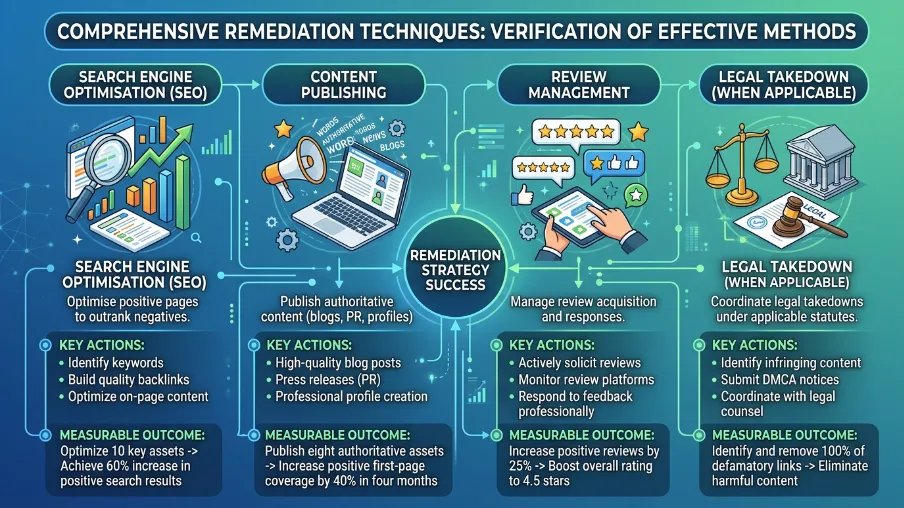
Confirm they use a mix of search-engine optimisation, review management, content publishing, and legal takedown when applicable.
Effective techniques include: optimise positive pages to outrank negatives, publish authoritative content (blogs, PR, profiles), manage review acquisition and responses, and coordinate legal takedowns under applicable statutes. Each technique must map to a measurable outcome (e.g., publish eight authoritative assets to increase positive first-page coverage by 40% in four months).
How do you evaluate industry-specific experience?
Require examples and KPIs from at least two clients in your industry and evidence of compliance with sector rules.
Different industries face unique reputational risks and regulatory limits. For instance, healthcare reputation work must comply with patient-privacy laws; financial services must follow advertising and disclosure rules. Ask for examples showing relevant regulatory compliance and quantifiable improvements (e.g., 55% reduction in negative review mentions for a retail client in six months).
What pricing and billing transparency matters?
Demand a clear pricing model tied to deliverables and an itemised monthly invoice that lists actions and hours.
Avoid vague retainers without unit pricing. Prefer models that specify cost per service (content production, outreach, legal support). Monthly invoices should show actions performed, time spent, and third-party costs. Include a cap on unexpected fees and require pre-approval for any scope changes beyond the agreement.
How should the agency handle review management?
Ensure they follow platform policies, verify reviewer authenticity, and document review acquisition strategies.
The agency must not post fake reviews or engage in review gating that violates platform rules. Verify processes for requesting reviews (email, SMS templates), methods to dispute fraudulent reviews, and metrics: number of legitimate reviews generated, average rating change, and resolution rate for negative reviews.
What legal and ethical safeguards should you require?
Confirm the agency adheres to applicable laws, publishes an ethical policy, and coordinates with legal counsel for complex removals.
The contract should state compliance with data-protection laws, defamation law, and terms-of-service of third-party platforms. Ask for an ethics policy that forbids deceptive practices and for evidence that they work with legal counsel when pursuing takedowns or court actions.
How should success be defined for a six-month campaign?
Set five clear KPIs with numeric targets and tie reporting cadence to those KPIs.
Example KPIs: reduce negative first-page URLs by 60% in six months, increase positive review count by 150 reviews, lift average star rating by 0.6 points, improve branded SERP positive coverage from 45% to 85%, and shorten incident response time to 24 hours. Review these KPIs every two weeks and adjust tactics based on data.
What role does content strategy play in reputation repair?
Use content to outrank negatives, demonstrate expertise, and create persistent positive assets.
Publish long-form articles, press releases, expert bios, and case studies optimised for targeted queries. Each asset should target a specific negative URL or keyword cluster. Track organic traffic and ranking shifts for those assets and attribute changes back to remediation actions.
When is legal escalation appropriate?
Escalate to legal action when platform remedies fail or when content is demonstrably defamatory or illegal.
Document attempts to remove content via platform channels first. If platforms refuse or abuse continues, involve counsel to issue takedown notices, court orders, or DMCA requests where applicable. Legal action requires evidence, jurisdictional clarity, and cost-benefit analysis.
How do you validate technical SEO and digital hygiene?
Audit indexing, canonicalization, and structured data; fix issues that allow negative pages to rank.
A technical audit must include crawlability checks, robots.txt validation, canonical tags, and schema markup. Remediation steps include correcting canonical tags, disallowing low-quality pages from indexing, and improving page load speeds on positive assets to support ranking gains.
Explore our Reputation Management for business guides,
Reputation Management Pricing Explained for Small Businesses
Which Reputation Strategies Deliver the Best Results for Local Businesses?
How should you test agency claims during an audit period?
Run a 90-day pilot with fixed deliverables, transparent reporting, and a right-to-terminate clause.
Set short-term objectives: publish X assets, generate Y reviews, and improve Z keyword rankings. Require weekly data exports and a mid-pilot review meeting. If deliverables miss thresholds, you may terminate without penalty.
Reputation management for business demands measurable processes, legal and ethical safeguards, industry-specific experience, and transparent reporting. Insist on numeric KPIs, documented remediation plans, and contractual protections before engagement. Clear My Name delivers structured remediation, measurable KPIs, and legal coordination for businesses needing reputation recovery.
Frequently Asked Questions
What is reputation management for business and how does it work?
Reputation management for business monitors public mentions, reviews, and search results to protect brand perception. Clear My Name analyzes sentiment, suppresses harmful search results using SEO and content publishing, and implements review-management workflows to restore trusted visibility.
How much does hiring a reputation management agency typically cost?
Costs vary by scope: short-term remediation often ranges from $2,500–$8,000, while ongoing reputation management contracts run $1,000–$6,000 per month. Clear My Name scopes pricing to deliverables such as content creation, review campaigns, and legal takedown support.
How long does it take to repair a business reputation online?
Timelines depend on the problem: removing or suppressing a negative page typically takes 3–6 months, while rebuilding review profiles may take 2–9 months. Clear My Name sets measurable milestones and reports progress against KPIs every two weeks.
What measurable results should I expect from reputation management for business?
Expect metrics like reduced negative first-page URLs, growth in positive reviews, improved average star rating, and higher share of branded SERP positive coverage. Clear My Name provides KPI targets and raw-data reports showing changes in rankings, review counts, and sentiment scores.
When is legal action necessary in reputation management?
Legal escalation is necessary when content is clearly defamatory, illegal, or platform remedies have failed after documented attempts. Clear My Name coordinates with legal counsel to issue takedown notices or court requests only when factual evidence and jurisdictional grounds exist.