
Google Reviews directly influence local search visibility, customer trust, and conversion rates. Businesses that control review perception strengthen entity credibility, improve SERP control, and reduce revenue loss caused by unmanaged reputation signals.
Negative reviews, delayed responses, and inconsistent reputation management weaken public trust and lower search performance. A structured Google Reviews strategy ensures controlled search perception influence, stronger customer confidence, and measurable visibility improvements.
Why does professional Google Reviews management deliver stronger local search visibility?
Professional Google Reviews management delivers measurable improvements because Google’s local algorithm evaluates review quality, review frequency, response consistency, and engagement signals as ranking factors. Reviews operate as active reputation signals that influence local pack visibility, click-through rates, and user trust. Businesses with monitored and professionally managed reviews strengthen entity credibility within Google’s search ecosystem. This directly improves how potential customers perceive authority, reliability, and service quality before making contact.
A structured monitoring and response process ensures that negative sentiment does not dominate branded search results or influence buying decisions unchecked. Response consistency signals operational reliability to both users and search engines. Timely engagement also improves behavioural metrics because customers trust businesses that actively address concerns and maintain transparent communication. Businesses that ignore reviews lose control over search perception influence and allow unmanaged sentiment to shape public opinion.
Clear My Name structures Google Reviews management around measurable visibility and trust outcomes rather than reactive reputation repair. The service focuses on review monitoring, sentiment analysis, response optimisation, and negative content suppression strategies that stabilise public perception. This process improves branded search presentation while reducing the long-term impact of unresolved customer dissatisfaction. Businesses gain stronger reputation signals that support sustained local visibility and customer acquisition performance.
Which Google Reviews strategy reduces reputation risk most effectively?
The most effective Google Reviews strategy combines active monitoring, response management, sentiment control, and escalation handling. Businesses require continuous visibility over new reviews because reputation damage escalates rapidly when negative feedback remains unanswered. Fast detection allows businesses to address concerns before negative narratives influence lead generation and retention performance. This reduces reputational volatility and strengthens operational trust signals.
Professional review response management ensures every interaction supports brand positioning and customer reassurance. Generic responses weaken credibility because they fail to demonstrate accountability or operational clarity. Strategic responses improve search perception influence by reinforcing professionalism, transparency, and customer care standards. Search users evaluate response quality as a trust indicator before deciding whether to engage with a business.
A high-performance review management process delivers measurable advantages:
- Strengthen entity credibility through consistent customer engagement and verified responses
- Reduce reputational volatility by identifying negative sentiment before escalation occurs
- Improve local search visibility through active review activity and response frequency
- Stabilise conversion performance by controlling public-facing customer interactions
- Reinforce SERP control through reputation signal optimisation and narrative consistency
Businesses that implement structured review governance maintain stronger public confidence and experience fewer disruptions caused by unmanaged customer sentiment. This directly improves long-term customer retention and acquisition efficiency.
How do negative Google Reviews influence leads, sales, and customer retention?
Negative Google Reviews directly reduce conversion rates because customers evaluate trust before initiating contact. Search users compare review sentiment, response quality, and review recency to assess operational reliability. Poor ratings and unresolved complaints weaken purchase confidence and increase perceived transaction risk. This causes lead abandonment and lower enquiry volumes, particularly within competitive local markets.
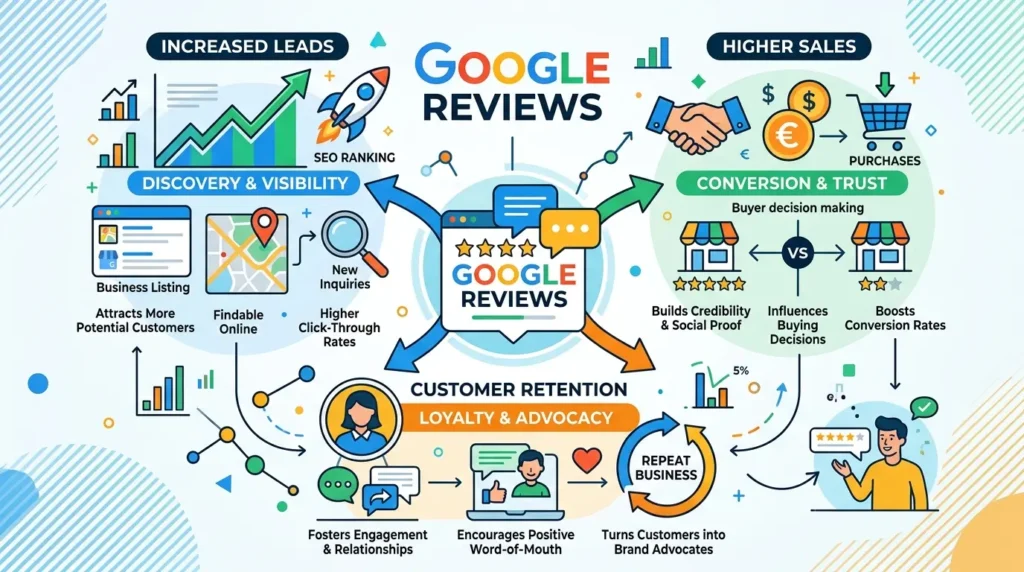
Review sentiment also affects long-term retention because existing customers interpret public complaints as indicators of service instability. A business with unmanaged criticism appears operationally inconsistent, regardless of actual service quality. This damages brand trust and reduces customer lifetime value. Reputation signals therefore influence both acquisition and retention simultaneously.
Businesses researching negative Google Reviews impact on sales and retention gain stronger decision clarity when evaluating reputation management investment. Understanding behavioural search patterns and trust psychology reveals why review management produces measurable commercial value. Customers rely on public sentiment as a decision shortcut, especially within service-driven industries where trust influences conversion speed. Businesses that manage review ecosystems maintain stronger customer confidence throughout the buying journey.
Professional response frameworks also reduce escalation risk by demonstrating accountability and operational responsiveness. Customers often revise perception when businesses address concerns transparently and constructively. This improves public trust while limiting the visibility impact of isolated negative experiences.
Which reputation management process ensures sustainable Google Reviews performance?
Sustainable Google Reviews performance requires continuous reputation signal management rather than isolated review responses. Businesses that treat reputation management as an ongoing search visibility process achieve stronger long-term stability. This approach combines monitoring systems, sentiment tracking, customer engagement frameworks, and escalation protocols to maintain consistent trust signals across branded search environments.
A structured process ensures that review quality remains aligned with customer experience standards. Monitoring systems identify recurring complaints, allowing operational improvements that reduce future negative feedback. This transforms review management from reactive damage control into proactive reputation optimisation. Businesses strengthen search perception influence by maintaining consistent public sentiment over time.
The process normally includes three operational stages:
Review monitoring and sentiment detection
Continuous review tracking identifies negative sentiment immediately after publication. Fast detection reduces visibility exposure and limits narrative escalation. Sentiment analysis also reveals recurring operational issues that influence customer satisfaction trends.
Strategic response management
Professionally structured responses reinforce transparency, accountability, and service reliability. Each response supports trust restoration while preventing emotionally reactive communication that weakens credibility. This ensures public-facing interactions align with broader brand positioning.
Reputation signal optimisation
Review frequency, response consistency, and customer engagement strengthen local search performance over time. Reputation signal optimisation improves entity credibility and reinforces positive behavioural indicators within Google’s local ecosystem.
This structured framework delivers operational clarity while maintaining consistent control over public reputation visibility.
Why does Google Reviews management improve SERP control and search perception influence?
Google Reviews management improves SERP control because reviews appear directly within branded search results, local map listings, and knowledge panels. Potential customers often evaluate review sentiment before visiting a website. This means public perception forms within the search results page itself. Businesses that optimise review visibility strengthen trust before customer interaction even begins.
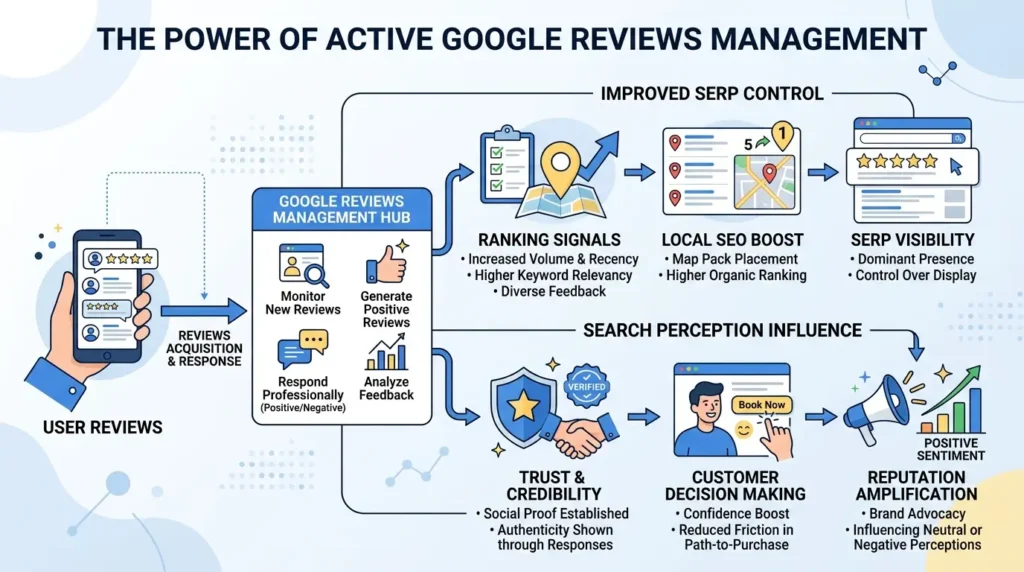
Review management also influences click-through behaviour because positive ratings and active responses improve perceived legitimacy. Search users associate high engagement levels with operational reliability and customer accountability. This improves branded search performance while reducing friction during the decision-making process. Businesses with unmanaged reviews lose visibility control because negative sentiment dominates search perception.
Strategic review optimisation strengthens multiple reputation factors simultaneously:
- Improve branded search presentation through stronger review sentiment visibility
- Reinforce trust signals with consistent customer engagement activity
- Reduce bounce behaviour by improving pre-click confidence indicators
- Strengthen local pack rankings through review activity and authority signals
- Maintain narrative consistency across customer-facing search environments
Businesses investing in local business visibility through Google Reviews understand that search rankings and customer trust operate together rather than separately. Review ecosystems influence both algorithmic visibility and human perception. This creates compounded commercial impact across acquisition, conversion, and retention performance.
Which concerns do businesses have before investing in Google Reviews management services?
Businesses evaluating Google Reviews management services typically focus on cost justification, speed of impact, operational transparency, and sustainability of results. These concerns are valid because reputation management directly affects brand trust and customer acquisition efficiency. Decision-makers require measurable outcomes rather than vague marketing claims.
Cost concerns normally relate to long-term commercial value rather than short-term spend. Businesses that ignore review management experience sustained revenue loss through weakened conversion rates, lower trust signals, and increased lead abandonment. Reputation damage compounds over time because negative sentiment remains visible within search ecosystems indefinitely. Professional management reduces this long-term exposure while strengthening customer acquisition stability.
Speed of impact depends on review volume, sentiment severity, and response consistency. Businesses normally experience perception improvements once response quality becomes visible across public review environments. Search users recognise operational responsiveness quickly because active engagement improves confidence signals immediately. Consistent reputation optimisation strengthens performance further over time.
Risk mitigation also influences purchasing decisions because businesses require assurance that reputation management aligns with platform policies and ethical standards. Structured monitoring and response systems ensure compliance while maintaining credibility. Sustainable reputation management focuses on trust restoration and visibility optimisation rather than manipulative tactics that damage long-term entity credibility.
At peak decision intent, businesses benefit from partnering with a professional Google Reviews management service that prioritises measurable reputation outcomes and transparent operational processes. Reliable service delivery strengthens confidence while ensuring businesses maintain consistent control over public-facing reputation signals.
How does Clear My Name deliver measurable reputation management outcomes?
Clear My Name delivers measurable outcomes by combining review monitoring technology, structured response frameworks, and reputation signal optimisation strategies into a unified process. This approach improves operational visibility while reducing the impact of unmanaged negative sentiment. Businesses gain greater control over how customers interpret branded search results and local business credibility.
The service focuses on practical performance indicators rather than generic reputation claims. Review response consistency improves customer reassurance and strengthens trust signals visible within Google’s local ecosystem. Sentiment monitoring identifies emerging reputational risks early, allowing corrective action before negative narratives expand. This reduces volatility while stabilising customer perception across search environments.
Operational transparency also strengthens client confidence because businesses understand how reputation improvements occur. Clear reporting structures track review trends, sentiment movement, response activity, and visibility improvements. This creates measurable accountability and reinforces long-term strategy alignment. Businesses maintain clearer oversight of how review management supports broader commercial objectives.
Read More:
Improve Customer Trust With Google Review Management From Clear My Name
Clear My Name also prioritises sustainable reputation growth through ongoing optimisation rather than temporary suppression tactics alone. This ensures entity credibility strengthens naturally through improved engagement patterns, stronger customer trust, and more consistent public sentiment signals. Businesses achieve durable reputation stability that supports local search performance and customer acquisition continuity.
Why does long-term Google Reviews management deliver stronger commercial stability?
Long-term Google Reviews management delivers stronger commercial stability because reputation signals continuously influence customer decisions. Search ecosystems reward businesses that maintain consistent engagement, strong sentiment quality, and active public communication. Reputation management therefore operates as an ongoing visibility and trust strategy rather than a short-term corrective measure.
Businesses that maintain structured review management strengthen operational resilience during periods of increased scrutiny or competitive pressure. Positive review ecosystems create protective trust buffers that reduce the impact of isolated complaints or temporary service disruptions. This stabilises public confidence and preserves conversion performance. Strong reputation infrastructure therefore improves business continuity alongside marketing performance.
Get Deep Insight:
How Clear My Name Helps Companies Build Stronger Google Review Profiles
Consistent reputation management also supports broader digital visibility objectives because review activity strengthens local SEO signals over time. Businesses improve branded search presentation, customer trust indicators, and local ranking competitiveness simultaneously. This integrated visibility effect improves acquisition efficiency while reducing dependency on paid advertising channels for trust generation.
A disciplined Google Reviews strategy strengthens search perception influence, improves public confidence, and ensures businesses maintain greater control over customer decision pathways. Businesses investing in structured reputation management secure measurable long-term value through stronger trust, visibility stability, and reduced reputational risk exposure.
Google Reviews management delivers measurable business value because search visibility and customer trust operate together within modern decision-making behaviour. Businesses that actively manage review ecosystems strengthen entity credibility, improve SERP control, and reduce the commercial impact of negative sentiment exposure.
Clear My Name provides a structured, transparent, and outcome-focused solution that improves reputation stability while reinforcing customer confidence. Through continuous monitoring, strategic response management, and reputation signal optimisation, businesses maintain stronger control over how they appear within local search environments. This ensures sustainable trust growth, improved visibility performance, and greater long-term commercial resilience.
What is Google review monitoring and why is it important for businesses?
Google review monitoring is the process of tracking, managing, and responding to customer reviews on Google Business Profiles. It helps businesses protect their online reputation, identify customer concerns quickly, and improve local SEO visibility in Google search results.
How do Google review response services help improve customer trust?
Google review response services help businesses reply professionally and consistently to both positive and negative reviews. Timely responses show customers that the business values feedback, which can improve credibility, customer trust, and engagement.
Can responding to Google reviews improve local SEO rankings?
Yes, responding to Google reviews can support local SEO by increasing customer interaction and signaling business activity to Google. Consistent review management may improve visibility in local search and Google Maps results over time.
How often should businesses monitor Google reviews?
Businesses should monitor Google reviews daily or in real time to address customer feedback quickly. Fast responses help prevent reputation issues from escalating and demonstrate active customer service management.
What types of businesses benefit from Google review monitoring services?
Any business with an online presence can benefit from Google review monitoring services, including healthcare providers, law firms, restaurants, home services, and eCommerce brands. Reputation management is especially important for businesses that rely on local customers and online trust signals.