
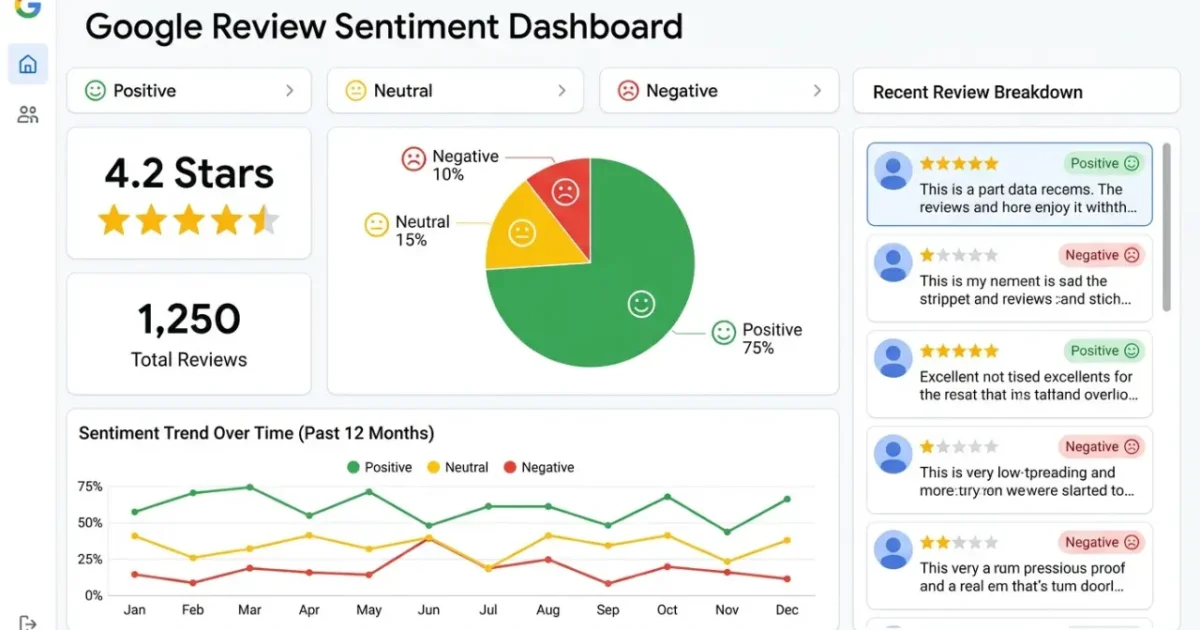
Google Review sentiment analysis evaluates customer language patterns, rating distributions, and behavioural signals to measure reputation performance in search ecosystems.
Reputation management strategies differ based on how organisations interpret sentiment distribution, respond to negative feedback, and influence search perception through content and engagement structures.
Online reputation control methods are evaluated through search ranking influence, entity credibility signals, and the consistency of public feedback across digital touchpoints. Google Review data operates as both a trust indicator and a behavioural dataset that search engines use to interpret commercial reliability, service quality, and user satisfaction patterns.
What Is Google Review Sentiment Analysis and How Does It Operate?
Google Review sentiment analysis is the process of evaluating emotional tone, recurring themes, and contextual language within customer feedback to measure reputation signals. The mechanism operates by analysing positive, neutral, and negative sentiment patterns across reviews, star ratings, response frequency, and keyword associations. Search ecosystems interpret these signals as indicators of entity credibility and user satisfaction consistency. Review sentiment contributes to local search visibility because engagement quality influences trust evaluation models within search algorithms. Sentiment analysis also reveals operational weaknesses that influence public perception and click behaviour. The evaluation process compares linguistic sentiment against review volume, recency, and rating distribution to identify reputation stability.
Traditional review monitoring focuses on isolated complaints, whereas sentiment analysis evaluates systemic perception trends. Manual monitoring identifies visible issues through direct reading, while automated sentiment categorisation measures large-scale behavioural patterns across datasets. Automated systems classify recurring sentiment indicators such as delivery delays, customer support quality, or pricing dissatisfaction. Manual evaluation provides contextual understanding but lacks scalability when review velocity increases. Automated analysis improves pattern recognition but reduces interpretive nuance when sarcasm, mixed sentiment, or ambiguous phrasing appears. The comparison between both approaches highlights the balance between operational efficiency and contextual accuracy.
Search engines interpret review sentiment as a behavioural trust framework rather than a standalone ranking factor. High-frequency positive sentiment reinforces entity reliability signals and improves perceived relevance within local search environments. Negative review clusters weaken trust signals when recurring complaints demonstrate unresolved operational issues. Sentiment consistency across platforms strengthens entity confidence because search systems compare external references and user-generated content patterns. Review volatility creates perception instability, particularly when negative engagement accelerates within short timeframes. Reputation analysis therefore measures both emotional sentiment and behavioural consistency.
Which Reputation Management Approaches Use Google Review Sentiment Most Effectively?
Proactive reputation management uses sentiment analysis more sustainably than reactive damage-control strategies because it evaluates perception trends before visibility decline occurs. Proactive systems operate by monitoring review language, identifying sentiment deterioration, and implementing operational corrections before negative sentiment concentration increases. Reactive methods focus on responding after reputational decline becomes visible within search results or review profiles. The proactive approach strengthens long-term reputation stability because search engines reward consistent trust signals over abrupt correction patterns. Reactive approaches address immediate visibility concerns but fail to stabilise entity credibility when negative sentiment patterns remain unresolved. The comparison reveals significant differences in sustainability and search perception resilience.
Dive Deeper With Our Expert Guides:
How Negative Google Reviews Influence Leads, Sales, and Retention
Comparing 5 Google Review Management Approaches for Local Businesses
Content enhancement strategies use sentiment analysis differently from content suppression methods. Content enhancement operates by publishing supportive informational content, increasing authoritative entity references, and reinforcing positive reputation signals within search ecosystems. Content suppression focuses on reducing the visibility of negative sentiment through ranking displacement or removal mechanisms. Enhancement improves long-term search perception because it expands contextual relevance around positive experiences and verified engagement signals. Suppression provides faster SERP composition control but introduces sustainability risks when negative reviews continue accumulating. Search systems interpret authentic engagement more favourably than artificial visibility manipulation.
Customer response frameworks also differ in effectiveness depending on response structure and consistency. Generic responses reduce credibility because repetitive phrasing weakens perceived authenticity. Contextual responses strengthen trust signals by acknowledging operational specifics and demonstrating visible engagement patterns. Timely responses influence user trust perception because recency contributes to behavioural interpretation models. Delayed engagement increases negative sentiment persistence within public review environments. Structured response systems therefore operate as both communication tools and reputation signals within search ecosystems.
How Do Organic and Reactive Reputation Strategies Compare in Search Ecosystems?
Organic reputation management creates gradual authority accumulation through consistent engagement and sentiment improvement. Reactive reputation management focuses on rapid mitigation after negative visibility emerges. Organic systems operate by improving operational quality, encouraging authentic reviews, and maintaining review-response consistency over time. Reactive systems prioritise crisis containment through response acceleration, content suppression, or dispute escalation mechanisms. Search engines interpret organic reputation growth as stable behavioural validation because engagement patterns remain consistent across timeframes. Reactive interventions often generate abrupt sentiment shifts that appear inconsistent within historical datasets.
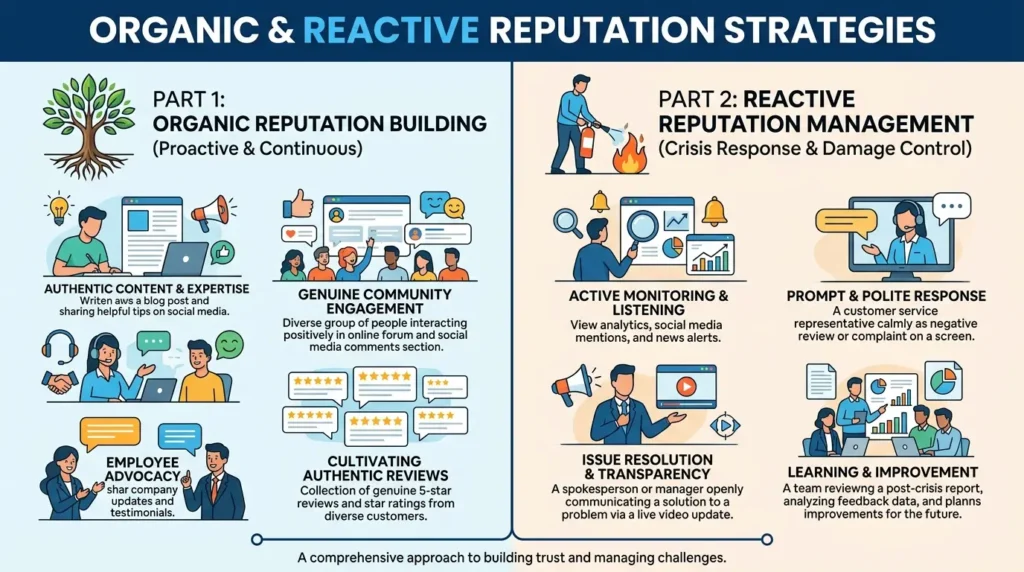
Organic strategies improve sustainability because reputation signals accumulate naturally through recurring customer interaction. Long-term review consistency strengthens entity credibility and reinforces local search ranking stability. Organic approaches also reduce risk exposure because authentic engagement aligns with search engine trust evaluation models. Reactive systems provide short-term visibility control but struggle to maintain perception stability when underlying operational issues remain unresolved. Negative review recurrence weakens recovery efforts because search systems continue detecting unresolved sentiment patterns. The comparison therefore demonstrates differences between temporary correction and structural reputation resilience.
Search result composition also changes depending on the reputation management framework used. Organic strategies influence SERP composition through positive engagement expansion, branded content reinforcement, and trust signal accumulation. Reactive strategies influence SERP composition by targeting immediate negative visibility reduction. Organic growth strengthens informational relevance because positive sentiment becomes integrated into broader search contexts. Reactive suppression influences isolated visibility elements but rarely improves overall perception consistency. Search ecosystems prioritise sustained behavioural reliability over temporary suppression patterns.
How Does Review Sentiment Influence Search Visibility and Entity Credibility?
Review sentiment influences search visibility through behavioural trust indicators, local ranking relevance, and user engagement metrics. Positive sentiment increases interaction likelihood because users interpret consistent favourable feedback as a reliability signal. High engagement rates reinforce search ranking influence because click-through behaviour, dwell time, and interaction consistency indicate user confidence. Negative sentiment concentration reduces perceived trustworthiness and weakens behavioural engagement patterns. Search ecosystems evaluate review quality alongside recency, frequency, and linguistic consistency to measure entity reliability. Sentiment analysis therefore operates as a perception evaluation framework connected to visibility performance.
Entity credibility depends on consistency between review sentiment and broader digital references. Search engines compare customer feedback with business listings, third-party mentions, and branded search behaviour to evaluate authenticity. Inconsistent reputation signals reduce confidence because conflicting sentiment patterns weaken entity coherence. Positive review clusters strengthen authority signals when operational feedback remains stable across multiple periods. Negative review surges increase risk exposure because search ecosystems interpret recurring dissatisfaction as a reliability concern. Reputation stability therefore depends on sentiment continuity rather than isolated positive reviews.
Review language also influences semantic search interpretation. Search systems analyse recurring terms associated with service quality, professionalism, responsiveness, and reliability. Positive keyword associations strengthen contextual relevance because semantic relationships reinforce entity positioning within industry-specific searches. Negative recurring language weakens perception signals when dissatisfaction themes appear repeatedly. Semantic analysis measures not only sentiment polarity but also topic relevance and behavioural intent. Review sentiment therefore contributes to both trust evaluation and contextual search association.
Which Sentiment Analysis Methods Provide the Most Reliable Reputation Insights?
Quantitative sentiment analysis provides scalable measurement accuracy, while qualitative analysis delivers contextual interpretation depth. Quantitative methods operate by categorising ratings, calculating sentiment ratios, and identifying numerical review trends. This approach improves scalability because large datasets can be evaluated efficiently across multiple periods. Quantitative systems also simplify performance benchmarking through measurable sentiment distribution comparisons. However, numerical analysis lacks contextual understanding when complex emotional language appears within reviews. Rating averages alone fail to explain operational causes behind negative perception shifts.
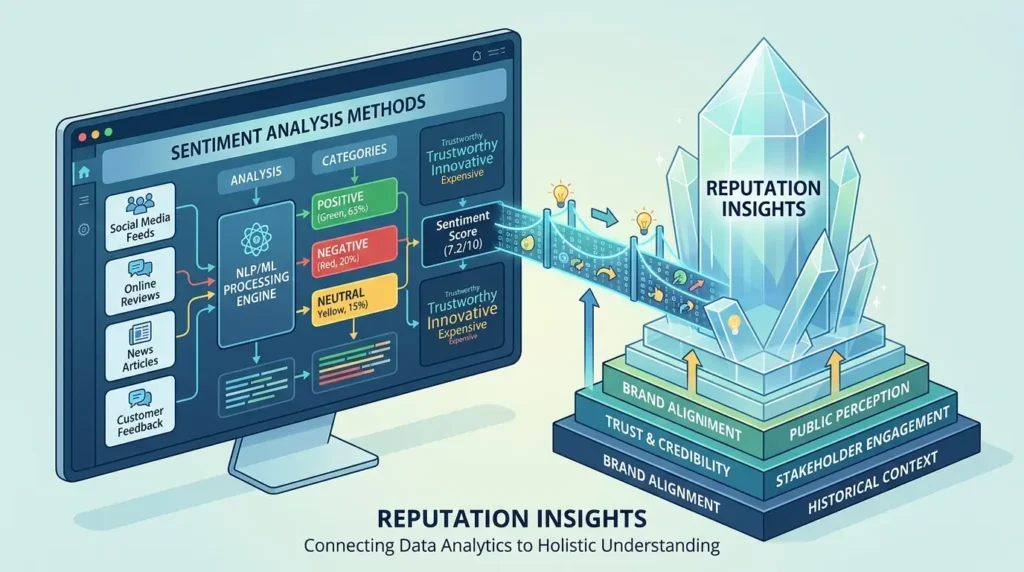
Qualitative sentiment analysis evaluates language context, behavioural intent, and thematic patterns within reviews. The method operates by interpreting recurring concerns, emotional emphasis, and operational references embedded in customer feedback. Qualitative analysis identifies perception drivers that numerical systems overlook, including communication failures, service inconsistency, or expectation mismatch. This approach improves strategic decision-making because operational insights become directly measurable through review interpretation. However, qualitative evaluation reduces scalability because contextual analysis requires deeper interpretive review processes. The comparison demonstrates the trade-off between efficiency and interpretive precision.
Hybrid sentiment analysis combines quantitative measurement with qualitative interpretation to improve reliability. Hybrid systems operate by integrating numerical trend detection with thematic review categorisation. This structure strengthens perception analysis because measurable sentiment shifts become linked to operational causes. Search ecosystems benefit indirectly from this approach because operational improvements influence review consistency and trust signals over time. Hybrid analysis also improves risk forecasting because emerging dissatisfaction themes become visible before large-scale sentiment decline develops. The combined method therefore provides broader reputation intelligence than isolated analysis models.
How Do Short-Term and Long-Term Reputation Strategies Differ in Effectiveness?
Short-term reputation strategies prioritise immediate perception control, while long-term strategies focus on sustainable trust development. Short-term systems operate by accelerating responses, disputing inaccurate reviews, and increasing visible engagement during periods of negative sentiment concentration. These approaches influence immediate perception because public responsiveness reduces visible inactivity within review environments. Short-term intervention also limits rapid trust deterioration during visibility-sensitive periods. However, temporary engagement patterns fail to improve entity credibility when operational dissatisfaction persists. Search ecosystems continue detecting negative behavioural signals despite visible response activity.
Long-term reputation management improves sustainability through structural sentiment improvement and engagement consistency. Long-term systems operate by integrating customer feedback into operational decision-making, communication refinement, and service optimisation. This approach strengthens reputation signals because positive sentiment develops through recurring behavioural validation rather than isolated intervention. Search engines interpret long-term consistency as stronger evidence of entity reliability. Review recency, frequency, and positive engagement distribution reinforce search ranking influence over extended periods. Sustainable reputation development therefore depends on operational alignment with customer expectations.
Risk exposure also differs between both approaches. Short-term systems reduce immediate visibility threats but increase vulnerability to recurring negative sentiment cycles. Long-term strategies reduce volatility because trust signals remain stable across changing search conditions and user behaviours. Reputation sustainability depends on sentiment continuity rather than isolated review recovery periods. The comparison demonstrates that immediate mitigation and durable credibility operate through different mechanisms within search ecosystems.
What Limitations Affect Google Review Sentiment Analysis Accuracy?
Sentiment analysis accuracy declines when contextual ambiguity, manipulated feedback, or limited datasets distort interpretation quality. Automated systems struggle with sarcasm, mixed emotional language, and indirect criticism because linguistic interpretation depends on contextual nuance. Positive wording combined with negative intent creates classification inaccuracies within algorithmic analysis frameworks. Sentiment categorisation also weakens when review volume remains insufficient for meaningful behavioural comparison. Small datasets distort perception measurement because isolated feedback disproportionately influences sentiment distribution.
Fake reviews create additional reliability limitations because manipulated sentiment patterns distort reputation signals. Artificial positive reviews weaken trust evaluation when engagement behaviour appears inconsistent with authentic user interaction. Coordinated negative review activity also creates visibility instability because sentiment concentration increases abruptly. Search engines attempt to identify manipulative behaviour through engagement anomalies, account patterns, and review consistency analysis. However, detection systems fail to eliminate all artificial sentiment distortion. Reputation analysis therefore requires validation mechanisms alongside automated interpretation.
Platform dependency also limits sentiment analysis accuracy because reputation signals extend beyond one review ecosystem. Google Review analysis provides local visibility insights but excludes broader digital trust indicators from forums, social platforms, news references, and third-party review environments. Reputation ecosystems operate through interconnected perception signals rather than isolated platform metrics. Exclusive reliance on Google Review sentiment therefore reduces strategic visibility across wider search ecosystems. Comprehensive reputation evaluation requires multi-source perception analysis combined with operational interpretation.
Google Review sentiment analysis evaluates customer perception through behavioural patterns, linguistic signals, and engagement consistency within search ecosystems. Different reputation management approaches influence search visibility, entity credibility, and trust perception through distinct operational mechanisms.
Organic strategies strengthen long-term reputation sustainability through authentic engagement and sentiment continuity, while reactive methods prioritise immediate visibility correction. Content enhancement differs from suppression strategies because one reinforces positive contextual relevance and the other attempts visibility displacement. Quantitative sentiment analysis improves scalability, whereas qualitative evaluation strengthens contextual interpretation accuracy. Short-term intervention reduces immediate exposure, while long-term reputation systems stabilise behavioural trust signals across evolving search environments.
Search engines interpret review sentiment as part of a broader reputation framework connected to entity credibility, engagement behaviour, and semantic relevance. Effective reputation analysis therefore depends on evaluating sentiment distribution, operational consistency, and search perception stability rather than isolated rating averages or temporary visibility adjustments. Businesses evaluating response frameworks and suppression mechanisms often analyse how organisations recover from negative Google reviews through long-term sentiment improvement, review-response consistency, and operational trust reinforcement.
What is Google review sentiment analysis?
Google review sentiment analysis is the process of evaluating customer reviews to identify positive, negative, and neutral feedback patterns. Businesses use sentiment analysis tools to understand customer satisfaction, improve reputation management, and identify recurring service issues from Google Reviews.
Why is sentiment analysis important for online reputation management?
Sentiment analysis helps businesses measure public perception by analyzing customer opinions in online reviews. It provides insights into customer experience trends, allowing companies to respond to negative feedback quickly and strengthen their online reputation strategy.
How can Google Reviews improve customer experience?
Google Reviews reveal what customers value most and where businesses may be underperforming. By analyzing review sentiment, companies can make data-driven improvements to customer service, response times, and overall user experience.
Can negative Google reviews affect local SEO rankings?
Yes, consistently negative Google Reviews can impact local SEO performance by lowering trust and engagement signals. Review sentiment, review frequency, and business responses all contribute to how businesses appear in local search results and Google Maps rankings.
How does Clear My Name help with review reputation management?
Clear My Name helps businesses monitor and manage harmful or misleading online reviews as part of a broader reputation management strategy. Combined with sentiment analysis, businesses can better understand customer concerns and maintain a more accurate online reputation.