

Negative Google reviews directly influence conversion rates, local search visibility, and customer trust. Businesses that fail to control reputation signals lose search perception influence and weaken entity credibility across Google’s ecosystem.
A structured reputation management strategy restores SERP control, improves trust indicators, and stabilises public perception through measurable visibility optimisation. Clear My Name delivers this process through evidence-driven Google Reviews management that reduces reputational risk and strengthens commercial credibility.
Why do negative Google reviews damage search visibility and conversion performance?
Negative Google reviews weaken trust signals that influence both search rankings and customer decision-making. Search engines evaluate review sentiment, response activity, review frequency, and business engagement as indicators of operational credibility. When negative sentiment dominates review profiles, Google associates the business entity with lower trustworthiness and reduced user satisfaction. This weakens visibility within local search results and increases abandonment during high-intent searches.
Customer behaviour reinforces this impact. Prospective buyers evaluate review sentiment before making contact, requesting quotes, or completing purchases. Poor ratings reduce click-through rates and increase hesitation during transactional searches. Negative reviews also create long-term search perception influence because screenshots, forum discussions, and third-party citations continue amplifying negative sentiment across the SERP. Without active reputation management, businesses lose control over branded search visibility and narrative consistency.
A reputation management strategy focused on Google Reviews delivers measurable correction through review optimisation, sentiment balancing, and negative content suppression. This process strengthens entity credibility by improving review engagement patterns and restoring balanced reputation signals across search ecosystems. Businesses regain authority within search results while reducing the long-term commercial damage caused by unmanaged review profiles.
Which reputation management approach delivers measurable Google review recovery?
The most effective approach combines review monitoring, response optimisation, sentiment analysis, and strategic SERP control. Reactive responses alone fail because search ecosystems prioritise long-term consistency rather than isolated reputation activity. Businesses require a structured process that improves review quality signals while reducing visibility dominance from damaging content.
Clear My Name implements reputation recovery through controlled visibility management and reputation signal optimisation. The process strengthens business perception using measurable search-focused mechanisms:
- Improve review sentiment by encouraging authentic positive customer feedback that balances negative review ratios.
- Strengthen engagement signals through professionally structured responses that demonstrate operational accountability.
- Reduce negative visibility by applying negative content suppression strategies across branded search queries.
- Stabilise entity credibility through consistent review acquisition and reputation monitoring.
- Improve branded SERP control by strengthening authoritative positive content linked to the business entity.
These mechanisms directly influence how customers interpret trustworthiness during transactional searches. Search engines reward businesses that demonstrate active engagement, reputation consistency, and positive user satisfaction signals. This creates sustainable visibility improvements rather than temporary reputation repair.
Businesses also benefit from clearer operational insights through customer trust in online reviews analysis, which identifies the behavioural triggers influencing conversion hesitation. Understanding review perception patterns allows businesses to align customer experience improvements with search visibility goals.
How does Google review management improve trust and public perception?
Google review management improves public perception by controlling the reputation signals users encounter during branded searches. Customers rarely evaluate businesses through direct interaction alone. They evaluate trustworthiness through aggregated search evidence, including ratings, review sentiment, response quality, and review consistency. This creates a search-driven credibility framework that directly influences conversion behaviour.
A managed reputation profile improves perception because it demonstrates responsiveness, transparency, and operational control. Businesses that actively manage reviews appear more reliable during comparison-based searches. Positive engagement patterns also strengthen emotional reassurance, which reduces customer hesitation during high-value purchasing decisions.
Google’s algorithms reinforce this relationship between reputation activity and visibility. Businesses with higher engagement rates and stronger review sentiment often achieve improved local ranking performance because search engines interpret those signals as indicators of user satisfaction. Reputation management therefore functions as both a visibility strategy and a conversion optimisation mechanism.
The process delivers measurable benefits:
- Increase click-through rates by improving star ratings and visible review sentiment.
- Reduce customer hesitation through structured review responses that address objections directly.
- Strengthen local SEO performance by improving engagement-related ranking signals.
- Improve branded search trust through controlled narrative positioning.
- Stabilise long-term perception using continuous reputation monitoring and response management.
These outcomes improve customer acquisition efficiency because trust barriers decline before direct sales interaction begins. Businesses enter transactional conversations with stronger credibility already established within the search environment.
Why is professional reputation management more effective than internal review handling?
Professional reputation management delivers stronger outcomes because reputation ecosystems require technical SEO understanding, behavioural analysis, and search visibility expertise. Internal teams often respond emotionally, inconsistently, or without strategic alignment to search behaviour patterns. This weakens SERP control and allows negative narratives to dominate branded searches.
A professional process applies structured review management supported by search ecosystem analysis. Reputation specialists understand how review sentiment interacts with local SEO signals, entity recognition systems, and user trust metrics. This enables strategic intervention that improves visibility while reducing reputational volatility.
Professional management also improves operational consistency. Businesses maintain response quality, monitoring frequency, and sentiment tracking without disruption caused by staffing changes or internal workload pressures. Consistent activity strengthens search trust signals because Google rewards ongoing engagement rather than sporadic reputation activity.
Businesses evaluating a professional reputation management service often prioritise three measurable advantages:
- Deliver faster sentiment recovery through structured response systems and review acquisition strategies.
- Improve search perception influence using coordinated visibility optimisation methods.
- Reduce reputational risk through continuous monitoring and escalation management.
These advantages create stronger long-term commercial stability. Businesses avoid recurring visibility damage while maintaining greater control over how customers interpret reputation signals during transactional searches.
How quickly can businesses recover from negative Google review impact?
Reputation recovery speed depends on review volume, visibility strength of negative content, and existing authority signals attached to the business entity. Businesses with active review management and strong customer engagement patterns often stabilise perception within months because positive reputation signals accumulate consistently across search ecosystems.
Immediate improvement begins through strategic review responses and sentiment balancing. Customers evaluating businesses focus heavily on recent review activity, response quality, and visible accountability. A professionally managed response strategy therefore improves trust perception even before negative reviews lose ranking prominence.
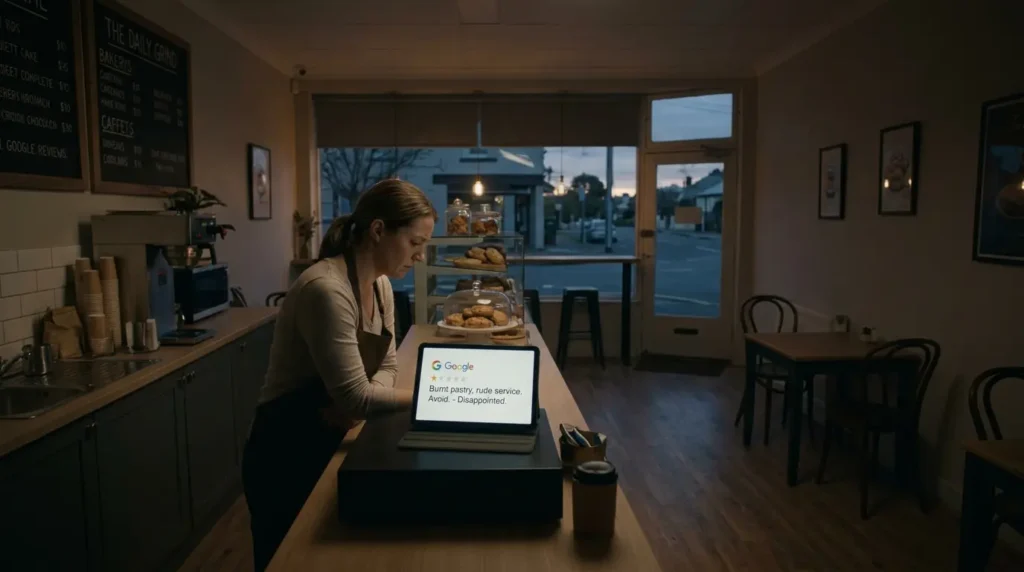
Long-term recovery requires sustained reputation signal optimisation. Search ecosystems prioritise consistency, which means ongoing review acquisition and visibility management remain essential for durable SERP control. Businesses that abandon reputation management after initial improvement often experience renewed visibility instability.
The recovery process typically includes:
- Analyse existing review sentiment to identify dominant trust barriers.
- Respond strategically to negative reviews using accountability-focused messaging.
- Encourage authentic positive reviews from verified customer interactions.
- Strengthen branded search visibility with authoritative positive content.
- Monitor reputation fluctuations continuously to maintain perception stability.
Businesses that apply this framework achieve stronger reputation resilience because positive sentiment gradually outweighs historic negativity within search evaluation systems.
Which business risks are reduced through strategic Google review management?
Strategic Google review management reduces commercial, reputational, and visibility-related risks. Negative reviews create measurable financial consequences because search users interpret review sentiment as predictive evidence of service quality. Unmanaged review profiles therefore increase lead loss, reduce enquiry rates, and weaken conversion efficiency.
Reputation management reduces these risks by stabilising perception across customer touchpoints. Businesses regain narrative control and minimise the visibility dominance of damaging content. This improves customer confidence during evaluation stages where trust directly influences purchasing behaviour.
The strategy also reduces operational risk connected to viral reputation escalation. Negative reviews frequently spread beyond Google through screenshots, social sharing, and third-party discussion platforms. Without structured intervention, negative sentiment amplifies across search ecosystems and weakens long-term entity credibility.
Key risk-reduction outcomes include:
- Reduce lead abandonment caused by visible negative sentiment.
- Prevent reputational escalation through rapid review monitoring and response management.
- Improve customer trust signals across branded search results.
- Stabilise local search visibility through ongoing reputation optimisation.
- Strengthen brand resilience against future reputation volatility.
These outcomes improve commercial predictability because businesses maintain stronger influence over customer perception throughout the search journey.
Read More:
Google Review Monitoring and Response Services by Clear My Name
Improve Customer Trust With Google Review Management From Clear My Name
How does review sentiment analysis improve reputation management decisions?
Review sentiment analysis improves decision-making by identifying behavioural patterns within customer feedback. Businesses often focus only on ratings while ignoring recurring trust objections embedded within review language. Sentiment analysis isolates these patterns and reveals which reputation signals most strongly influence customer hesitation.
This process improves operational clarity because businesses understand exactly how customers interpret service quality, communication standards, and reliability indicators. Reputation management becomes data-driven rather than reactive. Businesses address high-impact trust barriers directly while improving future customer experience consistency.
Advanced sentiment evaluation also strengthens search perception influence. Businesses identify the language patterns associated with positive engagement and incorporate those signals into review responses, customer communication, and visibility strategies. This creates stronger alignment between public perception and operational messaging.
Businesses using Google review sentiment insights gain measurable advantages because sentiment trends reveal the exact drivers behind declining trust signals. This analytical approach improves both review recovery efficiency and long-term reputation sustainability.
Why does long-term SERP control matter more than short-term review repair?
Short-term review repair improves immediate perception, but long-term SERP control determines sustainable reputation stability. Search ecosystems continuously re-evaluate reputation signals based on new reviews, user engagement, response behaviour, and content visibility patterns. Businesses that focus only on temporary correction lose control when new negative content emerges.
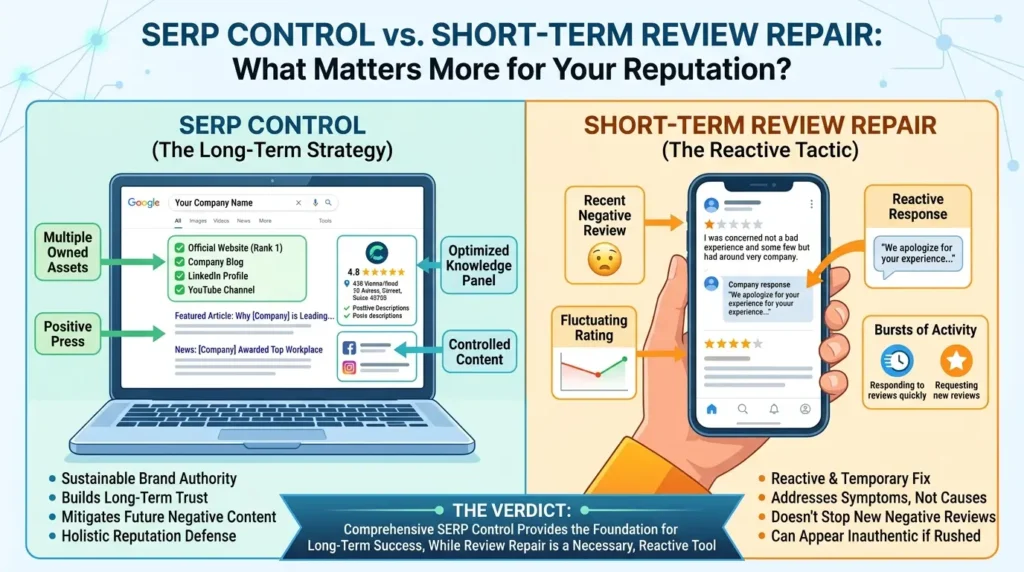
Long-term SERP control ensures positive and authoritative content maintains visibility dominance across branded searches. This reduces exposure to reputation volatility and strengthens entity credibility over time. Customers consistently encounter balanced, trustworthy search results instead of isolated negative narratives.
A sustainable strategy integrates review management with broader reputation signal optimisation. Businesses maintain continuous monitoring, sentiment balancing, and visibility enhancement to preserve trust consistency across evolving search environments. This creates commercial durability because reputation remains aligned with business objectives rather than external narrative shifts.
Clear My Name supports this long-term stability through structured Google Reviews management designed for visibility resilience, perception control, and trust restoration. The process delivers measurable reputation protection while ensuring businesses maintain stronger authority within search-driven customer decision journeys.
Businesses that invest in strategic reputation management secure stronger customer confidence, improved search visibility, and greater narrative control across competitive digital environments. Reputation signals influence every stage of transactional decision-making, making SERP control an essential commercial asset rather than a reactive marketing activity.
How can businesses recover from negative Google reviews?
Businesses can recover from negative Google reviews by responding professionally, resolving customer concerns, and improving their online reputation strategy. Services like Clear My Name help businesses manage harmful reviews, strengthen positive feedback, and improve brand trust in Google search results.
Can negative Google reviews hurt local SEO rankings?
Yes, negative Google reviews can impact local SEO rankings by lowering customer trust, reducing click-through rates, and affecting overall review ratings. Consistent reputation management and customer engagement can help businesses maintain stronger visibility in local search results.
What should a business do after receiving a fake Google review?
A business should report fake Google reviews through Google Business Profile and document any evidence that supports the claim. Clear My Name helps businesses identify policy-violating reviews and take the proper steps to protect their online reputation.
How long does it take to recover from bad online reviews?
Recovery time depends on the severity of the reviews and the business’s reputation management efforts. Most businesses improve customer perception over time by generating authentic positive reviews, responding consistently, and maintaining active review monitoring.
Why is online reputation management important for businesses?
Online reputation management helps businesses build customer trust, improve local SEO performance, and protect their brand image. A strong reputation strategy can influence purchasing decisions and increase credibility across Google Search and Maps.