
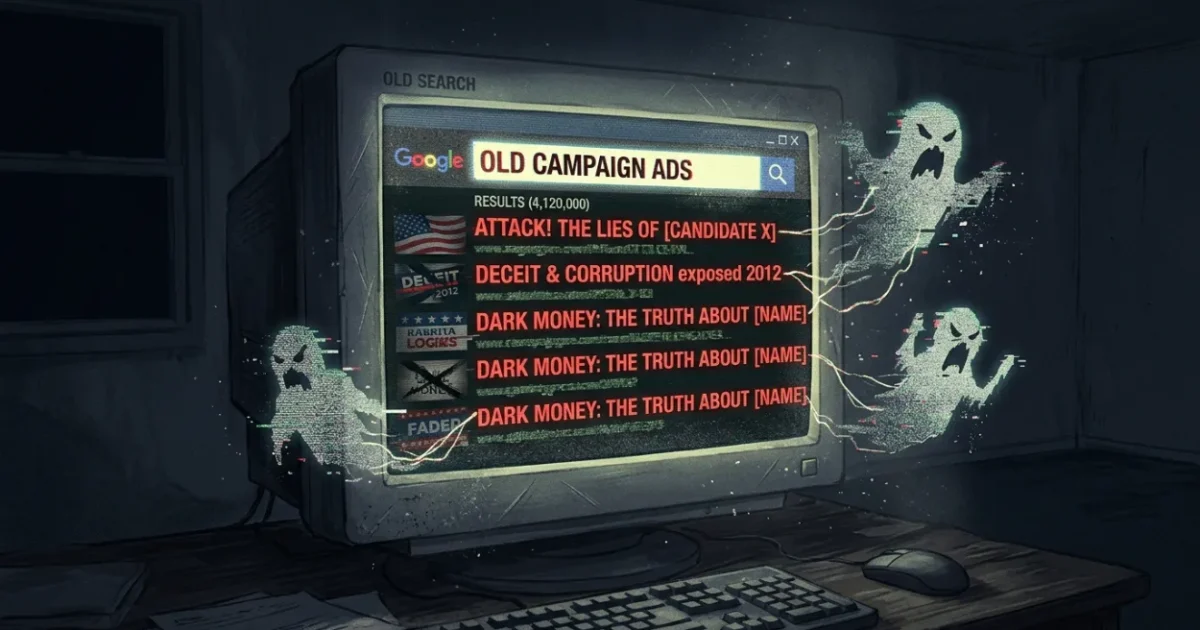
Attack ads remain in search results after a political campaign because search engines index and rank published content independently of whether the campaign has ended. Their continued visibility is influenced by content authority, relevance, links, indexing and ongoing public interest.
Reputation management is the process of analysing and influencing how information about an individual or entity is represented across digital environments. Online reputation refers to the collection of indexed information, reputation signals and public references that shape perception within search ecosystems. For political figures, campaign advertising forms one component of a much larger digital footprint. Understanding why old attack-ad content persists requires analysing how content indexing, search ranking and entity perception operate after the original campaign period has ended.
Why do attack ads remain visible after a political campaign ends?
Attack ads remain visible because publication does not automatically expire when a campaign ends. Search engines index webpages, videos, articles and other digital assets according to their own crawling and ranking systems rather than according to political campaign timelines. Once an attack advertisement has been published on a website with sufficient authority or relevance, the page becomes part of the indexed information environment. Its continued ranking depends on signals associated with the content and the search query. The end of a campaign therefore does not automatically remove the underlying search result.
Digital campaign material can also be reproduced across multiple websites and platforms. A single advertisement can generate news coverage, commentary, video uploads, social posts and archived campaign pages. Each publication creates an additional information node connected to the same political entity. Search engines process these sources separately while also identifying relationships between topics, people and events. This creates a wider digital footprint that persists beyond the original advertising period.
The persistence of such content is therefore an indexing issue as well as a reputation issue. A page that remains technically accessible remains available for crawling and retrieval unless a legitimate removal, restriction or de-indexing mechanism applies. Search visibility then determines how prominently that page appears for relevant queries. The result is an enduring reputation signal even when the original political objective no longer exists.
How does content indexing keep old attack-ad material searchable?
Content indexing keeps old attack-ad material searchable by storing information about publicly accessible webpages and other digital assets within a search engine’s index. Indexing is the process through which discovered content becomes available for consideration in search results. Once indexed, a page can appear when its content, entities or associated topics match a user’s query. Search engines do not require a page to be recent before considering it relevant. Historical content therefore remains searchable when it continues to satisfy ranking and retrieval criteria.
Indexing also creates persistence across different content formats. A campaign website, archived article, video transcript and news report can all contain references to the same political figure. Search engines process the text, entities and contextual relationships associated with each source. These assets then contribute to the wider digital footprint surrounding the individual. Removing the original campaign advertisement therefore does not necessarily remove derivative coverage from the search ecosystem.
The distinction between indexing and ranking is essential. Indexing determines whether content is available within the search engine’s information system, while ranking determines its position for a particular query. An old attack ad can remain indexed without ranking prominently for every search. Conversely, authoritative coverage discussing the advertisement can rank highly even when the original campaign page receives little visibility. Reputation analysis therefore examines both content availability and SERP prominence.
What makes an old attack ad rank highly in search results?
An old attack ad ranks highly when its content and source continue to satisfy relevant search-ranking signals. Relevance connects the material to the user’s query, while authority reflects characteristics associated with the source and its wider information environment. Links, references, topical alignment and continued interest also contribute to how content is evaluated. Search ranking is therefore not determined simply by publication date. Historical content remains competitive when it continues to match the search context.
Query relevance is particularly important for political reputation searches. A user searching for a politician’s name alongside a campaign controversy creates a different retrieval environment from a general search for the individual’s current political activities. Search engines evaluate the available information against the specific query. An old attack advertisement can therefore become prominent again when a related issue generates renewed search interest. Search visibility is consequently dynamic rather than permanently determined by the age of a page.
Authority also influences how historical information is interpreted within SERPs. A recognised publication discussing an old campaign claim carries different search signals from an obscure page with little external recognition. The same allegation can therefore produce different ranking outcomes depending on where it appears. Entity perception is shaped by this mixture of source authority, relevance and contextual information rather than by the original advertisement alone.
Does outdated political content lose ranking value over time?
Outdated political content can lose ranking relevance when newer and more relevant information becomes available, but age alone does not guarantee disappearance from search results. Search engines evaluate content according to multiple ranking signals rather than applying a universal expiry mechanism. A historical page can retain value when it remains relevant to a recurring query or continues receiving references. This explains why campaign material from a previous election can remain visible during later searches. Freshness is therefore one component of search evaluation rather than an automatic removal rule.

The continued relevance of historical content also depends on the subject itself. Political controversies often remain connected to the same individual, policy or campaign event. A page discussing a previous election therefore retains semantic relationships with searches about that politician. Search engines can identify these relationships through entities, terminology and contextual references. Historical relevance can consequently preserve visibility even after the original campaign has ended.
The search ecosystem also contains competing newer information. Current biographies, parliamentary information, policy statements and professional coverage provide alternative sources that contribute to entity perception. When these sources demonstrate strong relevance and authority, they can occupy more SERP positions. This process changes search composition without requiring the historical content itself to disappear.
How do attack ads affect a politician’s digital reputation?
Attack ads affect digital reputation by becoming reputation signals associated with a political entity, particularly when they remain highly visible for name-based searches. A reputation signal is information that contributes to how an individual or organisation is interpreted within a digital information environment. Search users encounter these signals through headlines, snippets, videos, images and linked pages. The prominence of a result therefore influences which information receives initial attention. Entity perception develops through the cumulative interaction of these sources.
The effect is not determined solely by the wording of an advertisement. The surrounding information environment provides additional context that affects interpretation. News coverage can discuss the claims, fact-checking can challenge them, and later reporting can establish whether the underlying issue remained relevant. These sources create a broader semantic network around the original campaign material. Reputation evaluation therefore requires analysis of the complete content environment.
Sentiment also forms part of this environment. Positive, neutral and negative references can coexist across different sources, producing a sentiment distribution rather than a single reputation score. Search engines do not simply assign a universal positive or negative reputation rating to an individual. Instead, they retrieve and rank information according to query relevance and other signals. Public perception then develops through exposure to the resulting information.
Why do search engines continue showing historical campaign content?
Search engines continue showing historical campaign content because search results represent available information rather than a chronological record that automatically deletes old material. A page remains part of the searchable environment when it remains accessible, indexed and relevant to a query. Political campaign content often retains strong entity associations because it explicitly names candidates, parties, policies and campaign events. These relationships preserve its relevance for searches connected with the same subjects. Search engines therefore treat historical material according to its information value rather than its campaign status.
News and commentary can also preserve the visibility of an original campaign claim. When journalists or commentators reference an advertisement, their pages create additional documents connected with the original event. These documents can rank independently of the original source. A search for the politician’s name can consequently surface secondary coverage even when the campaign’s own advertising page has disappeared. This demonstrates why reputation analysis must extend beyond first-party content.
Search persistence therefore operates through a network of related sources. Original advertisements, reporting, commentary and archived material can all contribute to the same digital footprint. The strength of each source varies according to authority and relevance. Understanding these relationships provides a more accurate explanation of why historical political content remains visible.
Dive Deeper With Our Expert Guides:
Why Constituent Complaints Online Affect Re-Election Chances
How a Single Viral Clip Can Redefine a Political Career
How do authoritative sources influence the visibility of attack-ad content?
Authoritative sources influence visibility by competing for the same search space and providing alternative information about the political entity. Authority is a reputation signal associated with the reliability, recognition and relevance of a source within a search ecosystem. Government pages, established publications, official records and recognised professional sources can provide strong contextual information. Their presence gives search engines additional documents through which to understand the entity. This changes the composition of available results.
The effect is different from directly removing historical campaign content. When authoritative sources become more visible, they provide additional information for users and search engines to evaluate. A politician’s current biography, verified professional information and substantive policy coverage can establish stronger contextual associations. This broader information environment can reduce dependence on one historical narrative. The old attack-ad content remains part of the digital footprint, but its relative prominence can change.
This process demonstrates the difference between content removal and content enhancement. Removal addresses the source itself when a legitimate basis exists. Enhancement strengthens the surrounding information environment by creating or improving authoritative sources. Both mechanisms operate differently and require separate evaluation.
Can negative search results be suppressed without removing the original content?
Negative search results can sometimes become less prominent without removing the original content through changes in the wider information environment. This process is generally described as content suppression through search-result displacement or content enhancement. It involves strengthening relevant, authoritative information so that search engines have additional high-quality sources to rank. The original page remains available but receives less relative visibility for targeted queries. The mechanism therefore changes SERP composition rather than deleting historical information.
Effective suppression depends on the strength and relevance of the competing content. Publishing unrelated pages does not create meaningful search perception influence. The content must establish a clear relationship with the entity and the queries being evaluated. Topical depth, authority, internal relationships and external references contribute to the ability of content to compete within search results.
For outdated political material, suppress outdated attack-ad content in search results involves understanding which pages rank, why they rank and which authoritative sources can provide stronger contextual information. The approach requires continuous SERP evaluation rather than a single publishing action. Search visibility then becomes the measurable variable used to determine whether the information environment has changed.
How does content enhancement compare with legitimate content removal?
Content enhancement and legitimate content removal address different causes of search reputation risk. Content enhancement operates by strengthening accurate and relevant information within the digital footprint. Legitimate removal addresses a specific source where an appropriate legal, platform or editorial mechanism exists. Enhancement therefore influences the competitive search environment, while removal acts directly on the problematic content. Neither method provides a universal solution for every historical political result.
Removal can produce a direct change when the source qualifies for an applicable removal mechanism. The resulting page becomes unavailable or less accessible through the relevant search pathway. Enhancement requires search engines to discover, index and evaluate alternative content before its ranking influence becomes measurable. The timeframe and outcome therefore differ between the approaches. Evaluation must account for the mechanism rather than treating all reputation interventions as equivalent.
A balanced reputation analysis also distinguishes legitimate public-interest information from outdated or inaccurate material. Historical political reporting can have enduring informational value. Suppression strategies therefore require careful source evaluation rather than blanket attempts to remove criticism. This protects the integrity of the search ecosystem while allowing legitimate reputation concerns to be analysed separately.
How should the persistence of attack-ad content be evaluated?
The persistence of attack-ad content is best evaluated through indexing, ranking, authority, relevance and entity perception. These factors reveal why a historical page remains visible and whether its prominence represents a continuing search reputation issue. Evaluation begins with identifying the exact URLs, queries and content formats involved. The next stage analyses source authority and relationships between the original advertisement and secondary coverage. This produces a clearer explanation of the reputation signal.
A structured evaluation can:
- Identify indexed campaign content by locating historical advertisements, articles, videos and related pages appearing for relevant searches.
- Analyse ranking behaviour by comparing query relevance, source authority, freshness and visibility across SERPs.
- Map entity relationships by connecting campaign content with the politician, events, policies and related topics represented online.
- Assess sentiment distribution by examining how positive, neutral and negative references coexist across authoritative sources.
- Monitor SERP composition by tracking changes in the prominence of historical content and newer authoritative information.
This framework prevents a ranking position from being interpreted without context. A result ranking highly for one query does not establish identical visibility across every search involving the same political figure. Likewise, a historical page appearing on a later SERP does not automatically indicate a reputation crisis. The significance depends on query intent, source authority and the information available alongside it.
What creates long-term search visibility for historical political content?
Long-term search visibility develops when historical political content retains relevance, authority, entity associations or continued references within the search ecosystem. Content that remains connected to an individual’s identity continues to provide information for relevant queries. External links and citations can reinforce the source’s position within the wider information network. Continued public interest can also sustain searches related to the historical event. These factors explain why campaign material can remain searchable long after election activity ends.
A durable digital footprint therefore contains both historical and current information. Older campaign content represents one layer, while later professional, political and public information provides additional layers. Search engines evaluate these documents independently while establishing relationships between their subjects. The resulting SERP composition changes as new content enters the ecosystem. Historical visibility consequently reflects an ongoing interaction between old information and new sources.
Long-term reputation analysis focuses on these relationships rather than assuming that time alone resolves search issues. Monitoring identifies whether historical content remains prominent, whether authoritative alternatives have developed and whether new references alter entity perception. This provides a more accurate understanding of search reputation over time.
Attack ads live on in search results because campaign publication and search indexing operate on different timelines. Search engines continue evaluating accessible content according to relevance, authority, entity relationships and other ranking signals, while political campaign periods eventually end. Historical advertisements can therefore remain part of a politician’s digital footprint through original pages, archived material and secondary reporting.
The resulting search reputation depends on more than the existence of one attack ad. Content indexing determines availability, ranking dynamics determine visibility, authority affects source prominence and the wider information environment influences entity perception. Content enhancement, legitimate removal and search-result suppression address these mechanisms differently. Evaluating them requires attention to accuracy, public-interest context, source authority and measurable SERP changes.
Understanding these systems explains why outdated campaign content does not automatically disappear and why search reputation remains an ongoing information-management issue. The most useful analysis separates historical availability from current visibility and examines how the complete digital ecosystem represents the political entity.
Why do attack ads remain in search results after a campaign ends?
Attack ads remain searchable because search engines index and rank published content independently of campaign timelines. Historical campaign pages, news coverage and archived material can continue contributing to a politician’s digital footprint.
How long do political attack ads stay online?
Political attack ads can remain online as long as the underlying webpage, video or archived content remains accessible and relevant to search queries. Their search visibility changes according to indexing, relevance, authority and ranking signals.
Can old attack ads affect a politician’s online reputation?
Yes, historical attack ads can contribute to reputation signals when they appear prominently for searches involving a politician’s name or related topics. Their impact depends on source authority, search visibility, sentiment and the surrounding information ecosystem.
Can outdated attack-ad content be suppressed in search results?
Outdated attack-ad content can sometimes become less prominent through legitimate removal, correction or search-result suppression strategies. Content enhancement can also strengthen authoritative information that provides additional context within the SERPs.
How does reputation management for politicians address old attack ads?
Reputation management for politicians analyses indexed campaign content, source authority, search rankings and entity perception to identify reputation risks. Appropriate strategies then focus on legitimate content removal, correction, suppression or authoritative content enhancement.