
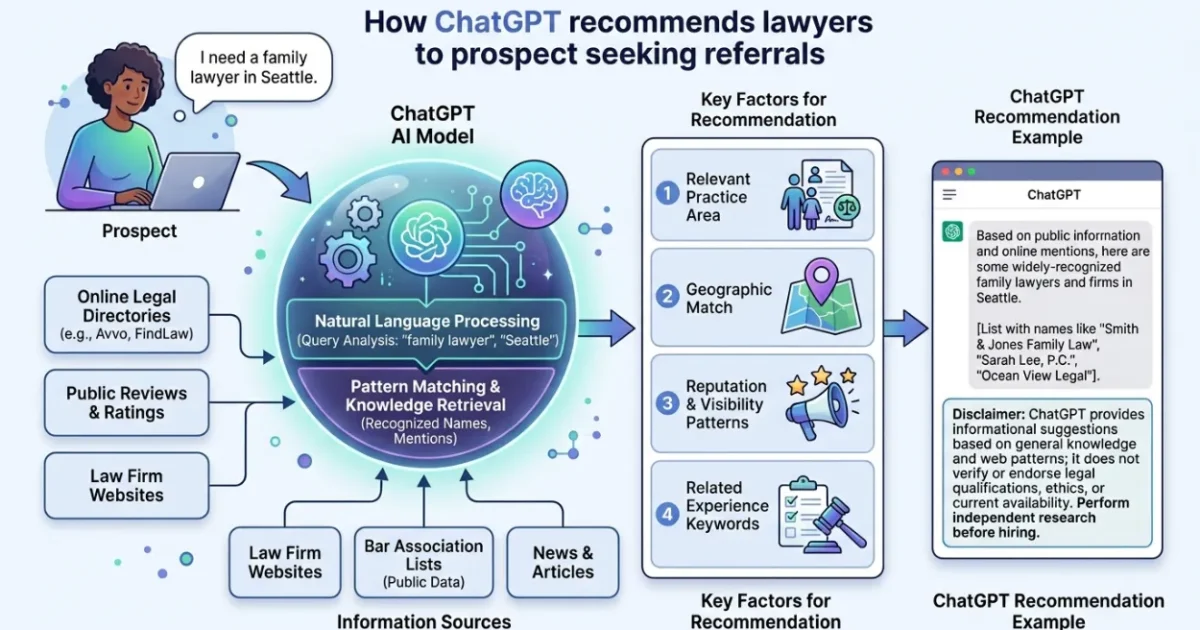
ChatGPT recommends lawyers by interpreting available information about legal practices, their areas of expertise, authority, reputation signals and relevance to a prospect’s question. Reputation management is the process of understanding and influencing how an entity is represented and interpreted across digital information systems.
Online reputation refers to the collection of information, signals and associations that shape how a person, organisation or professional practice is perceived across search ecosystems. For legal practices, this includes website content, professional profiles, reviews, publications, directories, citations and other indexed information that establish an entity’s identity and expertise.
How does ChatGPT determine which lawyers are relevant to a referral request?
ChatGPT evaluates relevance through the relationship between the user’s query and information associated with identifiable legal entities. A referral request is therefore not simply a search for a lawyer’s name; it represents a semantic query containing requirements such as practice area, location, legal expertise and professional relevance.
When a prospect asks for a lawyer specialising in a particular field, the underlying information needs to establish a clear connection between the legal practice and that subject. Content describing services, expertise and professional areas contributes to this entity understanding. The consistency of these associations across indexed sources also affects how clearly a practice is represented within the wider information environment.
Search visibility and entity perception are connected because discoverable information provides the evidence used to understand an organisation. A legal practice with clearly defined topical associations presents a more coherent entity structure than one with fragmented or contradictory information. ChatGPT’s recommendation output therefore depends partly on how well available information establishes relevance to the query.
What information influences how a legal practice is represented online?
A legal practice is represented online through its digital footprint, which consists of the publicly available information associated with the practice across websites and platforms. This footprint includes owned content as well as third-party references, professional listings, reviews and published material. Each source contributes information that search systems can index, compare and associate with the entity.
Website content defines the practice through explicit statements about its legal disciplines, expertise, locations and professional activity. Directory profiles reinforce these associations when their information remains consistent with the practice’s primary website. Professional publications and external references provide additional context by connecting the entity with specific legal subjects or areas of expertise.
Entity information also includes the relationships between the practice and its lawyers. Individual solicitor profiles, biographies and professional credentials create connections between people, expertise and organisations. These relationships help search systems distinguish one legal entity from another and establish topical relevance.
The digital footprint therefore operates as an information network rather than a single webpage. A prospect asking for a referral interacts with the outcome of that wider network because the available information determines which entities appear relevant to the question.
How do search engines interpret reputation and credibility signals?
Reputation signals are observable indicators that contribute to the evaluation of an entity’s credibility, relevance and prominence. Search engines analyse these signals alongside content, links, entities and other ranking factors when evaluating pages and websites. Reputation is therefore represented through accumulated information rather than a single numerical score.
Authority signals demonstrate connections between an entity and recognised areas of knowledge. For a legal practice, these signals include relevant professional publications, authoritative references, accurate professional profiles and content demonstrating expertise in specific legal subjects. Their function is to establish contextual relationships between the practice and the topics it claims to address.

Trust signals operate through consistency, transparency and corroboration. Consistent business information across reputable sources reduces ambiguity about the identity and characteristics of an entity. Contradictory information introduces uncertainty into entity interpretation because different sources provide competing representations.
SERP evaluation adds another layer to this process. Search results expose the information available about a practice, allowing users and information systems to evaluate its prominence, relevance and credibility. The resulting search environment becomes part of the practice’s online reputation.
How do reviews influence the perception of lawyers?
Reviews are reputation signals that provide external descriptions of experiences associated with a legal practice. Their importance extends beyond star ratings because written reviews contain language that identifies services, professional characteristics and recurring themes. Search systems can process this textual information as part of the broader content ecosystem surrounding an entity.
Review sentiment refers to the positive, negative or neutral orientation expressed within review content. Sentiment interpretation provides contextual information about how users describe their interactions with a practice. Repeated references to communication, expertise, responsiveness or particular legal services create semantic associations around the entity.
The source of a review also affects its informational context. A review published on a recognised platform provides a different type of signal from an anonymous reference on an unrelated website. Search systems evaluate information within its surrounding context, so review content forms part of a broader reputation structure rather than functioning independently.
Reviews also affect user perception through SERP visibility. When review pages, ratings or review-related content appear prominently for branded searches, prospects encounter those signals while evaluating the practice. This makes review content an important component of search reputation.
How does legal content establish authority and expertise?

Legal content establishes authority by creating explicit and meaningful relationships between a practice, its professionals and specific legal topics. A page about employment law, for example, provides topical evidence when it clearly explains relevant legislation, procedures, terminology and professional expertise. Content depth therefore contributes to how an entity is associated with a particular subject.
Topical authority refers to the strength and breadth of an entity’s demonstrated relationship with a defined subject area. A practice covering employment law through interconnected pages can create a stronger semantic structure than a website containing only a generic statement about employment services. Each relevant page adds contextual information that clarifies the entity’s topical scope.
Content quality also depends on factual accuracy and information structure. Legal subjects require precise terminology because ambiguous or unsupported statements weaken informational clarity. Clear authorship, professional credentials and appropriate references strengthen the relationship between the content and the legal entity producing it.
Content indexing determines whether these signals enter the searchable information environment. Unindexed material has limited visibility within conventional search retrieval systems because it is not available through the same discovery mechanisms as indexed pages. Consequently, content creation and content accessibility operate together within search reputation.

Why does consistency matter for lawyer entity perception?
Entity perception becomes clearer when information about a legal practice remains consistent across relevant digital sources. Consistency includes the practice name, location, areas of law, professional identities and descriptions of expertise. Matching information reduces ambiguity and supports a unified representation of the entity.
Inconsistent information creates competing associations. A directory might describe a practice as specialising in one area while its website focuses on unrelated services, creating a less precise topical profile. Differences in names, addresses or professional information can also complicate entity matching.
Entity resolution is the process through which information systems determine that different references represent the same real-world entity. For legal practices, accurate and consistent identifiers support this process. Strong entity resolution allows information from separate sources to contribute to a more coherent representation.
This principle also applies to individual lawyers. A solicitor appearing across a firm website, professional directory and publication should have consistent identifying information. These relationships help connect professional expertise with the wider legal-practice entity.
How do SERPs affect a prospect’s perception of a lawyer?
SERPs function as an information interface through which prospects evaluate legal practices. The results displayed for a lawyer’s name, practice name or legal speciality determine which information receives attention first. Search visibility therefore influences perception by controlling which publicly available sources are most accessible during research.
Branded searches reveal the reputation environment surrounding an entity. Website pages, professional profiles, directories, reviews and external publications can all occupy positions within the results. The combined result creates an information landscape rather than a single reputation signal.
Content ranking dynamics determine which pages receive greater visibility for particular queries. Relevance, content quality, authority, technical accessibility and other ranking factors contribute to these outcomes. A highly relevant page can therefore become more prominent for a specific legal topic than a general practice page.
SERP evaluation is consequently both algorithmic and behavioural. Search systems rank information according to retrieval signals, while prospects interpret the resulting information according to relevance and credibility. Reputation exists at the intersection of these two processes.
Dive Deeper With Our Expert Guides:
Why Multilingual Clients Search for Lawyers Differently Online
How Podcast and Webinar Appearances Build a Lawyer’s Authority
Can online reputation influence ChatGPT’s lawyer recommendations?
Online reputation forms part of the broader information environment from which AI systems can understand entities, although a recommendation cannot be reduced to one reputation metric. ChatGPT responses depend on the system, its available information, the user’s query and the context of the request. A lawyer’s online presence therefore represents one component of the information used to establish relevance and identity.
A clear digital footprint provides structured evidence about who the practice is, what it does and which legal subjects it covers. External references add corroborating context, while reviews provide experience-oriented information. Together, these signals create a richer representation of the entity than a single webpage provides.
The distinction between ranking and recommendation is important. Search engines primarily organise retrieved documents according to query relevance and ranking systems, whereas a conversational AI response synthesises information into an answer. A referral-style question therefore requires entity identification and semantic matching rather than simply reproducing a conventional search-results page.
This makes reputation an information-architecture issue as well as a perception issue. The clearer the available information about an entity, the easier it is to establish its topical identity within a digital information ecosystem.
What role does a lawyer’s digital footprint play in referral queries?
A lawyer’s digital footprint provides the information from which professional identity and relevance are established. It includes the practice website, professional biographies, legal directories, publications, reviews, citations and other publicly accessible references. Each source contributes a different layer of information to the entity’s overall representation.
A comprehensive footprint does not mean publishing information indiscriminately. Relevance and consistency remain central because unrelated material does not strengthen the connection between an entity and a specific legal query. Information architecture determines how individual pieces of content relate to the wider entity.
Referral queries also contain multiple semantic attributes. A prospect can specify location, practice area, client type, legal issue or required expertise within one question. The information surrounding a lawyer needs to establish corresponding relationships for the entity to appear relevant within that context.
The resulting recommendation is therefore connected to information completeness, topical relevance and entity clarity. These factors explain why online reputation extends beyond reviews and includes the entire searchable representation of a legal practice.
How can legal practices understand their search reputation objectively?
Legal practices can understand search reputation by analysing the information presented for their branded and non-branded queries. This process begins with identifying the pages, profiles, reviews and references that appear in relevant SERPs. The objective is to understand what information is visible and which entity associations it creates.
Analyse branded SERPs by identifying the dominant topics, sources and sentiment associated with the practice. Compare professional profiles against the firm’s primary information to identify inconsistencies. Evaluate indexed content to determine whether important expertise and professional information are discoverable.
Review external references to establish how independent sources describe the entity. Assess whether those references reinforce the practice’s stated legal expertise or introduce conflicting associations. This approach separates reputation analysis from promotional activity because it focuses on observable information and search-system behaviour.
Monitor changes over time because search ecosystems are dynamic. New pages, reviews, publications and references alter the available information environment. Continuous SERP evaluation therefore provides a more accurate understanding of search reputation than a one-time assessment.
What does ChatGPT referral behaviour reveal about legal reputation?
ChatGPT referral behaviour demonstrates the importance of entity clarity within modern information ecosystems. When a prospect asks for a lawyer recommendation, the system needs to interpret the query, identify relevant entities and connect those entities with appropriate legal topics. The quality and consistency of publicly available information contribute to this interpretation. How to Influence the Way ChatGPT Recommends Your Legal Practice involves understanding how entity information, reputation signals and topical relevance contribute to the digital representation of a legal practice.
Reputation management is therefore broader than removing negative information or generating positive content. It refers to understanding how information about an entity is created, indexed, connected and interpreted across digital systems. Online credibility emerges from the combined effect of authoritative information, consistent entity signals, relevant content and external references.
For legal practices, this framework makes search reputation a measurable information environment. Website content, reviews, professional profiles, publications and SERP visibility each contribute different signals to entity perception. Understanding those relationships provides a clearer explanation of why a practice appears relevant—or irrelevant—when prospects seek legal referrals through conversational search.
How does ChatGPT recommend lawyers for legal referrals?
ChatGPT analyses the context of a referral request and matches it with information about relevant legal entities, practice areas, expertise and locations. Online reputation signals, professional profiles and authoritative content contribute to how a legal practice is represented.
What factors affect a lawyer’s online reputation?
A lawyer’s online reputation is shaped by website content, client reviews, professional directories, publications, citations and other publicly available information. Consistency, relevance, authority and sentiment influence how the legal practice is perceived across search ecosystems.
Do online reviews affect how lawyers are perceived by prospects?
Yes. Online reviews provide reputation signals through ratings, written feedback and recurring sentiment about a legal practice, helping prospects evaluate credibility, expertise and client experience.
Why is a lawyer’s digital footprint important for search visibility?
A lawyer’s digital footprint connects information about their expertise, practice areas, professional identity and reputation across indexed sources. A clear and consistent footprint helps search systems establish entity relevance and display appropriate information in relevant SERPs.
Can reputation management for lawyers affect how a legal practice appears in search?
Reputation management for lawyers focuses on understanding and managing the information associated with a legal practice across digital platforms. Analysing reviews, indexed content, professional profiles and search results helps identify the reputation signals influencing online perception and search visibility.