
Counterfeit listings can damage a brand’s marketplace reputation by associating its name with unauthorised products, misleading information, and inconsistent customer experiences. Reputation management is the process of analysing and influencing the information that shapes how a brand is perceived across search engines, marketplaces, and other digital environments.
What Is a Marketplace Reputation for a Brand?
A marketplace reputation is the collection of information and reputation signals that shape how customers, platforms, and search engines interpret a brand within an online commerce environment. It includes product listings, seller information, customer reviews, ratings, product descriptions, images, pricing patterns, and references across external websites. Online reputation refers to the broader perception created by these digital signals and their visibility across search ecosystems. A brand therefore exists within an interconnected information environment rather than through its official website alone. Marketplace content becomes part of the brand entity when search engines and users associate product information, reviews, and seller activity with that brand.
Counterfeit listings introduce information that conflicts with the legitimate identity of the brand. A listing can use a brand name, logo, product description, image, or model identifier without representing an authorised product source. Search engines and marketplace systems process these elements as content and entity signals, while users interpret them as evidence about the brand. This creates a distinction between the authenticity of the brand and the accuracy of the information surrounding it. Marketplace reputation analysis focuses on that distinction to determine how unauthorised content affects entity perception.
Why Do Counterfeit Listings Affect Brand Reputation?
Counterfeit listings affect brand reputation because customers frequently encounter product information before they establish whether a seller is authorised. A marketplace result can display the brand name alongside an unauthorised product, creating an association between the brand entity and the listing. Product titles, descriptions, images, ratings, and seller information then become part of the visible information environment. Search engines can also index marketplace pages, allowing counterfeit-related content to appear beyond the original platform. The resulting search visibility expands the potential reputation impact from marketplace browsing into broader SERP evaluation.
The reputation effect comes from information association rather than simply from the existence of an imitation product. A customer encountering an inaccurate product description or poor-quality item can interpret that experience as evidence about the brand. Reviews can reinforce that interpretation when buyers leave negative feedback against a listing that uses the legitimate brand identity. The distinction between authorised and unauthorised sellers therefore becomes important to entity perception. When attribution is unclear, counterfeit content can distort the signals users associate with the genuine brand.
How Do Counterfeit Listings Influence Search Visibility?
Counterfeit listings influence search visibility when marketplace pages become indexed and relevant to brand-related queries. Content indexing refers to the process through which search engines discover, process, and store web content for potential inclusion in search results. An indexed counterfeit listing can therefore enter the search environment surrounding branded product searches, model names, or product-specific queries. Its ranking position depends on relevance, authority, content quality, marketplace signals, competition, and search intent. A highly visible listing creates greater exposure to unauthorised information and increases its role in the brand’s digital footprint.
Marketplace authority can intensify this effect because established commerce platforms often contain large quantities of structured product information. Search engines can interpret product titles, descriptions, reviews, seller details, and category information as relevant documents for commercial queries. A counterfeit page therefore gains an opportunity to appear when its content matches a user’s search. Search visibility does not confirm product authenticity; it determines whether the information becomes discoverable. This distinction explains why counterfeit listings represent both a commerce problem and a search reputation problem.
How Does Product Content Shape Entity Perception?
Product content shapes entity perception by providing information that users and search engines associate with the brand and its products. Titles establish topical relevance, descriptions explain product characteristics, images communicate visual identity, and structured data provides additional product attributes. When counterfeit listings reproduce or distort these elements, they create conflicting representations of the same brand entity. Search engines process the content according to relevance and other ranking signals rather than automatically determining whether every commercial claim is legitimate. Users then interpret the visible information through their own assessment of credibility and consistency.
Consistent product information strengthens entity understanding because legitimate pages present aligned terminology, specifications, imagery, and brand associations. Inconsistent information introduces ambiguity around product identity, authorised distribution, and expected quality. This affects online credibility because customers use visible information to assess whether a product appears genuine and whether the seller appears legitimate. Marketplace reputation therefore depends partly on semantic consistency across product-related content. Entity perception develops from the relationship between the brand’s established information and competing representations of that brand.
How Do Counterfeit Listings Affect Reviews and Sentiment Signals?
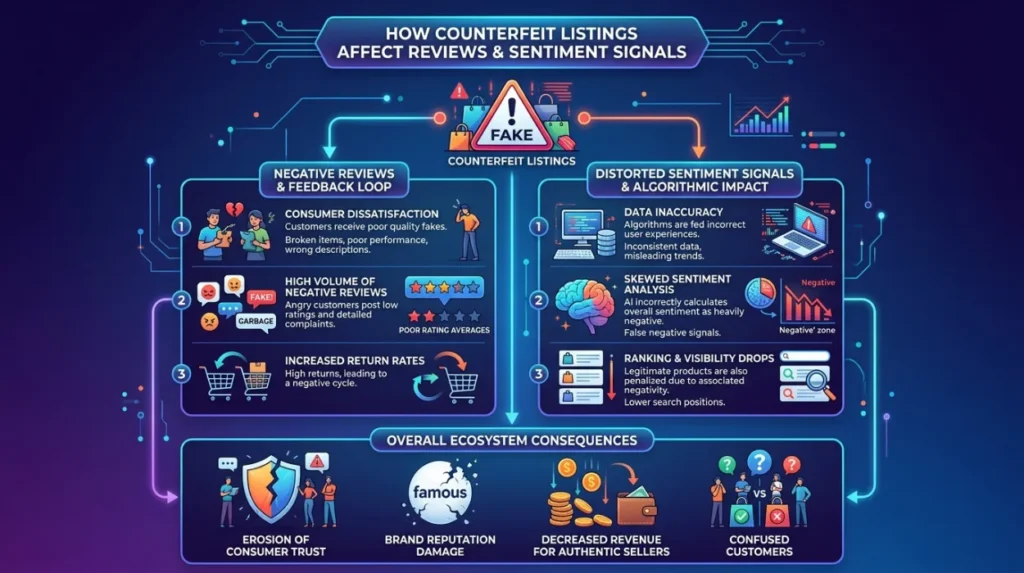
Counterfeit listings can distort review signals when customers attribute their experience with an unauthorised product to the brand itself. Review signals consist of ratings, written feedback, recurring themes, sentiment, and other user-generated indicators associated with a product or seller. A customer receiving a counterfeit item can publish negative feedback without distinguishing between the marketplace seller and the underlying brand. This creates sentiment that search users can encounter when researching the product or brand. The resulting sentiment distribution can therefore contain information that does not accurately represent the legitimate brand experience.
Sentiment interpretation also depends on where the review appears and what entity it references. A negative review attached to a counterfeit listing can become associated with a product identifier, brand name, or seller profile within the marketplace ecosystem. Search engines can then encounter these associations when processing indexed marketplace content. Users evaluating the brand may see the review as part of the available evidence about product quality. Reputation analysis therefore requires examining the relationship between review content, seller identity, product authenticity, and brand attribution.
Why Do Marketplace Authority and Trust Signals Matter?
Marketplace authority and trust signals matter because search engines and users evaluate information according to source characteristics as well as content relevance. An established marketplace provides a recognised digital environment where product information, seller profiles, reviews, and transactions are organised into structured records. A counterfeit listing within that environment can therefore gain visibility through the platform’s existing search infrastructure. The marketplace itself does not establish the authenticity of every individual listing. Source authority and product-level authenticity remain separate concepts within the information ecosystem.
Trust signals also include consistent brand information, authorised seller references, verified product details, accurate specifications, and reliable customer feedback. When these signals align, they provide stronger evidence about the genuine brand entity. Counterfeit listings introduce conflicting signals by presenting similar names, images, or product descriptions through unauthorised sources. Search engines process these signals as part of their broader relevance and entity evaluation systems. Users then combine visible authority cues with product information when forming an assessment of credibility.
Dive Deeper With Our Expert Guides:
Why Third-Party Comparison Sites Decide B2B Shortlists
How Founder Controversies Spill Over Onto the Whole Company
How Does Content Ranking Determine the Visibility of Counterfeit Listings?
Content ranking determines visibility by evaluating how closely a listing satisfies the search query and how its content compares with competing documents. Ranking systems analyse factors related to relevance, authority, content quality, accessibility, and other signals when determining search positions. A counterfeit listing with strong keyword alignment can therefore compete for branded product queries even when the underlying product is unauthorised. Its ranking position does not establish legitimacy or authenticity. It indicates that the page satisfies aspects of the search system’s retrieval and ranking criteria.
The competitive nature of ranking creates an important reputation consideration. Legitimate product pages, official brand information, authorised retailer pages, marketplace listings, reviews, and counterfeit listings can all compete within the same information environment. Users often assess the visible results collectively rather than examining the technical origin of each page. This means the composition of the SERP influences how the brand is understood. Reputation signals become stronger when accurate and authoritative information occupies relevant search positions and provides clear entity context.
Can Counterfeit Listings Change a Brand’s Digital Footprint?
Counterfeit listings can change the composition of a brand’s digital footprint by adding unauthorised pages, seller references, product descriptions, reviews, and external mentions to the searchable information environment. A digital footprint is the collection of online information associated with an entity across websites, marketplaces, search indexes, social platforms, directories, and other digital properties. Each indexed reference contributes information that search systems can associate with the brand. The footprint therefore expands when counterfeit content becomes discoverable and connected to the brand entity. This does not mean the counterfeit information becomes factually legitimate, but it becomes part of the searchable environment surrounding the brand.
Digital footprint analysis identifies these relationships by examining where brand references appear, how they are attributed, and how prominently they rank. It also distinguishes official content from third-party references and unauthorised marketplace activity. This classification establishes which sources contribute authoritative information and which create conflicting signals. A complete footprint analysis therefore looks beyond the brand’s owned properties. It evaluates the wider network of content that influences search perception and online credibility.
How Can Counterfeit Listings Distort Online Credibility?
Counterfeit listings distort online credibility when inaccurate product information becomes associated with the legitimate brand entity. Online credibility refers to the perceived reliability of an entity based on the quality, consistency, authority, and context of available information. A counterfeit product can introduce incorrect specifications, misleading pricing, poor-quality imagery, or inaccurate claims about authenticity. Users encountering this information can incorporate it into their evaluation of the brand. The credibility issue therefore results from information attribution rather than from the legitimate brand’s own content.
The effect becomes more significant when contradictory information appears across multiple digital properties. Official product pages can present accurate specifications while counterfeit listings display altered descriptions or imitation products. Customers then encounter conflicting evidence about what the brand sells and how its products are represented. Search engines process these pages according to their individual characteristics, while users interpret the combined information as part of the brand landscape. Consistency across authoritative sources therefore provides an important trust signal within the wider reputation system.
How Does SERP Evaluation Reveal Counterfeit-Related Reputation Risks?
SERP evaluation reveals counterfeit-related reputation risks by showing which information users encounter when they search for a brand or product. A structured evaluation examines branded queries, product names, model identifiers, marketplace pages, reviews, seller references, and external content. It identifies the ranking position and source type of each result and assesses whether the information accurately represents the brand entity. This creates a clearer picture of how counterfeit content participates in search visibility. The analysis also distinguishes a high-ranking marketplace page from an isolated page with limited search exposure.
A useful evaluation focuses on the information relationships surrounding the brand rather than a single ranking position. It examines whether counterfeit listings appear repeatedly, whether review sentiment is connected to unauthorised sellers, and whether inaccurate product information is indexed across multiple platforms. It also evaluates whether authoritative brand content provides sufficient contextual coverage for relevant queries. These factors demonstrate how search perception is created through a collection of signals. SERP evaluation therefore provides a practical framework for understanding the visibility and reputation implications of counterfeit listings.
What Is the Relationship Between Marketplace Reputation and Brand Reputation?
Marketplace reputation forms one component of broader brand reputation because marketplace information contributes directly to the digital evidence available about the entity. Brand reputation refers to the overall perception created by information, experiences, associations, and signals connected to a brand across digital and physical environments. Marketplace reputation concentrates specifically on product listings, sellers, reviews, ratings, fulfilment information, and customer interactions within commerce platforms. The two systems overlap when marketplace information is indexed, shared, reviewed, or referenced elsewhere online. A marketplace problem can therefore become part of a wider brand reputation landscape.
This relationship operates through information transfer between platforms. A marketplace review can appear in search results, a product listing can be indexed by a search engine, and a seller reference can be discussed on an external website. Each additional reference creates another potential association with the brand entity. The resulting digital footprint becomes broader and more complex as information travels between platforms. Understanding this relationship explains why counterfeit listings require analysis beyond the individual marketplace page.
How Do Authoritative Brand Signals Counter Conflicting Marketplace Information?
Authoritative brand signals provide stronger contextual evidence by clearly defining the legitimate identity, products, terminology, and professional presence of the brand. Official product information, recognised business profiles, authoritative publications, verified corporate references, and consistent product data establish signals that help distinguish the genuine entity from unauthorised representations. These signals do not automatically remove counterfeit listings from search results. Instead, they strengthen the information structure surrounding the brand and improve contextual clarity. Search engines can then evaluate a broader collection of relevant entity information.
The distinction between counteracting conflicting information and deleting it is important. A factual marketplace record remains a source within its platform, while authoritative brand content provides alternative evidence about the legitimate entity. Search ranking dynamics determine how these sources compete for visibility. Stronger relevance and authority can improve the prominence of accurate pages without changing the underlying marketplace record. This creates a reputation strategy based on information quality, entity clarity, and search visibility rather than unsupported assumptions about removal.
How Can Brands Analyse Counterfeit Listing Risks Through Reputation Signals?
Brands can analyse counterfeit listing risks by examining the relationship between marketplace content, search visibility, reviews, seller information, and authoritative brand references. Reputation signals provide measurable evidence about how users and search systems encounter the entity. Analysis begins by identifying counterfeit-related pages and determining whether they are indexed, ranking, reviewed, or referenced elsewhere. It then evaluates the authority and relevance of the sources competing for branded queries. This establishes whether counterfeit content represents a limited marketplace issue or a broader search reputation concern.
A structured analysis can:
- Identify listings by locating unauthorised product pages, seller references, copied descriptions, and duplicated brand imagery across relevant marketplaces.
- Evaluate visibility by measuring indexing status, ranking positions, branded-query appearances, and search-result frequency.
- Assess sentiment by examining ratings, recurring review themes, complaint language, and attribution to the brand or seller.
- Compare authority by analysing official brand pages, authorised retailers, marketplace sources, directories, and third-party references.
- Monitor associations by tracking how product names, seller identities, and counterfeit references connect with the brand across search results.
This framework separates the existence of counterfeit activity from its actual reputation impact. A listing that remains confined to a low-visibility marketplace page creates a different search risk from a counterfeit page ranking prominently for the brand name. Measurement therefore provides the basis for understanding search perception rather than assuming that every counterfeit listing produces the same outcome.
What Does Counterfeit Listing Visibility Reveal About a Brand’s Online Reputation?
Counterfeit listing visibility reveals how closely marketplace content has become connected to the brand’s searchable entity representation. High visibility indicates that unauthorised product information occupies meaningful search space around branded or product-specific queries. Removing Counterfeit Listings That Damage Your Brand on Marketplaces focuses on addressing this visibility risk by evaluating unauthorised listings, their search prominence, and their association with the legitimate brand entity. This creates a reputation signal because users encounter the listing during research and can associate its information with the brand. Low visibility represents a different information condition because the counterfeit content has limited exposure within search results. Visibility therefore provides an important measurement of reputation risk.
The broader lesson is that brand reputation depends on information accuracy across the digital footprint. Search engines organise content according to ranking and relevance mechanisms, while users interpret the resulting information through trust, consistency, and perceived authority. Counterfeit listings introduce conflicting information into this process. Understanding their influence requires analysing indexing, ranking, reviews, seller attribution, authority, and entity relationships together. Reputation management at the conceptual level therefore begins with understanding how information becomes visible and how visible information shapes perception.
How Do Counterfeit Listings Shape Marketplace Reputation?
Counterfeit listings can harm marketplace reputation by introducing inaccurate product information, conflicting seller signals, distorted review sentiment, and additional search-result associations around a legitimate brand. Their impact develops through content indexing, ranking dynamics, entity relationships, and user interpretation rather than through the existence of counterfeit products alone. Marketplace reputation becomes part of the wider brand reputation when listings, reviews, and seller references enter search results and the broader digital footprint. Authority, trust, consistency, and accurate product information provide important signals for evaluating the legitimate brand entity. Understanding these mechanisms allows counterfeit-related reputation risks to be analysed through search visibility, SERP evaluation, content ranking, sentiment distribution, and online credibility.
How do counterfeit listings affect a brand’s marketplace reputation?
Counterfeit listings can associate a brand with unauthorised products, inaccurate descriptions, poor-quality goods, and negative customer experiences. These reputation signals can affect online credibility, search visibility, and how customers interpret the brand entity.
Can counterfeit listings affect a brand’s Google search results?
Yes, counterfeit marketplace pages can appear in search results when they are indexed and relevant to branded product queries. Their visibility depends on factors such as content relevance, marketplace authority, ranking signals, and search intent.
Do counterfeit products affect customer reviews for a brand?
Counterfeit products can distort review signals when customers attribute an unauthorised product experience to the legitimate brand. Negative ratings and review sentiment can then influence marketplace reputation and wider brand perception.
How can brands identify counterfeit listings online?
Brands can monitor marketplaces for unauthorised sellers, duplicated product descriptions, copied imagery, unusual pricing, and inconsistent product information. Search-result monitoring also identifies counterfeit pages that become indexed or visible for branded queries.
Can removing counterfeit listings improve brand reputation?
Removing eligible counterfeit listings can reduce the visibility of unauthorised product information and limit its association with the legitimate brand. Where removal is unavailable, brands can analyse search visibility, strengthen authoritative content, and monitor reputation signals across marketplaces.